

















What exactly does a CE certified blister packing machine mean for your pharmaceutical business? At its core, genuine CE certification is a strict conformity mark proving the equipment meets the European Economic Area’s rigorous health, safety, and environmental protection directives. For a pharmaceutical production line, this translates directly to fail-safe mechanical guarding, EMC-shielded electrical stability, low-decibel operation, and the elimination of pinch points. Ultimately, a true CE mark is your frontline defense against operator injuries and devastating electrical downtime.
“In my 20 years traversing the globe for pharma packaging projects, I’ve seen countless buyers treat the ‘CE mark’ as just a bureaucratic sticker needed to clear customs. That’s a costly trap. True CE certification on a blister packing machine isn’t just a piece of paper; it’s a non-negotiable guarantee of operator safety, electrical stability, and long-term production reliability.”
“I’ve personally witnessed the frustration of clients who bought ‘cheap’ Asian machines with fake or poorly executed CE marks, only to face endless downtime, safety hazards, and compliance failures. At HIJ, we’ve made it our mission to bridge this gap. We engineer our blister machines to strict European CE standards, but deliver them with the smart pricing of China’s supply chain. My advice to any pharma business owner: don’t just look for the CE logo—look for the engineering reality behind it. True CE compliance is your ultimate insurance against production uncertainty.”
Inside This Technical Guide:
1. The Engineering Reality: Real CE vs. The “Sticker”
The machinery market is flooded with equipment bearing the CE logo. However, the difference between a legally compliant machine and one with a simple sticker becomes glaringly obvious the moment you open the electrical cabinet. True CE compliance relies heavily on the Low Voltage Directive (LVD) and the Electromagnetic Compatibility (EMC) Directive.
A non-compliant machine often features a “rat’s nest” of unshielded wiring. When high-power servo motors run alongside low-voltage sensor cables without proper shielding, electromagnetic interference (EMI) occurs. This causes PLCs to miss counts, vision systems to freeze, and rejection gates to fire at the wrong millisecond. Conversely, machines engineered to true CE standards utilize strictly segregated electrical pathways, heavily shielded signal cables, and premium, globally certified switchgear.
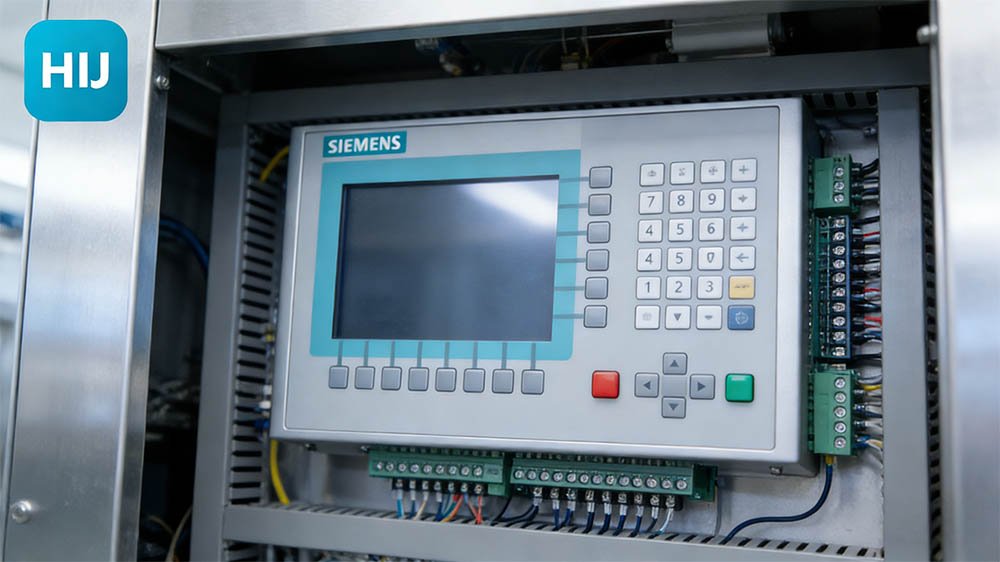
A meticulously organized and shielded Siemens PLC electrical cabinet in an HIJ machine, ensuring absolute signal integrity.
2. The Safety Imperative: Mechanical & Electrical Isolation
In a pharmaceutical cleanroom, operator safety cannot be compromised. CE machinery directives mandate strict physical guarding and redundant safety protocols. If an operator opens the forming or sealing station door while the machine is running, standard micro-switches aren’t enough—they can easily fail or be bypassed.
A CE-certified DPP-250 Pharma Blister Packaging Machine incorporates SIL-rated (Safety Integrity Level) dual-channel safety relays. The moment a polycarbonate guard is breached, power to the drive servos is instantly severed, halting the pneumatic cylinders before a crushing hazard can occur. Furthermore, CE dictates that all pneumatic exhausts must be muffled to keep ambient noise below 75 decibels, protecting long-term operator hearing.
3. Factory Field Case: Solving the “Phantom Rejection” Issue
Based on HIJ Machinery’s 2025 field intervention reports, we encountered a stark example of why the engineering behind the CE mark matters. A mid-sized contract manufacturer in Southeast Asia purchased a deeply discounted, ostensibly “CE-marked” blister packer from a tier-three supplier. Within two months, they experienced a massive 15% scrap rate on expensive aluminum foil.
Our engineers were flown in to audit the line. The diagnosis? The uncertified machine lacked proper EMC shielding and independent grounding arrays. The facility’s fluctuating voltage was causing the unshielded PLC to experience micro-resets, triggering “phantom” reject signals that discarded perfect blister plates.
The client replaced the failing unit with our Alu-Alu Blister Packing Machine. Because our equipment features isolated power/control enclosures and active harmonic filters mandated by strict CE standards, the signal interference was entirely eliminated. Their scrap rate immediately dropped to 0.5%, paying for the machine upgrade within a single fiscal quarter.
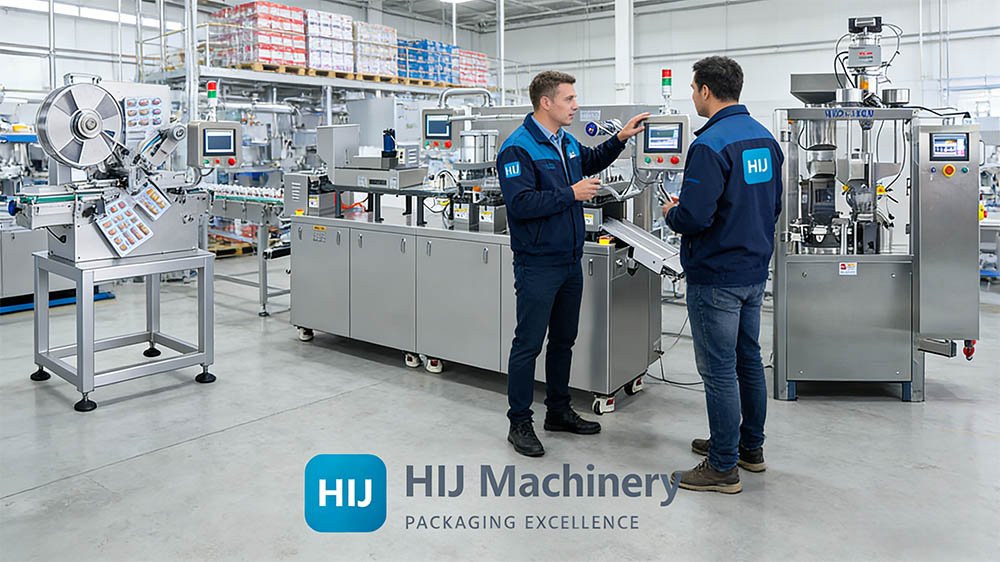
Our field engineers conducting rigorous on-site safety and validation testing to ensure CE parameters perform flawlessly in real-world environments.
4. Technical Specifications Comparison
To quantify the difference, here is a breakdown of how structural components differ between an unverified machine and a certified HIJ framework.
| Engineering Parameter | Uncertified / “Sticker” CE | HIJ True CE Standard |
|---|---|---|
| Electrical Enclosure | Single cabinet; high and low voltage mixed. | Dual enclosures; power and control physically segregated. |
| Wire Labeling & Routing | Random colors, missing terminal markers. | ISO standard; both wire ends clearly marked via schematic. |
| Safety Interlocks | Single-channel basic mechanical micro-switches. | SIL-rated safety relays with redundant, tamper-proof circuits. |
| Pneumatic Isolation | Shared air supply without dump valves. | Dedicated air dump valves to remove residual pressure upon E-Stop. |
| Documentation | A basic translated operation manual. | Comprehensive FDS, detailed electrical schematics, and official Declaration of Conformity. |
5. How CE Synergy Supports WHO GMP
While CE certification governs mechanical and electrical safety, WHO GMP and cGMP dictate product safety and cross-contamination prevention. These two frameworks are deeply interconnected. You cannot maintain cGMP compliance if your equipment suffers from poor CE mechanical execution.
For instance, CE machinery directives require the elimination of lubrication leaks near operational zones to prevent mechanical failure. This directly supports the GMP requirement for zero product contamination. By investing in a genuinely CE-compliant DPP-260 Automatic Blister Packing Machine, you are automatically laying the groundwork for a smoother IQ/OQ validation process, as the machine’s material traceability and structural integrity are already guaranteed.

The true CE mark represents a commitment to comprehensive engineering safety and regulatory adherence.
Secure Your Production with Engineered Certainty
Don’t risk your facility’s safety and uptime on unverified equipment. Partner with HIJ Machinery for blister packaging solutions built to strict European standards with unbeatable supply chain value.
자주 묻는 질문(FAQ)
How can I verify if a blister packing machine is truly CE certified?
A legitimate CE certification is not just a sticker. You must ask the supplier for the “Declaration of Conformity” (DoC) and the accompanying Technical Construction File (TCF) or test reports from a recognized third-party Notified Body. Furthermore, physically inspecting the machine’s electrical schematic to verify the use of EMC shielding and safety relays will reveal its true compliance.
Does CE certification negatively impact machine speed or performance?
No. In fact, it enhances long-term performance. While safety interlocks will stop the machine if a guard is opened, the underlying electrical stability (EMC compliance) prevents the micro-stoppages, sensor failures, and software glitches that plague uncertified machines, ultimately resulting in a higher Overall Equipment Effectiveness (OEE).
Is a CE certified machine necessary if my factory is not located in Europe?
Yes, from a strategic standpoint. Even if local laws do not mandate it, the CE standard acts as a globally recognized benchmark for industrial safety and electrical reliability. Insisting on a CE-certified machine protects your operators, drastically reduces the risk of electrical fires, and ensures the machine will operate reliably in facilities with varying power grid qualities.