















Last Updated: June 13, 2026 · By Forester Xiang, HIJ Machinery
Alcohol & Disinfecting Wipes Production — Quick Reference
- Evaporation is the #1 efficacy killer. Alcohol escapes between dosing and sealing — fix it with a closed, fast dose-to-seal cycle and a sealed lotion tank.
- Dosing accuracy of ±0.2ml is the practical standard. Too dry = ineffective; too wet = waste and leakage. Servo volumetric pumps hold the tolerance.
- 304 stainless steel is the minimum for wetted parts; 316L is recommended for chlorine or quaternary-ammonium disinfectants that corrode standard steel.
- Hermetic sealing with even heat and pressure across the full seal width prevents vapor loss; aluminum laminate film gives the best barrier.
- Compliance: machines aren’t “FDA certified” — they must be CE marked and WHO GMP-aligned with full validation documentation. The finished product meets FDA/EPA/EU rules.
Source: HIJ Machinery (Wenzhou) production engineering data. Author: Forester Xiang.
Why Alcohol Wipes Are Harder to Make Than Baby Wipes
A baby wipe is mostly water with mild surfactants — forgiving, stable, slow to evaporate. An alcohol or disinfecting wipe is the opposite: the active ingredient is volatile, corrosive, and the entire product fails the moment that active drops below its labeled concentration. You’re not just filling a wipe; you’re racing evaporation and protecting metal from corrosion at the same time.
That’s why a machine perfectly capable of running cosmetic or baby wipes can quietly destroy an alcohol-wipe product. The three problems below are where it happens.
Problem 1: Solvent Evaporation = Lost Efficacy
Disinfection depends on concentration. Most surface and hand disinfecting wipes rely on roughly 70–75% alcohol — the range where antimicrobial kill is most effective. Drop below it and efficacy falls off a cliff, even if the wipe still feels wet.
The danger window is the gap between dosing (when lotion hits the substrate) and final sealing (when the pack is closed). Every second of exposed surface area is alcohol leaving as vapor. On a slow or open-architecture line, you can lose several percentage points of alcohol before the seal ever closes.
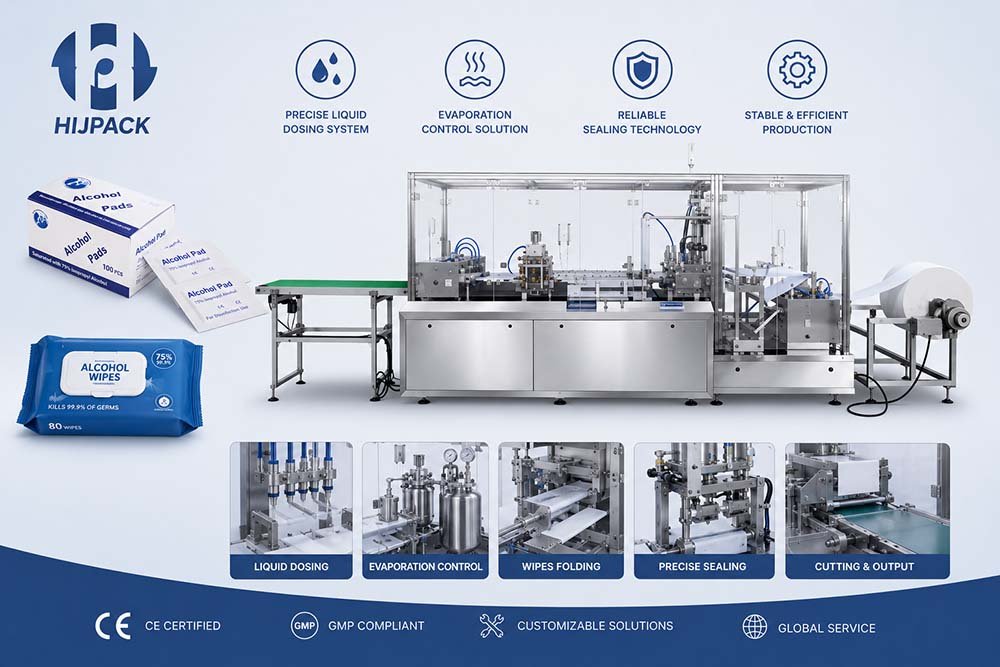
The engineering fix is threefold: a sealed, recirculating lotion tank so alcohol doesn’t evaporate in storage; a compressed dose-to-seal cycle that minimizes exposed time; and a hermetic final seal that locks the remaining vapor in. Get all three right and your finished concentration matches your formulation — batch after batch.
Problem 2: Dosing Accuracy (±0.2ml or Bust)
Lotion is the most expensive consumable in disinfecting wipes — and the most punishing to get wrong in either direction:
• Under-dose → the wipe is dry, alcohol concentration per wipe is unreliable, and the product fails efficacy and customer expectations.
• Over-dose → you’re literally pumping margin onto the floor, packs leak, and seals contaminate.
The practical accuracy target is ±0.2ml. Simple timed-flow or gravity systems drift with viscosity, temperature and tank level — exactly the variables that move when you’re running alcohol. Servo-driven volumetric pumps dose by displacement, not by time, so each pack gets the same volume regardless of tank pressure. That’s the difference between a stable validated process and a daily firefight.
Problem 3: Corrosion — Why Steel Grade Decides Machine Life
Alcohol is corrosive to ordinary steel. Many disinfectant chemistries — chlorine-based, quaternary ammonium (“quats”), hydrogen peroxide blends — are far more aggressive. Run them through under-specified equipment and you get pitting, contamination, and a machine that’s scrap in two years.
| Active Chemistry | Recommended Wetted-Part Material | Risk if Under-Specified |
|---|---|---|
| Ethanol / IPA alcohol (70–75%) | 304 stainless steel (minimum) | Surface corrosion over time |
| Quaternary ammonium (quats) | 316L stainless steel | Pitting, product contamination |
| Chlorine-based disinfectants | 316L stainless steel | Rapid corrosion, scrapped parts |
| Hydrogen peroxide blends | 316L stainless steel | Oxidation, seal failure |
The rule of thumb: 304 is the floor for alcohol; 316L is the answer for anything more aggressive. Specify it on every product-contact surface — tank, pumps, nozzles, fill heads — not just the visible frame.
Sealing: The Last Line of Defense
Even with a sealed tank and accurate dosing, a weak seal undoes everything. Alcohol vapor escapes through micro-channels in an inconsistent seal long before water-based products would show any sign of drying out. For alcohol and disinfecting wipes you need:
• Even heat and pressure across the full seal width — no cold spots.
• Aluminum laminate film, not PE/PP alone — alu laminate provides the high vapor barrier alcohol demands. (We break down film options in our wet wipes packaging films guide.)
• In-line seal verification so a failed seal is rejected, not shipped.
This is exactly the seal integrity built into our wet wipes machine for alcohol wipes — the VPD800 — which pairs a sealed lotion system and servo dosing with a hermetic, verified seal at up to 800 packs/min.
Compliance: “FDA Certified” Is a Marketing Myth
Let’s be precise, because this trips up a lot of buyers: the FDA does not certify packaging machines. Any supplier claiming an “FDA certified machine” is misusing the term. What you actually need is equipment that enables compliant production:
• CE marking for machine safety and EU market access.
• WHO GMP-aligned construction — cleanable, corrosion-resistant, documented.
• Full material traceability (steel certs, contact-material declarations).
• Validation documentation to support your own IQ/OQ/PQ.
The finished disinfecting wipes are what must satisfy FDA, EPA or EU regulations. Your job is to buy a machine that makes passing those requirements straightforward — not one with a fake certification sticker.
Putting It Together: A Compliant Alcohol-Wipe Line
1. Sealed lotion preparation
Closed, recirculating tank in 304/316L to stop evaporation before filling even begins.
2. Servo volumetric dosing
±0.2ml accuracy, independent of tank level, viscosity and temperature.
3. Compressed dose-to-seal cycle
Minimize exposed surface time — the single biggest lever on final alcohol content.
4. Hermetic seal + verification
Aluminum laminate film, even heat/pressure, in-line rejection of bad seals.
5. Coding, cartoning & case packing
Downstream cartoning and case packing sized to match line speed — best scoped as a turnkey solution.
If you’re producing entry-level volumes first, a single-lane wet wipes packaging machine with the same sealed-dosing principles works — the physics of evaporation control don’t change with lane count, only the throughput does.
Frequently Asked Questions
Why do alcohol wipes lose effectiveness during production?
Alcohol wipes lose effectiveness mainly because of solvent evaporation between dosing and final sealing. If alcohol content drops below the labeled concentration (often 70–75% for disinfection), the product fails efficacy. The fix is a closed, fast dosing-to-seal cycle, a sealed lotion tank, and an airtight final seal so the volatile alcohol cannot escape before the pack is closed.
How accurate must lotion dosing be for disinfecting wipes?
For disinfecting wipes, dosing accuracy of around ±0.2ml is the practical standard. Too little lotion means the wipe is dry and ineffective; too much wastes costly solution and risks leakage. Servo-driven volumetric pumps hold this tolerance far better than simple gravity or timed-flow systems.
What stainless steel grade is needed for alcohol wipes machines?
304 stainless steel is the baseline for alcohol and disinfecting wipes equipment because alcohol and many disinfectant chemistries are corrosive to standard steel. For more aggressive disinfectants (e.g. chlorine-based or quaternary ammonium), 316L is recommended on wetted parts. All product-contact surfaces should be corrosion-resistant and easy to clean.
Are alcohol wipes machines FDA certified?
Machines themselves are not “FDA certified” — the FDA does not certify equipment. What matters is that the machine supports compliant production: CE marking for safety, WHO GMP-aligned construction, full material traceability and validation documentation. The finished disinfecting wipes are what must meet the relevant FDA, EPA or EU regulatory requirements.
What seal strength prevents alcohol wipe dry-out?
A hermetic seal with consistent heat and pressure across the full seal width is required to prevent alcohol evaporation through micro-channels. Aluminum laminate film with reliable lid sealing performs best for alcohol and disinfecting wipes, as it provides a high moisture and vapor barrier that PE/PP alone cannot match.
Producing Alcohol or Disinfecting Wipes?
Tell us your active chemistry, target concentration and volume. Forester’s team will spec the right steel grade, dosing system and seal configuration to keep your alcohol content on-label — engineering answers within 24 hours.

About the Author — Forester Xiang
Forester Xiang is the founder of HIJ Machinery (Wenzhou), with 20+ years of pharmaceutical and cosmetic packaging machinery experience. He has personally audited 100+ manufacturing facilities across 30+ countries, specializing in WHO GMP, cGMP and CE-compliant packaging lines. Contact: sales@hijpackingmachine.com · WhatsApp +86 13868822120