
















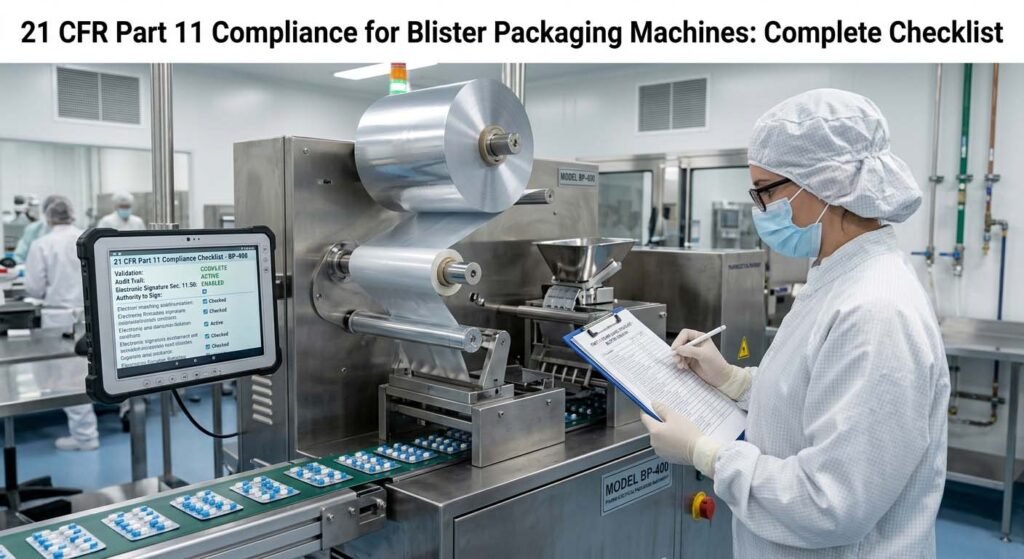
You’ve invested six figures in a new blister packaging line. Your U.S. registration timeline is locked. Your commercial launch date is set. Then your FDA inspector walks in, opens the audit trail on your HMI, and asks a single question: “Show me the complete, unmodified electronic batch record for lot 2024-XY-003, including every parameter change, who made it, and the exact timestamp.”
If your machine cannot answer that question instantly — with cryptographically protected, non-repudiable data — your line is not 21 CFR Part 11 compliant. It doesn’t matter what the vendor’s brochure says. What matters is what the machine actually does on the floor, under audit pressure, at 2 AM when a deviation report is raised. This checklist was written to close that gap.

Forester’s Insight: A 20-Year Engineer’s Perspective
Forester Xiang · Founder, HIJ Machinery · 20 Years in Pharma Packaging
- The Direct Answer:
21 CFR Part 11 compliance for blister packaging machines is non-negotiable for any pharma manufacturer selling into the U.S. market — it governs every electronic record and audit trail your machine generates, and an FDA inspector will check it. - The Field Experience:
“In my 20 years of commissioning blister lines across facilities in South America and Southeast Asia, the single most common — and most expensive — failure I’ve witnessed isn’t mechanical: it’s a machine with a PLC that generates audit trails technically, but whose user access controls and timestamp synchronization collapse under FDA scrutiny during SAT. Vendors will quote you ’21 CFR Part 11 ready’ in their datasheet, then quietly hand you a machine where the administrator password is factory-default ‘admin123’ and electronic batch records can be overwritten without a trace. That gap between compliant on paper and compliant on the floor has cost clients I’ve worked with months of remediation and hundreds of thousands in delayed market entry.” - The Strategic Advice:
Before signing any equipment contract, demand a dedicated Part 11 compliance matrix as part of the URS and validate it during FAT — not after installation. At HIJ, our turnkey blister packaging solutions are built with audit-trail integrity and role-based access control embedded by design, not retrofitted as an afterthought.

What Is 21 CFR Part 11 — And Why Your Blister Machine Is Directly in Scope
Title 21 of the Code of Federal Regulations, Part 11 (21 CFR Part 11), issued by the U.S. Food and Drug Administration, establishes the criteria under which the FDA considers electronic records و electronic signatures to be trustworthy, reliable, and equivalent to paper records and handwritten signatures. For pharmaceutical manufacturers, this regulation applies to any computerized system — including ماكينات تغليف الفقاعة — that creates, modifies, maintains, archives, retrieves, or transmits electronic records required under FDA predicate rules such as cGMP (21 CFR Parts 210/211).
The regulation is divided into three main operational areas: closed system controls (§11.10), open system controls (§11.30), and electronic signature requirements (§11.50–§11.100). For a blister packaging line, the most directly applicable clauses are those governing audit trails (§11.10(e)), user access controls (§11.10(d)(g)), system validation (§11.10(a)), and the accuracy and synchronization of computer-generated timestamps (§11.10(b)). Each of these requirements translates to specific, verifiable hardware and software features that must be present — and demonstrable — in your machine.
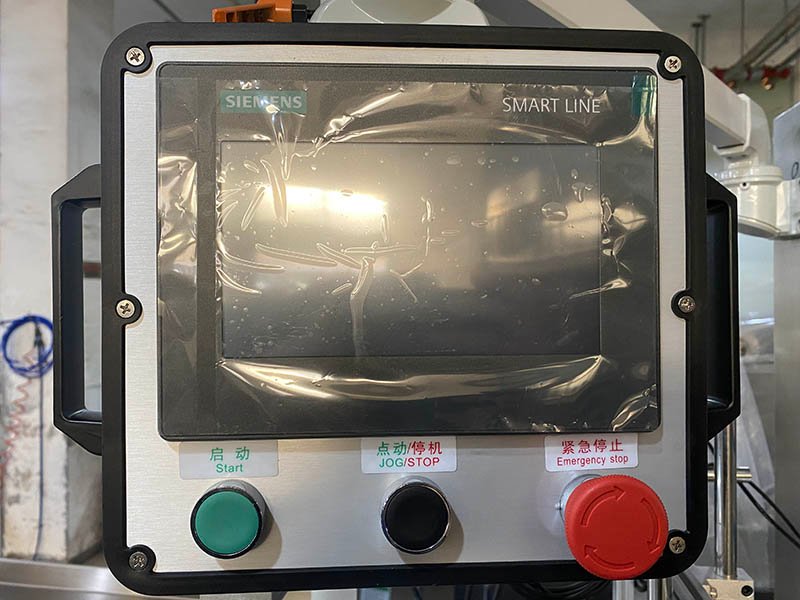
A critical point that many procurement engineers miss: 21 CFR Part 11 does not just apply to the MES (Manufacturing Execution System) or the site SCADA layer. It applies at the machine level. The HMI (Human-Machine Interface) on your blister packer, the PLC that records forming temperatures and sealing pressures, and the integrated vision system that logs rejection events — all generate electronic records that are subject to Part 11 scrutiny. If those records can be deleted, modified without trace, or accessed by unauthorized users, your machine creates a direct regulatory exposure, regardless of whatever upstream software system you are running.
The FDA’s 2003 guidance document on 21 CFR Part 11 reinforces a risk-based approach: the agency expects manufacturers to apply controls that are commensurate with the risk to product quality and patient safety posed by the records in question. For blister packaging — where batch records document sealing integrity, cavity fill confirmation, and temperature profiles that directly affect drug stability — that risk is unambiguously high.
The Complete 21 CFR Part 11 Compliance Checklist for Blister Packaging Machines
The following checklist is structured around the specific subparts of §11.10 that are most frequently cited in FDA 483 observations related to packaging equipment. Use this matrix during URS development, FAT protocol design, and SAT acceptance testing. Each requirement should be verifiable by direct system demonstration — not by the vendor’s written assertion alone.
How to use this checklist: During FAT, assign a dedicated validation engineer to test each item below against live machine behavior. Document the test method, observed result, and pass/fail determination. Any “RISK” item identified during FAT must be resolved by the vendor before shipment — never accepted as a post-installation software update commitment.
| CFR Clause | Requirement | What to Test on the Machine | Pass / Risk |
|---|---|---|---|
| §11.10(a) | System Validation | IQ/OQ/PQ documentation package available; software version control documented; change control SOP referenced in vendor manual | VERIFY AT FAT |
| §11.10(b) | Accurate Timestamps | Machine clock synchronized to a trusted NTP server or site network time source; timestamp immutability verified — no user-level access to modify system clock; UTC offset correctly configured | COMMON FAIL |
| §11.10(c) | Record Integrity & Retention | Electronic batch records stored in a non-rewritable format or protected by checksum/hash verification; export to PDF/A or CSV generates read-only file with digital signature; records accessible for minimum 3 years (or per predicate rule) | VERIFY AT FAT |
| §11.10(d) | Access Limitation | Role-based access control (RBAC) with minimum 3 tiers: Operator / Supervisor / Administrator; individual named-user accounts — no shared generic logins; automatic session timeout configured (recommended ≤15 min); factory-default passwords must be changed before commissioning | MOST COMMON FAIL |
| §11.10(e) | Audit Trail | All parameter changes (forming temp, sealing pressure, speed, batch number) recorded automatically with: old value, new value, user ID, date/time; audit trail cannot be disabled by any user level; records cannot be deleted or overwritten; audit trail itself is time-stamped and attributed | CRITICAL — TEST FIRST |
| §11.10(f) | Operational Checks | System checks performed at machine startup to verify hardware/software integrity; any sensor or safety interlock failure logged as a system event with timestamp and operator acknowledgment | VERIFY AT FAT |
| §11.10(g) | Authority Checks | System enforces that only authorized individuals can use electronic signatures or execute privileged functions (e.g., recipe modification, alarm suppression, batch release); authority matrix documented and configurable by Administrator only | VERIFY AT FAT |
| §11.10(h) | Device Checks | HMI validates input sources; barcode or RFID readers (if used for batch identification) have input validation logic; invalid entries rejected and logged | STANDARD |
| §11.10(i) | Personnel Training | Vendor provides training documentation on system security procedures; training records for HIJ commissioning engineers available on request; on-site operator training includes Part 11 system use protocol | HIJ STANDARD |
| §11.10(j) | Accountability | Distribution of responsibilities for system operation and oversight documented; vendor identifies individuals responsible for software development and maintenance | VERIFY AT FAT |
| §11.10(k) | System Documentation Controls | All documentation for the computerized system (IQ/OQ/PQ, software specification, FAT/SAT protocols) generated and managed under document control with version history; electronic copies protected from alteration | HIJ STANDARD |
| §11.50 / §11.70 | Electronic Signatures | If electronic signatures are used (e.g., for batch record review or recipe approval at the machine level): signature must be linked to the record; printed representation of the record must include the printed name, date/time, and meaning of the signature (e.g., “reviewed by,” “approved by”) | PROJECT-SPECIFIC |

Audit Trail Architecture: The Technical Reality Behind §11.10(e)
The audit trail is the single most scrutinized element of a blister packaging machine’s 21 CFR Part 11 implementation. Yet it is also the area where the largest gap exists between vendor claims and actual machine behavior. Understanding the technical architecture behind a compliant audit trail allows procurement and validation engineers to ask the right questions — and test the right functions — before accepting any machine.
A compliant audit trail on a pharmaceutical blister packaging machine must capture, at minimum, the following event categories: (1) process parameter changes — including forming temperature setpoint vs. actual, sealing pressure, sealing temperature, machine speed (strokes per minute), and dwell time; (2) alarm events — every alarm activation and acknowledgment, with user ID and timestamp; (3) batch-level events — batch start, batch end, production counters, and reject counts; (4) user session events — login, logout, session timeout, failed login attempts; and (5) recipe management events — recipe load, save, modification, and deletion, with before/after values recorded.
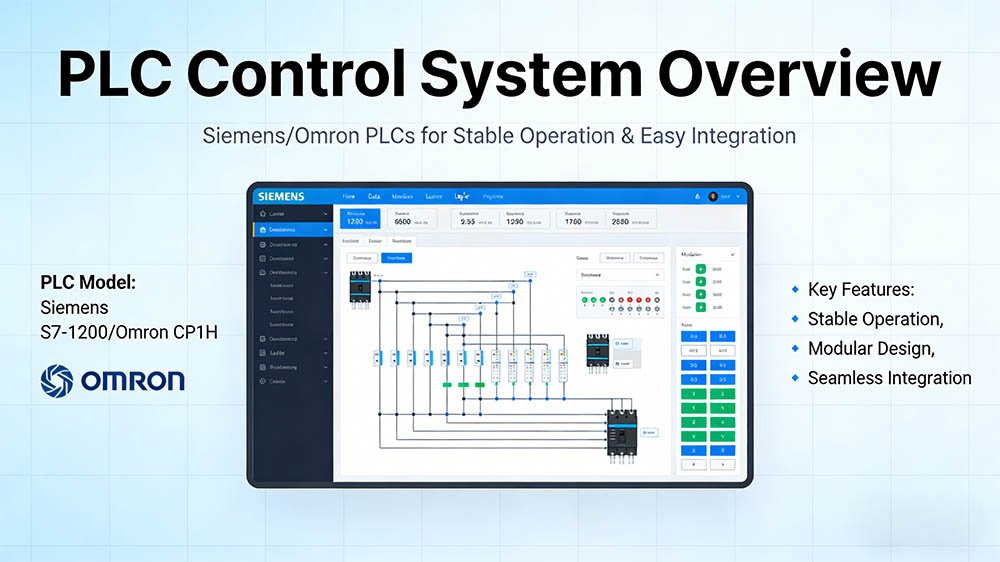
The architecture that delivers this at a technical level typically involves a Siemens S7 or Allen-Bradley ControlLogix PLC writing event data to a dedicated audit trail database stored in a non-volatile memory partition that is inaccessible to the HMI application layer. This separation is critical: if the HMI application has read/write access to the audit trail storage, a sufficiently privileged user can, in principle, manipulate records. The FDA has cited exactly this vulnerability in 483 observations. A properly engineered system writes audit trail entries at the PLC firmware level, below the HMI application, using a one-way data pipe that is write-only from the PLC’s perspective and read-only from the HMI’s perspective.
Timestamp synchronization deserves special attention. §11.10(b) requires that records be generated with accurate, computer-generated date and time stamps. In practice, this means the machine’s PLC internal clock must be synchronized to a network time source — either the plant’s NTP server or, in isolated environments, a GPS-synchronized time server — with a drift tolerance of no more than ±1 second per day. More importantly, the PLC’s clock must be accessible only to the Administrator role for configuration, and any manual clock adjustment must itself be logged as an audit trail event. If your machine’s system clock can be set by an Operator-level user without generating an audit entry, your Part 11 implementation is immediately compromised.
Critical Risk Item: During SAT at a client facility in the Philippines, I discovered that the blister machine’s audit trail was stored in the same SQL Lite database that the HMI application used for recipe storage — and the database file was located in a Windows shared folder accessible over the plant network. Any user with network access could open the database with a free tool and delete rows. This is a catastrophic Part 11 failure. Test for this specifically: attempt to access the audit trail storage medium directly from the machine’s operating system. If you can, the architecture is non-compliant.
Role-Based Access Control: The Most Frequently Failed §11.10(d) Requirement
In every FDA 483 observation related to packaging equipment computerized systems that I have reviewed or been involved in remediating, inadequate user access control is the number-one cited deficiency. The regulation is unambiguous: systems must be designed so that only authorized individuals can use them, and the level of access must be commensurate with the individual’s role and responsibilities.
For a pharmaceutical-grade blister packaging machine, a compliant RBAC architecture defines at minimum three distinct access tiers:
- Operator Level: Can start/stop the machine, acknowledge alarms, and view process parameters. Cannot modify recipes, change process parameter setpoints beyond approved ranges, access the audit trail configuration, or modify user accounts. Must log in with individual named credentials — shared “Operator” accounts are non-compliant.
- Supervisor / Technician Level: Can load approved recipes, perform mold changeover procedures, modify process parameters within validated ranges (with each change logged), and view the full audit trail. Cannot create or delete user accounts, modify access control settings, or disable system security features.
- Administrator Level: Full system access including user account management, access control configuration, system clock settings, and audit trail configuration. Administrator actions are subject to the highest level of audit trail scrutiny. There must be at least two named Administrator accounts to prevent single-point-of-failure access loss.
Beyond the tier structure, several specific implementation requirements are routinely missed. Automatic session timeout must be configured at the hardware/firmware level — not as an optional HMI setting that can be disabled. The recommended maximum session duration for unattended machines in a GMP environment is 10–15 minutes. Failed login lockout — typically after 3–5 consecutive failed attempts — must be implemented with an account lockout that requires Administrator intervention to release. And password complexity rules must be enforced at the system level: minimum 8 characters, mix of alpha/numeric/special characters, and a password history that prevents reuse of the last 5 passwords.
The Multi-Vendor Integration Nightmare vs. HIJ Turnkey: A 21 CFR Part 11 Reality Check
One of the most underestimated 21 CFR Part 11 risks in pharmaceutical packaging projects is the multi-vendor integration problem. It is common practice for procurement teams to source the blister machine from one vendor, the cartoning machine from another, the serialization system from a third party, and the MES interface from a fourth. Each piece of equipment arrives with its own audit trail database, its own user access control schema, its own timestamp format, and its own data export protocol. The result is a compliance patchwork that is, in practice, nearly impossible to validate as a unified system under §11.10.
⚠ Multi-Vendor Patchwork Approach
- 3–4 separate audit trail databases with no unified view
- Timestamp formats inconsistent across systems (UTC vs. local time, different epoch references)
- No single user access control master — separate user databases on each machine
- FDA 483 observation: “System does not provide a complete audit trail across the integrated packaging line”
- Validation effort multiplied by number of vendors; IQ/OQ/PQ protocols written independently
- Electronic signature linking broken at machine boundaries — cannot prove chain of custody for batch record
- One non-compliant vendor in the chain invalidates the entire line’s Part 11 status
✔ HIJ Turnkey Integrated Line
- Single unified data architecture from blister to cartoner to case packer
- Synchronized NTP-referenced timestamps across all line components
- Central user access control database — one login, consistent RBAC across entire line
- Consolidated audit trail exportable as a single batch record from HMI
- One set of IQ/OQ/PQ protocols covering the complete integrated system
- FAT/SAT performed as a complete line — Part 11 compliance demonstrated end-to-end
- Single point of accountability — HIJ owns the compliance narrative for the entire line
The HIJ turnkey approach is engineered specifically to address this integration challenge. When you source a complete turnkey pharmaceutical packaging line from HIJ, the blister packaging machine, cartoning machine, and downstream serialization interface share a common communication backbone — typically Profinet or EtherNet/IP — with a unified data layer that feeds a single audit trail repository. This architecture is designed to satisfy §11.10(e) at the line level, not just at the individual machine level, which is the standard that an FDA inspector applying a systems-based inspection approach will actually apply.
إن HIJ DPP-260 automatic blister packing machine and the HIJ DPH Alu-Alu cold-forming blister machine are both supplied with a Part 11 compliance matrix document that maps each §11.10 subpart to the specific machine feature that addresses it. This document is included as an annex to the URS response and is used directly in the FAT protocol as the test basis. It is not a marketing document — it is a validation-ready technical specification that your QA team can take to an FDA audit.
Embedding Part 11 Validation Into Your FAT/SAT Protocol
The most effective way to ensure 21 CFR Part 11 compliance is to make it a contractual and technical condition of machine acceptance, validated formally during Factory Acceptance Testing (FAT) before the machine leaves the manufacturer’s facility. This is non-negotiable in our project execution model at HIJ.
A Part 11-specific FAT test script for a blister packaging machine should include the following test cases, executed in sequence with documented expected results and observed results:
- Audit Trail Write Test: Log in as Operator, make a controlled parameter change (e.g., forming temperature setpoint from 110°C to 112°C), then log in as Administrator and verify the audit trail entry shows: old value (110), new value (112), Operator user ID, and accurate timestamp. Attempt to delete or modify the entry as Administrator — confirm the system prevents this.
- Clock Integrity Test: Document the machine’s current time against a reference NTP source. Attempt to change the system clock as Operator — confirm access is denied. Change the clock as Administrator — confirm the change is logged in the audit trail.
- Access Control Tier Test: Attempt to access recipe modification menus as Operator — confirm access is denied and attempt is logged. Confirm that the Operator-level HMI view provides no pathway to audit trail configuration settings.
- Session Timeout Test: Log in as Operator, leave the machine unattended for 15 minutes, confirm automatic logout occurs, and the logout event is recorded in the audit trail with timestamp.
- Data Export Integrity Test: Export the electronic batch record for the FAT production run to PDF. Verify the exported document cannot be modified without breaking the embedded digital signature or checksum. Verify the printed document includes all required fields: batch number, production quantities, alarm events, parameter changes, user IDs, and timestamps.
- Backup and Recovery Test: Verify that audit trail data is included in system backup procedures. Restore from backup and confirm data integrity is maintained with no records missing or modified.

Five Hidden Traps That Cause Part 11 Failures in Blister Packaging Installations
Based on first-hand experience across more than 100 pharmaceutical facility visits and dozens of FDA inspection readiness assessments, these are the five non-obvious Part 11 failure modes that generic equipment vendors will not disclose during the sales process:
- Trap 1 — The “Admin123” Password Default:
Machines shipped with factory-default administrator passwords that are either never changed, or changed to trivially guessable alternatives, represent a direct §11.10(d) violation. More importantly, if the vendor’s service portal has a back-door administrative account (a common practice for remote diagnostics), that account must be documented, its access events logged, and its credentials managed under your site’s access control SOP. Demand a complete list of all system-level accounts at FAT. - Trap 2 — The Overwrote-Able Audit Trail:
Some PLC implementations store audit trail data in a circular buffer with a fixed record limit. When the buffer fills, the oldest records are overwritten without notification. This is a catastrophic Part 11 failure: records that you are required to retain for the life of the batch may be overwritten within weeks of production. The maximum audit trail buffer size and the overwrite behavior must be specified in the URS and tested during FAT. - Trap 3 — Timestamp Drift in Isolated Networks:
In cleanroom environments where machines operate on isolated OT networks disconnected from the enterprise IT network, the PLC internal clock will drift. Without NTP synchronization, a machine running continuously for 12 months may develop a clock error of several minutes — enough to create an irreconcilable discrepancy between the machine’s electronic batch record timestamps and the site’s LIMS or MES timestamps. Specify NTP synchronization as a mandatory requirement, or specify a local NTP server on the OT network. - Trap 4 — The Validation Package That Doesn’t Exist:
Vendors routinely claim that IQ/OQ/PQ documentation is “available” without specifying whether it is pre-written generic documentation or site-specific executed protocols. Generic, un-executed IQ/OQ documentation is not a validation package — it is a template. Your purchase contract must specify that the vendor will provide executed FAT protocols with actual test results, not blank templates, as a delivery requirement. - Trap 5 — Recipe Version Control Without Approval Workflow:
A machine whose recipe management system allows any Supervisor-level user to save a modified recipe over an existing validated recipe — without a formal change control workflow requiring QA approval — is non-compliant with both §11.10(e) and the broader cGMP change control requirements of 21 CFR §211.68. Compliant recipe management requires a draft/approved/archived state structure, with promotion from draft to approved requiring an electronic signature from an authorized QA user.

The HIJ Standard: What “FDA Compliant Blister Machine” Actually Means at the Engineering Level
When HIJ describes a machine as an “FDA compliant blister machine,” we mean a specific, documented set of engineering features — not a marketing claim. Here is what is included as standard in every HIJ pharmaceutical blister packaging machine intended for the U.S. market:
- Siemens S7-1200/1500 or Allen-Bradley PLC with dedicated audit trail function block operating at firmware level, segregated from HMI application storage. PLC brand selection documented in machine specification; software source code available under escrow agreement.
- Three-tier RBAC implementation (Operator / Supervisor / Administrator) enforced at PLC level, not HMI application level. Individual named-user accounts mandatory; shared accounts architecturally impossible. Factory-default passwords changed as part of HIJ’s pre-delivery checklist, with new credentials issued to client at FAT.
- NTP-synchronized timestamp system configurable for enterprise NTP server address. PLC clock adjustment requires Administrator access and is automatically logged. Clock drift alarm configurable.
- Non-overwritable audit trail storage with configurable alert when storage reaches 80% capacity. Audit trail data exportable in FDA-compatible PDF/A format with embedded SHA-256 checksum for integrity verification.
- Recipe management with version control and a two-state (draft/approved) workflow. Recipe approval requires Supervisor-level electronic signature. Approved recipes locked against modification; modification requires creating a new draft version.
- Complete validation documentation package: machine design specification (DS), functional specification (FS), IQ/OQ protocol templates, and executed FAT report. SAT protocol provided as a client-executable document with expected results pre-populated based on FAT results.
- Part 11 Compliance Matrix document mapping each §11.10 subpart to the specific HIJ machine feature, with test method reference. Included as standard annex to URS response. Learn more about the HIJ quality standard.
This standard applies across the HIJ blister packaging range, including the tablet blister packing machine, capsule blister packing machine, و Alu-Alu cold-forming blister machine. For projects requiring integration with an MES or serialization system, HIJ’s engineering team works directly with your IT/automation team during the URS phase to define the data interface architecture, ensuring end-to-end Part 11 compliance across the complete line.
الأسئلة الشائعة
Q1: What is the difference between a “21 CFR Part 11 ready” machine and a “21 CFR Part 11 compliant” machine — and why does it matter?
“Part 11 ready” is an unregulated marketing term that typically means the machine has the hardware capability to support compliant operation, but the specific configurations required for compliance — such as RBAC implementation, timestamp synchronization, and audit trail architecture — have not been validated as meeting the regulatory standard. “Compliant” means the system has been validated, through documented testing, to meet each applicable requirement of §11.10. The distinction matters enormously in practice: a “ready” machine that has not been formally validated is a non-compliant machine from the FDA’s perspective. Always demand a validated, documented system, not a “ready” one.
Q2: Does 21 CFR Part 11 apply to my blister packaging machine if the machine’s electronic records are also printed on paper and signed manually?
This is a critical question with a nuanced answer. Under the FDA’s 2003 Part 11 guidance, the agency applies a risk-based enforcement discretion for certain legacy systems, and some manufacturers have used the “hybrid approach” (electronic records + paper copies) to argue reduced Part 11 scope. However, this approach has significant risks: the FDA has stated clearly that when electronic records are created, they are subject to Part 11 regardless of whether paper backups exist — unless the electronic record is not used in lieu of a paper record. If your blister machine generates a process data log (temperature, pressure, alarm events) that is used to support batch disposition decisions, that log is an electronic record under a predicate rule, and Part 11 applies. Consult your regulatory affairs team before adopting a hybrid approach.
Q3: How should I specify 21 CFR Part 11 requirements in my URS for a new blister packaging machine?
Your URS should include a dedicated “Computerized System and Data Integrity” section that specifies, at minimum: (1) the applicable regulatory standard (21 CFR Part 11, and optionally EU Annex 11 if the line will serve both markets); (2) a complete list of electronic records the machine will generate and the predicate rules that make them GMP-required records; (3) specific RBAC requirements including the number of access tiers, session timeout duration, and password complexity rules; (4) audit trail content requirements including the list of events that must be captured; (5) timestamp synchronization requirements including the reference source and maximum permitted drift; (6) data export format requirements; and (7) validation deliverables required from the vendor. HIJ provides a URS template section for Part 11 requirements upon request — contact our engineering team to obtain it.
Q4: Can an existing, non-compliant blister packaging machine be retrofitted to meet 21 CFR Part 11?
In some cases, yes — but the cost and complexity are frequently underestimated. If the existing machine uses a modern PLC platform (Siemens S7, Allen-Bradley ControlLogix) and the original software source code is available, it may be possible to upgrade the PLC application to add audit trail functionality, implement RBAC, and add NTP synchronization. The HMI application will typically require significant rework to support the new access control and audit trail display functions. The entire retrofitted system then requires full IQ/OQ/PQ validation as a modified computerized system. In my experience, the total cost of a compliant retrofit on a machine that was not originally designed for Part 11 is typically 40–70% of the cost of a new machine designed for compliance from the ground up. For machines older than 7–10 years, replacement is almost always the more cost-effective path.
Q5: What is EU Annex 11, and how does it relate to 21 CFR Part 11 for blister packaging machines targeting both the U.S. and European markets?
EU GMP Annex 11 (“Computerised Systems”) is the European equivalent of 21 CFR Part 11. The two frameworks are substantially aligned in their core requirements — audit trails, access controls, data integrity, validation — but differ in several areas of emphasis. Annex 11 places greater explicit emphasis on the supplier audit of the computerized system vendor, data governance frameworks, and periodic review of computerized systems. For blister packaging machines targeting both markets, HIJ designs to the more stringent requirements of the two frameworks in each area, resulting in a machine that satisfies both regulations without requiring market-specific variants. This is particularly relevant for Alu-Alu cold-forming blister machines commonly used for moisture-sensitive APIs in both U.S. NDA and EU MA product portfolios.
Conclusion: 21 CFR Part 11 Compliance Is an Engineering Decision, Not a Documentation Exercise
The central lesson from 20 years of pharmaceutical packaging machine commissioning is that 21 CFR Part 11 compliance cannot be achieved through paperwork alone. It is an engineering outcome that results from deliberate design decisions made at the PLC architecture level, the HMI application level, and the system integration level — decisions that must be locked into the machine’s specification before a single component is ordered, and validated with documented evidence before the machine is accepted.
The checklist in this article gives you the technical foundation to evaluate any blister packaging machine supplier’s Part 11 claims. Apply it rigorously during the URS development phase. Embed it in your FAT protocol. Refuse to accept a machine that cannot demonstrate compliance through live, documented testing — regardless of what the datasheet says.
The FDA’s inspection approach to packaging line computerized systems has become demonstrably more sophisticated over the past five years. Warning letters and import alerts citing Part 11 deficiencies in packaging operations are no longer rare edge cases — they are a systematic enforcement priority. The cost of getting this wrong is not measured in the price of the machine. It is measured in warning letters, consent decrees, and delayed market access for products that may be waiting to reach patients.
At HIJ Machinery, I don’t just sell you a machine. I deliver project certainty — including the documented, validated, FDA-ready computerized system that protects your manufacturing authorization for the entire operating life of the line.
Ready to Validate Your Blister Line’s Part 11 Compliance?
Send us your URS or describe your regulatory market requirements. Our engineering team will review your Part 11 specifications, map them to our machine architecture, and provide a documented Turnkey Quote within 48 hours — with FAT/SAT protocols and a Part 11 compliance matrix included as standard.