

















The 7 most common liquid blister packaging defects are: (1) leaking seals, (2) incomplete fills, (3) film delamination, (4) misaligned cavities, (5) tunnel seals, (6) cold seal spots, و (7) blister distortion. Each is preventable through correct forming film selection, calibrated sealing parameters (temperature ±2°C, pressure ±0.05 MPa), integrated line validation, and a single-source URS owner accountable for the full forming–filling–sealing chain.
Why Liquid Blister Packaging Defects Are More Dangerous Than Solid-Form Failures
Liquid blister defects are not just a quality issue. They are a safety and regulatory crisis waiting to happen.
Solid-dose blister failures — a broken tablet, a missing capsule — are visible at in-line inspection. A leaking liquid blister, by contrast, can pass visual inspection on the line, pass AQL sampling at QC, and fail four weeks into a stability study. Or worse: in the patient’s hands. The liquid migrates into the seal zone under ambient heat and humidity, creating a microenvironment that accelerates API degradation, promotes microbial growth in non-sterile oral liquids, and triggers foil corrosion cascades that compromise pack integrity across an entire batch.
FDA enforcement records for 2019–2023 show packaging as the root cause in 12% of pharmaceutical recalls — a figure I cite directly when procurement teams tell me the cost saving of $0.006 per blister card from switching to a low-bid film supplier justifies the risk. It does not.
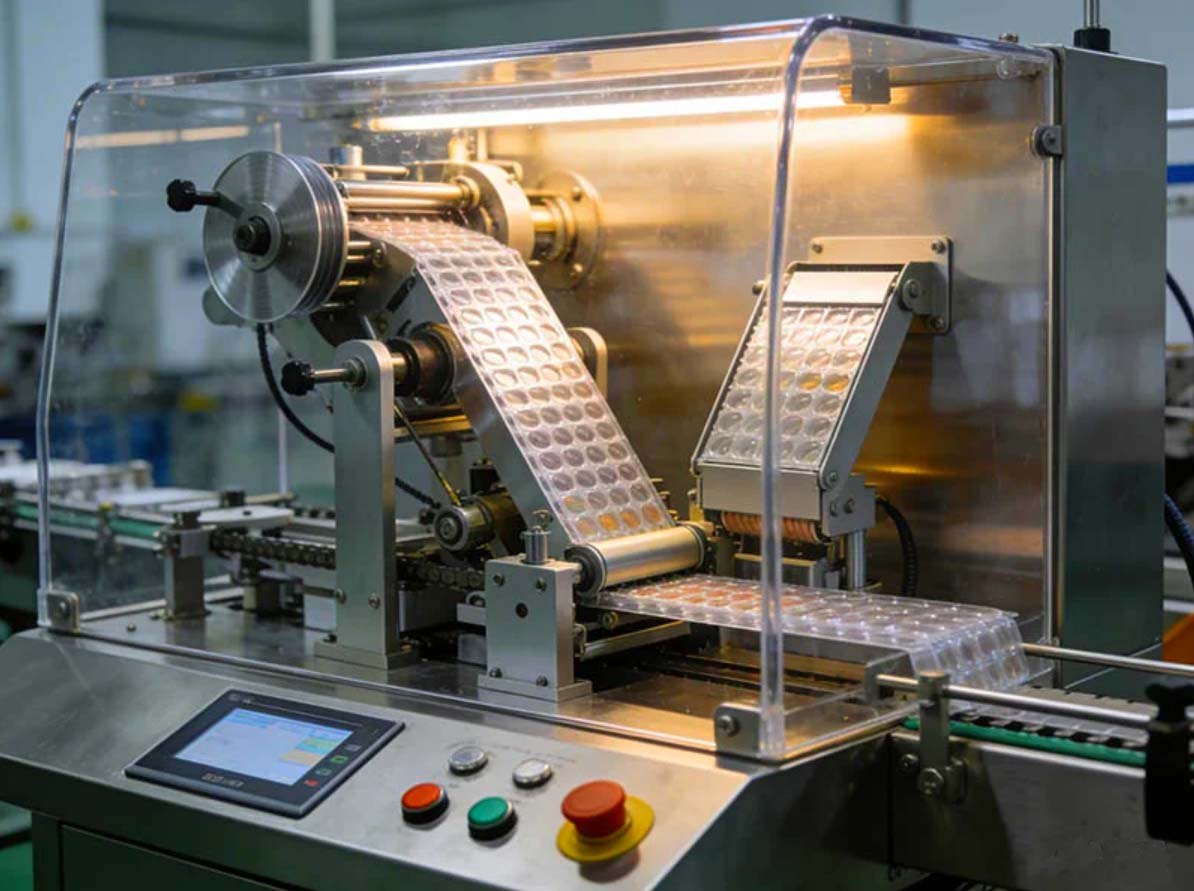
There is one more factor nobody writes about: the tolerance stack-up problem. When your forming station, filling station, and sealing station come from three different vendors, nobody owns the cross-station handoff. During FAT, everything looks fine at nominal settings. Six months into production, the forming film lot changes slightly — same spec on paper, different batch variability — and defect rates climb quietly from 0.3% to 3–5%. Every vendor points at the other two. The operator adjusts temperature up and down for days. The real cause stays invisible.
The 7 Most Common Liquid Blister Packaging Defects: Root Causes and Prevention
Each defect below is followed by its root cause, a detection method, and a prevention protocol I have used on real commissioning projects. Severity ratings reflect batch recall risk as defined by ISO 15223-1 classification practice and ICH Q8 quality risk management principles.
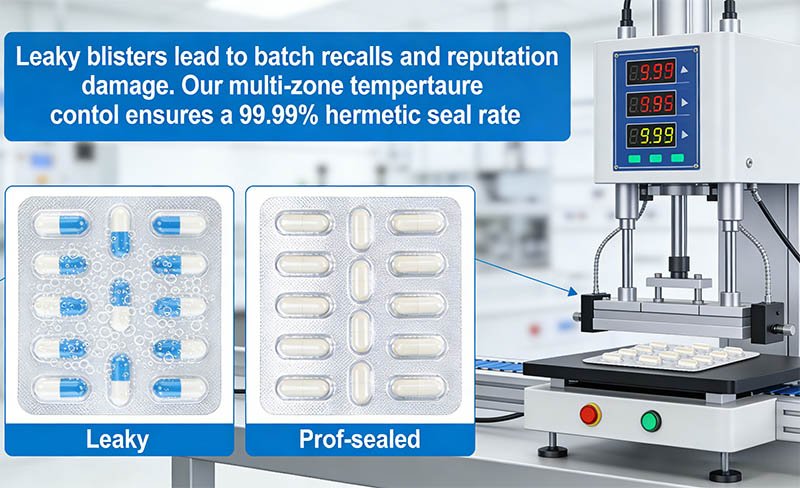
Seal leakage is the highest-frequency, highest-severity defect in liquid blister packaging — and it is almost never caused by what operators think it is. The instinctive response is to increase sealing temperature. In 14 of the 31 liquid blister line projects I handled in Southeast Asia between 2018 and 2023, that adjustment made the defect worse.
The actual failure mechanism: as temperature increases beyond the forming film’s softening threshold — typically 155–165°C for PVC/PVDC at standard gauge — the film micro-wrinkles at cavity edges, creating a non-planar sealing surface. Aluminum lidding cannot conform to that micro-wrinkle at standard sealing pressures of 0.2–0.35 MPa. The seal looks closed. Under dye-ingress testing per ASTM F2338 at 60 mbar, liquid paths appear in 23% of cavities that passed visual inspection in the batch I audited in Surabaya in 2021.
Incomplete fills mean under-dosed product reaches the patient. For a 5 mL pediatric syrup blister, a −12% fill deviation is a clinical dosing error, not a cosmetic defect. The threshold under Ph. Eur. 2.9.26 and USP <1> is ±1% for individual unit fill volume in pharmaceutical liquid blisters.
The fill accuracy problem is almost always a viscosity-temperature interaction. Liquid viscosity changes with temperature in the filling head — and filling heads are rarely temperature-controlled to ±1°C in standard machine configurations. A syrup product at 20°C vs. 26°C ambient can shift fill volume by 4–7% without any mechanical change. I watched this destroy a batch qualification in a plant outside Kuala Lumpur in 2020. The validation had been done in January. The batch ran in June.

Delamination — the separation of aluminum foil layers or PVC/PVDC laminate plies — does not happen at commissioning. It happens at month three, or month six, in a climate you did not test for. The delamination front starts at a forming cavity stress riser, propagates along the laminate adhesive bond line, and terminates in a visible bubble or — more commonly — an invisible moisture ingress channel that only shows up in accelerated stability data.
Peel strength for aluminum lidding on PVC/PVDC forming film should read ≥1.8 N/15mm under ambient conditions and ≥1.4 N/15mm after 40°C/75% RH six-week conditioning per ICH Q1A(R2) Zone IVb accelerated stability protocol. If your qualification package does not include post-conditioning peel data, the qualification is incomplete. Full stop.
Cavity misalignment in liquid blister packaging is a registration problem, not a mechanical problem. The distinction matters because operators typically respond by adjusting film tension — which addresses the symptom but not the cause. True misalignment originates from film web tracking drift at the unwind station, compounded by forming station index error accumulating over a production run.
On one line I commissioned in Lagos in 2022, the forming station index error was within spec (±0.3 mm per cycle) but cumulative drift over a 4-hour run reached 2.1 mm. The filling nozzle missed the cavity edge on the outer columns. The client had been running this way for six months, absorbing a 1.8% waste rate they attributed to “film quality.”
Probable cause: Film softening at sealing temperature creating micro-wrinkle at cavity edge.
Immediate action: Reduce seal temperature by 5°C increments; verify film lot Tg on COA. Do not increase pressure first.
Probable cause: Filling head temperature rising with ambient; viscosity-temperature shift reducing actual dispensed volume.
Immediate action: Gravimetric sample every 30 minutes; install filling-head temperature monitor; validate at three ambient temperatures before next batch.
Probable cause: Laminate adhesive bond below spec; forming temperature above PVDC thermal degradation threshold.
Immediate action: T-peel test on retained samples from same lot; review forming temperature set-point vs. film specification. Hold batch pending investigation.
Tunnel seals are linear air channels running across the sealing zone — parallel to the machine direction — visible as translucent streaks against backlight inspection. They are caused by liquid product migrating into the seal zone between filling and sealing stations.
This is the defect that betrays a poorly integrated filling–sealing handoff. If the dwell time between filling nozzle retraction and sealing station engagement is >800 ms, liquid in high-fill-volume cavities (>4 mL) can surface-creep along the PVC wall toward the seal flange. Surface tension of pharmaceutical syrups at 25°C is typically 35–45 mN/m — low enough to drive creep into a 0.8 mm seal flange gap in under one second. I have measured this directly on a line in Bangkok. The line had been running for eight months. Nobody had ever timed the dwell.
Cold seal spots are discrete areas of the sealing zone where the bond strength falls below 1.2 N/15mm — the minimum peel threshold for a commercially acceptable liquid blister seal. They appear as slightly dull zones on the foil surface and are almost invisible under normal inspection lighting. Under cross-polarized light or IR reflectance scanning, they are immediately obvious.
Cause: the heating platen surface develops hot and cold zones over time as the embedded resistance heaters age at different rates. The sealing station on a line running at 300 cycles/hour completes approximately 2.1 million sealing events per year. After 18–24 months without platen calibration, temperature uniformity across the platen face typically degrades from ±2°C to ±8–12°C. That is the hidden degradation nobody budgets for.
Blister distortion — cavities that are non-uniform in depth, off-center, or showing webbing between adjacent pockets — is a forming station problem that multiplies every downstream defect. A distorted cavity is a cavity whose fill volume is unpredictable, whose seal surface is non-planar, and whose print registration is wrong. It is the upstream failure that makes all six defects above harder to control.
PVC forming at 130–145°C is extremely sensitive to film thickness variation within a single roll. A ±5 μm thickness variation — which is within standard film specification — can produce a ±0.4 mm cavity depth variation at the forming station. For a 5 mL cavity, that is a ±3% volume error before the filling system even runs.

Liquid Blister Packaging Defect Reference: Root Cause, Detection & Severity
The table below consolidates all seven defects for quick cross-reference. Severity ratings follow ICH Q8 risk classification. Detection method references align with USP <1207> and ASTM F2338 standards.
| Defect | Severity | السبب الجذري الأساسي | Detection Method | Key Prevention Metric |
|---|---|---|---|---|
| Leaking Seals | حرجة | Sealing temp above film Tg; micro-wrinkle at cavity edge | ASTM F2338 dye-ingress at 60 mbar; USP <1207> | Seal temp ±2°C from validated set-point |
| Incomplete Fills | حرجة | Viscosity-temperature drift in filling head | Gravimetric check every 30 min; checkweigher ±0.5% | Fill head temp-controlled to ±1°C |
| Delamination | حرجة | Sub-spec laminate bond; thermal PVDC degradation | T-peel test post 40°C/75% RH conditioning | Peel strength ≥1.4 N/15mm post-conditioning |
| Misaligned Cavities | Major | Servo index cumulative drift; film web tracking error | Registration camera ±0.1 mm; pitch gauge check | Closed-loop web tension control at unwind |
| Tunnel Seals | حرجة | Liquid surface-creep into seal flange (>800 ms dwell) | Backlight inspection; ASTM F2338 channel detection | Fill–seal dwell ≤600 ms; fill ratio ≤90% |
| Cold Seal Spots | حرجة | Uneven heater aging across sealing platen | IR thermal camera platen map; 9-zone peel matrix | Platen thermal uniformity ±2°C across face |
| Blister Distortion | Major | Film thickness variation; forming temp non-uniformity | Cavity depth gauge per roll change; 3D profilometry | Film thickness tolerance ±3 μm in material spec |
In 20 years of commissioning liquid blister lines, I have never seen a defect pattern that could not be traced back to either a film specification gap, a cross-station handoff nobody owned, or a sealing platen that had not been thermally mapped in two years. The machines are not the problem. The integration is.
— فوريستر شيانغ، مؤسس شركة HIJ Machinery
The Hidden Root Cause: Cross-Station Tolerance Stack-Up in Multi-Vendor Liquid Blister Lines
Of the 31 liquid blister line projects I handled in Southeast Asia between 2018 and 2023, 11 required intervention after month-12 stability failures. In nine of those 11 cases, the root cause was a cross-station tolerance stack-up that was not caught during FAT — because FAT was conducted with the machine at nominal settings using fresh film from a pre-qualified lot.
Here is what happens in the real world. The line runs for six months. The original film supplier increases MOQ and the client switches to a secondary approved supplier — same specification, different lot variability. The forming film Tg shifts 3°C lower. The cavities form 0.3 mm deeper. The filling nozzle, calibrated at the original cavity depth, now slightly over-fills — increasing surface-creep into the seal zone. The sealing station, unchanged, now operates at an effective temperature 4°C above the new film’s softening threshold. Tunnel seals appear. Leaking seals appear. Nobody connects it to the film change. The root cause analysis points at the sealing station. The sealing station vendor adjusts parameters. Three weeks later, delamination appears.
This is the tolerance stack-up cascade. It is not rare. It is the default failure mode of multi-vendor liquid blister lines when no single integrator owns the complete URS.
Before commissioning any liquid blister line, insist on a full turnkey integration with a single-source URS owner accountable for the complete process chain — from film tensioning at the unwind to final seal integrity testing at the exit conveyor. At HIJ, our engineering position is straightforward: we build lines we are prepared to debug ourselves, under your roof, until the Cpk data proves the process is stable across three film lot changes. That is what “project certainty” actually means. You can review our liquid blister packaging machine specifications to understand how we engineer single-source integration into every line we supply.
- ASTM F2338 — Container Closure Integrity (Dye-Ingress)
- USP <1207> — Package Integrity Evaluation
- Ph. Eur. 2.9.26 — Fill Volume in Pharmaceutical Preparations
- ICH Q8 — Pharmaceutical Development (Risk Classification)
- ICH Q1A(R2) — Stability Testing, Zone IVb Protocol
- ISO 15223-1 — Symbols for Medical Device Packaging
- EU GMP Annex 1 (2022) — Contamination Control Strategy
- 21 CFR Part 211 — cGMP for Finished Pharmaceuticals
Pre-Production Defect Prevention Checklist for Liquid Blister Packaging Lines
A procurement director in São Paulo called me in early 2024. Her line had been running for four months. Defect rate was 4.2%. She had spent $38,000 on consultant audits. The answer was in the commissioning checklist — specifically, in what had not been done before the line started. The items below are what I now require as FAT prerequisites on every HIJ liquid blister line delivery.
Film supplier COA review: Tg range, thickness tolerance (±3 μm max), laminate peel strength ≥1.8 N/15mm at ambient, and ≥1.4 N/15mm post 40°C/75% RH 6-week conditioning. Reject any lot without this data.
Sealing platen thermal mapping: IR camera measurement of full platen face. Accept only if temperature uniformity is ±2°C across entire sealing zone. Document baseline for annual comparison.
Fill volume validation at three ambient temperatures (20/25/30°C): Gravimetric measurement of 30-unit sample at each condition. Filling head must be temperature-controlled; accept ±1% fill volume deviation maximum.
Fill–seal dwell time measurement: Verify actual dwell between nozzle retraction and sealing station clamp ≤600 ms. Document in machine qualification protocol.
Cavity depth gauge measurement: 10 random blisters per roll change. Accept ±0.3 mm from nominal cavity depth. Reject forming film lot if deviation exceeds specification.
ASTM F2338 dye-ingress seal integrity test: 30-unit sample at batch start, mid-run, and batch end. 100% rejection at any positive result. Do not substitute visual inspection as a primary seal integrity method for liquid product.
Cross-station index registration check: Verify cavity registration accuracy ±0.1 mm at production start and after 4-hour continuous run. Investigate any cumulative drift >0.5 mm before the next batch.
Probable cause: Blister distortion (cavity depth variation) creating uneven fill ratio across web width — outer cavities over-filled relative to center.
Check: Cavity depth gauge across full web width. Measure film thickness at edges vs. center of roll. If depth variation >0.4 mm, root cause is forming, not sealing.
Probable cause: Localized heater element failure or thermocouple drift on sealing platen at those positions. The set-point is correct; the actual temperature at those positions is 8–15°C lower.
Immediate action: IR thermal camera on sealing platen face before next run. Do not increase temperature compensating for cold spots — this will overheat the working zones and cause leaking seals in adjacent positions.
When Liquid Blister Packaging Defects Require Line Stop: A Decision Framework
Not all defects require immediate line stop. Some require line stop, batch quarantine, and root cause investigation before any further production. Knowing the difference — quickly, under production pressure — is the judgment call that separates a contained problem from a regulatory event.
The rule I use: any defect that compromises container closure integrity or dosing accuracy is a mandatory line stop. Immediately.
| Defect Observation | Action | Rationale |
|---|---|---|
| Any positive ASTM F2338 dye-ingress result on any unit | Line stop. Batch quarantine. | Container closure integrity failure. 100% of product since last passing test is suspect. Per EU GMP Annex 1 (2022) contamination control requirements. |
| Fill volume out of ±1% at in-process gravimetric check | Line stop. Investigate before restart. | Dosing accuracy failure. Clinical safety risk for pharmaceutical product. Aligns with Ph. Eur. 2.9.26 and USP <1> individual unit fill specifications. |
| Tunnel seals on >3 units in a 30-unit AQL sample | Line stop. Batch hold. | Seal channel defects at this frequency indicate a systemic process parameter excursion, not random variation. |
| Cavity registration drift >1.0 mm (cumulative) | Line stop. Re-calibrate before restart. | Registration error at this level creates fill volume error cascade across all seven defect categories. |
| Cold seal spots confirmed by IR camera on >2 platen zones | Scheduled maintenance within 48 hours. Do not increase global set-point. | Localized heater failure; increasing set-point compensates at working zones but overheats adjacent zones, trading cold-spot seals for leaking seals. |
| Cavity depth variation >0.5 mm at gauge check | Roll change. Investigate film lot. | Upstream forming defect will cascade into fill volume error and tunnel seal risk for the remainder of the roll. |
How Liquid Blister Packaging Machine Design Prevents These 7 Defects at the Source
The defect prevention framework above assumes a machine that gives you the mechanical precision to act on it. A lot of machines do not. That is not an opinion — it is a specification gap.
For leaking seals and cold seal spots: the machine must have multi-point thermocouple sealing temperature control (minimum 3 positions across the platen), not a single-point sensor at the platen edge. For incomplete fills: the filling head must be temperature-controlled to ±1°C, which eliminates viscosity-temperature drift as a variable entirely. For misaligned cavities and blister distortion: the unwind must use closed-loop servo tension control — not mechanical brake resistance — to maintain consistent film tracking regardless of roll diameter change over a 6-hour run.
For tunnel seals: the fill–seal dwell must be mechanically fixed and documented in the machine URS, not left as an operator-adjustable parameter. The moment an operator can extend that dwell — for whatever reason — liquid surface-creep becomes a production risk on every batch.
These are not premium features. They are the baseline specification for a machine qualified under 21 CFR Part 211 and EU GMP Annex 1. If a machine does not include them, the compliance cost will appear later — in deviations, in stability failures, and in recall investigations.
For a complete technical specification comparison of liquid blister packaging machines — including forming film compatibility matrices, filling system precision grades, and sealing station control architecture — the HIJ liquid blister packaging machine product page covers the full specification range. If you are still evaluating which machine configuration fits your product profile and production volume, the liquid blister packaging machine buyer’s technical guide walks through the selection criteria in detail.
Frequently Asked Questions: Liquid Blister Packaging Defects
Leaking seals are the most common critical defect in liquid blister packaging, occurring when sealing temperature exceeds the forming film’s softening threshold and creates micro-wrinkles at cavity edges that aluminum lidding cannot bridge at standard sealing pressures of 0.2–0.35 MPa. Detection requires ASTM F2338 dye-ingress testing at 60 mbar — visual inspection alone misses up to 23% of seal failures in high-humidity production environments.
Use ASTM F2338 dye-ingress testing at 60 mbar as the primary detection method — it is the standard specified in USP <1207> for container closure integrity evaluation of liquid pharmaceutical blisters. Supplement with 100% vision seal inspection using grayscale differential imaging at the sealing station exit. Do not rely on visual inspection alone: it misses sub-critical seal channels that are only detectable under pressure differential.
Incomplete fills are most commonly caused by viscosity-temperature drift in the filling head — as ambient temperature rises during a production run, liquid viscosity decreases and actual dispensed volume drops below the set-point, often by 4–7% for syrup products between 20°C and 26°C ambient. Secondary causes include worn piston seals on volumetric dosing pumps (typically after 2 million cycles without replacement) and back-pressure variation from downstream conveyor speed mismatch. The fix is a temperature-controlled filling head specified to ±1°C, validated at three ambient temperatures during OQ.
A tunnel seal is a linear air or liquid channel running across the blister sealing zone, caused by product migrating from the filled cavity into the seal flange between the filling and sealing stations. Liquid surface tension at 25°C (35–45 mN/m for typical pharmaceutical syrups) is sufficient to drive creep into a 0.8 mm seal flange gap in under one second if fill-to-seal dwell time exceeds 800 ms. Prevention requires a fill–seal dwell time specification of ≤600 ms in the machine URS and a fill ratio ceiling of 88–90% of cavity volume.
Not reliably — not with standard visual or seal integrity methods. Delamination is a latent failure that typically becomes visible at 3–6 month stability pulls, not at 0-time inspection. Commissioning-stage detection requires post-conditioning T-peel testing per ASTM D1876 after 40°C/75% RH 6-week conditioning per ICH Q1A(R2) Zone IVb protocol. Any qualification package without post-conditioning peel strength data on the forming film and lidding combination is missing the most predictive delamination indicator.
Critical defects (leaking seals, incomplete fills, tunnel seals) warrant AQL 0.65 or tighter using ISO 2859-1 sampling plans — equivalent to zero-acceptance on a standard sample size for high-production pharmaceutical lines. Major defects (misalignment, blister distortion) can use AQL 1.0. Never apply a standard AQL table to container closure integrity testing for liquid products; USP <1207> and EU GMP Annex 1 (2022) require 100% in-line CCI testing or a statistically validated destructive testing protocol, not a sampling plan.
Every 6 months at minimum, using an IR thermal camera on the full platen face. After 18–24 months of production at 300 cycles/hour, platen temperature uniformity typically degrades from ±2°C to ±8–12°C as resistance heaters age at different rates. That degradation range is large enough to produce cold seal spots in low-temperature zones and film softening defects in hot zones — simultaneously, on the same platen, in the same batch.
Yes. Blister distortion is the upstream failure that amplifies every other defect category. A distorted cavity has unpredictable fill volume (because cavity depth varies), a non-planar seal surface (increasing leak risk), and incorrect registration (disrupting fill nozzle placement). In nine of the eleven remediation projects I handled between 2018 and 2023, tracing the visible defect — leaks, tunnel seals — back to forming station distortion cut the root cause analysis time from weeks to days.