
















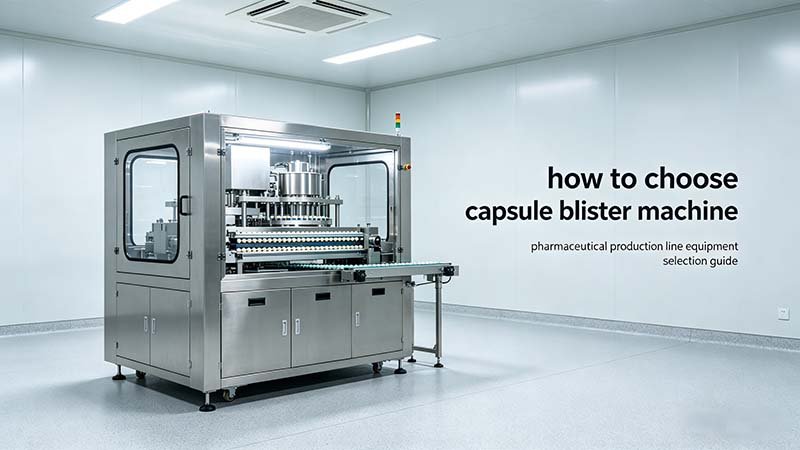
How to Choose the Right Capsule Blister Packing Machine for Your Pharma Line
The answer most vendors won’t give you: output speed is the last thing you should optimize for. In 20 years of commissioning blister lines across Southeast Asia, Latin America, and the Middle East, the facilities that chose wrong almost always chose on speed or unit price. The facilities that chose right started with three questions — compliance architecture, capsule geometry, and line integration protocol.
This guide gives you the five-criteria framework I use before I let any client issue a URS.
اختيار المناسب capsule blister packing machine requires evaluating five criteria in sequence: (1) verified output target in blisters/min, (2) capsule size range and feeder compatibility, (3) GMP structural compliance against your target market’s regulatory framework, (4) upstream/downstream integration protocol, and (5) total cost of ownership over a 10-year lifecycle — not unit price alone.
Extra cost from poor integration choices vs. upfront price savings
Pharma recalls linked to packaging as root cause (FDA 2019–2023)
Blisters/min output range across capsule blister machine classes
Lifecycle horizon for correct TCO calculation
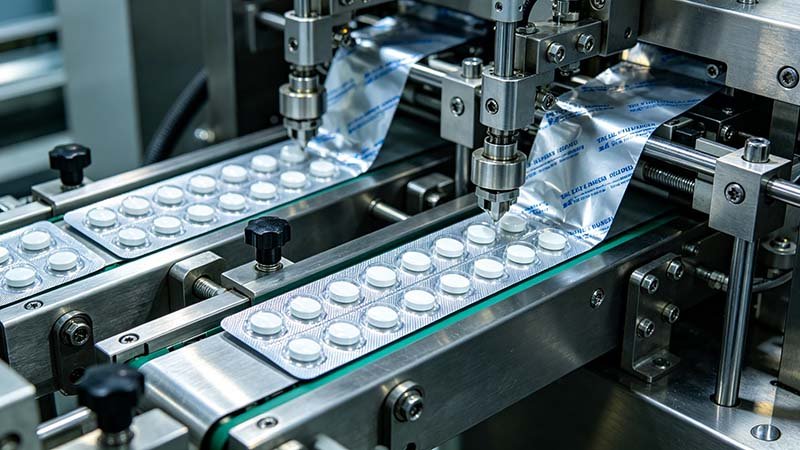
Technical specification review is the foundation of every correct capsule blister machine selection — before output speed, before price.
Why Most Capsule Blister Machine Purchases Go Wrong at FAT
Three weeks into a commissioning job in Surabaya, I was standing in a cleanroom watching a site acceptance test fail in real time. Not because the machine was defective. Because three machines — blister packer, capsule filler, cartoner — had been bought from three separate vendors, and nobody had defined PLC handshake protocol in the URS. The blister machine ran at 200 blisters/min. The cartoner topped out at 80 cartons/min. The buffer between them was a 1.5-meter gravity conveyor. Nobody had modelled the queue.
The recall risk wasn’t from the machines themselves. It was from the integration gap. Six weeks of rework. Two vendors pointing at each other. One quality director asking if we could just slow the blister packer down permanently. That’s a $380,000 machine running at 40% capacity indefinitely.
That scenario repeats more than the industry admits. FDA enforcement records for 2019–2023 show packaging as the root cause in 12% of pharmaceutical recalls — the figure I cite when procurement teams tell me the $8,000 price difference between two machines justifies skipping a proper FAT protocol review.
“The most expensive capsule blister packing machine I’ve seen wasn’t the one with the highest sticker price — it was the one bought on unit price that required 14 months of validation rework before first batch approval. Choosing right means choosing for your compliance architecture and your line, not for the spec sheet.”
— فوريستر شيانغ، مؤسس شركة HIJ Machinery
The 5-Criteria Framework for Capsule Blister Machine Selection
The five criteria for selecting a capsule blister packing machine are: verified output target, capsule size and feeder system, GMP structural compliance, line integration protocol, and 10-year total cost of ownership — evaluated in that sequence, not by price first.
I’ve used this framework across 31 blister line projects in Southeast Asia between 2018 and 2023. It doesn’t guarantee a perfect outcome — nothing in capital equipment procurement does — but it reduces the probability of a post-FAT disaster by addressing the variables that actually cause failures.
Criterion 1 — Verified Output Target (Blisters/Min, Not Theoretical Max)
Vendors publish theoretical maximum speeds. A machine rated at 300 blisters/min under ideal lab conditions running a single-cavity flat PVC/Alu card will rarely sustain that rate in your facility, with your capsule geometry, at your altitude and humidity. The number that matters is validated sustained throughput at 90% OEE.
For most generic pharma facilities entering blister packaging for the first time, the realistic operating range is 80–160 blisters/min. Entry-level automatic machines — like the HIJ DPP-260 — deliver 40–120 blisters/min with a standard capsule feeder, which matches the actual demand profile of a 5–15 million capsule/year production run. Buying a 300 blisters/min machine for that volume is an accounting problem, not an engineering solution.
Work backwards: annual volume ÷ operating days ÷ shifts ÷ hours = required sustained throughput. Add 20% buffer for changeovers. That’s your real speed target.
Criterion 2 — Capsule Size Range and Feeder System Compatibility
Capsule size determines cavity geometry, feeder plate configuration, and forming depth. A machine tooled for size 0 capsules cannot run size 4 without a full mold and feeder plate change. The question isn’t just “what size are we running today” — it’s “what sizes might we need to run in the next 5 years.”
The standard capsule sizes in global generics production are 00, 0, 1, 2, 3, and 4 — body diameters from 8.5 mm down to 5.0 mm. If your pipeline includes more than two size families, look for machines with quick-change tooling systems. Mold changeover on a properly designed machine should take 20–30 minutes by one operator; on a poorly designed one, it takes 4 hours and requires an engineer.
Feeder type also matters. Brush feeders work well for smooth gelatin capsules. HPMC capsules — increasingly common in halal, vegetarian, and hygroscopic API formulations — have slightly different surface friction coefficients and can jam in feeders designed only for gelatin. Ask your vendor directly: have they validated the feeder with HPMC capsules at humidity levels above 65% RH?

Capsule blister machine in production: feeder system compatibility with capsule size and shell material is a first-order decision, not a secondary spec.
Criterion 3 — GMP Structural Compliance
GMP compliance for capsule blister packaging machines is not a checkbox — it’s a structural specification that determines whether your validation dossier survives regulatory review. The core requirements are: 316L stainless steel or equivalent product-contact surfaces, no dead-leg zones where product residue can accumulate, cleanable-in-place design for product changeover, and sealed electrical enclosures rated for the classified zone.
For WHO GMP markets (most of Africa, Southeast Asia, parts of the Middle East), the critical reference is WHO TRS 992 Annex 3, which specifies pharmaceutical manufacturing equipment design requirements. For FDA-regulated markets, 21 CFR Part 211.68 governs equipment used in drug product manufacturing, and 21 CFR Part 11 applies if the machine uses electronic records and electronic signatures — which any modern PLC-controlled blister packer does. I’ve seen projects in Nigeria and Kenya delayed 8–10 months because the machine’s HMI system wasn’t configured for Part 11-compliant audit trails before installation.
A full compliance-focused analysis for your target market — including WHO and 21 CFR frameworks — is covered in depth in our guide to GMP compliance for capsule blister packaging.
Key regulatory frameworks for capsule blister packaging equipment: WHO TRS 992 Annex 3 (equipment design for pharmaceutical manufacturing) — 21 CFR Part 211.68 (automatic, mechanical, electronic equipment) — 21 CFR Part 11 (electronic records, audit trails) — EU GMP Annex 1 (2022, contamination control) — ICH Q10 (pharmaceutical quality system). Confirm which frameworks apply to your target registration market قبل issuing the URS.
Criterion 4 — Upstream / Downstream Integration Protocol
This is where single-machine thinking breaks the line. A capsule blister packing machine doesn’t operate in isolation. It receives capsules from a filling/polishing line and passes blister cards to a cartoner. The integration variables are: conveyor height matching, PLC communication protocol (Siemens S7, Allen-Bradley, Modbus, or proprietary), reject-handling handoff, and emergency stop cascade logic.
If you buy your blister packer from one vendor and your cartoner from another, you own the integration problem. Neither vendor does. I’ve had that conversation with procurement teams across three continents and the response is always the same: “But the vendor said it’s compatible.” Compatible in sales literature means the conveyor heights are close. It doesn’t mean the PLC handshake has been tested, the reject rates at line speed have been validated, or that the emergency stop cascade has been documented. Ask for the FAT protocol for the full line — not just the individual machine.
At HIJ, when we supply a turnkey line — capsule filler, blister packer, and cartoner — one set of engineers is accountable for the integration. That’s not a marketing claim. It’s an engineering contract. If you want to understand how full turnkey capsule blister packaging line planning works from URS to commissioning, our cluster on turnkey solutions covers the full methodology.
Criterion 5 — Total Cost of Ownership Over 10 Years
The procurement director showed me the comparison sheet in Bangkok. Machine A: $42,000. Machine B: $68,000. The recommendation was Machine A. I asked four questions: What is the Mean Time Between Failures for the forming station die? What is the cost and lead time for replacement cam assemblies? Does the vendor hold spare parts in-region or ship from the factory? What is the annual maintenance contract cost?
Nobody had the answers. That’s the real problem with unit-price comparison. A machine with a 180-day spare parts lead time in a market without local service coverage will cost you more in downtime in year 2 than the $26,000 price difference saved in year 0. Of the 31 blister line projects I handled in Southeast Asia between 2018 and 2023, 11 required a forming station component change before month 18 — and lead time on parts was the single largest driver of unplanned downtime.
Capsule Blister Machine Types: Technical Comparison by Production Scale
Capsule blister machines divide into three classes by output: entry-level automatic (40–120 blisters/min, for <20M capsules/year), mid-range (120–250 blisters/min, for 20–80M/year), and high-speed (250–500 blisters/min, for >80M/year) — with GMP compliance and integration complexity scaling accordingly.
| Machine Class | Output Range (Blisters/Min) | Annual Volume Fit | Typical Capsule Sizes | GMP Compliance Level | تعقيد التكامل | Indicative Price Range (USD) |
|---|---|---|---|---|---|---|
| Entry Automatic (e.g., DPP-260) | 40 – 120 | < 20M capsules/yr | Size 00 – 4 | WHO GMP / CE ready | Standalone or simple line | $18,000 – $45,000 |
| Mid-Range Automatic | 120 – 250 | 20M – 80M capsules/yr | Size 00 – 2 | WHO GMP / 21 CFR ready | Turnkey line integration | $45,000 – $120,000 |
| High-Speed Automatic | 250 – 500 | > 80M capsules/yr | Size 0 – 1 | Full GMP validation required | Full line engineering project | $120,000 – $350,000+ |
| شبه أوتوماتيكي | 15 – 40 | < 5M capsules/yr | Size 0 – 4 | Basic cGMP | Standalone only | $4,000 – $18,000 |
Note: Price ranges are indicative for standard configurations from Chinese manufacturers with CE marking. European-origin machines at equivalent output classes typically run 2–4× higher. Local taxes, import duties, and installation are excluded. See our full capsule blister machine cost breakdown for a detailed TCO model.

The HIJ DPP-260 automatic blister packing machine: designed for 40–120 blisters/min sustained output across capsule sizes 00–4, with WHO GMP-compliant structural design.
Which Blister Film Is Right for Your Capsule Formulation?
PVC (250 μm) passes 4–6 g/m²/day moisture vapor; PVDC-coated PVC cuts that to 0.2–1.0 g/m²/day; cold-form Alu-Alu drops it to 0.02–0.5 g/m²/day — the right choice depends entirely on your API’s moisture sensitivity and target market climate zone.
Standard PVC at 250 μm passes 4–6 g/m²/day. That’s the number that matters. For a hygroscopic capsule formulation — the kind on every WHO Essential Medicines formulary for tropical markets — that rate means you’re not packaging the drug; you’re just slowing the degradation curve.
The film choice also affects machine configuration. Cold-form Alu-Alu (aluminium/nylon/aluminium laminate) requires a cold-forming station — a mechanical rather than thermal process — that is a fundamentally different machine architecture from a standard PVC thermoforming blister packer. You cannot convert a PVC thermoforming machine to run Alu-Alu by swapping the forming die. It requires a different machine. I mention this because I’ve had three clients in the past five years discover this after purchase.
For most generics manufacturers targeting Southeast Asia or African markets — ICH Q1F Zone IVb conditions (40°C / 75% RH) — PVDC-coated PVC at 60 g/m² PVDC weight is a practical middle ground: significantly better moisture protection than plain PVC, compatible with standard thermoforming machines, and carrying a modest 15–25% premium over plain PVC film cost. For highly moisture-sensitive APIs or products targeting WHO prequalification with Zone IVb shelf life data, Alu-Alu is not optional — it’s the only architecture that delivers the required MVTR.
For a full material-level comparison including forming temperature ranges and sealing parameter specifications, see our guide on capsule blister packaging vs. bottle packaging, which covers the moisture protection trade-off across packaging formats in detail.
🔧 Field Diagnosis: Film Selection Errors I’ve Seen
Signal: 9-month stability data passes at 25°C/60% RH (Zone II); product fails on-market in Vietnam or Ghana after 6 months.
What happened: The stability study was designed for a European or US registration, not Zone IVb. The PVC film that passed in Germany at 25°C/60% RH is transmitting 4–6 g/m²/day in Manila or Accra at 38°C/75% RH, and the API is absorbing moisture above the degradation threshold within the in-use period. The machine wasn’t wrong. The film specification wasn’t wrong for the registered conditions. إصلاح: Define your target market climate zone before specifying the forming material. If you’re going to Zone IVb markets, design to ICH Q1F Zone IVb from the start — not as a post-approval variation.
Signal: Alu-Alu machine purchased; forming station producing cracked or pinhole-defect foil at edges.
إصلاح: Cold-form Alu-Alu requires precise forming pressure and stroke depth calibration specific to the foil gauge and laminate structure. Verify forming parameters against the foil manufacturer’s technical data sheet — not just the machine’s default settings. The default settings are calibrated for a reference foil; your foil will differ.
Capsule Blister Line Integration: The Pre-URS Checklist
Before issuing the URS for a capsule blister packing machine, confirm seven integration variables with your upstream capsule filler vendor and downstream cartoner vendor — PLC protocol, conveyor height, reject-handling handoff, E-stop cascade, batch record linkage, SCADA compatibility, and line balancing throughput simulation.
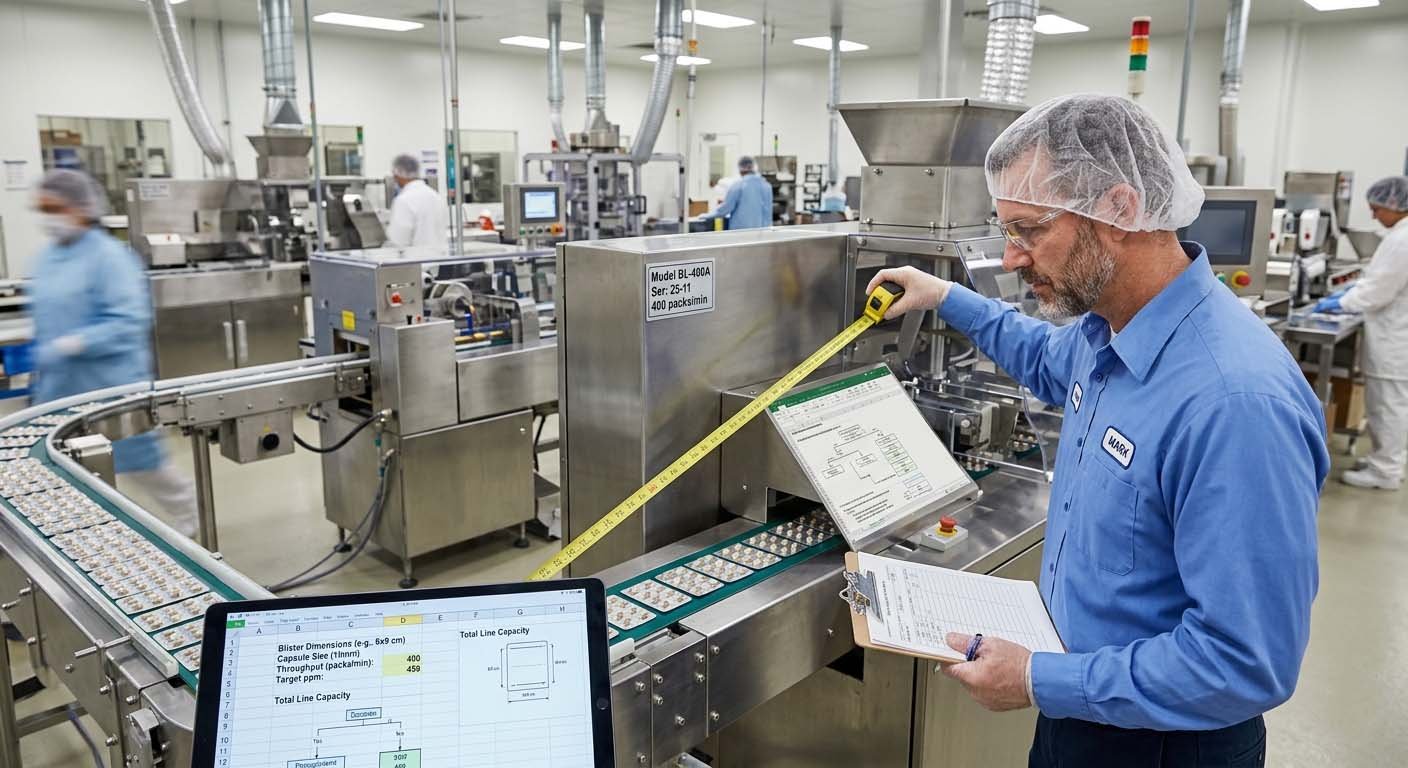
Line integration planning: the 7 variables that determine whether a capsule blister line runs at design OEE or spends year one in integration rework.
- PLC communication protocol: Confirm Siemens S7 / Allen-Bradley / Modbus TCP between blister packer and cartoner. Get it in writing from both vendors before purchase — “compatible” in a brochure is not an engineering commitment.
- Conveyor infeed/outfeed height: Standard transfer height is 850–950 mm floor-to-belt. Verify both machines and the connecting conveyor are designed to the same datum — even a 15 mm mismatch requires custom bridging and creates a potential product drop point in a classified zone.
- Reject-handling handoff: Define whether the blister packer’s vision rejection system outputs a reject signal to the cartoner PLC or ejects physically before the transfer. Uncoordinated reject logic is the most common cause of mixed-product incidents in multi-vendor lines.
- Emergency stop cascade: A line-level E-stop must halt all machines simultaneously in the correct sequence — cartoner first, then blister packer, then filler. Reverse sequencing causes product pile-up and potential damage at transfer points. Document the E-stop logic in the URS, not in a verbal agreement at FAT.
- Batch record linkage (21 CFR Part 11 / electronic batch records): If your facility uses an MES or SCADA, confirm the blister machine’s HMI can output batch record data in the required format. Retrofitting data acquisition after installation costs more than specifying it upfront.
- Throughput simulation: Before issuing the URS, run a simple queuing model: capsule filler output rate ÷ blister cavities per card ÷ blister packer cycle time = required buffer length. If the buffer is under 30 seconds at maximum line speed, you have a bottleneck by design.
- Single-source accountability: If using multiple vendors, define in each purchase contract who is responsible for integration testing and who owns problem resolution during SAT. If no one will sign that clause, you own it by default.
For facilities opting for full turnkey line supply, the integration checklist above is handled by a single engineering team. Our turnkey packaging line solutions cover the full scope from URS drafting through FAT/SAT sign-off.
A 20-Year Engineer’s Perspective: What the Spec Sheet Doesn’t Tell You
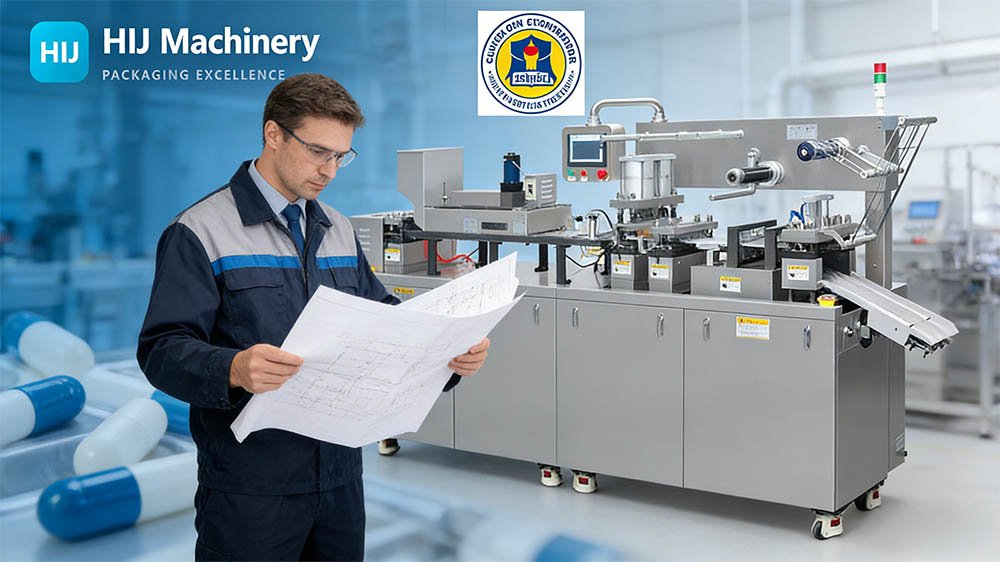
Line planning starts with the blueprint. The integration gaps that cause FAT failures are almost never in the individual machine spec — they’re in the white space between specs.
الإجابة المباشرة
Choosing the right capsule blister packing machine isn’t just about output speed — it’s about cGMP compliance readiness, upstream/downstream integration, and total cost of ownership over a 10-year lifecycle.
In my 20 years of commissioning blister lines across Southeast Asia and Latin America, the most expensive mistakes I’ve witnessed weren’t made during purchase — they were made during FAT. Facilities bought standalone machines from three different vendors, only to discover during SAT that PLC protocols couldn’t communicate, reject rates spiked, and no single supplier would own the problem. The hidden trap? A machine with an attractive unit price but zero turnkey integration capability will cost you 3–5× more in downtime, validation rework, and multi-vendor finger-pointing before your first batch is approved.
I saw this pattern most clearly in a plant outside Kuala Lumpur in 2021. Three machines, three vendors, all individually GMP-compliant. The batch record system in the blister packer used a different timestamp format than the MES. Nobody caught it until the data integrity audit eight months after installation. The correction involved re-qualification of the entire data acquisition chain. That’s not an engineering failure — it’s a procurement failure.
Before issuing your URS, demand a full line simulation and ask every vendor directly: “Who is responsible if the sealing station and the cartoner can’t sync?” At HIJ, our answer is always unambiguous — we are. One source, one accountability, European-standard engineering at pragmatic pricing.
I won’t tell you the decision is simple. It involves your API profile, your target markets, your validation timeline, and sometimes your relationship with the regulatory reviewer. That conversation took 40 minutes with one client in Lagos last year. I’m still not sure I convinced them to change the vendor mix. Six months later they called about an integration failure at SAT.
🔧 Field Diagnosis: URS and Procurement Errors
Signal: Machine delivered to spec, but OQ fails on reproducibility at >80 blisters/min.
السبب الجذري: Forming station die temperature uniformity was specified as ±5°C across the forming plate. At low speeds, heat has time to redistribute. At high speeds, the outer cavities run 8–12°C cooler than center cavities, producing inconsistent forming depth. إصلاح: Specify die temperature uniformity at maximum operating speed in the URS — not just at static conditions. Require a heat map test at FAT across the full speed range.
Signal: Sealing integrity test (ASTM F2338 dye-ingress at 60 mbar) fails at batch end but passes at batch start.
Root cause and fix: Sealing roller temperature drifts upward over a 4–6 hour run as the machine reaches thermal equilibrium. The URS only specified the set-point temperature, not the acceptable operating band during production. Specify maximum allowable sealing temperature drift (typically ±3°C from set-point during production) and require an 8-hour thermal stability test at FAT.
Step-by-Step: How to Write a URS That Actually Protects You
A defensible URS for a capsule blister packing machine requires seven defined sections: verified throughput target, capsule product specification, forming material and sealing parameters, GMP structural requirements, integration protocol, IQ/OQ/PQ acceptance criteria, and spare parts and service coverage — each with quantified acceptance limits, not qualitative descriptors.
The number of URSs I’ve reviewed that say “must comply with GMP” without specifying which GMP framework, which version, and which specific clauses is depressing. That’s not a URS — it’s a wish list. Here’s the structure that actually works:
- 1
Throughput Specification
State required sustained output in blisters/min at 90% OEE, not theoretical maximum. Include the specific capsule size(s), cavity layout (e.g., 4×4 per card), and card dimensions. Add: “Output rate to be demonstrated at FAT over a continuous 4-hour production run with the actual capsule product.”
- 2
Product and Capsule Specification
Specify capsule shell material (gelatin / HPMC), size(s) including tolerance range, fill weight range, and any special surface properties (enteric-coated, film-coated). Include the moisture sensitivity classification of your API and the required maximum MVTR of the forming material.
- 3
Forming Material and Sealing Parameters
Specify forming film type (PVC / PVDC / Alu-Alu), thickness, and forming temperature range. For sealing: specify aluminium foil gauge (typically 20–25 μm), sealing temperature set-point and allowable band, sealing pressure, and dwell time. These values must be validated against your actual materials, not defaults.
- 4
GMP Structural Requirements
Name the specific frameworks: WHO TRS 992 Annex 3, 21 CFR Part 211.68 (if US or US-reference markets), EU GMP Annex 1 (if EU or EU-reference markets). Specify: product-contact material (316L SS or HDPE only), surface finish (Ra ≤ 0.8 μm for product contact), no dead-leg zones, sealed electrical enclosures (IP54 minimum), and HMI audit trail compliant with 21 CFR Part 11 if applicable.
- 5
Integration Protocol
Specify PLC communication protocol, conveyor interface height, reject-handling signal interface, and E-stop cascade logic. If the machine will be integrated into a line with specific upstream/downstream equipment, name those machines and require the vendor to confirm integration in writing.
- 6
IQ / OQ / PQ Acceptance Criteria
Define the acceptance criteria for each qualification phase with quantified limits. IQ: documentation completeness checklist. OQ: forming depth uniformity ±0.1 mm, sealing temperature uniformity ±3°C, output rate within ±5% of specified. PQ: container closure integrity per USP <1207>, batch-to-batch consistency over three production batches. For a full guide on capsule blister machine validation, see our detailed IQ/OQ/PQ validation guide.
- 7
Spare Parts and Service Coverage
Specify: recommended spare parts list with 2-year stock quantity, maximum spare parts lead time (state your acceptable maximum — typically 30 days for critical components), in-region service engineer availability, and annual preventive maintenance protocol. This section protects your year 2–5 operating costs.
When Blister Packaging Is Not the Right Answer for Capsules
Capsule blister packaging is the right choice for unit-dose compliance, moisture-sensitive APIs, and markets requiring individual tamper evidence — but bottle packaging offers better economics for high-volume OTC products with lower moisture sensitivity and retail markets where bottle format is the category norm.
Not every capsule product belongs in a blister. The decision between blister and bottle packaging involves at least four variables: regulatory requirement (some markets require unit-dose packaging for reimbursement), API moisture sensitivity (high sensitivity favors blister, especially Alu-Alu), distribution channel (hospital formularies often specify blister; retail OTC often defaults to bottle), and unit economics at your specific volume.
At volumes below 2 million capsules per year per SKU, blister packaging unit cost is typically higher than HDPE bottle packaging when you factor in the forming material, lidding foil, and machine amortisation. Above 5 million units per year, the per-unit economics narrow significantly — and the compliance benefits of blister (tamper evidence, individual unit traceability, moisture barrier) often justify the premium.
For a full analysis of the trade-offs between blister and bottle packaging — including cost per unit at different volume thresholds and market-specific regulatory drivers — see our dedicated comparison guide on capsule blister packing vs. bottle packaging.
For tablet-form products, the same decision framework applies, and the machine architecture overlaps significantly. If your pipeline includes both tablets and capsules, a dual-purpose blister machine — with interchangeable feeding systems — may be more economical than two separate lines. Our ماكينة تعبئة الأقراص الفقاعية guide covers the additional tooling considerations for tablet geometries.
🔧 Field Diagnosis: Choosing the Wrong Format
Signal: Blister machine purchased, installed, and validated — then market registration requires HDPE bottle format for the target country.
What happened: The product was registered in the reference market in blister format. The in-country regulatory requirement for the target export market required bottle format with a specific desiccant insert. The blister machine was correct for the registered format but wrong for the actual distribution market. إصلاح: Before purchasing any primary packaging machine, confirm the packaging format requirements for every target registration market — not just the home market. A $2,000 regulatory review at planning stage is cheaper than a $40,000 machine that doesn’t match your dossier.
GMP Compliance: What Regulators Look at When They Inspect Your Blister Line
Regulatory inspectors evaluating a capsule blister packaging line focus on four areas: equipment qualification documentation (IQ/OQ/PQ protocols and executed reports), change control records for any post-validation modifications, data integrity of the machine’s electronic records, and cleaning validation records for product changeover — all of which must be established before the first commercial batch.
A CDSCO inspector cited ICH Q1A(R2) directly during a review of a blister line dossier I was supporting in Delhi in 2022. The question was whether Zone IVb stability data was present for the forming material used — it wasn’t. The dossier went back for supplementary studies. Eight months later. The machine was correct. The validation was correct. The stability study design was wrong, and it showed up in the packaging equipment section of the CTD.
That experience shaped how I think about GMP compliance for blister lines. It’s not just about the machine being “GMP-compliant” — it’s about the entire documentation chain supporting the machine’s role in the manufacturing process being defensible under regulatory scrutiny. For a complete framework covering WHO GMP, cGMP, and 21 CFR Part 11 requirements specific to capsule blister packaging, our dedicated compliance guide on GMP compliance for capsule blister packaging covers this in detail.
“Of the 31 blister line projects I handled in Southeast Asia between 2018 and 2023, 11 required a forming material change after month-12 stability failure — every one of them the result of designing to Zone II stability conditions for a Zone IVb distribution market. The machine was fine. The packaging material specification was wrong from day one.”
— فوريستر شيانغ، مؤسس شركة HIJ Machinery
Frequently Asked Questions: Choosing a Capsule Blister Packing Machine
What output speed do I need for a capsule blister packing machine?
Calculate your required sustained throughput by dividing annual capsule volume by operating days, shifts, and hours — then add a 20% buffer for changeovers and minor stoppages. For a 15-million-capsule-per-year facility running one shift, that typically resolves to 60–90 blisters/min required — well within the range of an entry-level automatic machine. Buying above your required throughput wastes capital and creates idle capacity that your validation team still has to qualify at the higher speed.
Can one blister packing machine run both tablets and capsules?
Yes, with the right tooling and feeder system. A dual-purpose blister packer requires interchangeable forming molds (one set per capsule size, one per tablet geometry) and a swappable feeding system (brush feeder for capsules, vibratory or perforated plate feeder for tablets). The changeover adds 30–60 minutes to line clearance. For facilities with both dosage forms in the pipeline, this is often more economical than two separate machines — provided the production schedule can accommodate the changeover time.
Is PVC blister packaging acceptable for WHO prequalification markets?
PVC blister packaging is acceptable for WHO prequalification if the stability data supports shelf life under the climatic zone conditions applicable to the distribution market. For Zone IVb markets (40°C/75% RH), plain PVC at 250 μm typically cannot support 24-month shelf life for moisture-sensitive APIs. PVDC-coated PVC or Alu-Alu is required in those cases. The answer depends on your specific API’s moisture sensitivity — not on a blanket rule.
What is the typical price of a capsule blister packing machine?
Entry-level automatic capsule blister machines from Chinese manufacturers with CE marking typically range from $18,000 to $45,000 for 40–120 blisters/min models. Mid-range machines (120–250 blisters/min) run $45,000–$120,000. European-origin machines at equivalent output classes typically cost 2–4× more. These figures exclude import duties, installation, validation services, and tooling — which can add 15–30% to the total project cost.
How long does capsule blister machine validation (IQ/OQ/PQ) take?
For a standalone capsule blister packing machine with pre-prepared validation protocols, IQ typically takes 1–2 days, OQ 3–5 days, and PQ (three production batches) 2–4 weeks depending on batch size and laboratory turnaround for quality release testing. Total calendar time from FAT sign-off to first commercial batch is typically 8–16 weeks for a well-prepared facility — longer if the protocols were not drafted before machine arrival.
Does a capsule blister packing machine need 21 CFR Part 11 compliance?
If the machine uses electronic records and electronic signatures in the context of drug product manufacturing for the US market — yes. Modern PLC-controlled blister packers generate electronic batch records, and those records are subject to 21 CFR Part 11 requirements including audit trail, access control, and data integrity protections. Specifying Part 11-compliant HMI configuration in the URS is far less expensive than retrofitting it post-installation.
What’s the difference between thermoforming and cold-form (Alu-Alu) blister machines for capsules?
A thermoforming blister machine heats PVC or PVDC film to 110–130°C and forms cavities with pressurised air or a plug-assist tool. A cold-form Alu-Alu machine mechanically presses an aluminium laminate film into cavities without heat, using a forming die and controlled pressure. The two are fundamentally different machine architectures — you cannot convert one to the other. Cold-form machines produce a superior moisture barrier (0.02–0.5 g/m²/day vs. 4–6 g/m²/day for plain PVC) but cost more per blister in forming material and typically run slower than equivalent thermoforming machines.
Which capsule sizes does the HIJ DPP-260 support?
The HIJ DPP-260 supports capsule sizes 00 through 4 with size-specific forming molds and feeder plates. Mold changeover is designed for a single operator in under 30 minutes. The standard feeder is a brush-type system validated for gelatin and HPMC capsules. Specifications and configuration options are available on the DPP-260 capsule blister packing machine product page.
Ready to Specify Your Capsule Blister Packing Line?
Tell us your annual volume, capsule sizes, target markets, and compliance framework. We’ll return a line simulation, forming material recommendation, and a detailed proposal — not a price list. One source, one accountability from URS to first commercial batch.