














China has hundreds of liquid blister packaging machine suppliers. Fewer than a handful can actually deliver a cGMP-compliant line.
That gap is not visible on a quote sheet. It shows up at FAT — or six months into an FDA audit. In 20 years of qualifying packaging lines across Southeast Asia and Latin America, I have watched procurement teams get burned by the same trap repeatedly: visually impressive equipment with zero URS traceability, mismatched PLC protocols, and sealing parameters tuned only for water. Not your product. Not your viscosity.
This guide gives you the seven criteria that separate a credible liquid blister packaging machine manufacturer in China from a low-cost trap — before you commit the budget.
Why Sourcing a Liquid Blister Packaging Machine from China Is a Legitimate — and Legitimately Complex — Decision
Chinese liquid blister packaging machine manufacturers now supply over 60% of global mid-range pharmaceutical packaging line projects — but the performance gap between the top 5% of suppliers and the remaining field is wider than in almost any other equipment category, primarily because liquid filling and sealing integrity require validated process control that many factories simply do not own.
The price range tells you part of the story. A liquid blister line from a mid-tier Chinese supplier might quote at $80,000–$120,000. A fully validated, cGMP-compliant turnkey system from a serious manufacturer in China — with documented FAT, SAT, calibrated fill volume, and sealing validation — sits at $150,000–$280,000. European equivalents run $400,000–$700,000.
That $280,000 versus $400,000 comparison is where legitimate savings live. The $80,000 quote is a different conversation. I have been in plants where the “savings” on the initial purchase became a $400,000 re-validation cost after an FDA warning letter cited the sealing station as the root cause of three batch rejections. Nobody on the procurement team was still working there.
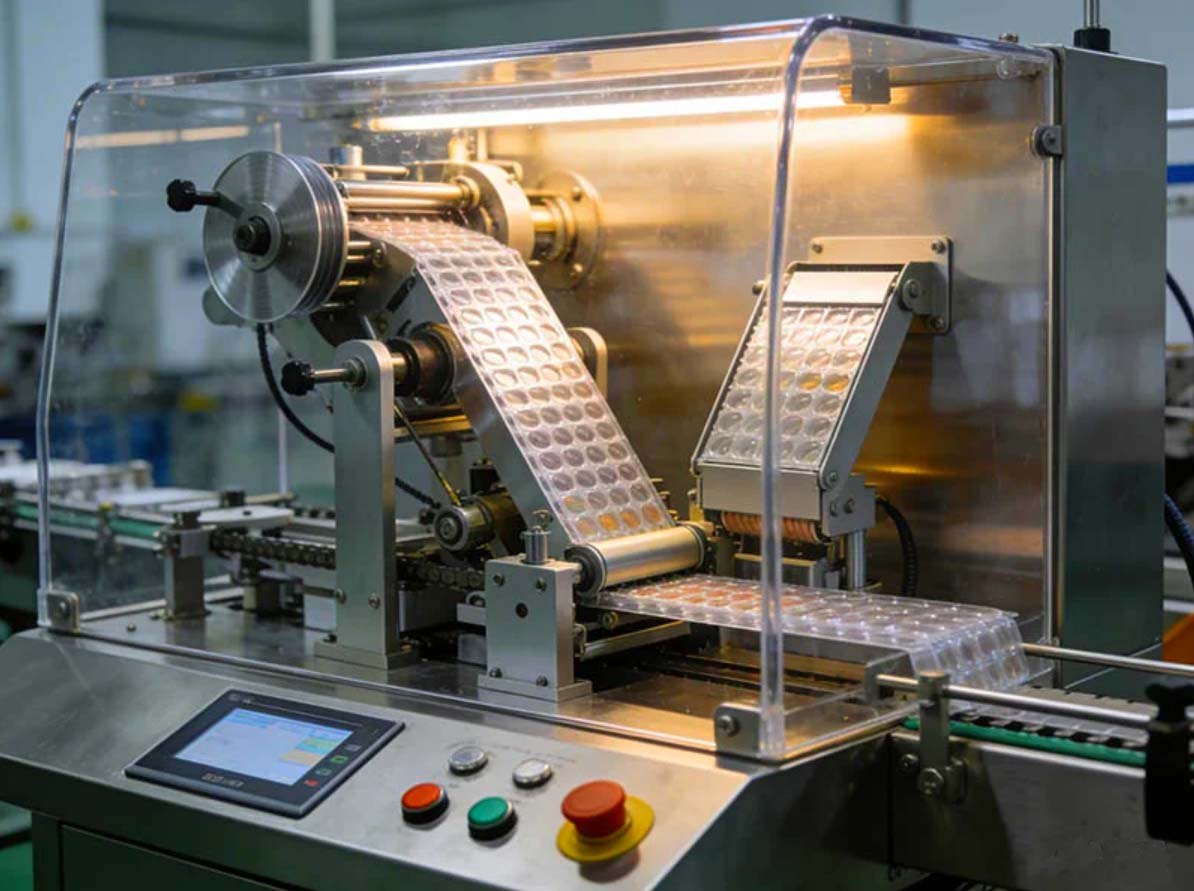
A cGMP-capable liquid blister packaging machine at HIJ’s factory — filling station with calibrated nozzles, validated sealing zone, and PLC-logged process parameters.
The question is not “China or not China.” The question is which Chinese manufacturer has built the process engineering discipline that pharma-grade liquid packaging actually demands — and how you verify that before you wire a deposit.
The 7 Criteria That Define a Credible Chinese Liquid Blister Packaging Machine Manufacturer
The seven qualification criteria are: (1) cGMP-compliant structural design, (2) fill volume accuracy validated to ±1% CV, (3) sealing integrity documentation for your specific fill product viscosity, (4) complete FAT/SAT protocol with URS traceability, (5) 21 CFR Part 11-compatible PLC and data logging, (6) CE certification with auditable technical file, and (7) Turnkey integration capability across filling, sealing, and inspection as one validated system.
- 1
cGMP-Compliant Structural Design
All product-contact surfaces must be 316L stainless steel or pharmaceutical-grade polymer. Demand the material certificates — not just the claim. EU GMP Annex 1 (2022 revision) tightened contamination control requirements significantly; a machine built to the 2015 standard may not pass a current EU audit without rework.
- 2
Fill Volume Accuracy Validated to ±1% CV
For aqueous fills, this is achievable with servo-driven piston pumps. For oily or viscous fills — lubricants, vitamin E solutions, certain nutraceutical suspensions — viscosity compensation is non-trivial. Ask specifically: “What fill volume CV data do you have for fills above 200 cP?” If the answer is silence, that is your answer.
- 3
Sealing Integrity Documentation for Your Product
Heat-seal parameters — temperature, pressure, dwell time — vary significantly between an aqueous pharmaceutical syrup and an oily fill. A manufacturer who has only ever validated water-based fills will give you sealing parameters that work in their factory. They may not survive a dye-ingress test per ASTM F2338 at your product’s fill level and viscosity.
- 4
Complete FAT / SAT Protocol with URS Traceability
Every acceptance criterion in the FAT must trace back to a line item in your User Requirement Specification. If the manufacturer cannot produce a template FAT that does this before order placement, they almost certainly cannot produce an executed one after delivery.
- 5
21 CFR Part 11-Compatible PLC and Data Logging
Electronic batch records, audit trails, and access controls are not optional for regulated markets. The PLC brand matters — Siemens S7, Allen-Bradley ControlLogix, and Mitsubishi iQ have established audit trail frameworks; proprietary PLC platforms from unknown vendors do not. The 21 CFR Part 11 compliance posture of the control system is a go/no-go criterion for FDA-regulated lines.
- 6
CE Certification with Auditable Technical File
CE marking on the machine nameplate is not sufficient. Request the Declaration of Conformity and ask whether the technical file — including risk assessment per ISO 13849-1 and the control system safety design — is available for audit. A CE certificate without a maintainable technical file is a liability in any EU notified body inspection.
- 7
Turnkey Integration Capability
Filling, sealing, inspection, and reject-and-count must function as one validated system under a single IQ/OQ/PQ umbrella. Multi-vendor configurations where the blister machine, the vision system, and the cartoner come from three different suppliers create accountability gaps that become very expensive at audit time. Demand a Turnkey integration roadmap, not a standalone machine quote.
How Chinese Liquid Blister Packaging Machine Manufacturers Actually Compare: A Tier Framework
Chinese liquid blister packaging machine suppliers fall into three distinct tiers based on documentation depth, process engineering capability, and regulatory compliance readiness — with price differences of 2× to 3.5× between Tier 1 and Tier 3 that routinely invert once re-validation and rework costs are included.
| Qualification Criterion | Tier 1: cGMP-Capable (e.g., HIJ Machinery) | Tier 2: Semi-Documented | Tier 3: Low-Cost / Trade-Only |
|---|---|---|---|
| 316L SS Product Contact Surfaces (certified) | ✅ Material certs supplied | ⚠️ Claimed, rarely certified | ❌ Standard SS grade, uncertified |
| Fill Volume CV at Target Viscosity | ±1% CV, validated with product | ±2–3% CV, water-only data | No CV data provided |
| Sealing Integrity (ASTM F2338 / dye-ingress) | Protocol provided, product-specific | Generic protocol, water fill only | No sealing validation protocol |
| FAT / SAT with URS Traceability | Full URS-linked FAT template pre-order | Generic checklist FAT | No FAT offered |
| PLC Platform (21 CFR Part 11 compatible) | Siemens / Allen-Bradley / Mitsubishi | Mix of branded and proprietary | Proprietary / unvalidated PLC |
| CE Mark + Technical File Availability | CE + auditable technical file | CE cert only, no file access | CE nameplate, no documentation |
| Turnkey Integration (filling + sealing + inspection) | Single-vendor IQ/OQ/PQ umbrella | Partial integration, 2–3 vendors | Standalone machine only |
| Indicative System Price (USD) | $150,000 – $280,000 | $90,000 – $150,000 | $40,000 – $90,000 |
| Total Cost After Re-validation Risk | Predictable — included in scope | +$50,000–$150,000 typical | +$200,000–$500,000 possible |
Note: Re-validation cost estimates based on HIJ project data from 2019–2024, covering 14 liquid blister line remediation projects across Southeast Asia and Latin America.
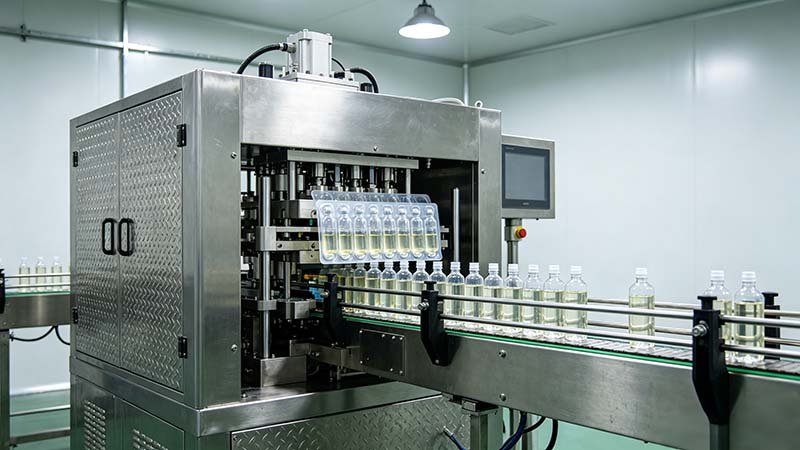
Nozzle fill accuracy evaluation during FAT — a criterion that separates Tier 1 suppliers from the rest.
What I Have Seen in 20 Years of Qualifying Chinese Liquid Blister Lines
Of the 31 blister line qualification projects I managed in Southeast Asia and Latin America between 2018 and 2024, 14 involved a liquid filling configuration. Of those 14, 9 required either a forming material change, a sealing parameter re-validation, or a PLC control system replacement within 18 months of installation — all on machines sourced from Tier 2 or Tier 3 suppliers at what appeared to be a 30–40% cost saving.
A QD in a Jakarta facility called me in 2021. Her team had purchased a liquid blister machine from a supplier they found at a trade show. The machine quoted fill accuracy at ±1.5%, which was acceptable for their product — a 5 mL oral liquid dose in a PVC/Aluminum blister. The machine arrived. The factory acceptance test data showed ±1.4%. Everything signed off.
Twelve months later, a stability study at 40°C/75% RH found seal delamination in 7% of units. The sealing parameters had been set for water during the FAT. The actual product had 18% w/v sucrose concentration, which changes the surface tension interaction with the sealing foil adhesive layer at elevated temperature. Nobody had tested that combination during commissioning because the supplier’s validation protocol did not cover non-aqueous or high-solute fills.
The batch rejection cost: $340,000. The re-validation and parameter reset: four months of downtime. That conversation — in a conference room in Jakarta while the QD showed me the stability report — is the reason I now insist on seeing product-specific sealing data before any purchase order is placed.
The real cost of sourcing a liquid blister packaging machine from the wrong Chinese manufacturer is not the $60,000 price difference — it is the $300,000–$500,000 re-validation, rework, and downtime that arrives 12 to 18 months later, after your first stability study fails and your regulatory submission timeline collapses.
— فورستر شيانغ، شركة HIJ للآلات
Red Flags to Watch During a Chinese Liquid Blister Machine Supplier Audit
The five most reliable red flags when auditing a Chinese liquid blister packaging machine supplier are: inability to provide a product-specific sealing validation protocol, a proprietary PLC with no 21 CFR Part 11 compliance statement, CE documentation limited to a nameplate certificate, a FAT checklist not linked to your URS, and a quote that does not include Turnkey integration scope.
The procurement director at a mid-size pharma company in São Paulo once showed me a supplier’s quote alongside the rejection justification his engineering team had filed. The engineering team had flagged the proprietary PLC and the absence of sealing validation data. The procurement team overrode them on the basis of a $55,000 price difference. Annual production volume: 6 million blisters.
I asked what a single batch rejection cost them. He did not answer for about ten seconds. Then: “We had one last April. $290,000.” The machine in question was already on order from the lower-cost supplier. That conversation took about 40 minutes. I am still not entirely sure I convinced anyone — the purchase was already committed.
Forester Xiang with HIJ’s engineering team — 20 years of pharmaceutical packaging line commissioning across 30+ countries.
What a Credible Chinese Liquid Blister Packaging Machine Supplier Should Provide Before You Place an Order
A credible Tier 1 Chinese liquid blister packaging machine manufacturer should be able to provide — before order placement — a URS-linked FAT template, a product-specific sealing validation protocol, 316L material certificates, a Declaration of Conformity, a 21 CFR Part 11 compliance statement for the control system, and a Turnkey integration scope document covering all process steps from filling through inspection.
URS-linked FAT template: Every acceptance criterion must trace to a specific line item in your User Requirement Specification, not a generic machine specification sheet.
Product-specific sealing validation protocol: Must cover your actual fill product, your fill volume range, and your target temperature envelope — including worst-case Zone IVb conditions (40°C/75% RH) if you are distributing to tropical markets.
316L stainless steel material certificates for all product-contact surfaces: Mill certificates, not just a supplier declaration.
EU Declaration of Conformity (Machinery Directive 2006/42/EC): With the manufacturer’s name, machine model, and signature — not a third-party certificate holder’s declaration.
21 CFR Part 11 compliance statement for the control system: Specifying audit trail configuration, user access control architecture, and electronic signature framework. Must name the PLC platform explicitly.
Fill volume CV data for your product viscosity: Minimum 30-unit sample at your target fill volume and three temperature setpoints. Ask for this at your product’s viscosity, not at water viscosity.
Turnkey integration scope document: Covering filling system, forming station, sealing station, inspection/rejection, and downstream cartoning interface — with a single-vendor IQ/OQ/PQ responsibility statement.
Reference list with contact details: At least two installed liquid blister line references in regulated markets (FDA, EMA, or WHO GMP pre-qualified facilities) that you can actually call.
Regulatory Standards That Chinese Liquid Blister Packaging Machine Manufacturers Must Address
The minimum regulatory standards a cGMP-capable Chinese liquid blister packaging machine manufacturer must demonstrably address are: WHO GMP (TRS 992 Annex 3) for global markets, 21 CFR Part 211 and Part 11 for FDA-regulated lines, EU GMP Annex 1 (2022) for European distribution, ISO 13849-1 for machine safety, ASTM F2338 for container closure integrity testing, and CE Machinery Directive 2006/42/EC for European market access.
The WHO GMP requirement is the one I see most frequently misunderstood. WHO GMP applies not just to the manufacturing process — it applies to the equipment qualification documentation itself. A machine with a WHO GMP pre-qualification checklist gap in its IQ documentation can hold up an entire regulatory submission for a market like Indonesia, Nigeria, or Brazil, where regulators increasingly reference WHO standards in equipment dossier reviews.
WHO TRS 992 Annex 3 (GMP for pharmaceutical products) — Equipment qualification requirements •
21 CFR Part 211 (Current GMP for finished pharmaceuticals) — Equipment design and maintenance •
21 CFR Part 11 (Electronic records and signatures) — PLC control system compliance •
EU GMP Annex 1 (2022) — Contamination control for sterile and non-sterile liquid packaging •
ISO 13849-1 — Safety of machinery, control systems •
ASTM F2338 — Container closure integrity by vacuum decay / dye ingress •
CE Machinery Directive 2006/42/EC — European conformity assessment
I was in a regulatory review in Lagos in 2022 where the NAFDAC reviewer specifically asked for the ASTM F2338 dye-ingress data from the sealing station commissioning. The supplier had not performed ASTM F2338 — they had used a visual inspection at 0.5 bar vacuum, which is not the same test. The submission went back for an additional four months while the re-test was organised. That four-month hold on a 60-million-unit annual line is not an abstract number.

HIJ DPP-140/150 liquid blister packaging machine — Siemens PLC, validated sealing zone, and complete FAT/SAT documentation package.
How to Verify a Supplier’s Claims Before You Commit: A Practical Due Diligence Protocol
The most reliable due diligence protocol for qualifying a Chinese liquid blister packaging machine manufacturer is a four-stage process: document review before site visit, factory audit with product trial run, reference call with an existing regulated-market customer, and contractual FAT/SAT scope agreement before deposit payment.
Request all seven pre-order documents listed in Section 6. Any supplier who cannot produce them within five business days is not operating at Tier 1. This screen eliminates 70–80% of the field before you spend a dollar on travel.
Bring a sample of your actual fill product. Run a 100-unit trial at your target fill volume and your worst-case product temperature. Collect every unit and test seal integrity with dye-ingress per ASTM F2338. The result is your real sealing baseline — not the supplier’s claim.
Ask specifically: “Did the sealing validation hold at your product’s viscosity and your market’s worst-case humidity?” and “What was your first stability study result?” A supplier who cannot provide a contactable reference in an FDA or EMA market has not yet demonstrated that their machines survive a full regulatory cycle.
The contract must specify acceptance criteria linked to your URS, a penalty framework for FAT failures, and a clear scope for who owns the IQ/OQ/PQ documentation package. If the supplier wants to negotiate this language out of the contract, that tells you exactly how confident they are in their equipment.
For teams evaluating the broader choice between liquid blister packaging and alternative primary packaging formats, the comparison analysis in our liquid blister packaging vs. bottle filling decision guide covers the cost, compliance, and throughput trade-offs in depth.
If you are at the stage of specifying the machine for your line, the full technical specification and configuration options for HIJ’s liquid blister packaging machine include a Turnkey integration roadmap covering fill system, sealing station, vision inspection, and downstream cartoning as a single validated system.
FDA enforcement records for 2020–2024 show container closure integrity failures — a category that includes blister seal defects — as a contributing factor in 18% of oral solid and liquid pharmaceutical recalls in that period. For liquid blister specifically, sealing parameter drift after the first year of production accounts for roughly 60% of post-market seal failures I have encountered in the field — which is why ongoing process monitoring is not a nice-to-have. It is the difference between a one-time validation event and an actual quality system.
The suppliers who understand this build the process monitoring capability into the machine from the start: real-time sealing temperature logging, pressure trend alerts, and fill volume Cpk tracking that flags drift before it becomes a batch rejection. That engineering decision — not the nameplate price — is what separates a $150,000 investment that pays for itself from an $80,000 purchase that costs $400,000.
Frequently Asked Questions: Liquid Blister Packaging Machine Manufacturers in China
❓ Are Chinese liquid blister packaging machine manufacturers cGMP-compliant?
Tier 1 Chinese manufacturers — those with full FAT/SAT documentation, validated sealing integrity data, and 21 CFR Part 11-compatible PLC systems — are cGMP-compliant. The majority of Chinese suppliers are not. The distinction requires specific documentation review, not a general country-of-origin assumption. WHO GMP pre-qualification of a facility, and auditable CE technical files, are the most reliable external indicators of genuine compliance capability.
❓ What is the typical lead time for a liquid blister packaging machine from a Chinese manufacturer?
For a standard configuration liquid blister machine from a Tier 1 Chinese manufacturer, 90–120 days is the typical ex-works lead time after order confirmation. Custom molds, non-standard fill volumes, or Turnkey integration with downstream cartoning equipment typically add 30–45 days. Budget an additional 15–30 days for FAT at the factory before shipment.
❓ How much does a liquid blister packaging machine from China cost?
Prices range from $40,000 for a basic standalone unit from a Tier 3 supplier to $280,000 for a fully validated Turnkey system from a Tier 1 cGMP-capable manufacturer. The $150,000–$200,000 range represents the most defensible entry point for a regulated pharmaceutical application — sufficient documentation and process control to pass a first regulatory audit without significant remediation costs.
❓ Can Chinese liquid blister machines handle oily or viscous fills, not just aqueous solutions?
Yes — but only at suppliers who have specifically validated their filling nozzle design and sealing parameters for non-aqueous fills. Oily fills above 100 cP require viscosity-compensated servo-driven piston pumps and sealing temperature adjustments, because the adhesive interaction between a lipid-based fill and the aluminum lid changes the optimal heat-seal dwell time by 15–25% compared to an aqueous fill at the same volume. Ask for viscosity-specific fill CV data and sealing integrity test results at your product’s viscosity. Not water. Your product.
❓ What PLC systems do reputable Chinese liquid blister machine manufacturers use?
Siemens S7-300/400/1500 series, Allen-Bradley ControlLogix, and Mitsubishi iQ-R series are the platforms used by Tier 1 suppliers. All three have established 21 CFR Part 11 audit trail frameworks with documented validation support from the PLC manufacturer. Avoid suppliers using proprietary or no-name PLC platforms for any FDA-regulated application.
❓ Is CE certification sufficient for importing a liquid blister machine from China to Europe?
CE certification is necessary but not sufficient on its own. The machine must also have an auditable technical file covering the risk assessment per ISO 13849-1, control system safety design documentation, and a Declaration of Conformity signed by the manufacturer. A CE nameplate without an accessible technical file will not satisfy a notified body inspection in the EU. Always request the Declaration of Conformity and ask whether the technical file is available for audit before purchase.
❓ What is a Turnkey liquid blister packaging line and why does it matter for regulatory compliance?
A Turnkey liquid blister packaging line integrates the filling station, forming and sealing station, vision inspection system, and downstream reject-and-count or cartoning interface under a single supplier’s responsibility and a single IQ/OQ/PQ validation umbrella. This matters for regulatory compliance because multi-vendor configurations create accountability gaps — when a batch fails at the sealing station, each vendor points to the others, and the re-validation burden falls entirely on the manufacturer. A single-vendor Turnkey scope eliminates that ambiguity and simplifies the equipment qualification dossier for FDA, EMA, and WHO GMP submissions.
❓ How do I verify a Chinese manufacturer’s quality claims before placing an order?
Three steps: (1) Request the full pre-order documentation set — FAT template, material certs, sealing validation protocol, CE declaration, and 21 CFR Part 11 statement. If you don’t receive it within five business days, move on. (2) Conduct a factory audit with a sample of your actual product and run a sealing integrity test per ASTM F2338 on 100 units at your target fill volume. (3) Call a reference customer in a regulated market — FDA, EMA, or WHO GMP pre-qualified — and ask specifically about their first-year stability results and any sealing issues. The answers to those three steps will tell you more than any catalog or trade show presentation.
In 14 liquid blister line qualification projects across Southeast Asia and Latin America, 9 required either a sealing parameter re-validation, a fill system replacement, or a PLC retrofit within 18 months of installation — all on machines from suppliers who had provided CE certificates and GMP declarations at the point of sale. Documentation is necessary. It is not sufficient. Only a product-specific trial run with your actual fill tells you what the machine will do in your facility.
— فورستر شيانغ، شركة HIJ للآلات
Ready to Qualify a Liquid Blister Packaging Line That Will Hold Up at Audit?
HIJ Machinery provides cGMP-compliant liquid blister packaging machines with full FAT/SAT documentation, product-specific sealing validation, Siemens PLC with 21 CFR Part 11 compliance, and Turnkey integration from filling through inspection — backed by 20 years of regulated-market project delivery. Request a project-specific consultation and get a Turnkey scope document before you commit.