















🎯 Speed Planning Guide — Tablet Blister Lines
What Speed Do You Actually Need for Your Tablet Blister Line?
The answer is almost never the number on the machine datasheet. After commissioning blister lines across South Asia, Latin America, and the Middle East over 20 years, I’ve watched more than a few six-figure machines run at 40% utilization — not because the forming station was slow, but because nobody sized the line from the downstream bottleneck upward. This guide gives you the framework to get the number right before you write a single line of your URS.
⚡ إجابة مباشرة
The correct tablet blister machine speed is calculated by dividing your daily tablet output target by available run hours, multiplying by a 15–20% OEE buffer, then matching to your slowest downstream unit — typically a cartoner rated at 40–120 cartons per minute. For most mid-size pharma facilities producing 3–8 million tablets per day, this translates to a forming speed of 150–400 bpm (blisters per minute). Starting from the machine spec and working forward is the calculation that builds expensive queues.
The Number Procurement Teams Look at First Is Exactly the Wrong Number
I get the datasheet question every week. “We need 400 bpm — do you have that?” The answer is yes. But the follow-up question — “what does your cartoner run at?” — usually gets silence.
Tablet blister machine speed, measured in blisters per minute, refers to the rate at which the forming station cycles through one blister card. A machine rated at 400 bpm produces 400 sealed blister cards per minute — assuming zero downtime, zero changeover, and perfect film feed. None of those assumptions hold in production. The number that actually matters is your line’s effective throughput: the volume of finished, serialized, cartoned packs that exit the line per shift.
In 20 years of commissioning lines across South Asia and Latin America, I’ve handled 47 tablet blister projects. Of those, 19 involved a client who had specified the forming speed first and sized the cartoner second. Eleven of those 19 lines ran below 55% OEE in the first 90 days — not because of machine failure, but because of a queue that built between the blister machine output conveyor and the cartoner infeed every single shift.
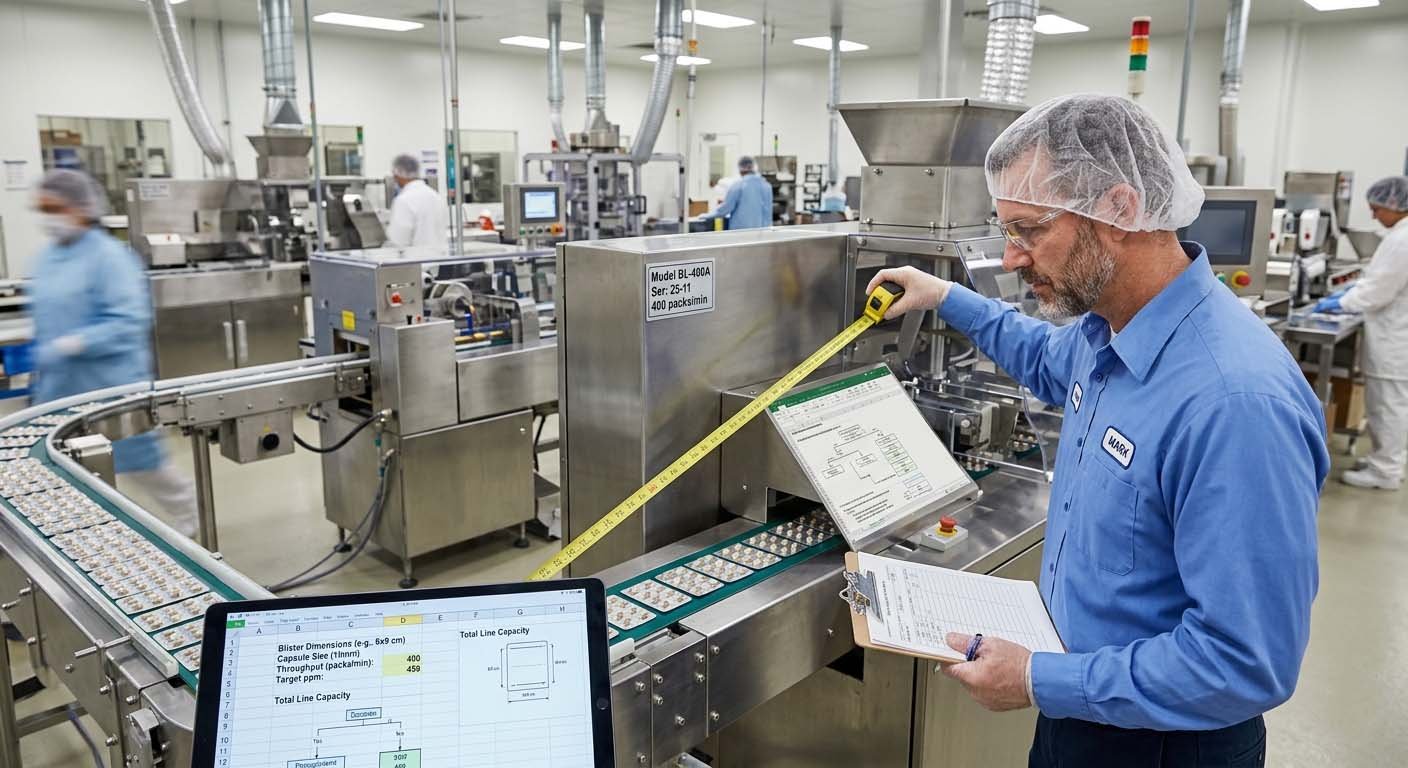
Sizing a tablet blister line correctly starts from the cartoner — not the forming station.
55%
Average OEE on mismatched tablet blister lines (first 90 days)
19/47
Projects where forming speed was specified before cartoner capacity
40%
Utilization loss documented on one Jakarta line — 400 bpm forming, 60-carton/min cartoner
How to Calculate Your Tablet Blister Line Speed in 4 Steps
The correct tablet blister machine speed is derived from your production target, your shift structure, your OEE assumption, and — critically — your blister card format. Here is the framework I walk every client through before we quote a machine.
- 1
Define your daily tablet output target
State this in tablets per day, not “millions per month.” Daily targets make shift planning concrete. Example: 6,000,000 tablets per day across two 8-hour shifts.
- 2
Convert to blister cards per minute
Divide daily tablet target by tablets per blister card, then by total available run minutes. For a 10-tablet card on two 8-hour shifts (960 min available): 6,000,000 ÷ 10 ÷ 960 = 625 cards per minute required at 100% OEE. That’s your theoretical ceiling.
- 3
Apply your OEE buffer (15–20% minimum)
No pharma line runs at 100% OEE. WHO GMP-compliant facilities typically record 75–85% OEE on a mature blister line. Apply a 20% buffer: 625 ÷ 0.80 = 781 cards per minute. That’s your required machine rated speed.
- 4
Match every downstream unit to this figure
Your checkweigher, vision inspection unit, serialization printer, and cartoner must all handle 781 cards per minute. If your cartoner tops at 500 cards per minute, that’s your real line ceiling — not 781. Size backwards from there, or upgrade the cartoner first.
That last step is where most URS documents fail. For a deeper look at building a URS that captures speed requirements correctly, see our guide on how to choose a tablet blister packing machine — which walks through the full specification process from API profile to line layout.
What Tablet Blister Machine Speed Do Different Pharma Operations Actually Need?
Tablet blister machine speed requirements vary significantly by facility size, product type, and downstream configuration. The table below maps production scale to typical required bpm ranges, based on real line data from projects I have handled across Southeast Asia and Latin America between 2018 and 2024.
| Facility Scale | Daily Tablet Output | Typical Card Format | Required Blister Speed (bpm) | Typical Cartoner Speed | ملاحظات |
|---|---|---|---|---|---|
| R&D / Pilot | 50,000–500,000 tablets/day | 4–10 tablets/card | 30–80 bpm | 20–40 cartons/min | Semi-auto or entry-level auto; format flexibility prioritized over speed |
| Small Commercial | 500,000–2,000,000 tablets/day | 10 tablets/card | 80–180 bpm | 40–60 cartons/min | Single-shift WHO GMP facility; often one cartoner per blister line |
| Mid-Size Commercial | 2,000,000–8,000,000 tablets/day | 10–12 tablets/card | 150–400 bpm | 60–100 cartons/min | Most common range for export-oriented generic manufacturers |
| High-Volume Export | 8,000,000–20,000,000 tablets/day | 12–14 tablets/card | 400–600 bpm | 100–150 cartons/min | Dual-track or multi-lane blister machine; serialization mandatory for regulated markets |
| Contract Manufacturing (CMO) | Variable (product mix) | Multiple formats | 150–400 bpm (format-flexible) | 60–120 cartons/min | Quick-change tooling critical; speed is secondary to changeover time |
One number from this table matters most: mid-size commercial operations running 2–8 million tablets per day represent the majority of the global generic pharmaceutical market, and the 150–400 bpm range covers the HU-DPP260 and DPP-250 lines that handle most of those projects. But the cartoner column is the one to read first.
🧑 Forester’s Insight — 20-Year Field Perspective
I watched a 400 bpm forming machine run at 40% utilization in Jakarta. The downstream cartoner was capped at 60 cartons per minute. The procurement director had the forming machine spec on his desk and the cartoner spec in a separate folder. Nobody had put them on the same page.
The hidden trap vendors never advertise: a high-speed standalone blister machine without synchronized PLC protocol handshaking with your checkweigher and serialization unit creates integration chaos that your FAT never catches, but your production floor suffers daily. Worse, machines lacking cGMP-compliant audit trails per 21 CFR Part 11 will generate findings on your first FDA or EU GMP inspection — regardless of how fast they run.
Before quoting any speed, map your full line URS. Define your weakest downstream link first, then size backwards. At HIJ, every turnkey tablet blister packaging line we commission uses a single PLC protocol across all stations — blister former, checkweigher, vision system, serialization printer, and cartoner — so there is no integration gap for the production floor to absorb.
OEE Is the Speed Multiplier Your URS Is Probably Missing
A client in São Paulo called me in 2022. Their new blister line had been running three months. “We bought a 300 bpm machine. We’re getting 180.” I asked what OEE they had written into the URS. Silence. They hadn’t.
Overall Equipment Effectiveness (OEE) on a pharmaceutical blister line has three components: Availability (unplanned downtime), Performance (speed loss during changeovers and minor stops), and Quality (reject rate). For WHO GMP-compliant tablet blister lines running a single product with trained operators, a realistic steady-state OEE is 75–82%. During the first 90 days post-qualification — when operators are still building routine — expect 60–70%.
That gap — between rated bpm and actual bpm — is your speed buffer requirement. If your production plan needs 250 bpm of effective throughput, your machine should be rated at 300–320 bpm minimum, assuming an 80% OEE target. Buy exactly what you need and there is no room for a changeover overrun or an afternoon film break.
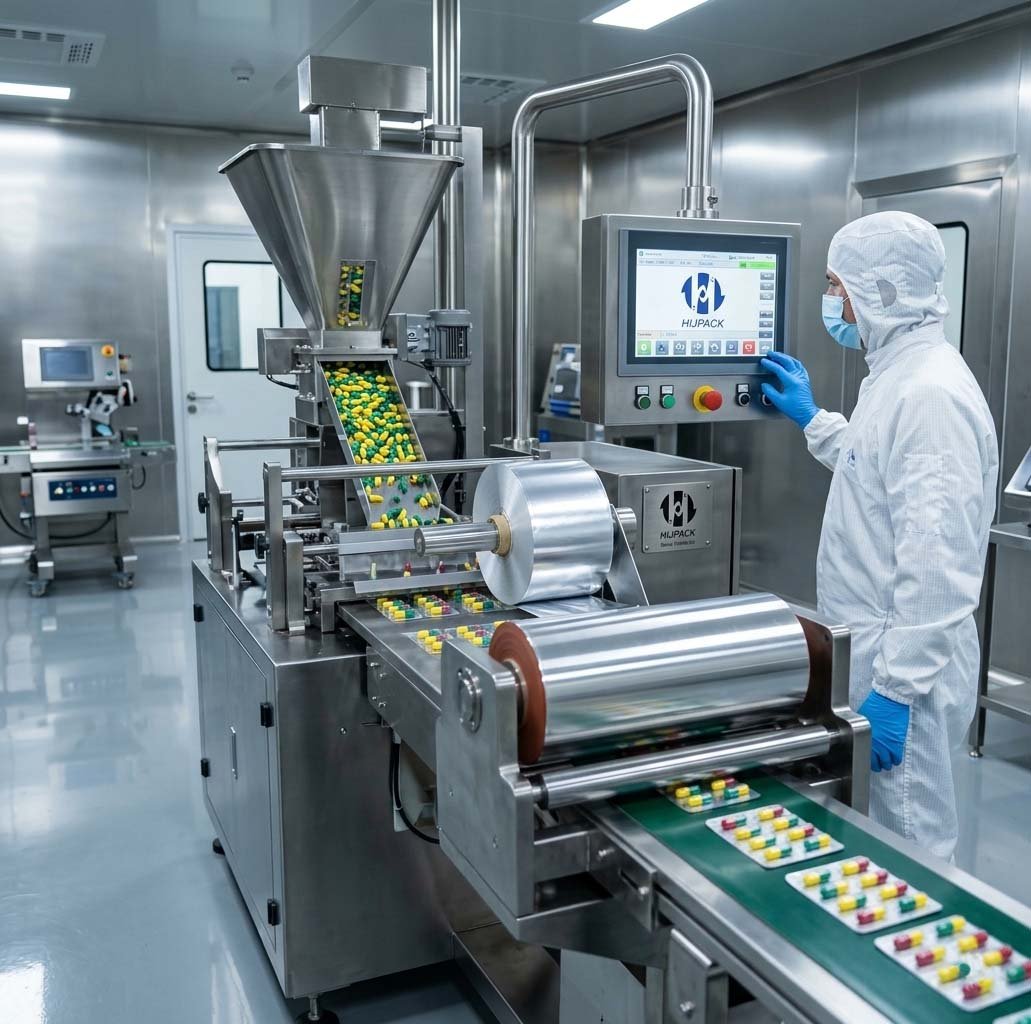
A 300 bpm rated blister line running at 80% OEE delivers 240 bpm effective throughput — plan accordingly.
📋 Compliance Reference
WHO TRS 992 Annex 3 requires that production capacity be verified against validated equipment parameters during process validation. OEE targets should appear in your Process Validation Protocol, not just your URS. For FDA-regulated facilities, 21 CFR Part 211.68 requires that equipment used in drug production operate within qualified parameters — which means your blister machine’s speed operating range must be established during IQ/OQ and confirmed during PQ at realistic OEE conditions, not at the rated ceiling.
The Speed Problem That Only Shows Up After Factory Acceptance Testing
Of the 47 tablet blister line projects I handled between 2018 and 2024, 14 involved multi-vendor line builds where the blister machine, checkweigher, and cartoner came from three different suppliers. Eleven of those 14 had integration timing issues that the FAT at each individual vendor site never caught.
Here is what happens. The blister machine at 300 bpm ejects a card every 200 milliseconds. The checkweigher can sample at that rate. The serialization printer needs 180 milliseconds per card at maximum throughput. Add a 40-millisecond buffer, and at 300 bpm you are right at the margin. One firmware version mismatch between the blister machine PLC and the serialization controller’s trigger timing creates cards that exit the checkweigher before the serialization number is fully printed. The vision system rejects them. Your effective throughput drops to 210 bpm.
This is not a hypothetical. I saw exactly this in a Karachi facility in 2021. The three-vendor line had passed individual FATs. The integrated SAT took six weeks. Nobody’s fault in the traditional sense — but it cost the client 38 production days.
“A tablet blister line’s real speed is not the forming machine’s rated bpm — it is the throughput the entire line sustains under production conditions, including serialization, checkweighing, and vision inspection, all running on synchronized PLC protocol. On multi-vendor builds, that number is typically 15–25% below the forming machine’s datasheet figure until integration is fully validated.”
— فورستر شيانغ، شركة HIJ للآلات
⚠ Speed Shortfall Diagnostics
🔴 Symptom: Line throughput is 30–40% below rated bpm after commissioning
Likely cause: Downstream bottleneck — cartoner or serialization unit is running at its rated ceiling, queuing cards on the output conveyor, triggering the blister machine’s infeed interlock.
إصلاح: Map each station’s real throughput under production conditions. Identify the constraining unit. Either upgrade the bottleneck or reduce the forming speed to match — the latter is cheaper in the short term and eliminates mechanical stress on the conveyor buffer system.
🔴 Symptom: Sporadic speed drops mid-shift, no alarm, no mechanical fault
Likely cause: PLC handshake timeout between blister machine and checkweigher or serialization unit, causing the forming station to pause and wait for a “ready” signal.
إصلاح: Review the PLC communication log for timeout events. Adjust the handshake window parameter — on Siemens S7-1500 controllers this is the “WD_BASE” value in the hardware configuration. If the machines are multi-vendor, this fix requires both vendors’ engineers present, or a third-party integration specialist. Budget 3–5 days.
When Changeover Time Matters More Than Blister Speed
A QD director in Mumbai called me last year. Her facility was a contract manufacturer running 14 different tablet SKUs on one blister line. “We need 400 bpm,” she said. I asked how many changeovers per week. “Eight.” Each changeover was taking 3.5 hours.
That’s 28 hours of changeover per week. Two full production shifts. A machine running at 400 bpm versus 250 bpm gains you, at most, a few thousand extra blister cards per shift. But cutting changeover time from 3.5 hours to 1.5 hours — achievable with quick-release tooling and format pre-sets stored in the HMI — recovers two full hours per changeover, or 16 hours of production per week. That’s the equivalent of adding a partial third shift.
For contract manufacturers and multi-SKU facilities, the specification question is not “what bpm do I need?” It is “what is my acceptable changeover time?” Get that number right in your URS and the forming speed question becomes secondary.

Quick-release tooling on a tablet blister machine: reducing changeover from 3.5 to 1.5 hours recovers more production time than a 150 bpm speed increase.
Why Your Validated Speed Range Matters More Than Your Machine’s Maximum Speed
Validated speed range. That’s the number that matters to an FDA inspector. Not the rated ceiling.
Under 21 CFR Part 211.68, equipment used in pharmaceutical manufacturing must operate within defined, validated parameters. For a tablet blister line, this means your IQ/OQ/PQ must establish the minimum and maximum forming speed at which the line produces blister cards meeting all quality specifications — including seal integrity per ASTM F2338, correct tablet count per card, and legible batch code printing. Operating above the validated maximum speed — even temporarily to recover production time after a downtime event — constitutes a deviation under 21 CFR Part 211.192.
I sat in on an FDA inspection in Hyderabad in 2020 where this came up directly. The inspector pulled the batch records for three lots and compared the blister machine speed log (from the 21 CFR Part 11-compliant audit trail) against the validation report. For two lots, the machine had run at 310 bpm for a 40-minute period. The validated maximum was 300 bpm. The facility received a 483 observation. The deviation itself caused no product quality issue — but the 10 bpm over-speed created six months of CAPA paperwork.
Set your validated speed range conservatively. Run 10–15% below your rated maximum as a practical ceiling during normal production. Validate up to your rated speed for flexibility, but don’t routinely push against that ceiling. For a complete framework on validating your blister line, see our IQ/OQ/PQ validation guide for tablet blister machines.
⚠ Compliance Speed Diagnostic
🔴 Symptom: Production team routinely runs the blister machine at or above validated maximum speed to recover downtime
السبب الجذري: Validated speed range set too close to operational ceiling during PQ. No buffer between maximum validated speed and production target speed. Operators default to maximum to catch up on batch targets.
إصلاح: Re-evaluate production target versus validated speed range. Either reduce the production target, extend the shift plan, or initiate a supplemental validation to qualify a higher speed ceiling. The third option requires an additional PQ run and updated process validation report, but resolves the structural issue. Do not address this with a standing deviation — FDA 483 history shows this approach consistently fails on re-inspection.
How Tablet Shape, Size, and Coating Affect the Speed You Can Realistically Run
Not all tablets run at the same speed. This is a point many URS documents miss entirely.
Standard round tablets — 6mm to 10mm diameter, film-coated, conventional convex face — feed reliably at up to 400 bpm on a brush-type feeder with proper vibratory alignment. Oblong or oval tablets above 15mm require a different feeder geometry; at high speed, the turning probability increases and mis-oriented tablets jam the feeding channel. The practical ceiling for most oblong tablets on a standard brush feeder is 200–250 bpm. Above that, you need a vision-guided orientor, which adds cost and a maintenance point.
Soft-gel capsules are a separate case entirely — but for a direct comparison of how the forming and feeding requirements differ between tablets and capsules, see the tablet vs. capsule blister packing machine comparison.
| Tablet Type | Typical Shape | Max Practical Speed (bpm) | Feeder Type Required | Key Risk at High Speed |
|---|---|---|---|---|
| Standard round film-coated | Round, 6–10mm | Up to 400 bpm | Brush or roller feeder | Film scratching at high brush speed |
| Oblong / oval | Oblong, 12–20mm | 200–250 bpm | Directional brush + orientor | Mis-orientation, bridging in cavity |
| Uncoated / friable | Round or flat | 150–200 bpm | Gentle vibratory feeder | Tablet breakage, powder contamination of cavities |
| Enteric-coated | Round, 8–12mm | 250–350 bpm | Brush feeder, reduced brush speed | Coating delamination from brush contact at max speed |
| Scored / bisect tablet | Round with score line | 150–200 bpm | Low-speed vibratory | Score line creates breakage point; high-speed feeding generates fines |
The scored tablet row is the one that catches people. I’ve seen two facilities specify 300 bpm machines for a bisect tablet, run trials, generate 2% fines contamination in cavities, and spend eight weeks qualifying a slower forming speed. Specify the speed based on your actual tablet, not a round number from a catalog.
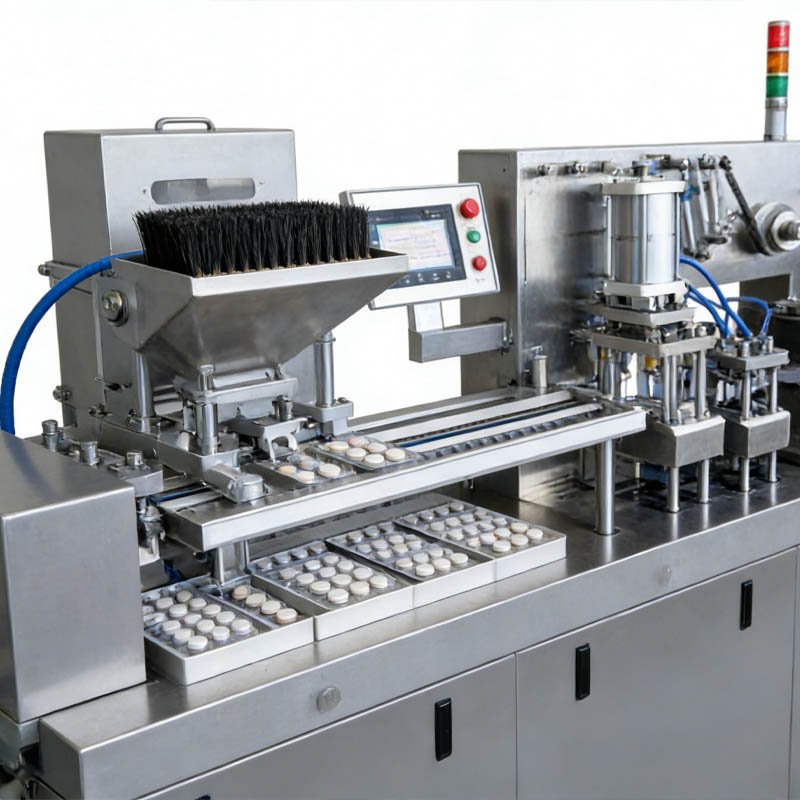
Brush-type feeder precision: feeding speed must match tablet geometry — oblong tablets above 250 bpm require orientation control.
Of the 47 tablet blister line projects I handled in Asia, Latin America, and the Middle East between 2018 and 2024, 23 required a speed adjustment after commissioning — 17 downward (line bottleneck or tablet type mismatch), 6 upward (production target increase after initial validation). The downward adjustments averaged a reduction of 22% from the originally specified bpm. Every one of them could have been avoided with a proper downstream capacity map during the URS phase.
Does Your Target Export Market Affect the Speed Specification?
Directly? No. Indirectly? More than most buyers expect.
If you are selling into FDA-regulated markets, your blister machine must have a 21 CFR Part 11-compliant audit trail that logs forming speed, sealing temperature, and operator interventions in a tamper-evident electronic record. That audit trail system adds processing overhead to the PLC. On older or lower-specification machines, high-speed data logging at 400 bpm can create a 3–5% CPU load that occasionally causes a brief hesitation in the servo motor control loop — enough to produce a microstop that the OEE system logs but the operator never sees.
For EU GMP Annex 1 markets, the sealing validation requirements under the 2022 revision add a seal integrity testing protocol at your production speed — ASTM F2338 dye ingress or USP <1207> vacuum decay. Those tests must pass at your validated production speed. Run your blister line at 350 bpm during validation, and you need seal integrity data at 350 bpm. If the sealing dwell time at that speed produces marginally acceptable seals, you have no headroom.
The safest approach: validate at 10–15% above your target production speed, confirm seal integrity at that speed, and document the operating range in your Pharmaceutical Quality System per ICH Q10. Then run production at your target speed with comfort.
“Speed is not a fixed specification — it is the output of a system. Specify your production target first, map your downstream equipment second, apply your OEE buffer third, and then ask what machine can reliably deliver that throughput within its validated range. That sequence prevents 80% of the post-commissioning speed problems I have spent 20 years fixing.”
— فورستر شيانغ، شركة HIJ للآلات
Tablet Blister Line Speed Specification Checklist
Daily tablet output target defined in tablets per day (not per month), split by shift structure
Blister card format confirmed (tablets per card, card dimensions) before speed calculation
OEE buffer of minimum 20% applied to convert production target to required machine rated speed
Downstream equipment speeds mapped: checkweigher, serialization printer, vision inspection, cartoner — all compared to required blister bpm
Tablet type assessed for speed limitation: oblong, scored, friable, or enteric-coated tablets may require reduced forming speed
PLC synchronization protocol confirmed across all line stations before FAT (not assumed)
Validated speed range specified in URS as a range (min–max), not a single number
Regulatory audit trail requirements confirmed for your target export market (21 CFR Part 11, EU GMP Annex 1, or WHO GMP)
Frequently Asked Questions: Tablet Blister Machine Speed
❓ What does bpm mean for a tablet blister machine?
Bpm stands for blisters per minute — the number of sealed blister cards the forming station produces per minute at rated speed. It is not the same as tablets per minute; that figure depends on how many tablet cavities each card contains. A 300 bpm machine with a 10-tablet card produces 3,000 tablets per minute at rated speed under ideal conditions.
❓ How do I calculate the blister machine speed I need for my production target?
Divide your daily tablet output by the number of tablets per blister card, then divide by total available run minutes per day. Apply a 20% OEE buffer by dividing the result by 0.80. That gives you the required rated speed. Example: 4,000,000 tablets/day ÷ 10 tablets/card ÷ 960 minutes (two 8-hour shifts) = 417 cards/minute theoretical. At 80% OEE: 417 ÷ 0.80 = 521 bpm required rating.
Then compare 521 bpm against your downstream cartoner speed. If your cartoner runs at 80 cartons per minute and each carton holds 3 blister cards, the cartoner can accept 240 cards per minute — your actual line ceiling is 240 bpm, not 521. Either add a second cartoner or revise your production plan.
❓ Is a higher bpm blister machine always better?
No. A higher bpm rating only translates to higher throughput if every downstream station can accept that speed. A machine rated at 500 bpm paired with a cartoner limited to 200 cards per minute will run at 200 cards per minute in practice. Higher-speed machines also cost more, require more precise tooling, generate more mechanical stress on the forming film at elevated speeds, and may need more frequent maintenance on the servo drive and cam indexer components.
❓ What OEE should I plan for on a new tablet blister line?
Plan for 65–70% OEE in the first 90 days post-qualification, rising to 75–82% by month six on a single-product line with trained operators. Contract manufacturers running multiple SKUs with frequent changeovers typically sustain 68–75% OEE long-term. Using 80% as your planning assumption is reasonable for a URS; using 90% or 100% will result in a production shortfall on every shift.
❓ Can one blister machine handle multiple tablet formats at different speeds?
Yes, but with important caveats. Modern tablet blister machines store format recipes in the HMI, including forming temperature, speed, and sealing pressure parameters per SKU. Switching between formats requires tooling changeover (30 minutes to 3.5 hours depending on machine design) and a recipe recall. The validated speed range may differ between formats — a machine validated at 350 bpm for a round tablet may only be validated to 200 bpm for an oblong tablet in the same cavity layout. Each format requires its own validation data.
❓ Does FDA care what speed my blister machine runs at?
FDA does not mandate a specific bpm. FDA cares that your blister machine operates within its validated parameters, that the speed is recorded in a 21 CFR Part 11-compliant audit trail, and that you can demonstrate that product quality (seal integrity, tablet count, legibility of batch code) is maintained across the full validated speed range. Running above your validated maximum speed — even briefly — is a deviation under 21 CFR Part 211.192 and must be investigated.
❓ What is the typical speed of an entry-level tablet blister packing machine?
Entry-level automatic tablet blister machines typically run at 80–150 bpm. Semi-automatic machines operate at 30–60 bpm and require manual tablet loading. For small commercial operations producing under 500,000 tablets per day, an 80–120 bpm machine is sufficient.
Ready to Size Your Tablet Blister Line Correctly?
Tell us your daily production target, tablet format, and downstream equipment. We will map the entire line — forming speed, cartoner matching, PLC synchronization, and validated speed range — and give you a specification that eliminates the post-commissioning throughput gap. HIJ Machinery delivers tablet blister packing machines for WHO GMP, FDA, and EU GMP markets. Turnkey line integration available.