
















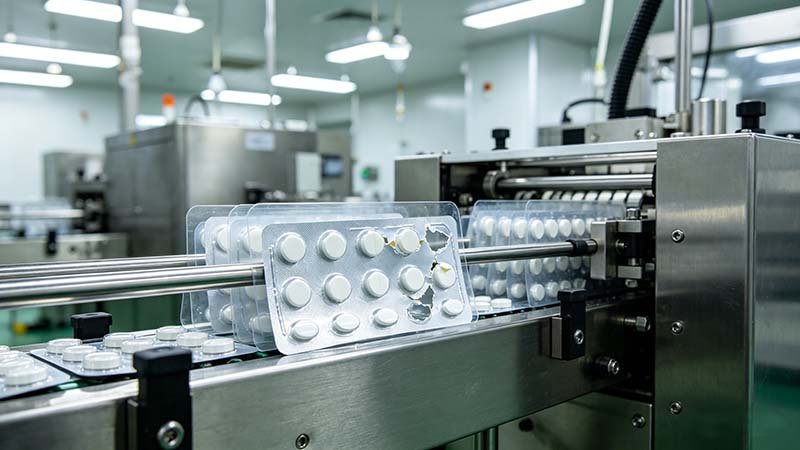
Tablet Blister Machine Troubleshooting: 7 Common Defects & How to Fix Them
Seal voids. Film tears. Misaligned cavities. These defects cost more than scrap — in a regulated market,
they cost batch records, audit readiness, and sometimes entire market authorizations. This guide gives
you the root causes, the parameter ranges, and the fixes. No guesswork.
The 7 most common tablet blister machine defects are: (1) seal voids / incomplete sealing,
(2) PVC or PVDC film tearing, (3) cavity misalignment, (4) aluminum lidding foil wrinkling,
(5) incomplete tablet fill, (6) delamination of lidding foil, and (7) die-cutting offset.
Each is caused by a specific out-of-range parameter — forming temperature, sealing dwell time,
film tension, or feeder calibration — and each is correctable without machine replacement
when the control architecture gives you the data to act.
A QA manager in Karachi called me at 6 a.m. his time. The blister line had been running for four hours.
Seal integrity had failed on three consecutive batches. They’d stopped the line. The audit was
in nine days. The conversation lasted forty minutes, and the root cause turned out to be something
nobody had changed intentionally — the ambient temperature in the production hall had dropped
11°C overnight because the HVAC chiller was serviced the previous evening, and the forming
station had never been recalibrated.
That’s not unusual. Most tablet blister machine defects look random on the surface. They’re
not. They’re predictable, repeatable consequences of a parameter sitting outside its validated
range — and once you know which parameter to look at, the fix is usually straightforward.
What’s not straightforward is producing documented evidence that the fix was applied within
cGMP parameters, which is why I always ask one question before troubleshooting anything: does your
machine log the data?
I’ve commissioned blister lines across South Asia, Latin America, the Middle East, and sub-Saharan Africa.
In 20 years, the most expensive pattern I’ve seen isn’t a machine that breaks down —
it’s a facility that buys a standalone blister machine with no PLC data logging, runs it for
six months, then faces an FDA or ANVISA audit and cannot produce a single batch record proving
seal integrity was maintained within cGMP parameters. The hidden trap isn’t the defect itself.
It’s operating a machine incapable of documenting the fix. Before diving into any troubleshooting
checklist, confirm your machine architecture supports real-time parameter monitoring and
21 CFR Part 11–compliant audit-trail logging. At HIJ, our
tablet blister packing machines
are engineered with integrated PLC controls and full FAT/SAT protocols precisely so your
troubleshooting data becomes compliance evidence, not a liability.
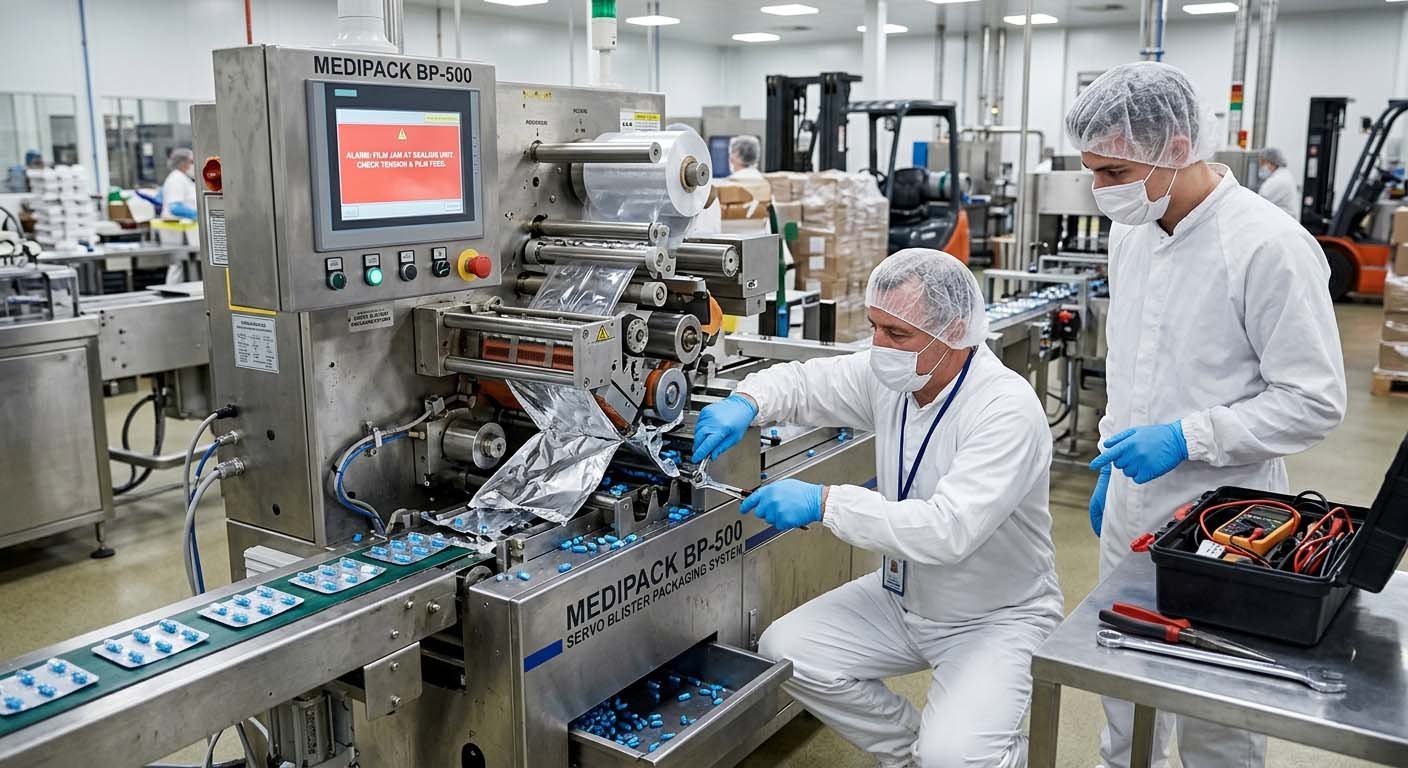
Systematic defect diagnosis on a pharmaceutical tablet blister packing line — Forester Xiang, HIJ Machinery
All 7 Tablet Blister Machine Defects at a Glance: Root Cause & Fix Summary
Each defect maps to a specific machine zone and a correctable parameter. The table below is the diagnostic
framework I use in every plant visit — built from 31 blister line commissioning projects across
Southeast Asia and Latin America between 2018 and 2023.
| # | Defect | Machine Zone | السبب الجذري الأساسي | Key Parameter to Adjust | Severity |
|---|---|---|---|---|---|
| 1 | Seal voids / incomplete sealing | Sealing station | Temperature too low; dwell time too short; contaminated sealing die | Sealing temp 180–220°C; dwell 0.3–0.8 s | حرجة |
| 2 | PVC / PVDC film tearing | Forming station | Forming temperature too high; film tension too tight; worn forming die | Forming temp 110–135°C (PVC); tension ±5% | حرجة |
| 3 | Cavity misalignment | Indexing / transport | Film step pitch drift; worn cam indexer; stretched film | Step pitch calibration; cam indexer inspection | حرجة |
| 4 | Aluminum lidding foil wrinkling | Sealing station | Uneven foil tension; misaligned foil guide; sealing pressure imbalance | Foil tension uniformity; guide roller alignment | معتدل |
| 5 | Incomplete tablet fill (empty cavities) | Feeding station | Vibratory feeder amplitude too low; tablet bridging; irregular tablet geometry | Feeder amplitude; brush height; lane width | معتدل |
| 6 | Delamination of lidding foil | Sealing station | Sealing temp too high; foil lacquer incompatibility; contaminated web | Reduce temp 5–10°C; verify foil lacquer spec | معتدل |
| 7 | Die-cutting offset | Punching station | Registration mark sensor drift; punch die wear; film slip | Sensor recalibration; die clearance 0.05–0.10 mm | Minor |
📋 Defect severity ratings based on cGMP impact and batch rejection risk. “Critical” defects require immediate line stop and CAPA documentation.
Defect 1: Seal Voids — Why Incomplete Sealing Is the Highest-Risk Blister Defect
Seal voids in tablet blister packaging occur when the heat-sealing station fails to bond the aluminum
lidding foil to the formed film across the full sealing surface, leaving micro-gaps that compromise
moisture vapor transmission rate (MVTR) and package sterility. Sealing temperature below 175°C
and dwell time under 0.3 seconds are the two most common culprits — separately or together.
Contamination on sealing die surface (tablet dust, foil debris) —
Uneven die pressure distribution — Worn silicone padding on sealing platen
Dwell time: 0.3–0.8 s —
Die pressure: 0.3–0.5 MPa —
Clean sealing die with lint-free cloth before each batch startup
FDA enforcement records for 2019–2023 show packaging as root cause in 12% of pharmaceutical recalls
— the figure I cite when procurement teams tell me the cost saving of $0.006 per blister card in
cheaper film justifies a lower-spec sealing station. Seal void failures are the most audited defect
in blister packaging. USP <1207> specifies container closure integrity testing using dye ingress
at 60 mbar — and if your line doesn’t produce consistent seals, that test will find the
failure before the patient does.
The factory in Karachi I mentioned at the start? The HVAC-induced temperature drop had pulled the sealing
station from 196°C to 181°C. Technically still within range — but the dwell time was set
to 0.32 seconds. At 181°C and 0.32 seconds, the PVC/Al seal was marginal. Any further ambient
variation would break it. We extended dwell to 0.48 seconds. The line ran clean for the next six hours.
The audit passed.
Seal fails dye-ingress test in isolated cards — Check sealing die surface for tablet dust buildup. Wipe die, retest. If failure persists, increase sealing temperature by 5°C increments, revalidate after each adjustment, and log every change in your batch record.
Seal fails consistently across full web width — Sealing temperature is uniformly low. Check thermocouple calibration at sealing platen. A 3–5°C thermocouple drift is enough to push the process below threshold. Replace thermocouple if drift exceeds ±2°C from setpoint.
Seal fails at edges but not center — Die pressure distribution is uneven. Inspect silicone padding on sealing platen for compression set. Replace padding; re-level die using pressure-sensitive paper before resuming production. This is a five-minute fix. Nobody does it until the audit.
Defect 2: PVC and PVDC Film Tearing at the Forming Station — Temperature Is Rarely the Only Variable
PVC or PVDC film tearing during cavity formation wastes material, stops the line, and — if not
caught immediately — produces cavities with compromised walls that pass visual inspection
but fail seal integrity testing downstream. The typical temperature range for PVC thermoforming is
110–135°C; PVDC runs tighter at 130–145°C. Set either film above that upper limit
and you’re thinning the material faster than it can form.
Film web tension too tight (reduces draw depth tolerance) —
Worn or sharp-edged forming die corners —
Film storage humidity causing brittleness before forming
PVDC: 130–145°C —
Film tension: maintain within ±5% of setpoint —
Die corner radius: minimum 0.5 mm for standard cavities

Forming station on a pharmaceutical blister line — film temperature and tension control are the two parameters that determine cavity wall integrity.
The number that matters is wall thickness after forming. For a 250μm PVC base film, the cavity wall
should retain at least 180μm after drawing. If it drops below 160μm, you’re operating with
material that will fail burst testing under WHO TRS 992 Annex 3 environmental simulation. I measure
this with a portable ultrasonic gauge during every FAT. Most buyers never ask for this data.
They should.
Film tension is where people lose time. The forming station pulls the web forward on each cycle.
If the dancer roller isn’t calibrated or the brake on the film unwind is worn, tension drifts
through the shift. That drift — even 8–10% above nominal — reduces draw depth
tolerance enough that cavities start tearing at corners during high-humidity days when the film has
absorbed 0.3–0.5% moisture. Two variables combining. One defect. Takes about 30 minutes to
diagnose if you’re systematic; takes days if you’re not.
Defect 3: Tablet Cavity Misalignment — When the Film Step Pitch Drifts
Cavity misalignment means the formed blister pockets don’t land correctly under the feeding
station, the sealing station, or the punching station. Tablets drop onto the film web instead of
into cavities. Seals form over cavity edges. Punched cards show cavities offset from the printed
registration mark. This is not a random event — it’s a film step pitch problem, and
it compounds in severity with every cycle until you stop the line.
Worn cam indexer reducing positional repeatability —
Film clamp wear allowing slip between cycles —
Incorrect pitch setpoint after tooling changeover
Inspect cam indexer every 500 operating hours —
Replace film clamp inserts at first sign of mark slippage —
Re-enter pitch setpoint from tooling datasheet after every format change
Of the 31 blister line projects I handled in Southeast Asia between 2018 and 2023, cavity misalignment
was the defect most frequently misdiagnosed. Teams would chase temperature or tension settings because
those are the parameters everyone checks first. The indexer issue would sit unaddressed for two or
three weeks because the misalignment was intermittent — visible on 1 card in 50, then 1 in 20,
then 1 in 8 as the cam wear progressed. By the time it became a production stoppage, the cam indexer
needed full replacement instead of a bearing swap. The repair that would have cost $300 in week one
cost $2,200 in week four. Plus downtime.
Defect 4: Aluminum Lidding Foil Wrinkling — The Defect That Looks Cosmetic Until It Isn’t
Aluminum foil wrinkling appears cosmetic. It’s not. Wrinkled foil creates micro-stress points
in the heat-sealed zone, reducing seal strength at the wrinkle intersection by 15–30% depending
on wrinkle depth and foil gauge. A 20μm foil wrinkle that reduces seal strength from 8 N/15mm
to 5.6 N/15mm will still pass visual inspection — and will still fail a peel-force test run
by a regulatory reviewer in a market where EU Annex 1 2022 packaging integrity standards apply.
Misaligned foil guide roller —
Sealing pressure higher on one side than the other —
Foil roll stored incorrectly (humidity / temperature causing deformation before use)
Realign guide roller to sealing die centerline (tolerance: ±0.3 mm) —
Use pressure-sensitive film to map die pressure distribution —
Store foil rolls at 15–25°C, 40–60% RH per manufacturer spec
Defect 5: Empty Cavities — Why Your Tablet Feeder Geometry Matters More Than Feeder Speed
“The feeder speed on the PLC says it’s fine.” That’s the sentence I hear most often
before finding an empty cavity problem. Feeder speed is a proxy, not a measurement. What matters is
whether tablets are landing in cavities — and that depends on the relationship between feeder
amplitude, tablet geometry, cavity geometry, and brush height. Get any one of those four wrong and
you get empty cavities, even at nominal feeder speed.
Tablet bridging in the hopper or feeder lanes —
Lane width too tight for tablet diameter tolerance (±0.2 mm typically) —
Brush height too low, sweeping tablets out of cavities before film advances
Set lane width = tablet max diameter + 0.3–0.5 mm clearance —
Set brush height = tablet height + 1.0–1.5 mm above film surface —
Inspect hopper agitator function every 50 operating hours

Brush-type feeding station on a tablet blister machine — lane width, amplitude, and brush height are the three parameters that determine fill rate consistency.
Tablet bridging in the feeder hopper is underreported because it’s intermittent and hard to
reproduce during a short machine demonstration. I’ve seen facilities run a 20-minute FAT with
no bridging, then experience bridging within the first production run because the actual tablet
batch has 4% higher bulk density than the reference tablets used in the FAT. The fix is simple:
increase agitator frequency by 10–15%. But you need to know to look for it.
Tablet bridging in hopper. Inspect agitator. Increase agitator frequency 10–15%. If bridging recurs, add a secondary vibration pad under the hopper base — low-cost retrofit that resolves 80% of bridging cases.
Lane width is too tight at edges. Outer lanes receive less tablet flow from the central feeder. Widen outer lanes by 0.2–0.3 mm and recheck fill rate over 500 cycles before resuming full-speed production.
Brush height is too low. The brush is sweeping tablets out of cavities as the film indexes forward. Raise brush height by 0.5 mm increments until fill retention reaches 99.8% or better across a 200-cycle test run.
Defect 6: Lidding Foil Delamination — When Too Much Heat Does More Damage Than Too Little
The stability report landed in March. An Indian generics exporter had been running their blister
line at 215°C sealing temperature — 10°C above validated range — because the
QA team had experienced seal voids the previous month and overcorrected. By April, the lidding foil
was delaminating: the lacquer layer separating from the aluminum layer in 3–5% of cards.
Visible after 48 hours of storage at 40°C/75% RH. A Zone IVb accelerated stability failure.
The dossier went back. Eight months later.
Foil lacquer specification mismatch with base film type —
Contaminated foil web (fingerprints, oils) reducing lacquer adhesion —
Extended dwell time combined with marginal temperature tolerance
Verify foil lacquer spec matches base film: heat-seal lacquer for PVC, HSL-V for PVDC —
Handle foil rolls with cotton gloves only —
Run peel-force test (target: 8–12 N/15mm) after any temperature change
Seal voids and delamination are inverse failure modes on the same dial. Run too cold and you get voids.
Run too hot and you get delamination. The validated temperature window is typically only 25–35°C
wide — which means a thermocouple drifting 8°C in either direction can push you into a
batch rejection. Calibrate your sealing station thermocouple every 30 days. Not every quarter.
— فورستر شيانغ، شركة HIJ للآلات
Defect 7: Die-Cutting Offset — The Defect That Shows Up in Patient’s Hands
Die-cutting offset is classified as “minor” on the severity table above, but that rating
applies only to patient safety — not to market presentation or regulatory submission. A blister
card with the punched edge cutting through a printed cavity instead of cleanly between cavities
will trigger a packaging non-conformance report in any GMP-regulated market. In export markets where
the NMPA or CDSCO reviews packaging photographs during registration, an offset card photograph in
the dossier can delay approval.
Punch die clearance worn beyond 0.10 mm —
Film slip between indexing and punching due to clamp wear —
Incorrect registration mark position on new lidding foil roll
Measure punch die clearance: replace if >0.10 mm —
Inspect film clamp surfaces for wear every 200 operating hours —
Run 10-card test after every foil roll changeover before resuming production speed
Why Your Machine’s Data Architecture Determines Whether Troubleshooting Becomes Evidence or Liability
Every defect in this guide has a fix. Some take five minutes. Some take two days. None of them matter
as much as the question your auditor will ask: “Show me the batch record proving the fix was
applied within validated parameters.”
If your machine logs sealing temperature, dwell time, forming temperature, and film tension in a
21 CFR Part 11–compliant audit trail, that question has a clean answer. If it doesn’t,
your troubleshooting data lives on a paper logbook that the operator may or may not have filled in
correctly during a production emergency. I’ve sat in rooms where that distinction determined
whether a batch was released or destroyed. $180,000 of product, two different answers, one machine
specification decision made three years earlier.
GMP Compliance Framework for Tablet Blister Troubleshooting:
- 21 CFR Part 211.68 / 21 CFR Part 11 — Requires electronic records and audit-trail logging for all process parameters on FDA-regulated lines
- الملحق 1 لممارسات التصنيع الجيد للاتحاد الأوروبي (2022) — Mandates container closure integrity testing and documented CAPA for packaging defects
- الملحق رقم 992 من تقرير منظمة الصحة العالمية رقم 992 المرفق 3 — Zone IVb stability requirements governing blister seal performance in tropical markets
- USP — Container closure integrity test methods including ASTM F2338 dye ingress at 60 mbar
- ICH Q10 — Pharmaceutical quality system requirements for CAPA documentation after process deviations

GMP-certified pharmaceutical blister line operator reviewing real-time parameter logs — audit-trail data transforms troubleshooting from guesswork into compliance evidence.
The HIJ HU-DPP260 ماكينة تعبئة الأقراص الفقاعية
records forming temperature, sealing temperature, dwell time, film tension, and machine speed in a
Siemens PLC system with full electronic batch record capability. Every parameter deviation generates
a timestamped alarm entry. When you fix a seal void defect on this machine, the fix is in the log.
That’s not marketing. That’s the difference between a CAPA that closes and a CAPA that
opens an investigation.
Confirm your PLC logs timestamp, operator ID, and parameter value for every setpoint change. Manual logbooks do not satisfy 21 CFR Part 11 audit trail requirements.
Pull the last 90 days of PLC alarm history. Any temperature or pressure alarm that does not have a corresponding CAPA entry is an open observation waiting for an auditor to find it.
Ensure dye-ingress test results (USP <1207>) are recorded per batch and linked to the batch manufacturing record. Frequency: minimum one test per 4-hour production block or at each film roll change.
Confirm thermocouple calibration certificates are current (≤30 days) for sealing and forming stations. Calibration intervals longer than 30 days are a common FDA Form 483 observation.
Verify punch die clearance measurements and cam indexer inspection records are documented and within validated tolerance. Missing tooling records are cited in >40% of packaging equipment GMP inspections I have reviewed.
Preventing Tablet Blister Machine Defects Before They Start: The Preventive Maintenance Parameters That Matter
Every defect above is preventable. Not theoretically — practically, with a maintenance schedule
that maps to the actual failure modes. I’ve seen facilities with quarterly PM schedules
experience three production stoppages between maintenance cycles. I’ve seen facilities with
weekly parameter verification runs go six months without a single seal integrity failure.
The difference isn’t the machine. It’s the schedule.
| Interval | Parameter to Check | Acceptance Criterion | Defect Prevented |
|---|---|---|---|
| Every batch startup | Sealing die surface cleanliness; forming temp at setpoint | Die: visually clean; Temp: ±2°C of setpoint | Seal voids; film tearing |
| Every foil roll change | Foil tension; registration mark sensor calibration | Tension uniform ±5%; 10-card test before full speed | Foil wrinkling; die-cutting offset |
| Every 50 operating hours | Feeder amplitude; hopper agitator function; brush height | Fill rate ≥99.8% over 200-cycle test | Empty cavities |
| Every 200 operating hours | Film clamp wear; punch die clearance; silicone pad compression | Clamp: no slip; Die: ≤0.10 mm clearance; Pad: no set | Cavity misalignment; die-cutting offset; seal edge failures |
| Every 500 operating hours | Cam indexer bearing play; thermocouple calibration | Indexer: ≤0.2 mm positional variation; TC: ±1°C | Cavity misalignment; seal voids; delamination |
| Every 30 days | Sealing station thermocouple calibration certificate | Current calibration within 30 days; certificate on file | Seal voids; delamination (regulatory) |
📋 Preventive maintenance intervals derived from HIJ field commissioning data across 31 blister line projects (2018–2023). Actual intervals should be confirmed against your machine OEM manual and validated process parameters.
If you’re evaluating whether your current line setup adequately covers these maintenance checks,
the دليل اختيار ماكينة تعبئة الأقراص ذات الفقاعة القرصية
covers the machine architecture features — PLC integration, data logging, and maintenance access
design — that determine whether preventive maintenance is practical or theoretical on your line.
I won’t tell you this list covers everything. Blister machine defects are site-specific in ways
that no general guide fully captures — your ambient humidity in Guangzhou during monsoon season
behaves differently from Riyadh in July, and both are different from a temperature-controlled cleanroom
in Dublin. What this guide gives you is the systematic framework: start with the parameter,
not the symptom. The symptom tells you something is wrong. The parameter tells you what and by how much.
Once you know how much, you can fix it, document it, and move on. That’s what
cGMP troubleshooting looks like when it’s done right.
When Troubleshooting Isn’t Enough: Signs Your Tablet Blister Line Needs an Upgrade
Three recurring defects in 90 days. That’s the threshold I use. If you’re applying
the fixes above correctly — documented, validated, logged — and you’re still
experiencing three or more distinct defect types within a 90-day period, the troubleshooting problem
has become a machine architecture problem.
Specific signals: the cam indexer has been replaced twice in 18 months; the sealing station thermocouple
is replaced quarterly; the forming temperature setpoint drifts more than ±5°C during a
four-hour shift without operator intervention. These are not maintenance events. They are symptoms of
a machine that has reached the end of its reliable production life for a regulated pharmaceutical
environment.
Seal void rate >0.5% per batch despite correct temperature and dwell time — sealing platen flatness may be compromised beyond adjustment.
Cavity misalignment recurring every 200–300 cycles after cam indexer inspection — the machine frame geometry may have shifted due to vibration fatigue.
No PLC audit trail — if your machine cannot produce electronic batch records, it is not suitable for FDA, EU, or WHO GMP regulated markets, regardless of how well it runs mechanically.
Downtime exceeding 8% of scheduled production hours — the industry benchmark for a well-maintained blister line is <3% unplanned downtime.
Unable to pass IQ/OQ/PQ revalidation — a machine that cannot be revalidated to current GMP standards is a regulatory exposure, not an asset.
If three or more of these apply to your current line, the economics of repair versus replacement are
worth running. A turnkey tablet blister packaging line
with integrated PLC data logging, validated sealing architecture, and full IQ/OQ/PQ support
typically recovers its capital cost within 18–24 months through reduced downtime,
eliminated rework batches, and audit readiness — in regulated markets where batch rejection
costs run $80,000–$250,000 per event.
Frequently Asked Questions: Tablet Blister Machine Troubleshooting
❓ What causes seal voids in tablet blister packaging?
Seal voids in tablet blister packaging are caused by sealing temperature below 175°C, dwell time
under 0.3 seconds, a contaminated or worn sealing die surface, or uneven pressure distribution
across the sealing platen. The most common single cause in tropical markets is ambient temperature
drop pulling the sealing station below its validated lower limit — often without a PLC alarm
because the setpoint itself hasn’t changed, only the actual die temperature has drifted.
Fix: extend dwell time by 0.1–0.15 seconds, clean the die surface, and verify actual die
temperature against setpoint using a contact thermocouple calibrated within 30 days.
❓ How do I fix PVC film tearing on my blister machine?
PVC film tearing is fixed by reducing forming temperature by 5°C increments until tearing stops,
then rechecking cavity wall thickness (target: ≥180μm for 250μm base film). If tearing
persists at correct temperature, check film tension: if it exceeds nominal setpoint by more than
5%, recalibrate the dancer roller or replace the unwind brake. Forming die corner radius below
0.5 mm will also cause tearing at cavity edges regardless of temperature — inspect with a
radius gauge and dress sharp edges with a fine-grade die stone.
❓ What is the correct sealing temperature for PVC/aluminum blister packaging?
The validated sealing temperature range for PVC/aluminum blister packaging is typically 180–220°C,
with dwell time 0.3–0.8 seconds and sealing pressure 0.3–0.5 MPa. Your validated
process parameters take precedence over these general ranges. Never adjust temperature outside
your validated range without a formal change control record.
❓ Why are my blister cavities misaligned after a format changeover?
Cavity misalignment after a format changeover almost always means the film step pitch setpoint
was not re-entered from the new tooling datasheet, or was entered incorrectly. This is the first
thing to check — before inspecting any mechanical components. If the pitch setpoint is
correct and misalignment persists, inspect the film clamp inserts for wear and check the cam
indexer for bearing play. Positional repeatability should be within ±0.2 mm of tooling
specification across 50 consecutive cycles.
❓ Can I troubleshoot tablet blister machine defects without stopping the line?
For minor defects like foil wrinkling or die-cutting offset, parameter adjustments can sometimes
be made during a brief production pause without a full line stop — but only if your machine
has a validated “running adjustment” protocol in the batch manufacturing record. For critical
defects — seal voids, film tearing, and cavity misalignment — a full line stop is
required under cGMP: all non-conforming product must be quarantined, the defect must be documented
in a CAPA, and the line must not resume until the root cause is identified and the fix is verified
over a minimum test run (typically 200–500 cycles depending on your SOPs).
❓ How often should I calibrate the sealing station thermocouple?
Every 30 days. This is the interval cited in FDA Form 483 observations most frequently. Quarterly
calibration is not sufficient for sealing station thermocouples on pharmaceutical blister lines
because thermocouple drift of 5–8°C can occur within four to six weeks of use under
continuous production conditions. Keep calibration certificates on file and linked to the batch
manufacturing record for every batch produced while the thermocouple was in service.
❓ What causes aluminum foil delamination in blister packaging?
Foil delamination is caused by sealing temperature exceeding the thermal tolerance of the foil’s
lacquer layer — typically when the sealing temperature is set more than 10°C above the
validated upper limit. It can also result from a foil lacquer specification mismatch (e.g., using
a lacquer designed for PVC on a PVDC base film), or from foil contamination with oils or moisture
before sealing. Reduce sealing temperature to the validated lower limit, verify foil spec matches
base film type, and run a peel-force test targeting 8–12 N/15mm before releasing product.
❓ Does a blister machine need PLC data logging for FDA compliance?
Yes. Under 21 CFR Part 11, electronic records on FDA-regulated pharmaceutical production lines
must include audit trails showing who changed what parameter, when, and from what value. A machine
without PLC data logging cannot produce this record. Paper logbooks do not satisfy this requirement.
This is not a gray area — it is a documented FDA enforcement position. If your current blister
machine lacks 21 CFR Part 11–compliant data logging and you export to or produce for the
US market, this is a compliance gap that requires immediate resolution.

Still Chasing a Defect Your Team Can’t Solve?
Send us your defect description — machine model, parameter settings, frequency, and any batch record data.
Our engineering team reviews every inquiry. We’ll tell you what we think the root cause is.
No sales call required.