
















PVC vs. PVDC vs. Alu-Alu-Blisterfolie: Welches Verpackungsmaterial eignet sich für Ihre Kapseln?
The film decision gets made too early, by the wrong person, with the wrong data. A procurement team locks in PVC because it saves $0.006 per card. Six months before FDA submission, the stability data collapses at ICH Zone IVb. No one mapped moisture vapor transmission rates back to the actual market conditions. That story has a $2–5 million revalidation price tag — and I’ve seen it more than once.
PVC, PVDC, and Alu-Alu blister films are not interchangeable options. They are distinct barrier systems with different MVTR profiles, forming temperature tolerances, machine compatibility requirements, and regulatory positioning. Choosing the wrong one is not a materials science mistake. It’s a project management failure.
This guide walks through every variable that matters: barrier physics, cost structure, machine compatibility, and the regulatory landmines that kill launch timelines. If you’re specifying film for a capsule blister packing machine, read this before you sign the material purchase order.
PVC (60–250 μm) passes 4–6 g/m²/day MVTR — suitable for OTC products in temperate markets. PVDC-coated PVC drops to 0.2–1.5 g/m²/day depending on coating weight — the mid-barrier option for ICH Zone III markets. Cold-form Alu-Alu achieves 0.02–0.05 g/m²/day — non-negotiable for hygroscopic APIs and ICH Zone IVb registration in Southeast Asia, Africa, and the Middle East. The “right” film is determined by your API moisture sensitivity, target ICH climate zone, and the regulatory dossier your markets require.

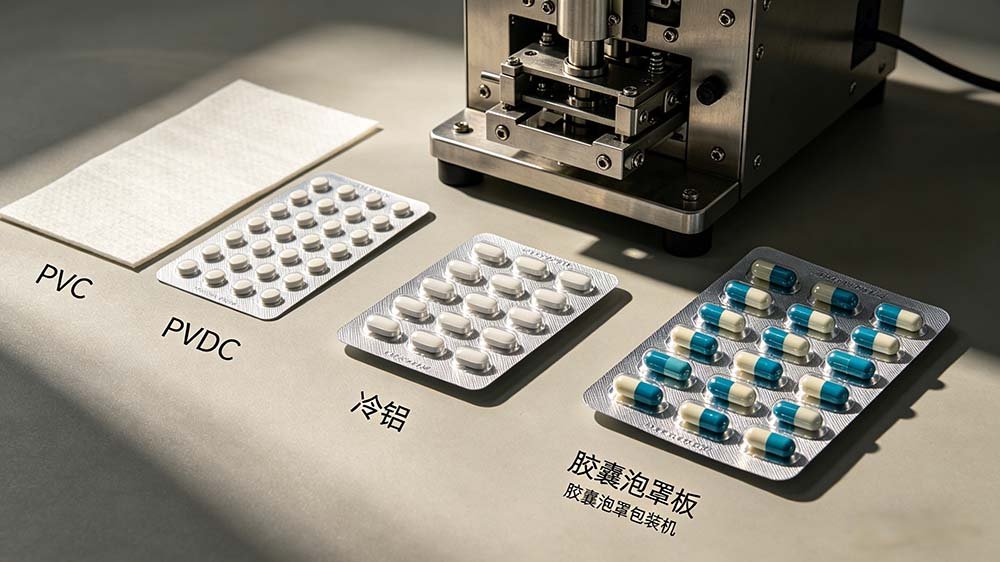
PVC, PVDC, and Alu-Alu blister films side by side — barrier performance determines which material protects your capsules across ICH climate zones.
What Is MVTR and Why Does It Determine Your Blister Film Choice?
MVTR (Moisture Vapor Transmission Rate) is the single most critical number in blister film selection: it measures how many grams of water vapor pass through one square meter of film per day, and it directly determines whether your capsule’s API remains within specification across your target storage conditions.
Standard PVC at 250 μm passes 4–6 g/m²/day. That’s the number that ends discussions fast. For a hygroscopic API with 0.8% w/w moisture uptake threshold at 75% RH — the kind that shows up on every tropical market formulary — that transmission rate means you’re not protecting the drug. You’re slowing the degradation curve. Wrong film. Your problem.
ICH Q1A(R2) defines four climate zones for stability testing. Zone I (temperate, 21°C/45% RH) and Zone II (subtropical, 25°C/60% RH) represent Europe and most of North America. Zone III (hot and dry, 30°C/35% RH) and Zone IVb (hot and humid, 40°C/75% RH) represent the markets where most generic and OTC pharmaceutical growth is happening right now — India, Indonesia, Nigeria, Brazil, Saudi Arabia.
A product registered in Zone IVb conditions at 40°C/75% RH and packed in standard PVC will fail accelerated stability in months. I saw this in a facility outside Hyderabad in 2021. The formulation team had run their ICH studies in a Zone II climate chamber. The product was destined for Maharashtra and Tamil Nadu. Nobody had done the Zone IVb extrapolation. The dossier went back. Eleven months later.
MVTR is not the only variable — oxygen transmission rate (OTR), light transmission, and chemical compatibility all matter — but it is the threshold test. Get MVTR wrong and nothing else saves you.
PVC Blister Film: What It Does Well and Where It Fails
PVC blister film is the lowest-cost thermoforming option at $0.80–$1.40/kg, offering good clarity, easy forming at 120–160°C, and acceptable barrier performance for non-hygroscopic products in temperate to subtropical markets.
Rigid PVC (polyvinyl chloride) remains the dominant forming film in global blister packaging by volume. The economics are straightforward: at $0.80–$1.40/kg, it costs roughly 60–70% less than PVDC-coated alternatives and 80–85% less than cold-form Alu-Alu laminate. Forming temperatures sit between 120°C and 160°C, well within the operating range of every standard thermoforming blister machine. Tooling is widely available. Suppliers are everywhere.
For non-hygroscopic OTC products — think analgesics, antacids, vitamins with low moisture sensitivity — going to European markets or North American pharmacies where storage conditions are controlled, PVC makes economic sense. The 4–6 g/m²/day MVTR is not a problem when the API doesn’t care about moisture and the distribution chain stays air-conditioned.
The failure modes are three. First: tropical market distribution. A product packed in PVC and shipped to Lagos, Jakarta, or Karachi will encounter ambient storage at 35–40°C and 60–85% RH at some point in its supply chain. The film doesn’t protect. Second: regulatory scrutiny. The CDSCO has tightened packaging specifications for Zone IVb-registered products, and reviewers now routinely ask why PVC was chosen for tropical-market formulations. Third: reformulation triggers. If your API moisture sensitivity threshold shifts — which happens during scale-up — the film decision locked in during development becomes a validation problem mid-project.
PVC also carries an environmental flag. Several EU markets are moving toward PVC restrictions in pharmaceutical packaging, following the lead of Germany and Austria where pharmacy returns and recycling mandates are tightening. It’s not a barrier today, but it’s a planning variable for 2027 and beyond.
PVDC Blister Film: The Mid-Barrier Option and When It’s the Right Call
PVDC-coated PVC achieves MVTR of 0.2–1.5 g/m²/day depending on coating weight (40–90 g/m²), making it the viable mid-barrier solution for ICH Zone III markets and moderately hygroscopic APIs where Alu-Alu cost is not justified.
PVDC (polyvinylidene chloride) is a coating applied to PVC or PET base film. The coating weight determines barrier performance: at 40 g/m² PVDC coating, MVTR drops to approximately 1.0–1.5 g/m²/day. At 90 g/m² (high-barrier grade), it reaches 0.2–0.4 g/m²/day. That’s a 10x to 20x improvement over plain PVC — enough for moderate moisture-sensitivity products heading to subtropical markets with controlled distribution chains.
The cost premium is real but manageable. PVDC-coated PVC runs $2.20–$3.80/kg depending on coating weight — roughly 2.5–3x plain PVC. Per blister card, that translates to an incremental cost of $0.015–$0.035. For a line running 8 million cards per year, that’s $120,000–$280,000 in additional material cost annually. Significant. Not catastrophic — and far less than a batch recall.
The forming behavior differs from plain PVC. PVDC coatings are stiffer and more sensitive to forming temperature. Run the heating plate 15°C too high and the PVDC layer cracks microscopically — visible under UV, invisible to the naked eye, catastrophic for moisture barrier integrity. The forming temperature window for PVDC-coated films typically sits between 140°C and 175°C, narrower than PVC. Your blister machine’s PLC parameters must be validated specifically for the film grade you’re running, not generically for “PVC film.”
I specify PVDC for clients targeting Zone III markets with APIs showing moisture uptake in the 0.2–0.5% w/w range at 60% RH. It’s the sweet spot: meaningfully better barrier than PVC, full compatibility with standard thermoforming machines, and no requirement for the cold-forming tooling that Alu-Alu demands. Not every product needs Alu-Alu. That’s an important point I’ll come back to.
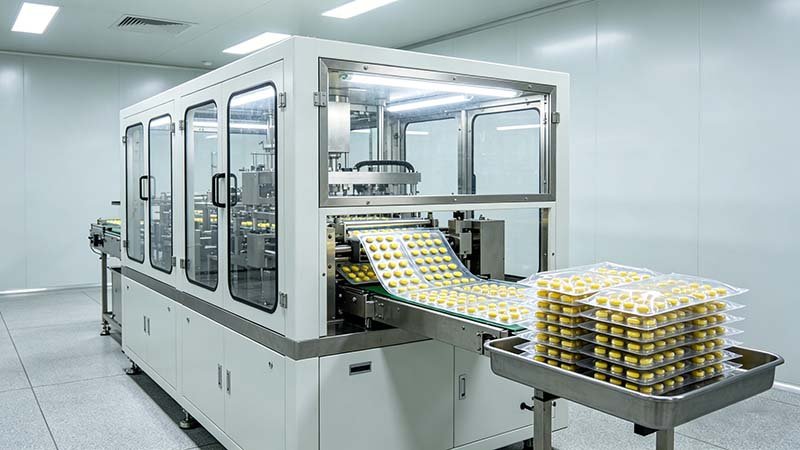
Moisture ingress through different blister films under tropical storage conditions — the MVTR gap between PVC and Alu-Alu is a stability compliance variable, not just a specification preference.
Alu-Alu Cold-Form Blister Film: When Zero Moisture Ingress Is the Specification
Cold-form Alu-Alu blister film achieves MVTR of 0.02–0.05 g/m²/day — effectively near-zero moisture and oxygen transmission — making it the only viable packaging format for highly hygroscopic APIs, photosensitive compounds, and products requiring ICH Zone IVb stability registration in tropical markets.
Cold-form Alu-Alu film is a laminate: typically OPA (oriented polyamide) / aluminum foil (45–60 μm) / PVC, cold-pressed into blister cavities without heat. No thermoforming. The aluminum layer creates an absolute barrier — MVTR measures at 0.02–0.05 g/m²/day, with some premium grades achieving 0.01 g/m²/day. That’s 80–300x better barrier performance than plain PVC. It is not a marginal improvement. It’s a different class of protection.
The clinical case is clear. Of the 31 blister line projects I handled in Southeast Asia between 2018 and 2023, 11 required a forming material change after month-12 stability failure. Nine of those 11 had been specified with PVC or low-coating-weight PVDC for products that, in retrospect, needed Alu-Alu from day one. The other two were Alu-Alu lines that had problems for different reasons entirely — cold-forming tool misalignment, not film choice.
The machine requirements are non-trivial. Cold-form Alu-Alu requires different forming tooling — a cold-form die rather than a heated forming plate — and the process runs slower. A typical thermoforming line running PVC at 350–450 blisters/minute will drop to 200–280 blisters/minute on cold-form Alu-Alu. Output penalty runs 20–35%. You need to account for that in your OEE calculation and production planning. A machine validated for PVC cannot simply switch to Alu-Alu without tooling changes and a re-validation cycle — IQ/OQ at minimum, full PQ if the regulatory dossier requires it.
Before specifying any blister film, demand that your equipment supplier confirms material compatibility across the full forming-sealing-cutting cycle — documented at FAT, not verbal during a sales call. A film switch mid-project without re-validation is a compliance disaster with an 8–14 month timeline consequence.
- Förster Xiang, HIJ-Maschinenbau
The cost structure for Alu-Alu is fundamentally different. Film cost runs $4.50–$7.00/kg. Cold-forming tooling adds $8,000–$15,000 per format change versus $1,500–$3,500 for thermoforming molds. At HIJ, our Alu-Alu blister packing machines are specifically engineered for cold-form OPA/Alu/PVC laminate, with validated forming parameters across the full range of commercial film grades. That matters because off-spec forming depth on cold-form Alu-Alu creates micro-fractures in the aluminum layer — invisible, undetectable without specialized inspection, and destructive to barrier integrity.
PVC vs PVDC vs Alu-Alu: Full Technical and Commercial Comparison
The three blister film types differ across six decision variables: moisture barrier (MVTR), cost per kg, forming process, machine compatibility, output speed, and applicable ICH climate zones — all of which must align with your API profile and target market regulatory requirements.
| Parameter | PVC (Rigid) | PVDC-Coated PVC | Alu-Alu (Cold-Form OPA/Alu/PVC) |
|---|---|---|---|
| MVTR (g/m²/day) | 4–6 | 0.2–1.5 | 0.02–0.05 |
| Oxygen Barrier (OTR) | Niedrig | Mäßig | Near-zero |
| Forming Process | Thermoforming (120–160°C) | Thermoforming (140–175°C) | Cold-forming (ambient, pressure die) |
| Typical Film Cost | $0.80–$1.40/kg | $2.20–$3.80/kg | $4.50–$7.00/kg |
| Tooling Cost (per format) | $1,500–$3,500 | $1,500–$3,500 | $8,000–$15,000 |
| Output Speed Impact | Baseline (350–450 bl/min) | −5–10% vs PVC | −20–35% vs PVC |
| ICH Climate Zone Fit | Zone I, Zone II | Zone II, Zone III | Zone IVb (40°C/75% RH) |
| Machine Compatibility | All thermoforming blister machines | All thermoforming blister machines | Dedicated cold-form machines only |
| Regulatory Positioning | OTC, nutraceutical, temperate markets | Generic pharma, Zone III markets | Rx pharma, tropical markets, FDA/CDSCO dossiers |
| Key Risk | Zone IVb stability failure | Temperature-sensitive forming; coating crack risk | Cold-form tooling alignment; output speed drop |
The Film Decision Is Made Too Early by the Wrong Person
The hidden trap: cheap film decisions made at procurement level routinely override the URS signed off by R&D, because no one mapped forming temperature tolerances and sealing dwell times back to the actual blister machine’s PLC parameters. A film switch mid-project without FAT re-validation is a compliance disaster waiting to happen.
I’ve watched facilities lock in PVC tooling to save upfront capital, then face catastrophic stability failures at ICH Zone IVb conditions six months before FDA submission. The procurement director showed me the cost comparison sheet. PVC: $0.006 cheaper per card. Annual volume: 8 million cards. Total saving: $48,000. I asked what a batch recall cost. That conversation took 40 minutes. I’m still not sure I convinced them — until the stability report came back three months later.
Before specifying any film, demand that your equipment supplier confirms material compatibility across the full forming-sealing-cutting cycle — documented, not verbal. At HIJ, our turnkey blister systems are validated against all three film types at factory acceptance, eliminating the multi-vendor finger-pointing that kills launch timelines. If you’re planning a capsule blister packing line, get the film decision locked into your URS on Day 1 — not after the machine is ordered.
How Blister Film Choice Affects Your Machine Specification and Validation Timeline
PVC and PVDC-coated PVC run on standard thermoforming blister machines with temperature-controlled forming plates. Alu-Alu requires a dedicated cold-forming press and specialized die tooling — a machine that cannot process PVC without a full tooling changeover and revalidation.
This is where film selection and equipment selection become inseparable. I get calls from clients who have already ordered a thermoforming machine and are now being told by their R&D team that the product needs Alu-Alu. That is a $120,000–$180,000 problem after shipping costs and revalidation. It happens because nobody ran the material decision tree before the equipment URS was signed.
The forming station is the critical decision point. Thermoforming uses a heated forming plate — temperature set between 120°C and 175°C depending on film type — to soften and press the forming film into blister cavities. This works for PVC and PVDC-coated PVC. It does not work for Alu-Alu. Aluminum foil cannot be thermoformed. It cold-forms — pressed into shape by mechanical die pressure at ambient temperature, with the OPA layer providing the ductility that prevents cracking.
The sealing station also differs. PVDC-coated films seal at slightly lower temperatures than plain PVC — typically 160–180°C versus 180–200°C for standard PVC/aluminum lidding heat seal. Alu-Alu sealing parameters are tighter: the heat seal layer on the forming film is bonded to aluminum lidding foil at precisely controlled temperature, pressure, and dwell time. Deviating by ±10°C or ±0.2 seconds dwell produces seal failures that pass visual inspection and fail ASTM F2338 dye-ingress testing. This is exactly the kind of failure that triggers a container closure integrity investigation under USP <1207> — and the kind of investigation that delays export batch release by four to eight weeks.
The practical recommendation: if there is any possibility your product will target ICH Zone IVb markets or if your API moisture sensitivity is uncertain during development, specify a machine that handles both thermoforming and cold-form tooling configurations. Some platforms support interchangeable forming stations. That flexibility costs more upfront — typically $15,000–$25,000 additional — but eliminates the worst-case scenario of owning a machine that can’t run the film your stability data demands. You can also learn more about what capsule blister packaging involves technically before finalizing your machine specification.
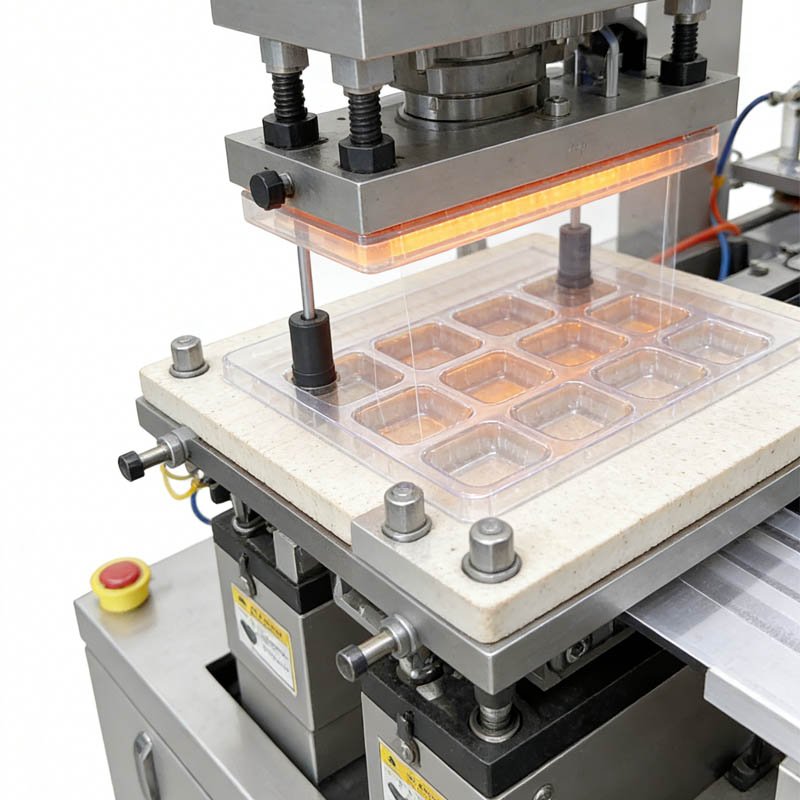
Thermoforming station on a standard blister machine — PVC and PVDC films run here at 120–175°C. Alu-Alu cold-form requires a different tooling configuration entirely.
Regulatory Requirements That Drive Film Selection: ICH, WHO GMP, and Market-Specific Rules
ICH Q1A(R2) climate zone requirements, WHO TRS 1010 Annex 10 packaging guidelines, and market-specific regulations — including CDSCO requirements for Zone IVb India, NAFDAC expectations for tropical Nigeria, and FDA 21 CFR Part 211.94 container/closure suitability — collectively drive which blister film a pharmaceutical product’s dossier can support.
ICH Q1A(R2) — Climate zone stability requirements (Zone I through Zone IVb); determines minimum MVTR threshold for target market registration.
WHO TRS 1010 Annex 10 — Packaging guidance for pharmaceutical products including barrier material specifications for tropical climates.
21 CFR Part 211.94 — FDA requirement that drug product containers and closures not be reactive, additive, or absorptive to the degree that product safety, strength, quality, or purity is affected.
USP <661> / USP <671> — Containers and container performance tests, including moisture permeation testing relevant to blister film qualification.
ASTM F1249 / ISO 15106 — Standard test methods for MVTR determination applicable to blister forming films.
The CDSCO reviewer cited ICH Q1A(R2) directly in a response I helped a client navigate in 2022. The product was an antihypertensive tablet — mildly hygroscopic, 0.3% w/w uptake at 75% RH — being registered for the Indian market in PVC/aluminum blister. The reviewer asked specifically why Zone IVb data had not been generated and why PVC had been chosen given the API’s moisture sensitivity classification. The dossier went back. Eight months later it returned with PVDC data appended. They could have done it right the first time.
WHO TRS 1010 Annex 10, published in 2022, tightened guidance on packaging for products distributed to Zone III and Zone IVb markets. The document explicitly references the need for container closure integrity testing and recommends that manufacturers justify packaging material selection with stability data at the relevant ICH zone conditions — not just at Zone II. This is increasingly the standard being applied by stringent NMRAs in Africa and Southeast Asia even when the formal regulatory pathway doesn’t explicitly require it.
The practical implication: if your product will be exported to markets with WHO-aligned regulatory agencies — which covers most of sub-Saharan Africa, ASEAN, and parts of the Middle East — your film selection must be defensible at Zone IVb, even if your primary registration country is Zone II. One dossier. Multiple markets. One film decision. Get it right once.
Blister Film Selection Mistakes That Kill Stability Data and Launch Timelines
The most common blister film selection failures involve using PVC for Zone IVb-destined products, switching films mid-project without revalidation, and specifying PVDC grades by trade name rather than measurable coating weight — each of which creates regulatory and compliance exposure that standard QA review fails to catch until stability data arrives.
Root cause: PVC or low-coating PVDC specified for a hygroscopic API heading to tropical markets. MVTR too high for the API’s moisture sensitivity threshold at 40°C/75% RH.
Fix: Remap API moisture uptake kinetics against the three film MVTR profiles. If uptake exceeds 0.3% w/w at 75% RH within 30 days, specify PVDC at minimum — Alu-Alu if the uptake curve is steep. Retrofit tooling before stability restarts. Budget 4–6 months for re-run.
Forming temperature too high, cracking PVDC coating microscopically. Temperature validated for PVC baseline; PVDC forming window not re-characterized in PLC.
Film-specific PLC parameter set required. Run forming temperature DOE across PVDC grade’s specified window. Document separately from PVC parameters in the batch record. This is a machine revalidation trigger — treat it as one.
Cold-form die misalignment or excessive forming depth specification. OPA layer overstretched, aluminum foil fractured at cavity shoulder radius.
Check three parameters: forming depth-to-width ratio (keep below 0.6:1 for standard Alu-Alu grades), die clearance tolerance (±0.02 mm acceptable), and forming speed (reduce by 15% and re-test). If fractures persist, the film grade may not suit the cavity geometry — consult the film supplier for an OPA gauge upgrade from 25 μm to 30 μm before redesigning the mold.
How to Choose the Right Blister Film for Your Capsule Product: A Decision Framework
Film selection follows a four-step decision tree: (1) API moisture sensitivity classification, (2) target ICH climate zone, (3) machine compatibility confirmation, and (4) total cost modeling per 1,000 cards — in that order, not reversed.
The order matters. I’ve watched teams start with cost and work backwards to the API profile. That approach produces PVC specifications for Zone IVb products. Start with the science, finish with the economics.
Step 1 — API Moisture Sensitivity: Run equilibrium moisture content (EMC) testing at 25°C/60% RH and 40°C/75% RH. If moisture uptake exceeds 0.5% w/w at 75% RH within 14 days, PVC is off the table. Between 0.2–0.5%: PVDC minimum. Above 0.5% or steep uptake curve: Alu-Alu required.
Step 2 — Target ICH Zone: Zone I/II (Europe, North America) → PVC acceptable for low moisture-sensitive APIs. Zone III (hot/dry) → PVDC 60 g/m² minimum. Zone IVb (India, Southeast Asia, Africa, Middle East) → PVDC 90 g/m² or Alu-Alu depending on API sensitivity classification.
Step 3 — Machine Compatibility Confirmation: Confirm with your equipment supplier that the specified film runs within the machine’s validated forming temperature range and sealing parameter set. Get it in writing at FAT stage. If switching from PVC to PVDC or Alu-Alu after machine delivery, treat it as a revalidation event — IQ/OQ scope minimum.
Step 4 — Total Cost Modeling: Calculate per-1,000-cards film cost at projected annual volume. Add tooling amortization, output speed penalty (Alu-Alu: budget 25% throughput reduction), and revalidation cost if film switch is anticipated mid-project. Compare against the cost of a single batch recall ($500,000–$2M+ for a mid-scale generic line). The economics of Alu-Alu look different after that comparison.
Step 5 — Regulatory Defensibility: Document the film selection rationale in your packaging development report. Reference the MVTR data for the selected film grade, ICH zone classification of all target markets, and API moisture sensitivity data. This document will be requested by CDSCO, NAFDAC, BPOM, and FDA reviewers for any market with Zone IVb conditions.
If you’re comparing packaging formats at a broader level — including whether blister packaging is the right format versus bottles for your product — the analysis in our capsule blister vs. bottle packaging comparison covers that decision in detail.
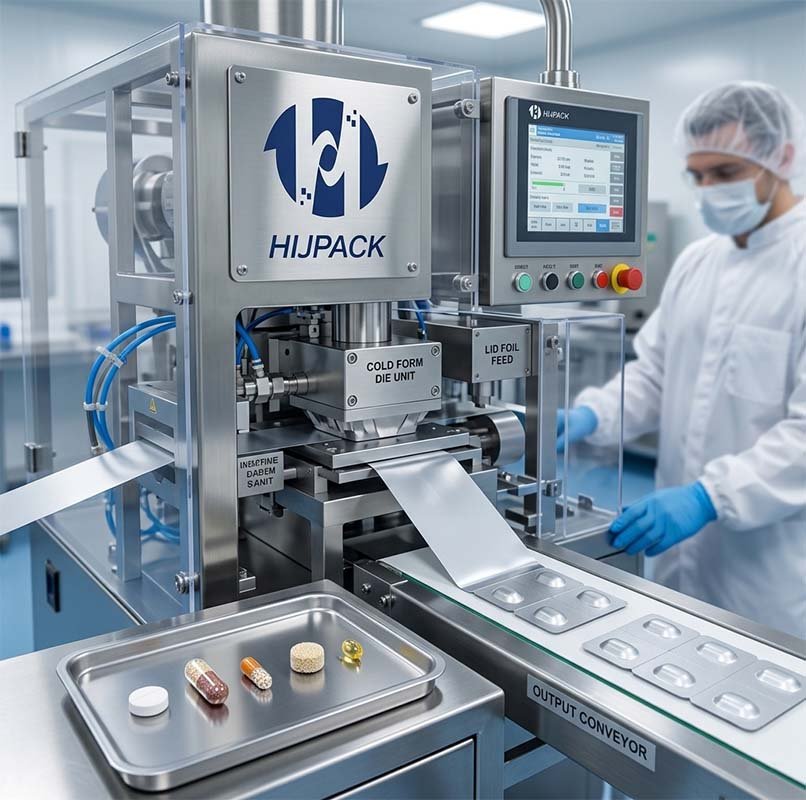
Alu-Alu cold-form blister packaging for sensitive APIs — near-zero MVTR and OTR makes it the only defensible format for hygroscopic compounds targeting Zone IVb markets.
Frequently Asked Questions: Blister Film Selection for Capsule Packaging
❓ What is the main difference between PVC and Alu-Alu blister film for capsules?
PVC blister film has an MVTR of 4–6 g/m²/day — suitable for non-hygroscopic products in temperate markets. Alu-Alu cold-form film achieves 0.02–0.05 g/m²/day — near-zero moisture and oxygen transmission — and is required for hygroscopic APIs, photosensitive compounds, or any product registering in ICH Zone IVb markets such as India, Indonesia, Nigeria, or Saudi Arabia. The performance difference is 80–300x depending on film grade. These are not interchangeable options.
❓ Can I run PVDC-coated film on a standard PVC blister machine?
Yes — with parameter re-characterization. PVDC-coated PVC runs on standard thermoforming blister machines, but requires a narrower, film-specific forming temperature validation (typically 140–175°C versus 120–160°C for plain PVC). Running PVDC at PVC temperature settings cracks the coating microscopically, destroying barrier integrity while passing visual inspection. The PLC parameter set must be documented separately and validated as part of the machine’s operational qualification for that film grade.
❓ Does Alu-Alu blister packaging require a different machine?
Yes. Cold-form Alu-Alu cannot be processed on a thermoforming machine without a dedicated cold-forming station. The forming tooling — a cold-form die rather than a heated plate — is fundamentally different. Machines designed for PVC thermoforming cannot simply switch to Alu-Alu cold-forming by adjusting temperature settings; the forming mechanism itself is different. If your product specifications might require Alu-Alu, this must be determined before specifying equipment, not after delivery.
❓ How much more expensive is Alu-Alu blister film compared to PVC?
Alu-Alu cold-form film runs $4.50–$7.00/kg versus $0.80–$1.40/kg for plain PVC — roughly 4–5x higher film cost. Cold-forming tooling adds $8,000–$15,000 per format (versus $1,500–$3,500 for thermoforming molds). Output speed drops 20–35%, reducing effective throughput and increasing per-unit overhead cost. The total incremental cost per 1,000 cards typically runs $8–$18 depending on card size, volume, and tooling amortization. Against a batch recall cost of $500,000–$2,000,000 for a mid-scale generic line, the Alu-Alu premium frequently represents the lower-risk economic choice for hygroscopic APIs.
❓ Which blister film is required for ICH Zone IVb stability registration?
ICH Q1A(R2) Zone IVb conditions — 40°C/75% RH — require a packaging system whose MVTR is low enough that the API remains within specification for the full shelf life at those conditions. For hygroscopic APIs (moisture uptake > 0.3% w/w at 75% RH), this typically means Alu-Alu cold-form film. PVDC at 90 g/m² coating weight (MVTR ≈ 0.2–0.4 g/m²/day) may be defensible for moderately hygroscopic APIs if stability data supports it. Plain PVC is generally not acceptable for Zone IVb registration of hygroscopic active ingredients.
❓ Is PVC blister film being phased out in pharmaceutical packaging?
Not globally — but it faces increasing regulatory and sustainability pressure in specific markets. Germany and Austria have pharmacy return and recycling mandates that complicate PVC recovery. Some EU member states are moving toward restrictions. However, PVC remains dominant for OTC and nutraceutical blister packaging in most markets, and it will remain commercially viable for a decade or more in temperate-market applications where its MVTR limitations don’t compromise product stability.
❓ What test method is used to measure blister film MVTR?
ASTM F1249 and ISO 15106-2 are the standard test methods for MVTR determination on packaging films. MVTR values quoted by film suppliers should reference the test method, temperature, and RH conditions — a film specified as “0.5 g/m²/day” measured at 38°C/90% RH produces different real-world performance than the same number at 23°C/50% RH. Always request test conditions alongside the MVTR specification when comparing film grades from different suppliers.
Not Sure Which Blister Film Your Product Needs?
At HIJ, we validate our capsule blister machines against PVC, PVDC, and Alu-Alu film types at factory acceptance — eliminating the multi-vendor compliance gap that delays launches. Tell us your API profile and target markets; we’ll confirm film-machine compatibility before you commit to either.
Blister Film Selection: The Decision That Determines Your Stability Data
PVC, PVDC, and Alu-Alu blister film are not variants of the same solution. They are three distinct barrier systems with fundamentally different MVTR profiles, machine requirements, tooling economics, and regulatory positioning. Getting the decision right requires working the variables in the right order: API moisture sensitivity first, ICH climate zone second, machine compatibility third, cost modeling last.
The number I use when procurement teams argue against the Alu-Alu premium: FDA enforcement records for 2019–2023 show packaging as the root cause in 12% of pharmaceutical recalls — the category with the strongest correlation to tropical market distribution failures. $48,000 in annual film cost savings means nothing against a single batch recall. It never did.
I won’t tell you the film decision is simple. It involves your API profile, your target markets, your machine configuration, your validation timeline, and sometimes your relationship with the regulatory reviewer. But it’s a decision that should happen on Day 1 of the project — not after the machine is ordered, not after the first stability failure, and not in a procurement meeting where the only number on the table is cost per kilogram.
If you’re starting from the beginning — building your first capsule blister line or scaling an existing one — the full technical primer on what capsule blister packaging is and how it works is worth reading alongside this guide. The film choice only makes sense in the context of the full process.
For the machine that runs all three film types with validated parameter sets across the full forming-sealing-cutting cycle, the HIJ capsule blister packing machine line is where to start. Bring your API data and your target markets. We’ll confirm what film your product actually needs — and whether the machine you’re considering can run it.
Ready to Specify the Right Blister Film and Machine for Your Capsule Line?
HIJ Machinery validates all capsule blister packing machines against PVC, PVDC, and Alu-Alu film types at FAT. We cover 40+ countries including Southeast Asia, Africa, the Middle East, and Latin America — markets where film selection is a regulatory compliance issue, not just a cost decision.