
















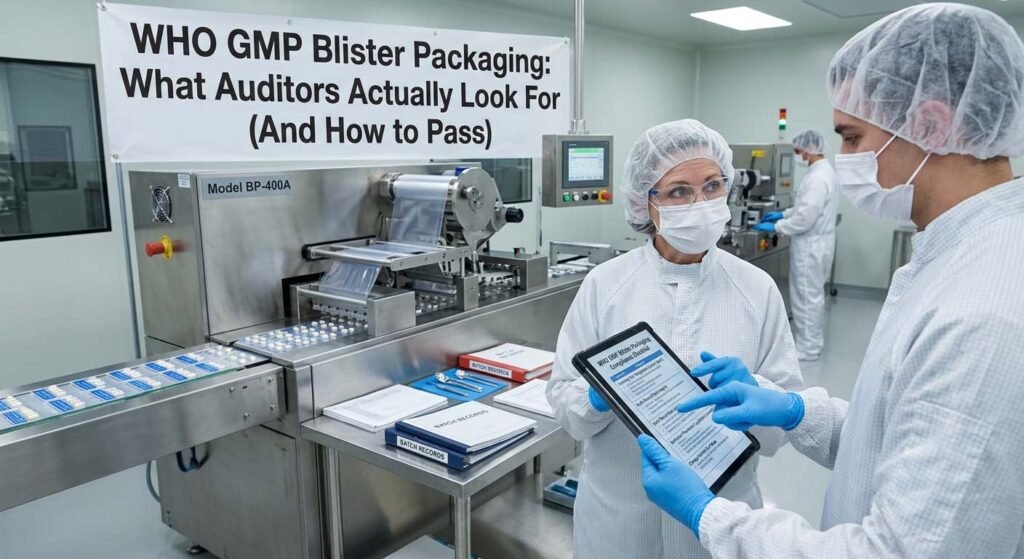
You have invested six figures in a new blister packaging line. Your U.S. or emerging-market registration timeline is locked. Your commercial launch date is set. Then your WHO inspector walks in, opens the audit trail on your HMI, and asks a single question: “Show me the complete, unmodified electronic batch record for lot 2024-XY-003, including every parameter change, who made it, and the exact timestamp.”
If your machine cannot answer that question instantly — with cryptographically protected, non-repudiable data — your line is not 21 CFR Part 11 compliant. It doesn’t matter what the vendor’s brochure says. What matters is what the machine actually does on the floor, under audit pressure, at 2 AM when a deviation report is raised. This checklist was written to close that gap.
- The Direct Answer: Passing a WHO GMP audit for blister packaging is not about having the newest machine — it is about proving your process is documented, validated, and repeatable under every foreseeable condition.
- The Field Experience: In my 20 years of walking production floors from Lagos to Lahore, I have watched facilities fail audits not because their AL/PVC blisters were defective, but because their blister line could not produce a clean audit trail — no IQ/OQ/PQ records, no sealing temperature validation logs, no batch traceability linked back to the filling station. The hidden trap no vendor tells you: a standalone blister machine purchased from a low-cost supplier almost never ships with the validation documentation package an auditor actually demands on Day One. You buy the hardware; you inherit the paperwork nightmare.
- The Strategic Advice: Before your next procurement decision, demand a full FAT protocol and a compliance documentation package as contractual deliverables — not afterthoughts. At HIJ, our turnkey blister packaging lines are engineered with cGMP-compliant control architecture and a structured URS-to-SAT validation pathway, so your audit readiness is built into the machine, not bolted on later.

What WHO GMP Auditors Actually Inspect on a Blister Line
The WHO Technical Report Series 961 (Annex 9) and TRS 992 (Annex 3) set the governing framework for pharmaceutical packaging validation. Most quality managers read these documents as abstract policy; experienced auditors read them as a physical checklist they will walk through on your production floor. Understanding that distinction is the first step to audit readiness.
Auditors evaluate your blister packaging operation across five interlocking domains: equipment qualification, process parameter control and logging, material traceability, environmental controls, und batch record integrity. A deficiency in any single domain — regardless of how strong the others are — can result in a critical observation that suspends your manufacturing authorisation.
Validation phases auditors demand: IQ, OQ, and PQ — all with original signatures
Part 11 electronic records standard — required even when WHO GMP governs
Maximum sealing temperature deviation tolerated across the full sealing die surface
Here is what the auditor’s checklist actually looks like in practice — and the exact evidence they will demand for each item:
| Audit Domain | Specific Evidence Demanded | Risk Level |
|---|---|---|
| Equipment Qualification (IQ/OQ/PQ) | Signed IQ confirming utility connections, material compatibility, and calibration certificates; OQ with worst-case parameter ranges; PQ showing 3× consecutive batches meeting spec | CRITICAL |
| Sealing Temperature Validation | Thermocouple mapping across full sealing die (min. 9 points); temperature uniformity ≤±2°C; validated dwell time and pressure parameters recorded per product code | CRITICAL |
| Forming Depth Consistency | Statistical process control (SPC) data showing cavity depth Cpk ≥1.33; plug assist pressure logs; material batch records for PVC/PVDC film | CRITICAL |
| Electronic Batch Records (EBR) | 21 CFR Part 11-compliant audit trail: user-ID-linked entries, time-stamped, non-editable, with deviation and CAPA linkage | CRITICAL |
| Leak / Seal Integrity Testing | Blue dye immersion test or vacuum decay records per ASTM F2338; 100% online vision system rejection logs; AQL sampling plan documented | CRITICAL |
| Environmental Monitoring | Particle count logs for ISO Class 8 (or better) filling zone; differential pressure records; HEPA filter integrity test certificates | MAJOR |
| Changeover / Mold Documentation | Line clearance SOP with dual-operator verification; tooling calibration records; format part traceability numbers | MAJOR |
| Preventive Maintenance (PM) | Scheduled PM log matching manufacturer’s specification; calibration due-date tracking for load cells, thermocouples, vision cameras | MAJOR |
⚠️ Auditor’s First Move: In over 80% of blister line inspections I have witnessed, the first document an auditor requests is not the SOP — it is the IQ/OQ/PQ execution report. If that binder is missing, incomplete, or unsigned, the audit is effectively over before it begins. Every other compliance measure becomes irrelevant.
The 5 Critical Process Parameters That Determine Pass or Fail
Beyond documentation, WHO GMP auditors perform direct physical verification of your blister machine’s process control capabilities. The following five parameters are not negotiable — each one has a specific measurable acceptance criterion that your machine must demonstrate on the spot, not just in a validation report dated 18 months ago.
1. Sealing Temperature Uniformity and Stability
The sealing station is the highest-risk point on any thermoform blister line. An auditor will request your thermocouple mapping report, then may demand a live demonstration where the machine runs at production speed while they observe the HMI temperature readings. The acceptance criterion under WHO guidelines is ≤±2°C variation across the full sealing die area, with a validated set-point tolerance of ±1°C. Machines using legacy single-zone heaters with manual dial thermostats will fail this test. Compliant machines use PID-controlled multi-zone heaters with independent K-type thermocouple feedback, and the HMI must display zone-by-zone real-time temperatures with alarm limits set in the recipe management system.
2. Film Forming Depth Consistency (Cpk ≥ 1.33)
For thermoformed PVC/PVDC/PE blisters, the cavity depth directly determines whether a tablet or capsule is fully protected and whether the foil seal is under or over-stressed during sealing. Auditors look for in-process SPC data — not just finished product testing. Your machine must log forming heater temperature, plug assist stroke, and forming air pressure for every cycle, and these values must be within ±3σ of the validated set-points. HIJ’s DPP-250 pharma blister machine uses servo-driven plug assist with positional accuracy of ±0.05 mm, generating a data stream that feeds directly into the SPC log — eliminating the manual measurement bottleneck that causes most Cpk failures.

3. Seal Integrity — 100% Online Detection Plus Destructive Sampling
WHO GMP requires a two-tier approach to seal integrity verification. Tier one is a 100% online detection system — typically a vision camera array or force-monitoring system — that rejects any blister with an incomplete seal before it reaches the output conveyor. Tier two is periodic destructive testing: blue dye immersion per ASTM F2338, or vacuum decay per ASTM F2096, performed on a statistically valid AQL sample every two hours of production. Both tiers must produce logged, traceable records linked to the specific batch and time window. A machine without integrated vision rejection fails Tier one automatically.
4. Electronic Batch Record (EBR) and 21 CFR Part 11 Compliance
Even when a facility operates under WHO GMP rather than FDA jurisdiction, auditors from NAFDAC, DRAP, NDA Uganda, and most NMRA bodies now apply 21 CFR Part 11 data integrity principles as the global de facto standard. This means every recipe change must be time-stamped with the operator’s unique user ID, every alarm acknowledgement must be logged with reason code, and all records must be stored in a format that cannot be modified without leaving a visible audit trail. Systems that store batch data in Excel files on a networked PC do not meet this standard, regardless of whether they claim to be “GMP-compliant.” Your PLC must communicate batch records to a validated SCADA or MES system with role-based access control and a protected audit trail database.
5. Cleaning Validation and Product Changeover Traceability
For multi-product blister lines — the reality for most mid-size manufacturers — WHO GMP requires documented cleaning validation showing that carryover of the previous product falls below the Acceptable Daily Exposure (ADE) or Permitted Daily Exposure (PDE) threshold for the next product. Your machine’s surface finish specification (Ra ≤ 0.8 µm on all product-contact surfaces) must be verified at IQ. Changeover records must include a dual-operator line clearance checklist, a photographic record of the cleared line, and a formal release signature before the next product batch begins.
Multi-Vendor Patchwork vs. Turnkey: The Audit-Readiness Gap
The most common procurement mistake I see in emerging-market pharmaceutical facilities is the “best price per unit” strategy: buy the blister machine from Vendor A, the vision system from Vendor B, the cartoner from Vendor C, and the MES software from Vendor D. On paper, the individual price points look attractive. On audit day, the result is catastrophic.
⚠️ The Multi-Vendor Patchwork Reality
- No single vendor owns the IQ/OQ/PQ for the integrated line — each blames the other for interface failures
- Vision system rejection data logged in a separate, non-integrated database — auditor sees a gap in batch traceability
- Recipe management is inconsistent: blister machine uses one naming convention, cartoner uses another — no unified batch ID
- Sealing temperature alarms on the blister machine are not propagated to the MES — alarm history is incomplete
- Cleaning validation must be repeated separately for each equipment vendor’s acceptance criteria — tripling the validation burden
- On-site support during audit: four different vendors, four different response times, zero coordinated accountability
✅ The HIJ Turnkey Standard
- Single-source IQ/OQ/PQ validation package covering the entire line — blister machine through cartoner — delivered as a contractual deliverable before shipping
- Integrated vision system data writes directly into the unified electronic batch record via Siemens/Allen-Bradley PLC backbone
- Centralized recipe management: one approved recipe sets parameters across all stations simultaneously — no manual transcription
- All alarms — sealing temperature, vision rejection rate, film tension — logged to the same EBR timestamp stream
- Single cleaning validation protocol for the full line with documented surface finish certificates for every product-contact component
- One phone call to HIJ covers the entire line — one engineer, one accountability chain, one SLA
Die HIJ Turnkey Solutions framework is specifically engineered to eliminate the integration risk that turns a multi-vendor procurement strategy into a compliance liability. Our lines are built on a unified control architecture — typically Siemens S7-1500 or Allen-Bradley ControlLogix PLC platforms — with a single SCADA layer that consolidates batch records, alarm histories, and recipe data across every station. When your auditor asks for lot 2024-XY-003’s complete batch record, the answer is a single PDF export from one validated system — not a three-day reconciliation exercise across four vendor portals.

The URS-to-SAT Validation Pathway: How HIJ Builds Audit Readiness In
At HIJ, every blister line project follows a structured validation pathway that mirrors the WHO/ISPE GAMP 5 lifecycle model:
- URS Review (Week 1–2): Our engineering team reviews your User Requirement Specification in detail — including API moisture sensitivity, blister format library, production throughput target (OEE ≥ 85%), and regulatory submission markets. Every URS requirement is mapped to a machine specification before design lock.
- Design Qualification (DQ) Report: We generate a formal DQ document showing how each machine sub-system satisfies its corresponding URS requirement. This is the document that proves “fitness for intended use” before metal is cut.
- Factory Acceptance Testing (FAT) with Full Protocol: FAT is conducted at our facility in China with your QA team present (or via live-streamed video with screen-capture documentation). Every critical parameter — sealing temperature map, forming depth, vision rejection sensitivity — is tested against the OQ acceptance criteria and signed off on the protocol.
- Crating, Shipping, and Site Acceptance Testing (SAT): On installation at your site, our field engineer conducts a full SAT requalification confirming that utility connections, environmental conditions, and machine performance meet the same acceptance criteria confirmed at FAT. The SAT report becomes the final document that releases the line to GMP production status.
- Process Performance Qualification (PPQ) Support: For customers submitting dossiers to strict regulatory bodies (EMA, USFDA, WHO Prequalification), we provide technical writing support for the PPQ protocol, including the statistical sampling plan and the Cpk calculation methodology that auditors require.
This end-to-end documentation package — URS, DQ, FAT protocol, IQ/OQ/PQ master plan, SAT report — is delivered as a structured binder that maps directly to the document list an auditor will request on Day One. It is not a promise; it is a contractual deliverable, specified in the purchase agreement and tracked on a shared project milestone register.
Cold-Form Alu-Alu Blisters: The Additional Audit Complexity
Facilities packaging moisture-sensitive APIs — beta-lactam antibiotics, hygroscopic lyophilized products, nitroglycerin tablets — often move from thermoformed PVC/PVDC blisters to cold-formed aluminum/aluminum (Alu-Alu) format. The WHO GMP audit requirements for Alu-Alu lines are more demanding in three specific areas that many procurement managers underestimate.
Forming pressure validation replaces temperature validation as the primary process control parameter. Cold forming relies on mechanical deformation of the OPA/AL/PVC laminate under precisely controlled punch pressure. Auditors expect a validated forming force window (typically expressed in kN/cm²), with load cell data logged per cycle. This requires a machine platform built with integrated force monitoring — not a retrofit pressure gauge bolted on after delivery.
Pinhole detection is mandatory for Alu-Alu lines under WHO TRS 992. The aluminum barrier’s integrity is the entire protection rationale; a pinhole renders the packaging specification void. A compliant line must include an online 100% pinhole detection system — typically a high-frequency spark tester or an electrolytic leak detector — with automatic rejection and a logged rejection event linked to the batch record. Our HIJ Alu-Alu Blister Packing Machine ships standard with integrated spark-tester and automatic rejection conveyor.
Film tension control is the third Alu-Alu-specific audit point. Inconsistent web tension during the forming cycle produces micro-cracks in the aluminum layer that do not cause visible pinholes but compromise the moisture vapor transmission rate (MVTR). WHO auditors may request MVTR test data from retained samples — and if the data shows variance between production batches, they will trace it back to the tension control records. A servo-driven dancer-roller tension control system with ±0.5 N web tension accuracy is the engineering standard required to pass this inspection.

Häufig gestellte Fragen
Installation Qualification (IQ) verifies that the machine has been installed according to manufacturer specifications: utility connections, material compatibility of product-contact surfaces (Ra ≤ 0.8 µm 316L SS), calibration certificates for all instruments (thermocouples, load cells, vision cameras), and software version control documentation.
Operational Qualification (OQ) demonstrates that the machine operates within specified parameter ranges across its full operating envelope — typically tested at minimum, nominal, and maximum set-points for sealing temperature, forming pressure, and line speed. OQ requires worst-case challenge testing, not just nominal-condition verification.
Performance Qualification (PQ) — also called Process Performance Qualification (PPQ) — proves that the machine consistently produces compliant product under actual production conditions with actual materials. This requires a minimum of three consecutive batches meeting all release specifications, with statistical process capability data (Cpk ≥ 1.33 for all critical quality attributes).
WHO GMP auditors prioritize all three equally, but in practice they begin with IQ because it is the prerequisite for OQ validity. An IQ binder with missing calibration certificates or unsigned approval signatures will trigger an immediate critical observation before OQ or PQ data is even reviewed.
Yes, in practical terms. The WHO’s current data integrity guidance (WHO TRS 996, Annex 5) aligns directly with the FDA’s 21 CFR Part 11 principles and MHRA’s “Expectation for Computerised Systems in GXP Environments.” All three frameworks require the same core controls: unique user identification for every system interaction, time-stamped and non-editable electronic records, a visible audit trail for any data modification (including the original value, the new value, the reason for change, and the operator identity), and access control via role-based permissions.
Additionally, WHO Prequalification inspectors are increasingly trained on FDA/EMA inspection techniques. A blister line that stores batch data in an unprotected Excel file or in a PLC memory buffer that overwrites after 24 hours will receive a critical data integrity observation under WHO inspection — regardless of the specific regulatory standard cited in the observation report.
At HIJ, our standard Blisterverpackungsmaschinen are configured with Siemens or Allen-Bradley PLC platforms that support 21 CFR Part 11-compliant audit trail modules as a standard feature, not an optional upgrade.
Under a conventional procurement approach — where the customer purchases the machine and then engages a third-party validation consultant — the IQ/OQ/PQ cycle typically takes 12 to 20 weeks after installation, depending on the complexity of the line, the number of product formats validated, and the availability of the customer’s QA team for protocol review and approval cycles.
The HIJ approach compresses this timeline significantly through two mechanisms. First, we deliver a pre-written IQ/OQ/PQ master validation plan and execution protocols as part of the FAT package — these documents are customized to your specific machine serial number, your site’s environmental specifications, and your product format library before the machine ships. Your QA team reviews and approves the protocols during the FAT period, meaning they arrive at SAT with pre-approved documentation rather than starting from a blank page.
Second, our FAT protocol is structured to execute OQ-level testing at our factory, so the FAT execution report serves as the OQ pre-qualification evidence. This means your on-site OQ can focus on reconfirmation of key parameters rather than a full from-scratch execution. Combined, these approaches typically reduce the post-installation validation cycle to 4 to 8 weeks for a standard pharmaceutical blister line. For facilities with urgent regulatory submission timelines, contact our service and support team to discuss accelerated validation scheduling.
The correct sealing parameters are product- and material-specific, not generic machine defaults. However, the following validated ranges represent industry norms for common blister material combinations, which you can use as a starting framework in your URS:
PVC/Aluminum foil: Sealing temperature 160–210°C (zone-dependent); dwell time 0.3–0.8 seconds; sealing pressure 2–4 bar. The exact parameters must be determined by your material supplier’s specification sheet and confirmed through OQ challenge testing at the extremes of the validated range.
PVDC/Aluminum foil: Sealing temperature 130–180°C; dwell time 0.4–1.0 seconds; pressure 2–4 bar. PVDC requires tighter temperature control due to its narrower sealing window.
Alu-Alu cold forming + heat seal lidding: Sealing temperature 150–200°C; dwell time 0.5–1.2 seconds; pressure 3–5 bar. The sealing station for Alu-Alu must be validated separately from the forming station, as they are mechanically independent process steps.
In all cases, the URS should specify the acceptance criterion for temperature uniformity across the sealing die (≤±2°C), not just the set-point temperature, because uniformity is what auditors measure — not the nominal dial setting.
Conclusion: Audit Readiness Is an Engineering Decision, Not a Documentation Exercise
The pharmaceutical manufacturers who consistently pass WHO GMP blister packaging audits share one defining characteristic: they treated compliance as an engineering specification, not a paperwork project. Their blister lines were procured with validation documentation as a contractual deliverable. Their sealing stations were specified with thermocouple mapping and PID multi-zone control as standard equipment features. Their HMIs were configured with 21 CFR Part 11-compliant audit trail modules before the machine left the factory.
The manufacturers who fail audits treated compliance as something to be retrofitted after installation — and discovered, on the day the auditor walked in, that you cannot retrofit an audit trail, you cannot retrofit a validation pathway, and you cannot retrofit 20 years of process control philosophy into a machine that was never designed to support it.
At HIJ Maschinenpark, every blister line we engineer — from the entry-level DPP-260 automatic blister packing machine to full turnkey blister-cartoning lines — is designed with cGMP-compliant structural architecture, a Siemens or Allen-Bradley control backbone, and a URS-to-SAT validation pathway that delivers audit-ready documentation as a standard deliverable, not an optional extra.
I don’t just sell you a machine. I deliver project certainty — the certainty that when an auditor walks into your facility at 2 AM on Day One of inspection, your line can answer every question they ask, instantly, completely, and without hesitation.
Ready to Build Audit-Ready Blister Packaging Into Your Line?
Send us your URS or regulatory submission target. Our engineering team will review your compliance requirements, specify the correct machine architecture and validation pathway, and provide a documented Turnkey Quote within 48 hours — with FAT/SAT protocols included as standard deliverables.