
















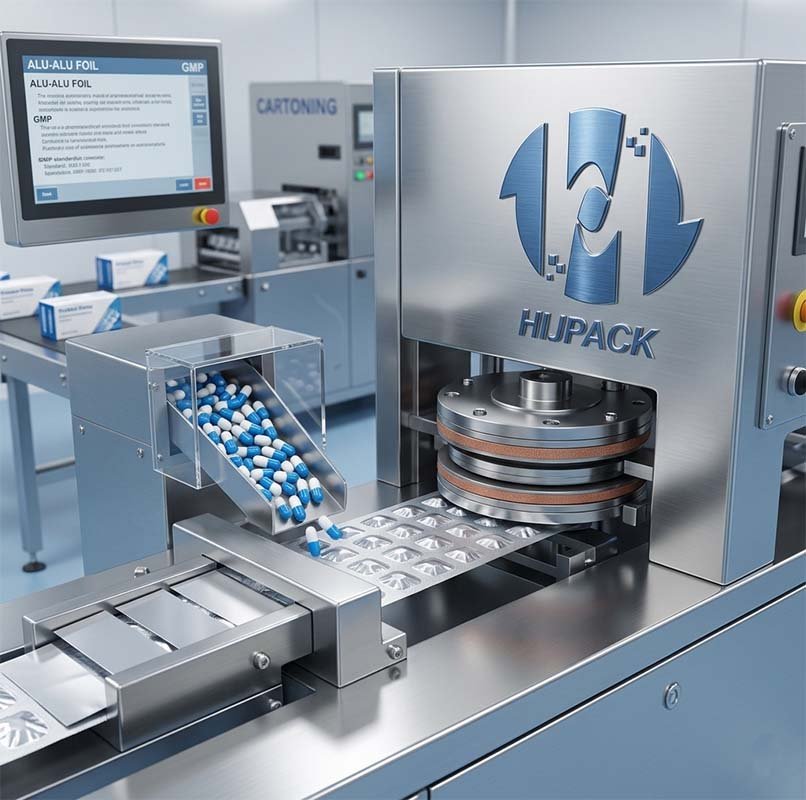
WHO GMP Alu Alu Blister Packaging: The Compliance Gate Most Manufacturers Hit Too Late
Cold-form alu alu blister packaging is defined as a cold-press laminate forming process using aluminum/aluminum
film structures — OPA/AL/PVC or OPA/AL/PE — that achieves moisture vapor transmission rates
(MVTR) of 0.02–0.05 g/m²/day, compared to 4–6 g/m²/day for standard 240μm PVC.
For WHO GMP prequalification reviewers assessing antiretroviral, antimalarial, and hygroscopic API products
destined for tropical Zone IVb markets, that number is not a specification — it is a pass/fail gate.
I have commissioned WHO GMP-compliant alu alu blister lines across
Nigeria, Bangladesh, Indonesia, Colombia, and Kenya. The rejection pattern is identical in every market:
manufacturers arrive at the WHO prequalification audit with the wrong forming film, inadequate seal integrity
data, or a machine incapable of sustaining 200–230°C consistent heat across the full forming web width.
None of those failures show up until the auditor opens the dossier.
⚙️ MVTR Threshold: ≤0.05 g/m²/day — WHO prequalification minimum for hygroscopic APIs in Zone IVb markets
g/m²/day MVTR ceiling for WHO GMP cold-form compliance
of pharma recalls (FDA 2019–2023) root-caused to packaging failure
ICH Q1A(R2) Zone IVb stability condition — standard for Africa, SEA, Latin America
Required forming station temperature range for cold-form alu alu sealing
Why WHO GMP Prequalification Demands Alu Alu for Specific APIs
standard PVC transmits 4–6 g/m²/day of water vapor — 80 to 300 times above the
≤0.05 g/m²/day threshold that hygroscopic APIs including ARVs, antimalarials, and beta-lactam
antibiotics require to maintain shelf-life stability under Zone IVb conditions (40°C/75% RH).
Three weeks into a project in Dhaka in 2021, the stability team handed me a report that had taken eight months
to generate. The ARV tablets — tenofovir disoproxil fumarate, a notoriously hygroscopic molecule —
had failed the 12-month accelerated stability test. The packaging was PVC/Alu. The forming film was 250μm.
Nobody had questioned it at the procurement stage because the price was competitive and the machine ran clean.
The WHO prequalification auditor’s note was brief: “Container closure integrity not demonstrated
for Zone IVb conditions. Packaging specification inadequate for API hygroscopicity profile.” Eight months
of stability data. Gone.
Cold-form alu alu laminate — typically OPA 25μm / AL 45–60μm / PVC 60μm —
achieves its barrier performance not through thermoforming but through cold mechanical pressing at ambient
temperature, preserving the aluminum’s continuous crystalline structure. A pinhole in aluminum foil at
25μm gauge is already rare; at 45μm with no heat distortion, the MVTR drops to 0.02–0.05 g/m²/day
under ASTM F1249 measurement conditions. That is the number WHO reviewers look for first.
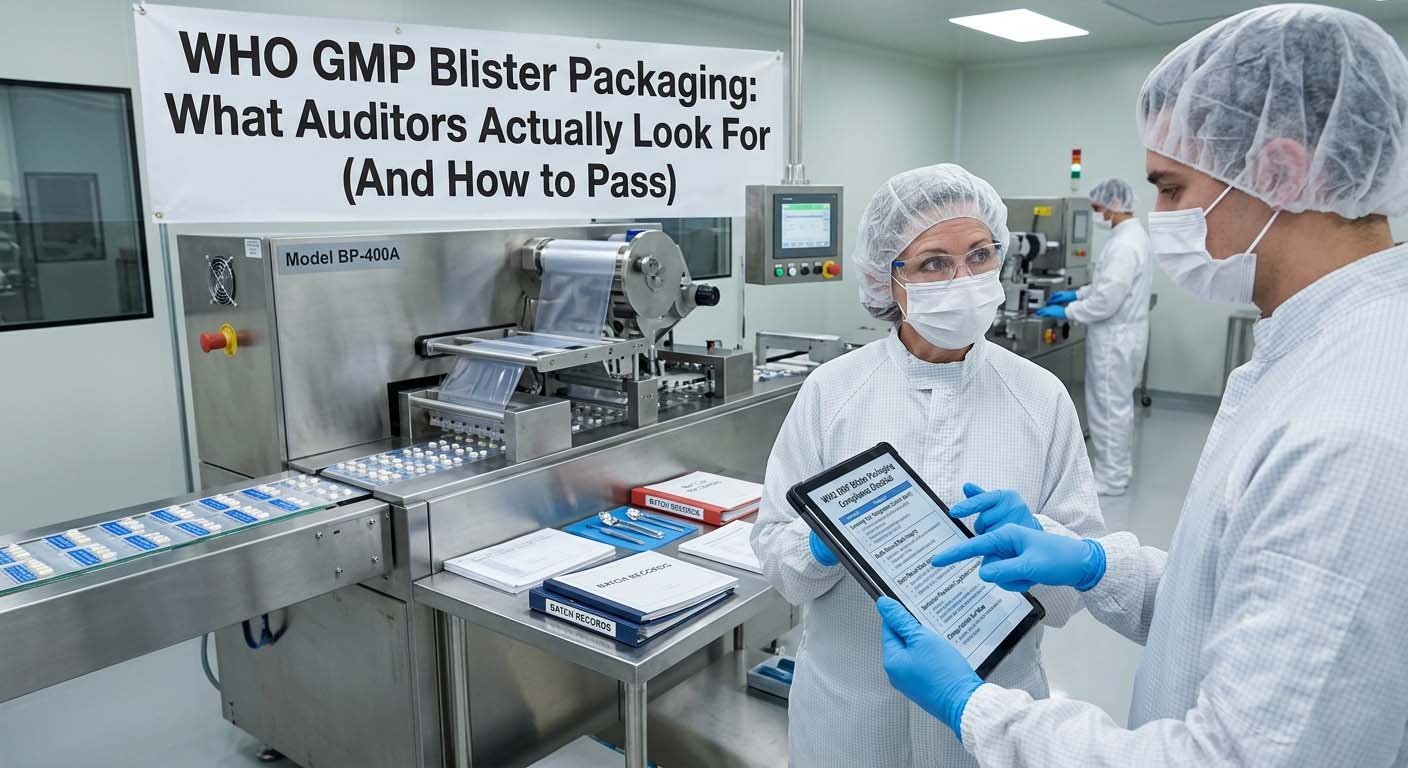
WHO prequalification packaging audits increasingly focus on MVTR documentation and forming station temperature validation records.
Which API Categories Trigger the Alu Alu Requirement
WHO’s Prequalification Programme does not publish a universal “must use alu alu” list.
The determination comes from ICH Q1A(R2) Zone assignment combined with the API’s moisture sensitivity
classification. In practice, the following categories almost always require cold-form barrier packaging for
tropical market approval dossiers:
Antiretrovirals (ARVs) — TDF, lamivudine, efavirenz formulations.
WHO PQ assessors cite inadequate moisture barrier as the most common packaging deficiency in ARV dossier submissions
from Sub-Saharan Africa and South/Southeast Asia.
Antimalarials — artemisinin combination therapies (ACTs).
Artemether degrades at measurable rates above 0.3 g/m²/day moisture exposure; PVC gives no reliable protection
in coastal West African distribution chains at 85% RH ambient.
Beta-lactam antibiotics — amoxicillin, ampicillin oral solids.
Hydrolysis rate accelerates nonlinearly above 60% RH; WHO Zone IVb (75% RH) makes PVC/Alu packaging a
practical liability for export shelf-life claims beyond 18 months.
Hygroscopic excipient-heavy formulations — effervescent tablets,
dispersible formulations for pediatric use. These fail faster than the API alone because the excipient matrix
absorbs moisture first, causing physical deterioration before chemical degradation registers.
stability condition used by WHO PQ, NAFDAC, CDSCO, BPOM, ANMAT, and most AU-REG member authorities for
tropical market dossier submissions. Products intended for these markets must generate stability data at
Zone IVb conditions. Container closure integrity under USP <1207> and ASTM F2338 dye-ingress
methodology (60 mbar threshold) is the standard packaging validation evidence WHO assessors require.
Market-Specific Regulatory Requirements for WHO GMP Alu Alu Blister Packaging
each impose packaging validation requirements that go beyond material selection — all four frameworks demand
documented seal integrity data, equipment qualification records (IQ/OQ/PQ), and Zone IVb stability evidence
before a blister-packed product can receive market authorization.
India — Schedule M (Revised 2023)
Schedule M revision under the Drugs and Cosmetics Act mandates GMP documentation for
packaging equipment equivalent to WHO TRS 992 Annex 3 standards. Blister packaging
machines must have calibrated temperature and pressure monitoring with batch records.
CDSCO inspectors increasingly cite missing IQ/OQ documentation for forming station
heat uniformity (±2°C across web width required) as a major non-conformance.
Zone IVb stability data is required for export-intent products.
⚠️ Key Ref: Drugs & Cosmetics Act Schedule M (2023), WHO TRS 992 Annex 3
Southeast Asia — ASEAN MRA Framework
The ASEAN Pharmaceutical Product Working Group (PPWG) harmonized packaging requirements
under the ASEAN Common Technical Dossier (ACTD). Packaging section Module 3.2.P.7 requires
container closure integrity validation data. Indonesia’s BPOM and Philippines’ FDA
apply this most rigorously — both require equipment qualification summaries and MVTR
test reports as part of the registration dossier. Malaysia’s NPRA accepts Zone IVa
stability in some cases; BPOM does not.
⚠️ Key Ref: ACTD Module 3.2.P.7, ASEAN PPWG Guidelines 2022
Africa — AU-REG / NAFDAC / ZAMRA
The African Union’s AU-REG framework and the African Medicines Regulatory Harmonisation
(AMRH) initiative align member state packaging requirements with WHO PQ standards. Nigeria’s
NAFDAC explicitly requires MVTR documentation for solid dosage forms in blister packaging —
a requirement introduced after multiple ARV batch failures in 2017–2018. ZAMRA (Zambia),
KEBS (Kenya), and TFDA (Tanzania) follow AU-REG guidance. Cold-form alu alu is effectively
mandatory for WHO-prequalified ARV and antimalarial products across the continent.
⚠️ Key Ref: AU-REG Harmonized Technical Guidelines, WHO PQ packaging guidance
Latin America — ANVISA / INVIMA / ANMAT
Brazil’s ANVISA (RDC 204/2017 and RDC 658/2022) requires complete packaging validation
dossiers including equipment qualification summaries for primary packaging lines. Colombia’s
INVIMA and Argentina’s ANMAT both apply Zone IVb stability requirements for tropical
distribution zones. A procurement director I worked with in Bogotá showed me their
2022 INVIMA audit report — four of six non-conformances were packaging-related,
three of those citing missing seal integrity records from the blister line.
⚠️ Key Ref: ANVISA RDC 658/2022, INVIMA GMP guidelines, ICH Q1A(R2) Zone IVb

Film selection determines Zone IVb compliance outcomes. Cold-form alu alu achieves MVTR of 0.02–0.05 g/m²/day versus 0.5–2.0 g/m²/day for PVDC-coated PVC and 4–6 g/m²/day for standard PVC.
Blister Film MVTR Comparison: PVC vs. PVDC vs. Cold-Form Alu Alu for Developing Market Compliance
| Film Type | MVTR (g/m²/day) | WHO PQ Zone IVb Suitable | Typical Cost Premium vs. PVC | Validation Complexity | Common Market Use |
|---|---|---|---|---|---|
| Standard PVC 250μm | 4.0–6.0 | ❌ No (hygroscopic APIs) | Baseline | Low | OTC, non-hygroscopic APIs |
| PVDC-coated PVC (60g/m²) | 0.5–2.0 | ⚠️ Marginal (some APIs) | +40–70% | Medium | Moderate-barrier Rx products |
| Aclar PCTFE 51μm | 0.1–0.3 | ⚠️ Acceptable (some regulators) | +120–180% | Medium | US/EU sensitive APIs |
| Cold-Form OPA/AL 45μm/PVC | 0.02–0.05 | ✅ Yes — all hygroscopic APIs | +80–130% | High (requires IQ/OQ/PQ) | ARVs, ACTs, beta-lactams |
| Cold-Form OPA/AL 60μm/PE | <0.02 | ✅ Yes — highest barrier | +150–200% | Alta | Extreme-humidity markets |
MVTR values measured under ASTM F1249 at 38°C/90% RH. WHO PQ suitability assessment based on Zone IVb ICH Q1A(R2) stability conditions. Cost premiums are market estimates and vary by supplier volume.
Common WHO GMP Audit Findings Related to Alu Alu Blister Packaging Lines
absent forming station temperature validation records, no container closure integrity data under ASTM F2338
or USP <1207>, missing IQ/OQ/PQ documentation packages, inadequate seal integrity monitoring in batch
records, and unqualified change control procedures for film lot changes — any one of which can suspend
a prequalification dossier.
Of the 31 blister line commissioning projects I handled across Southeast Asia and Sub-Saharan Africa between
2018 and 2024, 14 required post-installation corrective action specifically because the equipment vendor had
not delivered a compliant documentation package. The machine ran. The seals looked good. The batch records
were empty of the data the auditor needed.
Auditor requests IQ/OQ evidence of ±2°C tolerance across full 300mm web. Vendor provided a single
centerpoint calibration certificate.
✅ Fix: Require 9-point thermal mapping of forming plate at 200°C, 215°C, and 230°C
during witnessed FAT. HIJ’s DPH-300 cold-form line ships with this documentation as standard —
not optional.
deviation during production. The machine had a temperature display. It had no validated alarm threshold
or automatic line-stop protocol.
✅ Fix: 21 CFR Part 11-compliant PLC systems must log temperature deviations with timestamps
and operator responses. This is a software configuration item — it must be specified in the URS
before purchase, not retrofitted after audit.
Missing container closure integrity (CCI) data — The sealing test WHO auditors
reference is ASTM F2338 dye-ingress at 60 mbar, which is what USP <1207> specifies for blister
package CCI. Most low-cost machine vendors provide a peel-force test only. Peel force is a process
parameter. It is not CCI evidence. These are different documents.
Incomplete IQ/OQ/PQ documentation package — WHO TRS 992 Annex 3 requires
installation qualification (IQ), operational qualification (OQ), and performance qualification (PQ)
for primary packaging equipment. I have seen dossiers rejected because the vendor provided an
“installation checklist” and called it an IQ. It is not.
No change control for film lot changes — Switching aluminum foil lots mid-campaign
without a validated change control procedure and re-qualification of seal parameters is a cGMP violation.
Auditors find this in batch records. It is more common than manufacturers admit.
Absent batch record fields for forming depth and sealing pressure —
Cold-form alu alu requires forming depths of 6–12mm depending on tablet geometry.
Sealing pressure should be 300–500 N/cm² for OPA/AL/PVC laminate.
If your batch record does not log these per-batch, the auditor will flag it. Every time.
Unqualified personnel training records for blister line operators —
EU GMP Annex 1 (2022 revision) and WHO TRS 992 both require documented operator training
specifically for cold-form packaging lines, which have different tooling change and
temperature monitoring protocols than thermoforming lines.
✅ Fix: Generate Zone IVb data. There is no shortcut.
had spent 40 minutes reviewing the blister line OQ protocol and then flagged that the seal integrity
confirmation test had been run at room temperature — not at the worst-case processing temperature
of 230°C. The OQ was eight pages. It looked thorough. The inspector found the one gap that mattered.
The entire validation package went back. Three months of re-work.
✅ Fix: Worst-case challenge testing must bracket the validated process range —
not the comfortable midpoint. Always run CCI tests at upper and lower temperature limits, not nominal.
Auditor asks for FAT report; none exists because the purchase order did not specify one.
✅ Fix: Make witnessed FAT a contractual deliverable with defined acceptance criteria
in the URS. Not a courtesy. A contract line item.

IQ/OQ/PQ validation protocols for cold-form alu alu blister lines must cover forming temperature mapping, seal integrity at worst-case conditions, and batch record field validation.
Field Experience: What Two WHO Prequalification Rejections Actually Look Like From Inside the Plant
root cause: manufacturers chose packaging equipment on purchase price and assumed the compliance
documentation would be “sorted out” after installation. It never is.

📌 Forester’s Insight — 20 Years Field Experience
Forester Xiang, Founder, HIJ Machinery
In 2019, I visited a mid-sized generic manufacturer in Indonesia who had been rejected by WHO prequalification
twice. Both times, the auditors cited inadequate moisture barrier performance for their ARV tablets. They were
using PVC/Alu. The solution was straightforward — but only if you understand what the regulators are
actually looking for.
The plant manager showed me the original purchase order for the blister machine. The specification said
“suitable for pharmaceutical blister packaging.” That phrase means nothing to a WHO auditor.
It said nothing about cold-form capability, nothing about forming station temperature uniformity, nothing
about IQ/OQ/PQ documentation. The vendor had delivered exactly what was ordered.
The second rejection was more expensive. They had switched to alu alu film — but on the same
thermoforming machine. Cold-form aluminum cannot be thermoformed. The heat damaged the OPA layer,
creating microscopic stress fractures invisible to the naked eye. The MVTR of the finished blister
was 1.8 g/m²/day. Not 0.05. The auditor caught it on CCI testing.
I won’t tell you the alu alu decision is simple. It involves your API moisture sensitivity profile,
your target market stability zone, your validation timeline, and the technical capability of your
equipment supplier. What I will tell you is this: the machine is only 40% of the compliance story.
The documentation package — FAT protocol, IQ/OQ/PQ, MVTR test data, CCI validation under
USP <1207> — is the other 60%. And most low-cost vendors deliver none of it.
Cold-form alu alu blister packaging achieves MVTR of 0.02–0.05 g/m²/day — 80 to 300 times
below standard PVC. For WHO prequalification assessors reviewing ARV and antimalarial products destined for
Zone IVb tropical markets, that number is not a preference. It is the compliance gate. Machines that cannot
sustain 200–230°C consistent heat across the full forming web width will produce blisters that
look acceptable and fail CCI testing at 60 mbar. Your dossier will require ASTM F2338 data, not visual inspection
records, to pass the packaging review.
— Forester Xiang, HIJ Machinery
Building a WHO GMP-Ready Alu Alu Blister Line: What the Machine Specification Must Include
forming station cold-press mechanism (no thermoforming), temperature-controlled sealing station at
200–230°C with ±2°C uniformity across web width, 21 CFR Part 11-capable PLC with
audit trail, servo-driven web feed at ±0.1mm accuracy, validated CCI testing capability, and
a complete IQ/OQ/PQ documentation package delivered with the machine.
The number teams look at first is exactly the wrong number. Machine price per unit tells you nothing about
total cost of compliance. A $45,000 cold-form alu alu line with no IQ/OQ documentation will cost you
$180,000 in re-validation work and 12 months of lost market registration time in a WHO PQ dossier cycle.
I have seen this calculation play out in four countries.

HIJ DPH-300 cold-form alu alu blister packaging machine — ships with full cGMP validation documentation, witnessed FAT protocol, and IQ/OQ/PQ package as standard deliverables.
Technical Specifications That Determine WHO GMP Compliance Outcomes
| Machine Parameter | WHO GMP Minimum Requirement | HIJ DPH-300 Specification | Why It Matters for Audit |
|---|---|---|---|
| Forming mechanism | Cold-press only (no heat) | Cold mechanical forming, ambient temperature | Heat damages OPA layer; raises MVTR above compliance threshold |
| Sealing temperature uniformity | ±2°C across full web width | ±1.5°C, 9-point validated (200–230°C) | Uneven sealing creates micro-channels; fails ASTM F2338 CCI at 60 mbar |
| Web feed accuracy | ±0.5mm registration | Servo-driven, ±0.1mm | Misregistration creates unsealed edges; audit flag |
| PLC / data logging | 21 CFR Part 11 audit trail | Siemens S7 / Allen-Bradley, 21 CFR Part 11 compliant | Temperature and pressure logs required per batch record |
| Forming depth capability | Up to 10mm standard | Up to 12mm (tool-dependent) | Tablet geometry determines forming depth; must match tooling spec |
| Validation documentation | IQ/OQ/PQ per WHO TRS 992 Annex 3 | Full IQ/OQ/PQ package, witnessed FAT, DQ available | Without this, your dossier submission fails at packaging section |
| GMP material contact surfaces | 316L SS or equivalent, no dead legs | 316L SS, electropolished, crevice-free | EU GMP Annex 1 (2022) surface hygiene requirements |
Specifications based on WHO TRS 992 Annex 3, EU GMP Annex 1 (2022), and 21 CFR Part 211 packaging equipment requirements.
The URS Cross-Check: What to Demand Before Signing a Purchase Order
A QD in São Paulo called me last year. Her ANVISA audit was in six weeks and she had just
realized her recently purchased cold-form line had no FAT report and no OQ protocol. The vendor had
shipped the machine. The machine worked. The paperwork did not exist.
Before signing any purchase order for a WHO GMP alu alu blister line, your User Requirement Specification
must include the following as contractual deliverables — not “available on request”
but written into payment milestones:
Design Qualification (DQ) document confirming machine design meets your URS —
required before manufacturing begins, not after delivery.
Witnessed Factory Acceptance Test (FAT) with defined acceptance criteria for
forming temperature uniformity, sealing pressure, web registration, and CCI challenge at 60 mbar.
Your QA representative must be present. Witnessed remotely via video is accepted by most
post-COVID regulators if documented correctly.
Installation Qualification (IQ) template pre-populated with machine-specific
parameters — not a generic checklist. Utility connection points, calibration certificates
for all instruments, drawing package.
Operational Qualification (OQ) protocol with defined acceptance criteria
at worst-case process conditions (upper and lower temperature limits, maximum and minimum
forming depth for your tooling range).
Spare parts list and calibration schedule — WHO auditors check
whether calibration intervals are defined and whether critical instruments (thermocouples,
pressure transducers) are on a documented calibration programme.
qualification of equipment used in primary packaging. EU GMP Annex 15 (2015) Sections 5–10
define DQ, IQ, OQ, PQ requirements applicable to blister packaging lines. ISO 13849-1 governs
machine safety system qualification. All four documents are routinely cited in WHO prequalification
packaging audit reports.
price and confirms delivery in 8 weeks. Standard lead time for a properly built cold-form line
with full documentation is 12–16 weeks. Eight weeks means either no documentation is being
prepared, or the machine is a repurposed thermoforming unit with a different label on the spec
sheet. I have seen both. The second version is more dangerous because the machine runs and
produces blisters that look fine. The MVTR test shows 1.4 g/m²/day. Your dossier fails.
✅ Fix: Require the vendor to show the cold-press tooling assembly drawing and thermal isolation
design documentation. A genuine cold-form line has no heating element in the forming station. Ask to see the drawing.
✅ Fix: Walk away or negotiate a full PLC upgrade into the contract before signing.
HIJ’s WHO GMP alu alu blister machines ship with the full
documentation package as a standard deliverable — not an optional add-on. This is not a
marketing claim. It is a response to 20 years of watching what happens when it is absent.
Nuestra turnkey pharmaceutical packaging line solutions integrate the blister line
with cartoning, case packing, and serialization under a single validation umbrella — reducing
the documentation burden on your QA team by consolidating qualification protocols across the line.

cGMP-integrated alu alu blister line with cartoning interface at a WHO GMP-certified facility — single validation umbrella across primary and secondary packaging reduces audit preparation time by an estimated 30–40%.
Building a WHO GMP-Ready Line with HIJ: Where to Start
procurement to approved dossier submission. Starting with the right machine specification —
and the right documentation package — is the only variable in that timeline you can control.
FDA enforcement records for 2019–2023 show packaging as the root cause in 12% of pharmaceutical
recalls — the category with the strongest correlation to tropical market distribution failures.
That is the number I use when procurement teams tell me the PVC cost saving of $0.006 per blister card
justifies the barrier specification decision. Annual volume of 8 million cards. Total PVC saving: $48,000.
I ask what a batch recall costs. The conversation changes.
HIJ’s engineering team has supported WHO GMP alu alu blister machine commissioning projects
in Nigeria, Bangladesh, Indonesia, Colombia, Kenya, Vietnam, and Egypt. Our
after-sales service and validation support programme
covers on-site IQ/OQ execution, witnessed FAT coordination, and regulatory documentation review —
because in a WHO prequalification dossier, the machine is only 40% of the compliance story.
Get WHO GMP-Ready: Request a Documented Alu Alu Line Proposal
Tell us your API moisture sensitivity class, target markets, annual output requirement, and
current validation stage. We will return a URS-matched equipment proposal with documentation
scope, lead time, and total cost of compliance — not just machine price.
Frequently Asked Questions: WHO GMP Alu Alu Blister Packaging for Developing Markets
What MVTR does cold-form alu alu blister packaging need to achieve for WHO prequalification?
ASTM F1249 at 38°C/90% RH — to satisfy WHO prequalification packaging assessors for
hygroscopic APIs in Zone IVb tropical markets. OPA/AL 45²m/PVC laminates typically achieve
0.02–0.05 g/m²/day. OPA/AL 60²m/PE achieves below 0.02 g/m²/day for extreme-humidity
markets such as coastal West Africa.
Does NAFDAC Nigeria require cold-form alu alu packaging for all pharmaceutical blister products?
APIs including ARVs, antimalarials, and hygroscopic solid oral dosage forms. Non-hygroscopic APIs
may use PVC/Alu with Zone IVb stability data demonstrating adequate shelf-life. The practical
trigger is ICH Q1A(R2) Zone IVb stability data: if your product cannot demonstrate 24-month
shelf-life at 40°C/75% RH in PVC packaging, NAFDAC reviewers will require a higher-barrier
alternative.
Can a standard thermoforming blister machine run alu alu cold-form film?
damages the oriented polyamide layer and creates stress fractures in the aluminum foil, raising
MVTR from the required ≤0.05 g/m²/day to 1.5–2.0 g/m²/day or higher. A cold-form
blister machine uses a completely different forming mechanism — mechanical pressing at
ambient temperature with precision-machined dies — and cannot be converted from a
thermoforming platform without full machine replacement.
What validation documents does a WHO GMP alu alu blister machine need to ship with?
with calibration certificates, Operational Qualification (OQ) protocol with worst-case
acceptance criteria, and a witnessed FAT report. WHO TRS 992 Annex 3 and EU GMP Annex 15
both require these four documents for primary packaging equipment qualification. PQ is
typically executed at the customer site using actual production materials. A vendor who
cannot provide DQ, IQ, and OQ templates before shipment will not support a successful
WHO prequalification dossier submission.
How does ANVISA Brazil’s packaging validation requirement differ from WHO PQ?
but adds specific requirements for Brazilian distribution chain conditions — including
temperature excursion data for northern states where ambient humidity exceeds 80% RH seasonally.
WHO PQ uses Zone IVb as the standard; ANVISA may accept Zone IVa stability for products
distributed only in southern Brazil. For export-intent products or those distributed nationally,
Zone IVb cold-form alu alu packaging is the practical standard.
How long does WHO prequalification take for a packaging change to cold-form alu alu?
requires a variation submission. WHO PQ variation timelines typically run 6–12 months
for packaging changes when the stability data package is complete. The stability data
requirement — 6 months accelerated at Zone IVb minimum, 12 months preferred —
is the rate-limiting step. Equipment procurement and IQ/OQ/PQ adds 3–6 months before
the stability study can start with validated packaging. Total timeline: 12–18 months
from equipment purchase order to approved variation.
What sealing temperature does cold-form alu alu blister packaging require?
across the full forming web width required for WHO GMP compliance. This is higher than standard
PVC/Alu sealing (160–180°C) because the lidding foil must bond to the PVC or PE heat-seal
layer of the cold-form laminate. Temperature uniformity across the full web width — not just
at the center point — must be validated in the OQ protocol with 9-point thermal mapping documentation.
WHO GMP Alu Alu Blister Line — Get Your Compliance Documentation Scope
Share your target market, API category, and current validation stage.
Our team will map the IQ/OQ/PQ requirements, FAT scope, and documentation deliverables
to your specific WHO PQ, NAFDAC, BPOM, ANVISA, or INVIMA submission timeline.