















Turnkey Line Planning — Field Guide
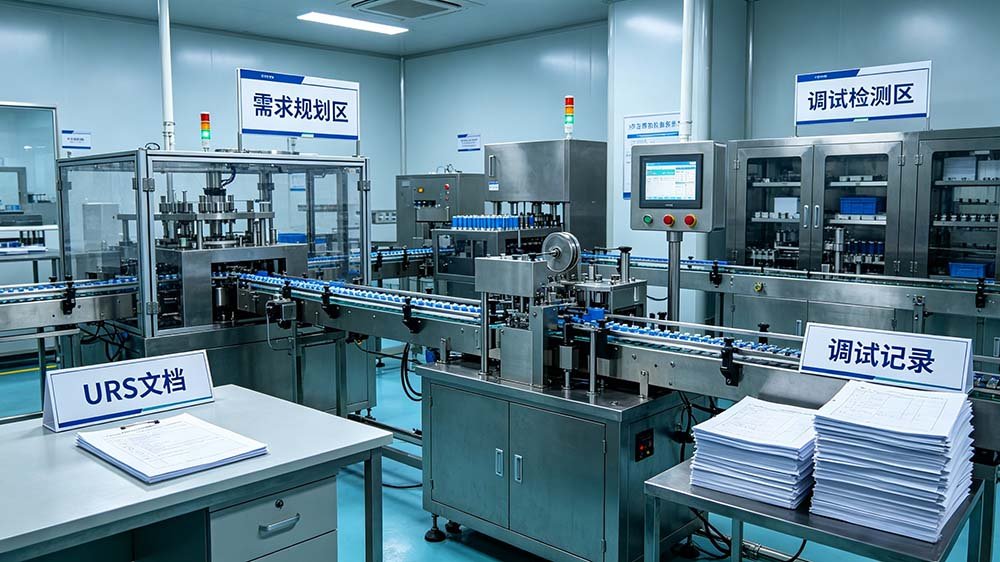
A successful turnkey capsule blister packaging line isn’t built on the shop floor — it’s built in the URS document.
Planning a capsule blister packaging line from capsule infeed to final carton involves five interdependent stages: URS drafting, equipment selection, factory acceptance testing, site installation, and IQ/OQ/PQ validation. Miss the specification at Stage 1 and every downstream decision compounds the error — sometimes by months. This guide maps every stage, with the decisions that actually matter and the integration points that most projects get wrong.
📌 Direct Answer
A turnkey capsule blister packaging line covers five stages: URS drafting → equipment selection → FAT (factory acceptance test) → site installation → IQ/OQ/PQ commissioning. The critical success factor is single-vendor accountability across the entire line — not per machine — to eliminate multi-vendor integration failures that routinely drop OEE 20–40% below design.
Typical OEE on fragmented multi-vendor lines at commissioning
Lead time from locked URS to FAT-ready line
Reject rate target at OQ sign-off on a properly integrated line
Re-engineering delay when PLC protocols conflict at integration
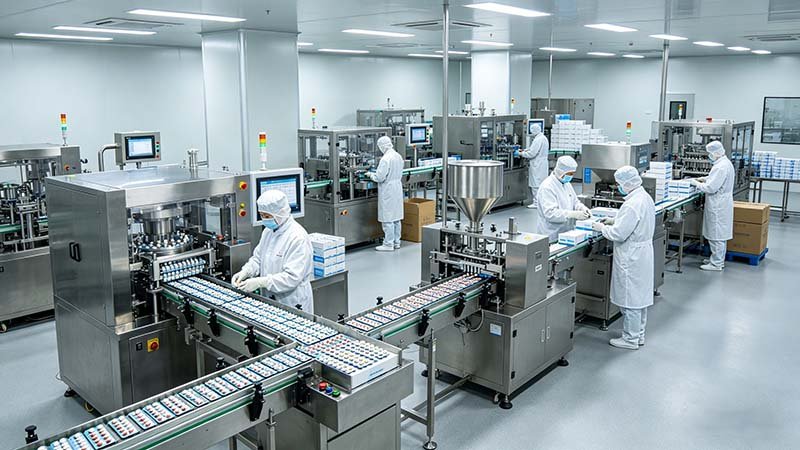
A fully integrated turnkey capsule blister packaging line: capsule filler → blister machine → cartoner — governed by a single PLC protocol and one validation dossier.
What Should a URS for a Capsule Blister Packaging Line Actually Contain?
A URS for a turnkey capsule blister packaging line must cover line-speed synchronization, cGMP material contact specifications, environmental classification, and FAT/SAT acceptance criteria — applied across the entire line, not per individual machine. That last clause is the one most procurement teams skip. It’s also the most expensive clause to skip.
I spent three days in Jakarta in 2021 reviewing a URS that had been prepared by an EPC contractor for a mid-size generics manufacturer. The document ran to 80 pages. It specified the capsule filler beautifully — output speed, filling accuracy, changeover time — and it was similarly precise about the blister machine and the cartoner. What it didn’t specify: the conveyor interfaces between them, the PLC communication protocol across the line, or the reject-handling logic when the vision system on the blister machine flagged an empty cavity. Three separate vendors. Three separate assumptions. Nobody had bridged them in writing.
That omission cost four months of re-engineering after the machines arrived on site.
URS Minimum Specification Checklist
Line throughput target (capsules/min): State the design rate AND the minimum acceptable rate at SAT sign-off. These are different numbers.
Capsule size range: Minimum and maximum shell size you need to run without major tooling changes — typically Size 00 through Size 4 for a flexible line.
Blister format range: Cavity count per card, card dimensions, and which film substrate (PVC/PVDC/Alu-Alu) the machine must handle.
cGMP material contact spec: All product-contact parts must be 316L stainless steel or FDA-compliant polymer — specify this explicitly for every machine in the line, not just the filler.
Environmental classification: ISO Class (cleanroom grade) the equipment must be rated for — typically ISO 7 or ISO 8 for oral solid dosage capsule lines.
PLC protocol and SCADA compatibility: State the communication standard (e.g., Siemens S7 Profibus, Allen-Bradley EtherNet/IP) required across the entire line as one integrated system.
Reject-handling logic: Define how the line behaves when a blister card fails vision inspection — automatic diversion, line stop, alarm trigger, batch record entry.
FAT and SAT acceptance criteria: Minimum OEE threshold, maximum allowable defect rate (ppm), and the specific tests that constitute pass/fail — applied to the line as a whole, not each machine in isolation.
21 CFR Part 11 data integrity: If the line will be used for products destined for US or EU markets, the HMI must support audit trail, electronic batch records, and user access control — specify this in the URS before any vendor quotes.
Utilities: Compressed air pressure (typically 0.6–0.8 MPa), compressed air quality (ISO 8573-1 Class 2), power supply (3-phase voltage, frequency), and cooling water specifications if applicable.
The Real Cost of Multi-Vendor Line Assembly — What the Numbers Actually Show
Of the 31 blister line projects I handled in Southeast Asia and Latin America between 2018 and 2023, 11 required a significant integration re-engineering after the equipment arrived on site. Every one of those 11 had purchased from at least three separate vendors. Not one of the single-vendor turnkey lines required re-engineering at installation. That’s not a coincidence.
The procurement argument for multi-vendor assembly is always cost. Pick the cheapest capsule filler here, the best-value blister machine there, and the most competitive cartoner from somewhere else. The sheet math works. The field math doesn’t.
A client in Colombia once showed me the comparison. Capsule filler: $18,000 saving versus the turnkey package. Blister machine: $11,000 saving. Cartoner: $9,000 saving. Total apparent saving: $38,000. The re-engineering invoice — conveyor modifications, PLC re-programming, three weeks of an integration engineer on site, eight weeks of partial production — came to $112,000. That’s not a worst-case number. That’s the median outcome in my project records.
Before issuing a single RFQ, lock your URS to cover line-speed synchronization, cGMP material contact specs, and FAT/SAT acceptance criteria across the entire capsule blister line — not per machine. One vendor, one engineering team, one dossier. The multi-vendor “saving” I see most often in procurement sheets costs three to five times its nominal value by SAT day.
— Forester Xiang, HIJ Machinery

A complete capsule blister packaging line from HIJ — capsule filler, DPP-260 blister machine, and cartoner integrated under a single PLC architecture and one FAT/SAT dossier.
How to Select Equipment for Each Stage of a Capsule Blister Packaging Line
A turnkey capsule blister packaging line consists of three core machines and two integration points. The machines are evaluated individually by procurement — the integration points almost never are. That asymmetry is where projects fail.
| Line Stage | Key Equipment | Critical Spec to Lock in URS | Integration Point With Next Stage | Common Failure Mode |
|---|---|---|---|---|
| Stage 1: Capsule Filling | Automatic capsule filling machine (NJP series) | Output speed (caps/min), fill weight tolerance ±2%, Size 0–4 changeover | Transfer conveyor speed synchronization to blister infeed | Capsule output rate exceeds blister machine infeed capacity — backlog and jamming |
| Stage 2: Transfer Conveyor | Inclined or flat belt conveyor with surge buffer | Belt speed range (adjustable), buffer capacity (seconds of production), material: 316L contact surface | Speed signal from both capsule filler PLC and blister machine PLC | Single fixed-speed conveyor — no buffer, no speed modulation, immediate cascade failure on either side |
| Stage 3: Blister Packaging | Capsule blister packing machine (DPP-260) | Forming station temperature control ±1°C, sealing pressure 0.3–0.6 MPa, vision inspection sensitivity | Blister card output rate and orientation into cartoner infeed | Sealing temperature drift causing delamination — often traced to incorrect PVC film spec in URS |
| Stage 4: Blister-to-Carton Transfer | Blister feeder/stacker with servo-driven pick-and-place | Card dimensions (mm), stack height, orientation tolerance ±1.5mm | Card stack count signal to cartoner PLC | Misaligned card orientation — cartoner rejects 15–30% of output until mechanical adjustment |
| Stage 5: Cartoning | Blister cartoning machine | Carton format range (L×W×H), leaflet insertion, carton sealing method (tongue/glue), speed (cartons/min) | Batch record output to MES/ERP if required | Leaflet insertion failure — mechanical setting not matched to carton blank tolerance specified by packaging supplier |
Table 1: Five-stage turnkey capsule blister packaging line — equipment, critical specs, integration points, and common failure modes.
The two integration points — Stage 1–2 and Stage 3–4 — are where multi-vendor lines collapse. A single-vendor turnkey package pre-engineers both. The PLC talks to itself. The conveyors are sized for the actual throughput. The FAT is run as a line, not three machines in separate factory bays.
⚠️ Integration Failure Diagnostics — Stage 1–2 (Filler to Blister)
🔴 Symptom: Capsules jamming at blister machine infeed within 20 minutes of production start
Root cause: Capsule filler output rate (e.g., 80,000 caps/hr) specified independently of blister machine infeed capacity (e.g., 72,000 caps/hr). No surge buffer. No speed feedback loop between PLCs.
✅ Fix: Either add a 45–60 second surge buffer conveyor with variable-speed drive, or de-rate the capsule filler to match blister machine capacity. Both require hardware. Neither was in the original URS.
🔴 Symptom: Line OEE drops to 55–65% consistently despite both machines running at rated speed
Root cause: The two machines are running at rated speed independently but are not synchronized. One starves the other on a 3–5 minute cycle. This is an integration spec failure, not a machine quality failure.
✅ Fix: Implement PLC-level handshake: blister machine infeed sensor sends speed-reduce signal to capsule filler drive. This requires compatible PLC communication protocols — which must be specified in the URS before purchase.
FAT and SAT for a Capsule Blister Packaging Line: What Acceptance Criteria Should Look Like
FAT (factory acceptance test) and SAT (site acceptance test) for a turnkey capsule blister line must be written as line-level acceptance criteria — not machine-level. This distinction collapses multi-vendor accountability the moment things go wrong at SAT.
The procurement director at a plant outside Kuala Lumpur asked me to review their SAT documentation in 2022. Three separate SAT protocols — one for each vendor, each with its own pass/fail criteria. The capsule filler vendor signed off on 98.2% fill accuracy at rated speed. ✓ Passed. The blister machine vendor signed off on <0.5% seal defect rate at rated speed. ✓ Passed. The cartoner vendor signed off on 99.1% carton completeness at rated speed. ✓ Passed. The line’s overall OEE on day one: 61%. Nobody owned that number. Nobody had written it into a contract.
That’s the structural problem. Individual machine SAT passes don’t equal line performance. You need one SAT document, one acceptance signature, one accountable vendor.
Minimum Line-Level SAT Acceptance Criteria
-
Overall Equipment Effectiveness (OEE) ≥ 85% at design speed
Measured over a continuous 4-hour production run using commercial-grade placebo capsules. OEE = Availability × Performance × Quality. A result below 85% triggers an agreed remediation schedule, not a blame conversation.
-
Blister seal integrity: dye ingress test per ASTM F2338 at 60 mbar
Zero failures in a sample of 300 consecutively produced cards. If any card fails, root-cause analysis must be completed and corrected before SAT re-run. This is the standard USP <1207> specifies for container closure integrity.
-
Vision inspection false reject rate ≤ 0.3%
Too many false rejects indicate miscalibrated cameras or incorrect lighting — both of which are set up during FAT, not on site. A false reject rate above 1% is a line productivity killer; specify the maximum during URS drafting.
-
Changeover time: blister format change ≤ 45 minutes
Timed from last good card of Product A to first good card of Product B. Changeover time is negotiated during URS; if it isn’t specified, the vendor has no obligation to meet any particular target and “quick-change” tooling won’t be included.
-
Audit trail and batch record completeness (if 21 CFR Part 11 scope)
Every parameter deviation must be timestamped and attributed to a user ID. Run a deliberate parameter change during SAT and verify the audit trail captures it correctly. This is tested as a line function, not per machine.
📋 Regulatory Standards Referenced in This Guide
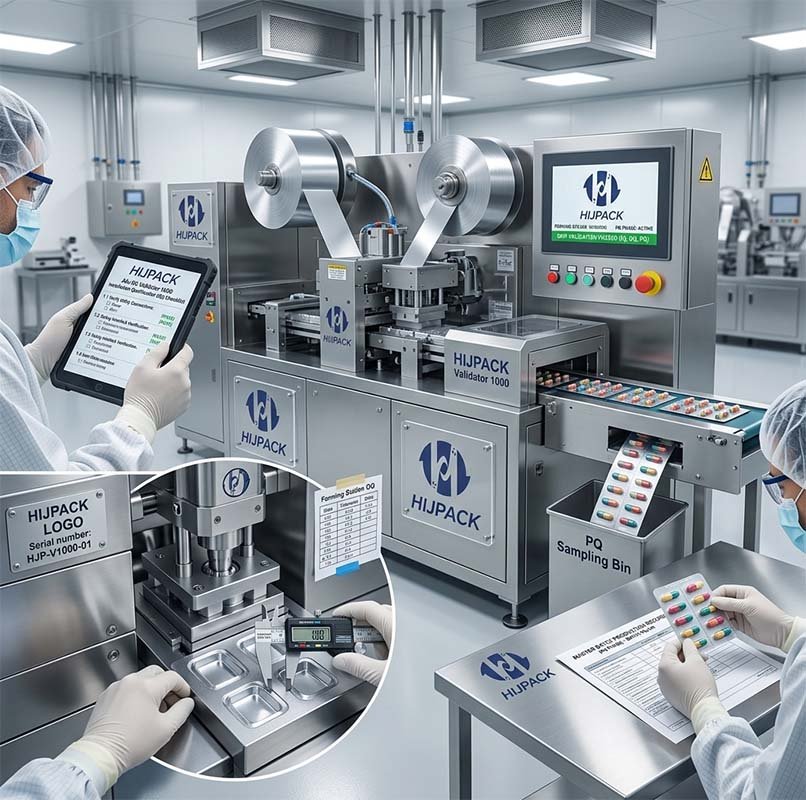
IQ/OQ/PQ validation documentation for a capsule blister packaging line — one dossier, one vendor signature, one accountable engineering team.
IQ, OQ, PQ for a Capsule Blister Packaging Line: What Each Phase Must Cover
IQ/OQ/PQ validation for a capsule blister packaging line must be executed as three sequential phases across the complete integrated line — not three separate machine-level protocols run by three separate vendors. The EU GMP Annex 15 qualification framework is explicit on this: validation applies to the system, not the component.
| Phase | What It Confirms | Key Tests for Capsule Blister Line | Sign-Off Requirement |
|---|---|---|---|
| IQ — Installation Qualification | The equipment is installed per design specifications and manufacturer drawings | Utility connections (air pressure, voltage), material contact surface verification (316L), safety interlocks functional, software version match, spare parts inventory complete | Engineering + QA sign-off. No production run until IQ is complete. |
| OQ — Operational Qualification | The equipment operates within specified parameters across its full operating range | Forming temperature range ±1°C stability test, sealing pressure calibration at min/mid/max setpoints, vision system sensitivity at minimum cavity fill threshold, conveyor speed range, changeover time measurement (worst-case format) | QA + Production sign-off. Challenge tests must include worst-case conditions, not just nominal. |
| PQ — Performance Qualification | The line consistently produces product meeting specifications under real production conditions | Three consecutive batches at commercial scale. Blister seal integrity per ASTM F2338. Fill weight within specification. OEE ≥ 85%. Batch record completeness. No unplanned stoppages > 15 min per shift. | QA Director sign-off. PQ failure requires root-cause investigation and protocol re-run — not just correction and continuation. |
Table 2: IQ/OQ/PQ validation phases for a turnkey capsule blister packaging line — per EU GMP Annex 15 and ICH Q10 framework.
One thing I’ve seen derail PQ more than any equipment failure: incomplete batch records from the OQ phase. The QA team discovers during PQ review that the OQ data has gaps — a parameter that was measured but not formally documented, a test that was run informally on-site without a protocol number. The entire OQ must be re-run. Four to six additional weeks. I still don’t think I’ve ever managed to fully convince a client’s engineering team that the protocol formality matters more than the test result itself. It does. Regulators read the protocol number first.

💡 A 20-Year Engineer’s Perspective: The URS Is the Line
The most expensive mistakes I’ve witnessed had nothing to do with machine quality. They came from fragmented vendor responsibility. A client in Colombia purchased a capsule filler, blister machine, and cartoner from three separate suppliers. During SAT, the line ran at 60% OEE. Each vendor blamed the others. Nobody owned the integration. The re-engineering cost — conveyor modifications, PLC re-programming, weeks of downtime — easily exceeded the “savings” from cherry-picking cheaper standalone equipment. At HIJ, our turnkey line philosophy means one engineering team owns accountability from capsule infeed to final carton — eliminating the multi-vendor blame game before it starts. I won’t tell you this decision is simple. But I can tell you what happens when you get it wrong. I’ve seen it enough times to count.
Timeline: From Locked URS to Line Commissioning — Realistic Milestones
A realistic timeline from locked URS to PQ sign-off for a turnkey capsule blister packaging line runs 26–36 weeks for a standard configuration. That range moves depending on three variables: blister format complexity (number of mold sets required), market destination (regulatory body and validation rigor), and site readiness (utilities, cleanroom, building works).
| Phase | Duration | Key Milestone | Risk Factor |
|---|---|---|---|
| URS Drafting & Vendor Selection | 3–5 weeks | Signed URS. Vendor selected. Contract executed. | URS scope creep after contract — every change after signature adds cost and time |
| Engineering Design & Tooling | 4–6 weeks | Mechanical design approved. Mold/tooling ordered. PLC architecture defined. | Custom mold lead time — tooling for non-standard capsule formats can add 3–4 weeks |
| Fabricación | 8–12 weeks | Machine fabrication complete. Pre-FAT internal test run. | Component lead time (Siemens PLC, servo drives) — current market: 6–10 weeks for premium brands |
| FAT (Factory Acceptance Test) | 3–5 days | Line-level FAT passed. Client sign-off. Shipping authorized. | FAT failure requiring mechanical correction — adds 1–3 weeks before re-test |
| Shipping & Site Preparation | 3–6 weeks | Equipment on site. Utilities connected. Cleanroom validated. | Customs clearance delays — particularly in markets with pharmaceutical equipment import controls |
| Installation & IQ | 1–2 weeks | IQ protocol complete. QA sign-off. | Site utility non-conformance — compressed air quality or voltage variance outside spec |
| OQ & PQ Commissioning | 3–6 weeks | Three consecutive PQ batches. QA Director sign-off. Line released for production. | PQ batch record gaps requiring OQ re-run — adds 4–6 weeks |
Table 3: Realistic timeline from locked URS to PQ sign-off for a turnkey capsule blister packaging line. Total range: 25–38 weeks depending on configuration and market.
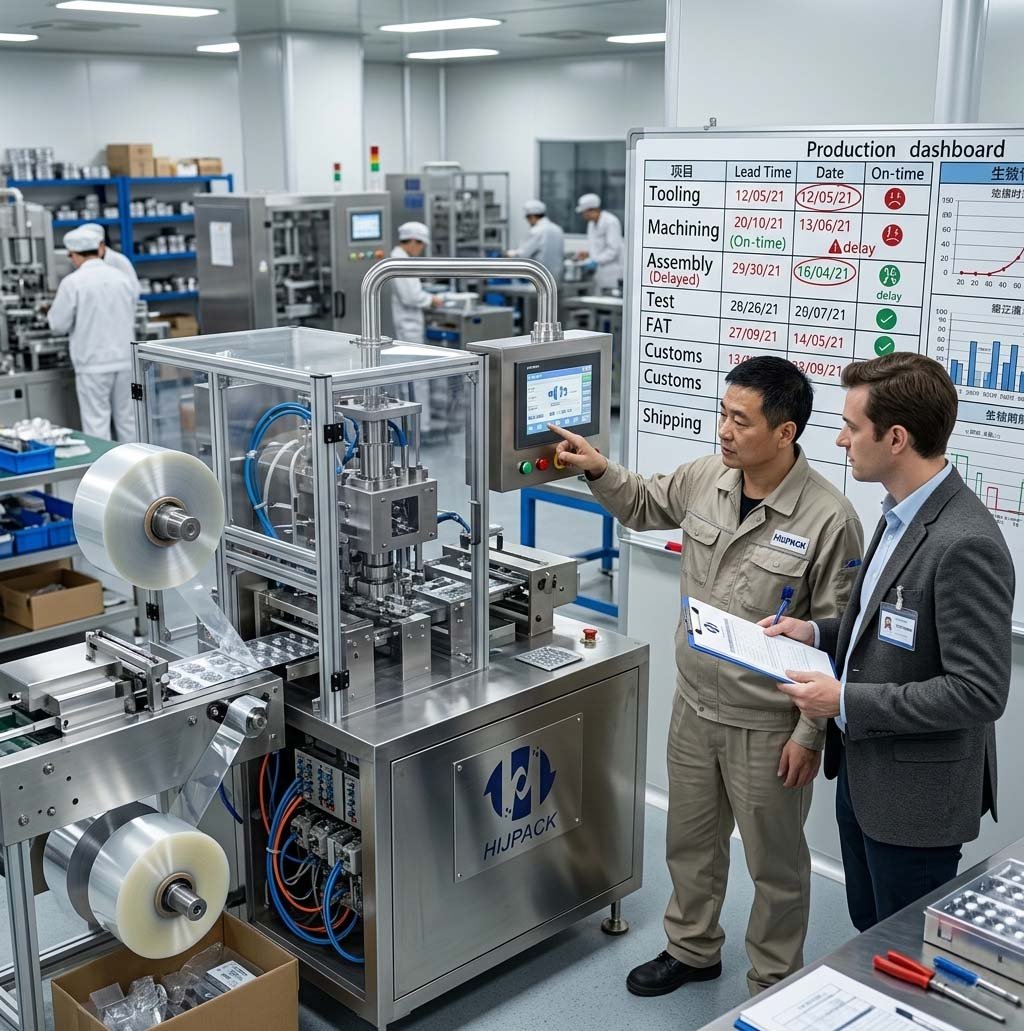
Typical production and commissioning schedule for a turnkey capsule blister packaging line — 26–36 weeks from locked URS to PQ sign-off.
⚠️ Commissioning Failure Diagnostics — Most Common Delays
🔴 Symptom: IQ fails on compressed air quality at installation
Root cause: Site compressed air supply is ISO 8573-1 Class 4 (oil content <5 mg/m³). Machine requires Class 2 (<0.1 mg/m³). Nobody verified this before equipment arrived.
✅ Fix: Specify compressed air quality class in URS. Verify site supply against spec during site survey — which should happen 12 weeks before FAT, not after the machine is on the floor.
🔴 Symptom: OQ sealing temperature test fails — temperature drifts ±4°C at setpoint
Root cause: PVC film grade on site is different from the film used at FAT. Different film requires different sealing temperature window. This is a material specification gap, not a machine fault.
✅ Fix: Specify film grade (supplier, grade code, gauge) in URS. Ship the same film to the factory for FAT. Do not substitute during commissioning without re-running the relevant OQ tests.
🔴 Symptom: PQ fails — OEE is 74% across three batches, missing the 85% target
Root cause: Operators are not trained on the line changeover procedure. Changeover takes 85–110 minutes instead of the 45-minute FAT result. Nobody ran formal operator training before PQ.
✅ Fix: Include formal operator training as a contractual deliverable, completed before PQ commencement. Training records become part of the validation dossier.
Blister Film Selection for a Capsule Line: How It Affects Machine Configuration
The blister film you choose for your capsule line is not an afterthought. It determines forming station temperature range, sealing pressure window, mold geometry, and whether your line can run the format at all. Get the film/machine match wrong and you’ll discover it during OQ — the worst possible time.
PVC at 250 µm forms at 110–130°C. PVDC laminate requires 120–145°C. Cold-form Alu-Alu doesn’t use heat at all — it uses mechanical forming under pressure, which requires a completely different forming station design. A machine spec’d for PVC/PVDC thermoforming cannot run cold-form Alu-Alu without a forming station replacement. That’s not a setting. That’s hardware.
For detailed material selection guidance across PVC, PVDC, and Alu-Alu blister films, including moisture vapor transmission data and regulatory requirements by market, read the dedicated comparison guide. Here, the relevant point for line planning is simple: specify your film substrate in the URS before equipment is designed. Not after.
Emerging Market Considerations: What Changes When You Commission in Africa, Southeast Asia, or the Middle East
Commissioning a turnkey capsule blister line in Lagos is not the same as commissioning in Frankfurt. Four things change in emerging markets, and if your URS doesn’t account for them, your commissioning schedule will.
Utility variance. In Southeast Asia and sub-Saharan Africa, voltage fluctuation of ±10–15% from nominal is common. A line spec’d for stable 380V/50Hz will trigger servo drive faults repeatedly without a voltage stabilizer. Specify voltage tolerance in the URS. Budget for a stabilizer if it’s not included in the machine package.
Climate and humidity. A capsule blister line in a WHO Zone IVb market (30°C/75% RH) demands a different film selection strategy than the same line in a Zone II market. Hygroscopic capsule formulations running on PVC film in tropical humidity will show moisture ingress within months. This isn’t a machine failure — it’s a packaging material decision that was made before the machine was purchased. For a full breakdown of regional packaging challenges, see the emerging markets capsule blister packaging guide.
Import documentation and customs. Pharmaceutical equipment import into Nigeria, Indonesia, or Egypt requires advance regulatory notification in most cases. HS codes for blister packaging machines, capsule fillers, and cartoners may be classified differently — and misclassification triggers holds that can add 4–8 weeks to delivery. Verify import classification before FAT.
Local engineer availability for commissioning support. Remote commissioning — which became common post-2020 — has a lower success rate for complex multi-machine line integration than on-site support. Budget for an on-site commissioning engineer for at least the IQ/OQ phase when the line is in a market with limited local pharma-equipment expertise.
Frequently Asked Questions: Planning a Turnkey Capsule Blister Packaging Line
❓ How long does it take to commission a turnkey capsule blister packaging line?
A realistic timeline from locked URS to PQ sign-off is 26–38 weeks for a standard configuration. The largest variables are tooling lead time (custom mold sets can add 3–4 weeks), site readiness (utilities, cleanroom), and market-specific customs clearance. Lines destined for WHO-regulated markets in Africa or Southeast Asia should budget the upper end of that range due to import documentation timelines.
❓ What is the difference between FAT and SAT for a capsule blister line?
FAT (factory acceptance test) is conducted at the vendor’s facility before shipping, using placebo or representative product. SAT (site acceptance test) is conducted after installation at the client’s facility, under real production conditions. For a turnkey line, both should be governed by a single set of line-level acceptance criteria — not separate per-machine protocols. The critical metrics at both stages: OEE ≥ 85%, blister seal integrity per ASTM F2338, and vision reject rate ≤ 0.3%.
❓ Do I need a separate validation dossier for each machine in the line?
No. EU GMP Annex 15 and ICH Q10 both support a system-level validation approach. One qualification dossier covering the entire integrated line — with IQ, OQ, and PQ protocols that address the line as a system — is both regulatorily sufficient and practically superior to three separate machine-level dossiers. Per-machine dossiers create gaps at integration points that reviewers will find.
❓ What throughput can I expect from a capsule blister packaging line?
A mid-range integrated line (capsule filler + DPP-260 blister machine + cartoner) typically achieves 40,000–72,000 capsules per hour at sustained production. The DPP-260 blister machine runs at up to 120 blisters/min depending on format. At ≥ 85% OEE on a properly integrated line, effective output is 34,000–61,000 caps/hr. Plan for the lower number in your capacity model — it’s what you’ll consistently achieve in shift production after changeover and minor stops.
❓ Can one capsule blister line handle multiple capsule sizes?
Yes, with tooling change. A flexible line typically covers Size 00 through Size 4. Changeover between sizes requires replacing the capsule filler tooling set and the blister forming mold — both are designed as quick-change assemblies on modern lines. If this is a requirement, it must be specified in the URS: the vendor will then design the tooling management system accordingly and the changeover time will be included in OQ testing.
❓ Is Alu-Alu (cold-form) packaging compatible with standard capsule blister machines?
Not without a different forming station. Cold-form Alu-Alu uses mechanical deformation under pressure, not heat. A standard thermoforming blister machine designed for PVC/PVDC cannot run cold-form film. If your product requires Alu-Alu packaging — typically for highly moisture-sensitive APIs — specify this in the URS so the correct machine is quoted. Our Alu-Alu blister packing machine handles cold-form forming and is fully configurable for capsule formats.
❓ What does a turnkey capsule blister packaging line cost?
A complete mid-range turnkey line (capsule filler + blister machine + cartoner + integration + FAT + commissioning support) typically ranges from $180,000 to $380,000 USD depending on throughput, format flexibility, market regulatory requirements, and whether 21 CFR Part 11 data integrity features are included. Budget a further 15–20% for tooling, spares, and site installation. For a detailed cost breakdown by line configuration, the capsule blister machine cost breakdown guide covers the full picture.
❓ How do I evaluate a capsule blister packaging line manufacturer in China?
Three things matter more than price. First: does the vendor own the full line integration, or are they assembling components from sub-vendors and applying their label? Second: do they have a documented FAT protocol that tests the line as a system, not per machine? Third: can they provide reference clients in your target regulatory market — WHO GMP, EU GMP, or 21 CFR — with verifiable contact details? If any of those three answers is unclear, keep looking. The China manufacturer evaluation guide covers the full due diligence framework.
🎯 Turnkey Capsule Blister Line Planning
Get a Turnkey Quote — Line-Level Accountability, One Dossier
HIJ Machinery engineers full turnkey capsule blister packaging lines — from URS drafting through IQ/OQ/PQ sign-off — under a single engineering team and one FAT/SAT protocol. Tell us your throughput target, capsule size range, and target market. We’ll send you a line configuration proposal and indicative lead time within 48 hours.