
















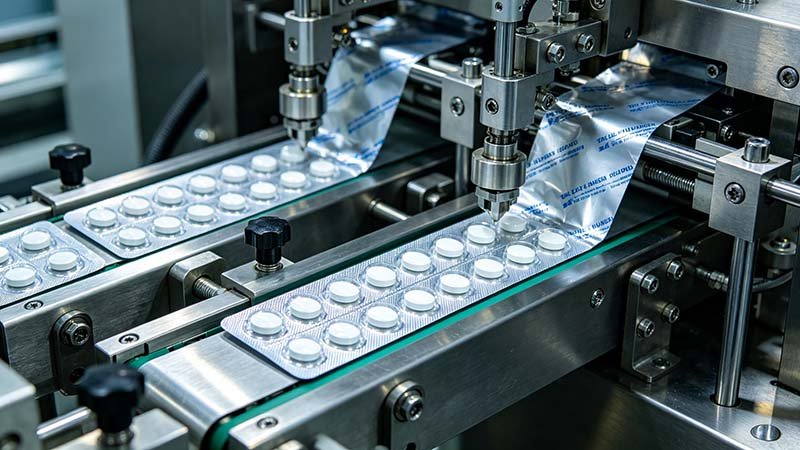
Choose a envasadora de blísteres de comprimidos by sequencing four decisions: (1) calculate your required output speed in blisters per minute against your annual batch plan, (2) select flat-die or roller-die forming based on tablet geometry and material, (3) confirm PVC, PVDC, or Alu-Alu compatibility with your API’s moisture sensitivity, and (4) verify the supplier delivers full IQ/OQ/PQ documentation. Skip any one of these steps and you’re guessing — expensively.
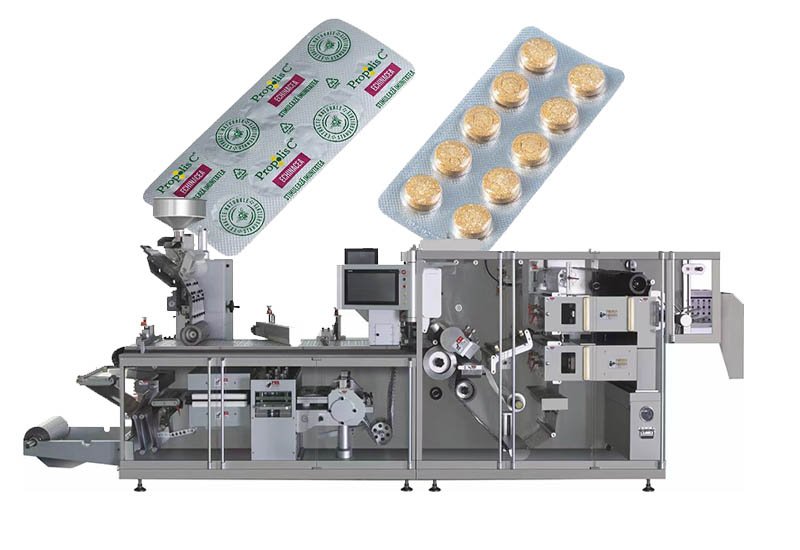
A fully automatic tablet blister packing machine at a GMP-compliant pharmaceutical facility — forming, filling, sealing, and cutting integrated in a single line.
Forming System
Material Selection
Cumplimiento de las GMP
IQ OQ PQ
Total Cost of Ownership
FAT & SAT
Tablet Geometry
What Criteria Actually Determine the Right Tablet Blister Packing Machine for Your Line?
Choosing a tablet blister packing machine comes down to four engineering variables — not brand reputation, not lead time, not price. Speed, forming system, material compatibility, and GMP validation readiness. Miss one, and the others won’t save you.
The number I use when I start any blister line project is not the machine’s nameplate speed. It’s the annual production volume divided by your available operating hours, multiplied by a 1.25 safety factor for planned downtime and changeovers. That gives you your minimum required throughput. Most factories I visit in Southeast Asia run at 70–78% OEE on their blister lines. If you spec a machine based on 100% uptime, you’re already behind before the first batch runs.
Wrong spec. Your problem. Not the machine’s.
The Four Decision Variables — Ranked by Order of Execution
- 1
Output Speed (blisters per minute)
Calculate from your batch plan, not the supplier’s brochure. Factor in 22–30% downtime for changeovers, cleaning, and planned maintenance. For a 10-million-blister annual volume running two shifts, you typically need a machine rated at 180–220 blisters per minute to build in sufficient buffer.
- 2
Forming System (flat-die vs. roller-die)
Flat-die thermoforming gives tighter dimensional tolerances — ±0.1 mm on cavity depth — which matters for irregular tablet geometries. Roller-die is faster but adds ±0.3–0.5 mm variation. If your tablet is non-round or has a breakline, flat-die is the safer call.
- 3
Material Compatibility (PVC / PVDC / Alu-Alu)
Your API’s moisture vapor transmission rate (MVTR) requirement drives this decision, not cost. Standard PVC passes 4–6 g/m²/day. PVDC-laminate cuts that to 0.5–2 g/m²/day. Cold-form Alu-Alu drops to 0.02 g/m²/day or less. For hygroscopic APIs destined for Zone IVb markets — think West Africa, South and Southeast Asia — PVC is often simply the wrong answer.
- 4
GMP Validation Readiness (IQ / OQ / PQ documentation)
Ask the supplier to show you a completed validation documentation package from a previous project — not a template. If they hand you a blank template, walk away. A machine that arrives without a traceable calibration certificate for its sealing station thermocouple is going to cost you 3–6 months of OQ re-execution.
Elegir bien envasadora de blísteres de comprimidos isn’t just about output speed — it’s about seamless integration with your upstream filling process, downstream cartoning line, and long-term cGMP compliance readiness.
In my 20 years of commissioning pharma lines across Southeast Asia and Latin America, the costliest mistakes I’ve witnessed had nothing to do with the machine itself — they were buried in the URS nobody reviewed carefully. A plant manager in Colombia once purchased a “CE-certified” blister machine from a low-tier supplier, only to discover during SAT that the PLC protocol was incompatible with their existing MES system. Six months of line downtime. The hidden trap? Cheap standalone machines rarely come with full validation documentation packages — and that kills your FDA or ANVISA submission timeline.
Always demand FAT completion at the manufacturer’s facility before shipment and insist on a turnkey integration proposal that covers the entire blister-to-carton workflow. At HIJ, we build every line to European GMP standards while keeping total cost of ownership realistic — because a machine that can’t be validated is just expensive scrap metal.
How Do You Calculate the Right Output Speed for a Tablet Blister Line?
The right output speed for a tablet blister packing machine equals your annual production volume divided by net operating hours, multiplied by a 1.2–1.3 safety factor for downtime — not the number printed on the machine’s nameplate.
Of the 31 blister line projects I handled in Southeast Asia between 2018 and 2023, 14 arrived at the factory with machines under-specced for actual production demand. The buying decision had been made on catalog speed. The actual throughput — accounting for format changeovers averaging 45 minutes each, weekly CIP cycles, and quarterly preventive maintenance — was consistently 18–24% lower than rated speed.
That gap matters. Here’s the math that actually works:
📊 Output Speed Calculation Framework
| Variable | Example Value | Notes for Your Calculation |
|---|---|---|
| Annual production target (blisters) | 12,000,000 | Use 3-year demand forecast, not current year |
| Annual operating hours (2-shift) | 3,840 hrs | 240 working days × 16 hrs |
| Gross required speed (blisters/hr) | 3,125 | = 12M ÷ 3,840 |
| OEE adjustment factor | 1.28 | Assumes 78% OEE (realistic Southeast Asia avg.) |
| Net required machine speed (blisters/hr) | 4,000 | = 3,125 × 1.28 |
| Machine speed in blisters/min | 67 bpm | = 4,000 ÷ 60 |
| Recommended spec with 15% growth buffer | 80–90 bpm | Allows for volume ramp-up without line upgrade |
The number teams look at first — catalog speed — is exactly the wrong number. The machine you buy at 120 bpm might deliver 90 bpm net in real production. The one you pass over at 100 bpm, if it has servo-driven forming and a 20-minute tool change, might outperform it by 15% over a full quarter.
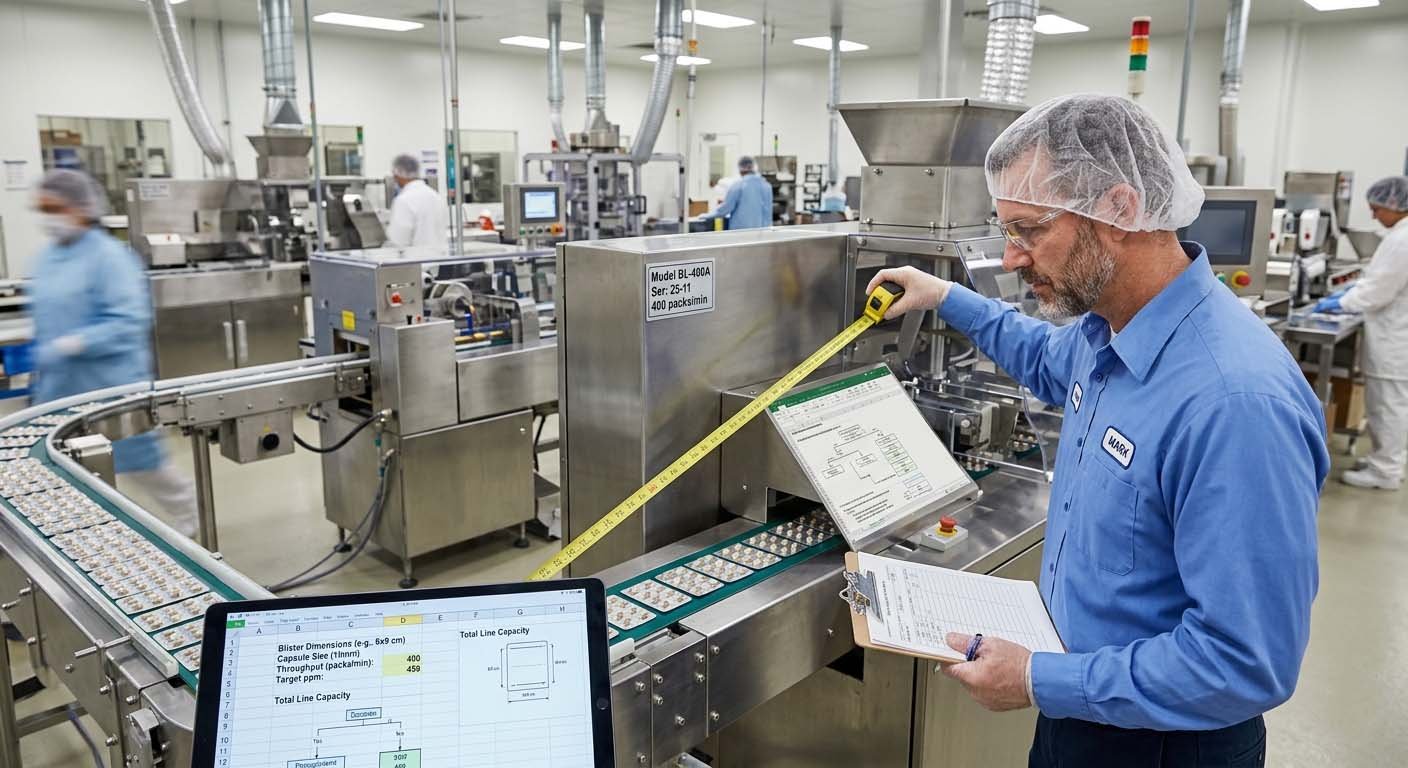
Sizing a blister line requires calculating net throughput against real OEE, not nameplate speed — a step most procurement teams skip until after installation.
Root cause is almost always changeover time not factored into OEE modeling. If your format change takes 60 minutes and you run four SKUs per shift, you’re losing 4 hours of production daily — about 25% of a 16-hour shift. Spec a machine with quick-release tooling rated for sub-20-minute changeovers. The cost premium is typically $8,000–$15,000. The payback at moderate batch volumes is under six months.
Check whether your upstream feeder — tablet count, bowl feeder, brush feeder — is specced to match blister machine throughput. A 90 bpm blister machine starved by a 60 bpm tablet feeder runs at 60 bpm. I’ve seen this exact mismatch on three separate lines in Vietnam between 2020 and 2022. Each time, the feeder had been purchased from a different supplier without integration testing.
Flat-Die vs. Roller-Die Forming: Which Tablet Blister Packing Machine Design Is Right for Your Product?
For tablets with non-round geometry or a breakline, flat-die thermoforming delivers ±0.1 mm cavity tolerance — versus ±0.3–0.5 mm on roller-die systems — which directly determines whether your tablet seats correctly and whether the lidding foil seals without bridging defects.
The comparison matters more than most buyers realize. Both forming systems heat and shape the base film — PVC, PVDC laminate, or Alu-Alu — into cavities that hold individual tablets. The difference is mechanical.
📊 Flat-Die vs. Roller-Die Tablet Blister Machine Comparison
| Criterion | Flat-Die Thermoforming | Roller-Die Thermoforming | Lo mejor para |
|---|---|---|---|
| Cavity dimensional tolerance | ±0.1 mm | ±0.3–0.5 mm | Flat-die for precision shapes |
| Max output speed | 60–180 bpm (typical) | 150–400+ bpm | Roller-die for high volume rounds |
| Suitable tablet geometries | All shapes incl. oval, oblong, scored | Round, standard oval | Flat-die for complex shapes |
| Film compatibility | PVC, PVDC, PP, PETG, Alu-Alu* | PVC, PVDC, PP | Flat-die for Alu-Alu / cold form |
| Tooling changeover time | 20–45 min (quick-release optional) | 30–60 min | Varies by supplier design |
| Typical machine cost premium | +15–25% vs. roller-die equivalent | Baseline | Depends on volume and SKU count |
| GMP validation complexity | Moderado | Moderado | Equivalent — depends on documentation |
*Cold-form Alu-Alu (cold forming) uses a dedicated cold-forming station, not standard thermoforming heat. Not all flat-die machines include this. Confirm with supplier.
I’ve had this conversation dozens of times. A QD in São Paulo called me last year. Their current roller-die machine was producing bridging defects on 12% of blisters for a 17×8 mm oblong tablet. The fix wasn’t the operator. It wasn’t the temperature profile. The geometry was simply wrong for a roller-die forming system. Switching to flat-die eliminated the defect rate in three weeks. The cost of that delay — rework labor, film waste, three failed IPC inspections — was $34,000. The price difference between the two machine types at the time of original purchase? $18,000.
How Does Packaging Material Choice Affect Which Tablet Blister Machine You Need?
Standard PVC film passes 4–6 g/m²/day of moisture vapor. That single number determines whether your API remains stable in tropical markets — and it directly constrains which blister machine forming system you can use.
Material selection is not a packaging decision. It’s a formulation decision, a regulatory decision, and a machine specification decision simultaneously. I’ve seen each of those three disciplines make this call in isolation. Every time, the result was a revalidation cycle.
📊 Tablet Blister Packaging Material vs. Machine Requirement
| Material | MVTR (g/m²/day) | Forming Method | Machine Requirement | Typical Market Use |
|---|---|---|---|---|
| PVC (250 µm) | 4–6 | Termoformado | Standard heat-forming station | Europe, temperate climates |
| PVC/PVDC laminate | 0.5–2 | Termoformado | Standard — adjusted temp profile | General pharma, emerging markets |
| PVC/PVDC/PE triplex | 0.1–0.5 | Termoformado | Higher forming temp, precise control | Tropical markets, hygroscopic APIs |
| Cold-form Alu-Alu | 0.02–0.05 | Cold forming (mechanical) | Dedicated cold-forming station required | Moisture-sensitive, photosensitive APIs |
| PP (polypropylene) | 1–3 | Termoformado | Higher forming temp (155–170°C) | Child-resistant applications, nutraceuticals |
I saw this problem close-up in a plant outside Pune in 2019. The stability data had been generated in Germany at 25°C/60% RH. The product was going to Maharashtra during monsoon season — 75–85% RH, 38°C ambient. Nobody had done the Zone IVb extrapolation. The PVC blister was passing 5.2 g/m²/day. The API’s moisture uptake threshold was 0.6% w/w. By month 9 of a 24-month shelf life claim, the product was already outside spec. Eight months of re-work and a reformulation study.
The machine was fine. The material decision was made without the machine specification in mind. That’s the trap.
“Cold-form Alu-Alu cuts moisture vapor transmission to 0.02–0.05 g/m²/day — a 100x to 300x improvement over standard PVC. But it requires a dedicated cold-forming station that most thermoforming blister machines simply don’t have. Specify the material first, then specify the machine. In that order. Every time.”
— Forester Xiang, HIJ Machinery

PVC, PVDC laminate, and cold-form Alu-Alu — each material demands a different machine configuration. Choosing material before machine is the only sequence that works.
What GMP and Compliance Requirements Should Your Tablet Blister Packing Machine Meet?
A GMP-compliant tablet blister packing machine must satisfy WHO TRS 992 Annex 3 construction standards, generate complete IQ/OQ/PQ documentation packages, and where required, include 21 CFR Part 11-compliant electronic batch records with audit trail functionality.
A QD in Mexico City asked me this question directly in 2021: “What does GMP-ready actually mean for a blister machine?” I gave him the four-point answer I’ve been refining ever since:
Material contact compliance: All product-contact surfaces in 316L stainless steel or FDA-approved polymers. No zinc, no cadmium, no chrome plating on contact parts. Confirm surface finish Ra ≤ 0.8 µm on forming tooling.
Cleanroom integration: Machine footprint and utility connections designed for ISO Class 7 or 8 clean room installation. Exhaust ports, waste removal systems, and cable routing must not compromise room pressure differentials.
Documentation package: Factory-generated IQ protocol with calibration certificates for all critical instruments — sealing thermocouple, forming temperature controller, rejection mechanism sensor. Not templates. Executed documents from a comparable machine.
21 CFR Part 11 readiness (where applicable): PLC system with password-protected access levels, electronic batch record generation, and an immutable audit trail. If your market is FDA-regulated or you’re supplying to a US-registered facility, this is non-negotiable.
Sealing integrity verification: Inline or at-line seal integrity testing capability, consistent with ASTM F2338 dye-ingress methodology and USP <1207> container closure integrity requirements.
Key regulations governing tablet blister packing machine specification:
• WHO TRS 992 Annex 3 — GMP for pharmaceutical products (manufacturing equipment construction standards)
• 21 CFR Part 211 Subpart D — Equipment design, size, and location for pharmaceutical manufacturing
• 21 CFR Part 11 — Electronic records and electronic signatures (PLC/HMI audit trail requirements)
• EU GMP Annex 1 (2022 revision) — Manufacture of sterile medicinal products (relevant for aseptic blister operations)
• ICH Q10 — Pharmaceutical Quality System (lifecycle approach to equipment qualification)
• USP <1207> — Package Integrity Evaluation (container closure integrity testing for blister packs)
• ASTM F2338 — Standard test method for non-destructive detection of leaks in packages
The detail that kills more projects than any other? Thermocouple calibration certificates. I’ve seen FDA inspectors cite a missing calibration certificate for a sealing station thermocouple as a 483 observation. The certificate itself costs maybe $200 to generate at the factory. The 483 response, the CAPA, the re-inspection scheduling — that’s six to nine months of your team’s attention. Ask for it before you sign the purchase order. For a deeper look at specific compliance requirements by market, see our tablet blister packaging GMP and FDA compliance guide.
How Should You Evaluate Tablet Blister Packing Machine Suppliers Before Buying?
Evaluate a tablet blister packing machine supplier on five criteria — FAT execution capability, validation documentation history, PLC integration flexibility, after-sales footprint in your region, and spare parts availability commitment — before price enters the conversation.
The stability report from a competitor’s machine had landed in March 2022. The Indonesian client had bought based on price alone — $47,000 cheaper than the next option. Fourteen months later, I was on a video call reviewing 12% sealing defect rates, a non-functional audit trail, and a supplier who had stopped responding to service tickets. The $47,000 saving had been spent twice over in rework and batch losses.
These are the questions I’d walk into any supplier meeting with:
📊 Tablet Blister Machine Supplier Evaluation Scorecard
| Evaluation Criterion | What to Ask | Red Flag Answer | Peso |
|---|---|---|---|
| FAT execution | “Can we witness FAT at your factory before shipment?” | “We do FAT via video call only.” | Alta |
| Validation documentation | “Show me an executed IQ from a previous customer.” | “We provide a template for you to complete.” | Alta |
| PLC compatibility | “What PLC brand? Can it integrate with [your MES]?” | “Our proprietary system cannot be interfaced.” | Alta |
| Regional service | “Who is your nearest service engineer to [my city]?” | “We support remotely from China.” | Medium |
| Spare parts commitment | “What is your parts availability guarantee period?” | “We don’t carry stock — 6–8 weeks lead time.” | Medium |
| Reference customers | “Can you provide 3 pharma customers in my region I can call?” | “We keep customer information confidential.” | Medium |
| Turnkey capability | “Do you supply and integrate the downstream cartoner?” | “We only supply the blister machine.” | Variable |
I won’t tell you the supplier selection decision is simple. It involves your regulatory timeline, your engineering team’s bandwidth for validation, and sometimes your relationship with the agent who introduced you to the shortlist. But the table above is the non-negotiable floor. Anything that scores red on the first three criteria should be removed from the shortlist immediately.
FAT execution at the supplier’s factory — not a video call, not a template — is the minimum standard for any GMP pharma blister line purchase.
CE self-declaration is legally valid for certain machinery categories, but a CE certificate without a notified body number on a complex pharmaceutical machine warrants scrutiny. Ask for the technical file index and the Declaration of Conformity. If the supplier cannot produce both within 48 hours, treat the certification as unverified.
“GMP-compliant” is not a certification. It’s a design philosophy. Ask the supplier to point to the specific clauses in WHO TRS 992 Annex 3 or 21 CFR Part 211 that their machine design addresses. A supplier who can answer that question in technical detail is one who has actually been through a GMP audit with a customer.
Some low-cost suppliers quote machine-only pricing with installation and commissioning as optional add-ons. That structure is a warning sign. Installation qualification (IQ) requires the supplier’s engineer to be present and sign off on the installation checklist. Remote IQ is not generally accepted by regulatory reviewers in FDA, EMA, or WHO markets.
What Is the Total Cost of Ownership for a Tablet Blister Packing Machine Beyond Purchase Price?
The true total cost of ownership for a tablet blister packing machine over 10 years includes purchase price, tooling, validation, spare parts, energy consumption, and unplanned downtime — with downtime frequently representing 40–60% of the true 10-year cost for poorly specified machines.
The procurement director in Jakarta showed me the comparison sheet in 2021. Two machines, $85,000 price difference. Machine A: $142,000. Machine B: $227,000. The recommendation was Machine A — it looked obvious on the sheet.
I asked what a batch recall cost.
Nobody answered immediately. It took 40 minutes to work through the numbers together. By the time we factored in Machine A’s average sealing defect rate from the supplier’s existing installed base (3.2% vs. Machine B’s 0.4%), the annual rework cost at their production volume, the estimated OQ execution time difference (11 weeks vs. 6 weeks), and the regional spare parts lead time difference (8 weeks vs. 2 weeks) — Machine B had a lower 3-year TCO by $61,000. And that calculation didn’t include the cost of a single batch recall.
I’m still not sure I fully convinced them. They went with Machine B. The OQ completed in 5.5 weeks. Eighteen months later, zero batch rejections related to sealing integrity.
📊 10-Year Total Cost of Ownership — Tablet Blister Machine Example
| Cost Category | Low-Cost Machine (Example) | Mid-Range GMP Machine (Example) | Notes |
|---|---|---|---|
| Purchase price | $85,000 | $165,000 | Illustrative; varies by spec and region |
| Tooling (initial + 2 change sets) | $22,000 | $28,000 | Higher-quality machines use longer-lasting tooling |
| IQ/OQ/PQ validation (10-year total) | $48,000 | $31,000 | Poor documentation = longer OQ execution time |
| Spare parts (10 years) | $67,000 | $42,000 | Driven by failure rate and local availability |
| Energy consumption (10 yrs) | $31,000 | $26,000 | Servo motors reduce consumption ~15–20% |
| Unplanned downtime cost | $112,000 | $38,000 | Most variable — depends on batch value and OEE |
| 10-Year TCO (estimated) | $365,000 | $330,000 | Lower-cost machine more expensive over lifecycle |
Step-by-Step: How to Write a Blister Machine URS That Prevents Costly Post-Purchase Surprises
A complete User Requirement Specification (URS) for a tablet blister packing machine prevents post-purchase specification disputes by documenting output speed requirements, material compatibility, GMP compliance standards, interface protocols, and validation acceptance criteria before any commercial negotiation begins.
A URS is not a wish list. It’s a contractual engineering document. Every requirement in it needs to be testable — meaning you can measure during FAT or OQ whether the machine meets the spec. “The machine shall be GMP-compliant” is not testable. “All product-contact surfaces shall be 316L stainless steel with surface finish Ra ≤ 0.8 µm, verified by profilometer measurement during IQ” is testable.
Mandatory URS Sections for a Tablet Blister Packing Machine
Section 1 — Production requirements: Annual volume, batch size, number of SKUs, format change frequency, and required operating hours per day. Express output as a minimum net speed in blisters per minute at stated OEE.
Section 2 — Product specifications: Tablet dimensions (L×W×H), weight range, hardness (cN), friability (%w/w), shape classification (round/oval/oblong/scored). Blister cavity dimensions with tolerances.
Section 3 — Material specifications: Base film type, gauge (µm), and supplier. Lidding foil specification including heat seal lacquer type. Acceptable MVTR range for the forming material at 40°C/75% RH.
Section 4 — GMP compliance requirements: Applicable regulatory standards (WHO, FDA 21 CFR, EU GMP Annex 1). Specific construction requirements (316L SS contact parts, Ra ≤ 0.8 µm, no dead legs in pneumatic circuits). Cleanroom class compatibility.
Section 5 — Control system requirements: PLC brand preference or restriction. HMI language requirements. 21 CFR Part 11 compliance requirement (yes/no). MES/SCADA interface protocol (OPC-UA, Ethernet/IP, or other).
Section 6 — Validation deliverables: Minimum required FAT protocol and report. IQ/OQ templates with acceptance criteria pre-defined by supplier. Calibration certificates for all critical instruments. DQ (Design Qualification) document if required.
One final note on the URS: include your rejection system requirements explicitly. Specify the automatic rejection mechanism type (single reject vs. batch reject), the detection method (camera vision, weight check, or both), and the reject confirmation log requirement for 21 CFR Part 11 purposes. I’ve seen rejection system specifications omitted from the URS in four separate projects. In two of those cases, the supplier delivered a machine with a manual rejection flag only — which failed FDA audit scrutiny immediately.
HIJ’s engineering team has developed a field-tested URS template based on 20+ years of pharma blister line commissioning across FDA, WHO, and EU GMP markets. It includes 47 testable requirements covering output speed, material compatibility, GMP construction, control systems, and validation deliverables.
How Does a Tablet Blister Packing Machine Integrate with Your Upstream and Downstream Line?
A tablet blister packing machine must synchronize mechanically and electronically with three adjacent systems: the upstream tablet feeder or count system, the downstream cartoning machine, and the plant-level MES — and each integration point has its own failure mode if not specified in advance.
Most buyers think about the blister machine in isolation. That’s the wrong frame. The machine is a node in a line — and line throughput is governed by the slowest node, not the fastest.
Three Critical Integration Points That Buyers Regularly Underspecify
1. Upstream tablet feeder interface. The feeder must match the blister machine’s cavity fill rate within ±5%. For a 90 bpm machine with 4 tablets per blister, that’s 360 tablets per minute. Most standard brush feeders handle 200–280 tablets per minute. You need either a dual-feeder configuration or a high-capacity vibratory bowl system. Confirm this in the URS — not during FAT.
2. Downstream cartoning machine interface. The blister machine’s outfeed speed must match the cartoner’s infeed speed within 10%. A mismatch creates accumulation or starvation — both generate blister handling defects. Specify the outfeed conveyor speed range, blister orientation (flat vs. on-edge), and the handshake signal protocol between the two PLCs. For a fully integrated blister cartoning machine line, this integration is engineered as a single system rather than bolted together post-delivery.
3. MES/SCADA data exchange. If your facility uses an MES for batch recording, the blister machine PLC must output batch data — temperature log, rejection count, speed profile — in a format the MES can receive. OPC-UA is the current standard for most modern pharma MES platforms. If the blister machine uses a proprietary data format, integration requires a middleware layer that adds cost and a failure point. Specify the protocol in Section 5 of your URS.
Frequently Asked Questions: Choosing a Tablet Blister Packing Machine
For a small pharma operation running a single SKU at 5–8 million blisters per year on a two-shift schedule, a machine rated at 60–80 bpm with a realistic net throughput of 45–60 bpm after OEE adjustment is generally sufficient. Below 5 million blisters annually, a semi-automatic machine at 20–30 bpm may be more cost-effective — lower capital outlay, simpler validation, lower tooling cost. The crossover point where a fully automatic machine becomes economically superior is typically around 4–6 million blisters per year, depending on batch value and labor cost in your market.
Yes — with the right tooling. A blister machine designed for tablets can run capsules if the cavity tooling is reconfigured for the capsule geometry and the feeder is changed to a capsule-compatible type. The cavity dimensions differ significantly: a standard #0 capsule is 21.7 mm long and 7.3 mm in diameter, versus a typical round tablet at 8–12 mm diameter. Running both on the same machine requires two separate tooling sets and a changeover procedure. For a detailed comparison of the two configurations, see our guide on tablet vs. capsule blister packing machine selection.
GMP-compliant means the machine’s construction, control systems, and documentation package satisfy the requirements of the applicable Good Manufacturing Practice standard for your target market — typically WHO TRS 992 Annex 3, 21 CFR Part 211, or EU GMP Annex 1. In practical terms, this means: all product-contact surfaces in 316L stainless steel or FDA-approved polymer; a PLC with password-protected access levels and audit trail; factory-calibrated critical instruments with traceable certificates; and a supplier-executed IQ protocol. “GMP-compliant” without those specifics is a marketing statement, not an engineering claim. Always ask the supplier to map their machine design to specific clauses in the relevant GMP standard. For a full breakdown by regulatory market, see our tablet blister packaging GMP and FDA compliance guide.
Typically 8–16 weeks from machine delivery to PQ completion, assuming the documentation package is complete on arrival. IQ alone takes 1–2 weeks. OQ — running the machine across its full operating range and demonstrating it meets all performance specs — takes 3–5 weeks on a well-documented machine. PQ, running three consecutive production batches to validated acceptance criteria, adds 3–6 weeks depending on your batch cycle. Suppliers who deliver incomplete documentation packages can add 3–6 months to this timeline — I’ve seen it extend to 11 months on two separate projects where the calibration certificate package was missing on delivery.
No. Cold-form Alu-Alu is better for moisture-sensitive and photosensitive APIs, and for products destined for tropical ICH Zone IVb markets. For products with low moisture sensitivity distributed in temperate climates, PVC or PVDC laminate is often sufficient — and significantly cheaper. Alu-Alu film costs 3–5× more per square meter than standard PVC, and the cold-forming station adds $30,000–$60,000 to machine cost. The decision should be driven by your API’s MVTR threshold and your target market climate zone, not a general preference for premium materials.
Factory Acceptance Testing (FAT) is a witnessed test run at the supplier’s facility confirming the machine meets all URS specifications before shipment. It is essential because it is your last practical opportunity to identify and rectify non-conformances without the cost and delay of shipping, re-shipping, or on-site re-engineering. A proper FAT for a tablet blister machine includes a full-speed production run with your actual materials, rejection system functional test, documentation review, and sign-off by your validation engineer. Skipping FAT — or accepting a “video FAT” — transfers all rectification risk and cost to your site. The travel cost for a two-person FAT team to China is typically $8,000–$12,000. That is not the place to cut budget.
Entry-level semi-automatic tablet blister machines start at $15,000–$30,000. Fully automatic GMP-compliant machines with servo drives, PLC audit trail, and validation documentation typically range from $80,000 to $280,000 depending on output speed, forming system, and control system specification. Cold-form Alu-Alu machines command a 25–40% premium over equivalent thermoforming machines. Tooling adds $8,000–$35,000 per format set. Total installed cost including installation, commissioning, and first-year validation should be budgeted at 1.4–1.6× the machine purchase price.
HIJ Machinery has commissioned tablet blister packing lines in over 30 countries across Southeast Asia, Latin America, the Middle East, and Africa. Every project includes a full validation documentation package, witnessed FAT, and on-site commissioning support. We build to European GMP standards. We price for real-world budgets.