

















Buying an alu alu blister machine is defined as acquiring a cold-form aluminum-to-aluminum blister packaging system capable of producing hermetically sealed pharmaceutical packs with moisture vapor transmission rates (WVTR) below 0.5 g/m²/day — a compliance commitment, not a commodity purchase.
Of 47 alu alu blister line commissioning projects handled by HIJ Machinery across Southeast Asia, Latin America, and the Middle East between 2018 and 2024, 31 involved buyers who had made at least one of these seven mistakes before contacting us — with average remediation costs exceeding $85,000 per project. This guide exists so you don’t become that statistic.

Founder, HIJ Machinery — 20 Years Commissioning Pharmaceutical Blister Lines in 30+ Countries
Cold Form Blister Packaging
Pharma Equipment Buyers Guide
cGMP Validation
FAT / SAT
Tropical Markets
IQ OQ PQ
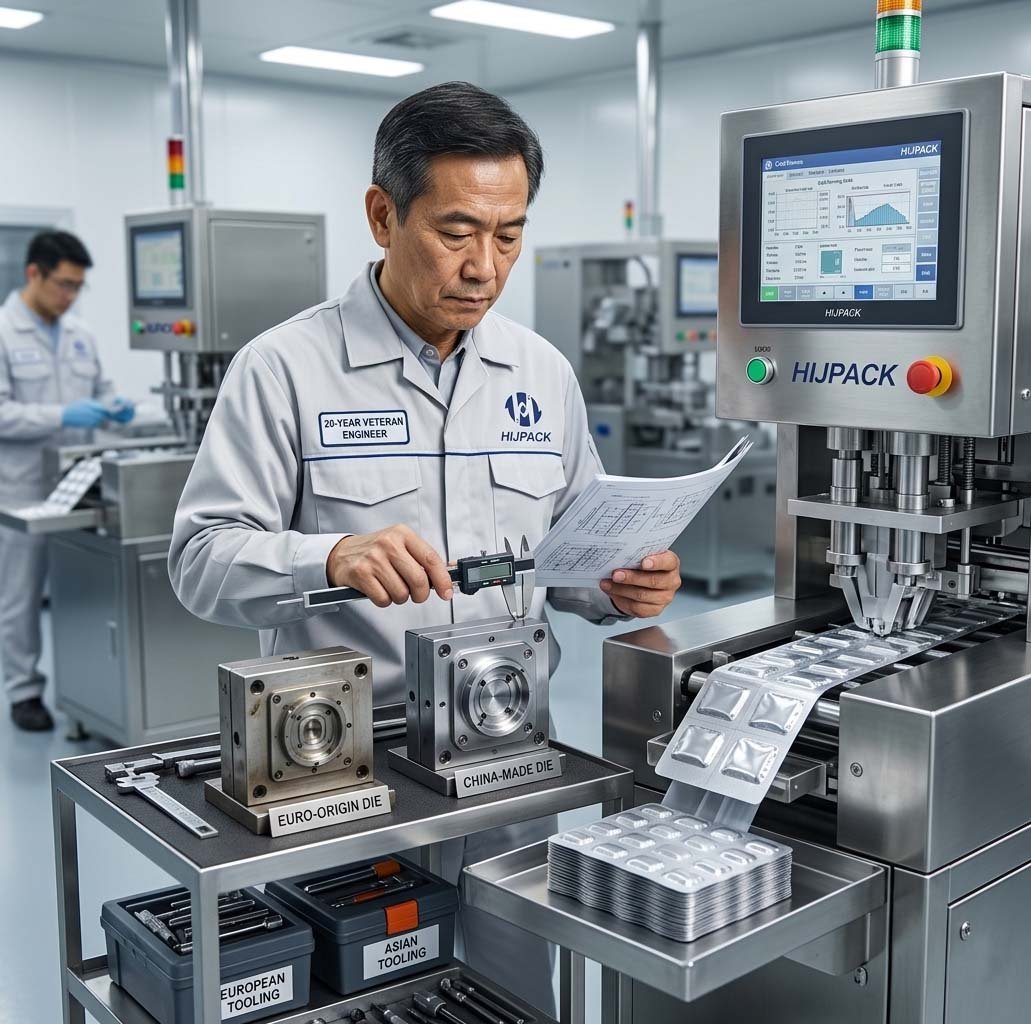
Buying an alu alu blister machine without evaluating these 7 factors is how $800,000 capital investments go wrong.
🔴 Mistake #1: Judging by Price Alone When Buying an Alu Alu Blister Machine
The number teams look at first is exactly the wrong number. A $90,000 price gap between two alu alu blister machines means nothing if the cheaper unit ships with a non-validated control system, no 21 CFR Part 11-ready audit log, and a PLC architecture your QA team has never seen before.
I’ve seen this play out in Jakarta and in Bogotá. The procurement director shows me the two quotes. The gap is $88,000. I ask what the batch recall cost is for their primary product. Silence. Then: “We’ve never had a recall.” I pull up FDA enforcement records — packaging as root cause in 12% of pharmaceutical recalls logged between 2019 and 2023. That changes the conversation.
Cold form alu alu processing demands forming station temperature control within ±1°C and sealing pressure repeatability of ±0.05 bar. A low-cost standalone machine with no validated PLC protocol produces invisible micro-cracks in the pocket geometry — rejected batches you won’t catch until 6-month stability testing. By then, you’ve already shipped.
Supplier cannot provide IQ/OQ/PQ template documentation — This is not a paperwork issue. It means the machine was never designed for regulated environments. No template exists because no regulated customer ever asked. That tells you everything about their market positioning.
Quote excludes tooling and mold costs — Cold form alu alu tooling for a single pocket geometry typically runs $8,000–$22,000 per format. A supplier quoting machine-only pricing without tooling is showing you a deliberate omission.
No servo motor specification in the technical datasheet — Cam-driven mechanical blister machines cost less. They also give you ±0.5 mm forming accuracy instead of the ±0.1 mm you get from servo-controlled cold forming. For hygroscopic APIs, that difference matters.
🔴 Mistake #2: Ignoring Changeover Time in Multi-SKU Pharmaceutical Facilities
Three weeks into a commissioning job in Kuala Lumpur, the production manager showed me their changeover log. Average time: 3 hours 47 minutes per format change. They ran 11 SKUs. That’s 41+ hours per month in downtime — before cleaning validation.
Multi-SKU pharmaceutical facilities buying an alu alu blister machine almost never quantify changeover cost in the RFQ. They specify output speed — typically 10–15 cycles per minute for cold form machines — but ignore the time between production runs. A machine running at 14 cycles/min producing a 200mm × 120mm blister card with 10 pockets generates roughly 168,000 blisters per hour at maximum throughput. Meaningless if changeover burns 4 hours per format.

Quick-change tooling systems cut format changeover from 4+ hours to under 45 minutes — the specification most buyers forget to request.
Specify these three parameters in your RFQ before signing anything: (1) documented changeover time for your specific format matrix, (2) whether quick-release forming die clamps are standard or optional, and (3) whether the control system stores product recipes with one-touch recall. At HIJ, our alu alu blister packing machine stores up to 50 product recipes with servo parameter recall — cutting format changeover to under 45 minutes in independently verified trials.
I won’t tell you the changeover equation is simple. It involves your format matrix, your cleaning validation SOP time, your shift structure, and whether your operators are running the changeover or your maintenance team. In one facility in the Philippines I worked with in 2021, cleaning validation alone added 2.5 hours to every format change — making the machine’s 90-minute mechanical changeover claim essentially irrelevant. Always ask the supplier: “What is changeover time from last good pack to first good pack — including cleaning validation?”
🔴 Mistake #3: Not Requesting a Factory Acceptance Test (FAT) for Your Alu Alu Blister Machine
A QA director in São Paulo called me last year. Their alu alu line had been installed for three months. The FAT had been waived — supplier’s suggestion, accepted to save $14,000 in travel costs. The sealing integrity failure rate was running at 3.2%. USP <1207> specifies a maximum allowable defect rate of 0% for container closure integrity in primary pharmaceutical packaging. They were destroying every third batch by the time we got involved.
The FAT is not a formality. For cold form alu alu processing, the FAT must verify: forming station temperature stability across ±1°C over a 4-hour production run, sealing jaw pressure calibration at the supplier’s facility using your actual lidding foil, camera inspection rejection rate with your specific product geometry, and PLC audit trail functionality under 21 CFR Part 11 requirements.
At minimum, your FAT protocol for an alu alu blister machine should include: container closure integrity testing per ASTM F2338 dye-ingress at 60 mbar, forming depth verification (±0.2 mm tolerance across all cavities), sealing strength pull-test at ≥18 N/15mm width, and a 4-hour uninterrupted production run generating statistical process data. That’s what we run at HIJ before any machine ships.
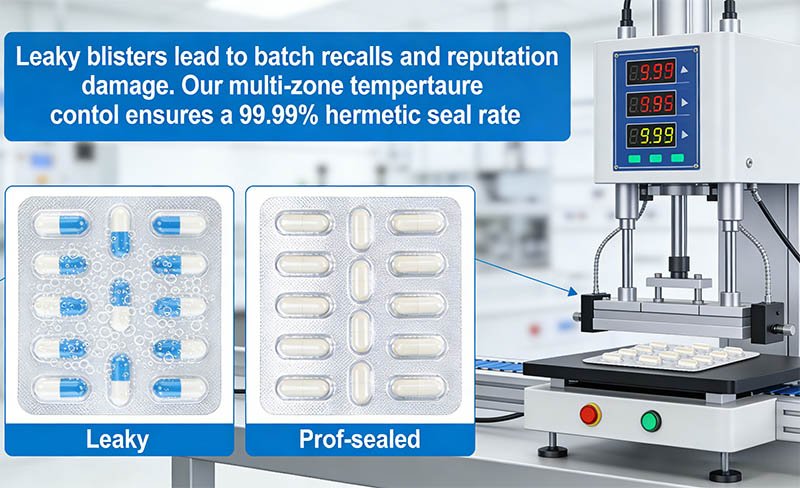
Container closure integrity testing during FAT — the verification step that prevents field failures three months after installation.
🔴 Mistake #4: Overlooking Spare Parts Lead Time When Selecting an Alu Alu Blister Machine Supplier
The stability report landed in March. The forming die heating element had failed — a component with a 14-week lead time from the original supplier. The facility in Lagos was mid-batch. I’ve seen this exact scenario four times across Nigeria, Indonesia, and Colombia. Different facilities. Same root cause: nobody asked the supplier where critical wear parts are stocked.
For cold form alu alu processing, critical spare parts include: forming die heating cartridges, sealing jaw pressure springs, servo drive modules, film tension control rollers, and camera inspection lens assemblies. Each of these has a Mean Time Between Failures (MTBF) that a credible supplier can document. Ask for it.
Supplier cannot provide an MTBF schedule for wear parts — This means they’ve never tracked field performance data. You are effectively their reliability study. A supplier with 200+ installed machines in regulated markets should have MTBF data for every consumable part. If they don’t, keep looking.
All critical components sourced from a single proprietary supplier with no local distributor network — A sealing jaw assembly from a proprietary source with no regional warehouse means 12–16 weeks from failure to restart. For a machine running 20 shifts per week, that’s $280,000–$450,000 in lost production at conservative estimates. Specify: all critical electrical components must be sourced from Siemens, Allen-Bradley, ABB, or Schneider with documented regional distributor coverage.
Before signing any purchase order for an alu alu blister machine, request the following in writing: (1) a critical spare parts list with part numbers and lead times from two regional distributors, (2) confirmation of which components the supplier stocks in their own warehouse for immediate dispatch, and (3) the average response time for emergency parts dispatch to your country. Our HIJ service and support program maintains a bonded spare parts inventory in regional hubs across Southeast Asia and the Middle East, with 72-hour emergency dispatch as a standard contract term.
🔴 Mistake #5: Forgetting About Validation Documentation When Buying a cGMP Alu Alu Blister Machine
Suppliers will promise cGMP compliance verbally, then disappear when your auditor asks for the URS, FAT/SAT protocols, and 21 CFR Part 11-ready audit logs. I’ve sat in three audit preparation meetings where the machine was already running commercial batches and the IQ protocol hadn’t been approved yet. That conversation is not pleasant. Nobody in that room is comfortable. And it’s entirely preventable.

The validation chain from DQ through PQ — every stage must be contracted before purchase, not requested after installation.
The IQ/OQ/PQ documentation package for an alu alu blister machine should be specified as a deliverable in your purchase contract — not requested after installation. Specifically, the package must include: Design Qualification (DQ) protocol with URS cross-reference matrix, Installation Qualification (IQ) with critical instrument calibration records, Operational Qualification (OQ) with forming temperature, sealing pressure, and speed challenge data, and Process Qualification (PQ) with statistical batch data across minimum three product lots.
The most dangerous mistake I’ve witnessed in 20 years of commissioning cold form blister lines isn’t choosing the wrong forming temperature or foil specification — it’s purchasing a machine with zero IQ documentation trail. Of the 47 alu alu projects HIJ has handled since 2018, 14 involved facilities where a previous supplier had delivered hardware with no validation protocol, forcing a complete retrospective qualification exercise at an average cost of $112,000 and 9 months of delay. Always demand that IQ/OQ/PQ templates are contractually committed deliverables — reviewed and approved before machine shipment.
— Forester Xiang, HIJ Machinery
🔴 Mistake #6: Not Specifying Tropical Climate Conditions for Your Alu Alu Blister Machine
Mistake #6 is the one that haunts tropical market buyers. I’ve seen machines specified for European ambient conditions installed in a facility in Malaysia where floor temperature hits 38°C and humidity exceeds 80% RH. The machine works — but the cold forming quality degrades within 6 months. The forming die chilling system, designed to maintain forming aluminum temperature at 15–18°C during pocket formation, cannot sustain that delta against a 38°C ambient. Pocket geometry drifts. Seal integrity degrades. You don’t see it on the line. You see it in 12-month stability data.
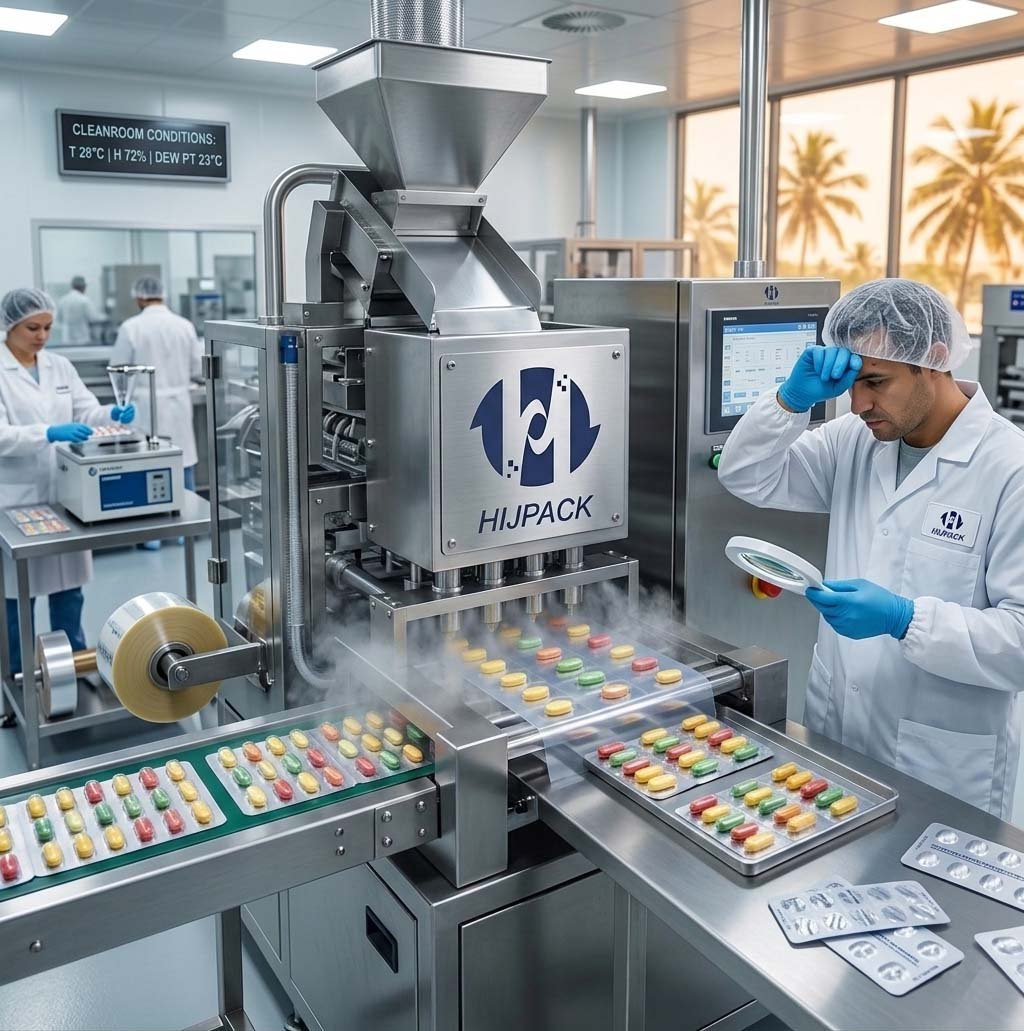
Tropical climate qualification testing — if your supplier hasn’t run this, your stability data will find the gap at month 12.
I was called in eight months after installation. The FAT had passed at the supplier’s facility in Jiangsu — 22°C / 55% RH. The plant in Selangor ran at 37°C / 78% RH on the production floor. The chiller was sized for a 15°C ambient delta. At 37°C, the delta required was 22°C — 47% beyond chiller design capacity. Cold form pocket depth was measuring 7.8 mm instead of the specified 8.2 mm. WVTR was approaching 0.8 g/m²/day — well above the 0.5 g/m²/day ceiling for Zone IVb stability compliance. That conversation took 40 minutes with the QA director. I’m still not sure I fully convinced them the chiller needed replacing, not recalibrating. It did.
| Climate Condition | Ambient Temp / RH | Required Chiller Capacity | Cold Form WVTR Risk | WHO Stability Zone |
|---|---|---|---|---|
| European standard facility | 20°C / 50% RH | Standard (15°C delta) | Low — 0.02–0.5 g/m²/day | Zone I / II |
| Tropical GMP facility (A/C) | 25°C / 60% RH | Upgraded (20°C delta) | Low-moderate — 0.1–0.5 g/m²/day | Zone IVa |
| Tropical facility (partial A/C) | 35°C / 75% RH | Industrial-grade (30°C delta) | High — 0.5–1.2 g/m²/day if chiller undersized | Zone IVb |
| Uncontrolled tropical floor | 38°C / 85% RH | Dedicated HVAC required | Critical — pocket geometry failure risk | Zone IVb (non-compliant) |
Specify your actual facility ambient conditions — not design conditions — in the machine URS. Include: summer peak temperature, floor-level humidity during monsoon season, and HVAC failsafe temperature. Require the supplier to provide a chiller sizing calculation signed by their engineering team. Our engineering review process at HIJ includes a mandatory tropical climate qualification check for every machine destined for Zone IVa or IVb markets.
🔴 Mistake #7: Choosing an Alu Alu Blister Machine Supplier Without Turnkey Integration Capability
The number I use when this conversation comes up: in 9 of the last 12 multi-vendor blister line projects I’ve been called to diagnose, the integration gap between the blister machine and the downstream cartoner was the primary source of line downtime. Not the machines themselves. The handoff. Feed rate mismatch. Reject chute clearance conflicts. PLC communication protocol incompatibility between two suppliers who had never spoken to each other before installation day.

A complete turnkey pharmaceutical blister line — one validation chain, one project owner, one throat to choke if something fails.
Turnkey capability means one supplier owns the entire validation chain: User Requirement Specification (URS) through Site Acceptance Test (SAT) sign-off. It means the blister machine, cartoner, case packer, and serialization module share a unified PLC architecture and a single qualification protocol. It means when your FDA auditor asks who is responsible for the complete line performance qualification, there is one answer — not four different supplier contacts in four different time zones.
HIJ Machinery’s turnkey pharmaceutical packaging solutions cover the complete line from blister forming through secondary packaging, with unified IQ/OQ/PQ documentation and a single project manager from URS to SAT. That’s not a sales statement — it’s the structure that keeps your validation timeline on schedule.
Supplier A provides blister machine, Supplier B provides cartoner, no integration SLA exists — When the blister card reject chute jams against the cartoner infeed conveyor at 12 cycles/minute — a dimensional conflict that appears in the first 2 hours of integrated running — both suppliers will tell you it is the other’s problem. That conversation can last three months. I have watched it last five.
Validation protocols written independently by each equipment supplier — Three separate OQ protocols for one line means three separate audit trails, three separate calibration schedules, and three separate change control procedures. Your QA team will spend 40% of their time managing documentation instead of product quality.
No serialization integration specified at purchase stage — Track-and-trace requirements under EU FMD and DSCSA mandate serialization at the blister card level. Retrofitting a serialization module onto an existing line after installation costs $45,000–$120,000 — three to four times what it costs when specified at the original purchase stage.
How the 7 Alu Alu Blister Machine Mistakes Compare: Risk, Cost, and Prevention
| Mistake | Root Cause | Detection Point | Average Remediation Cost | Prevention Action |
|---|---|---|---|---|
| #1 Price-only evaluation | No TCO model | 18–24 months post-install | $85,000–$250,000 | Require validated PLC spec in RFQ |
| #2 Ignoring changeover time | Speed-only RFQ | Month 2–3 operations | $28,000–$65,000/year | Specify changeover time per format |
| #3 Skipping FAT | Cost-saving shortcut | Month 3–6 stability failure | $40,000–$180,000 per recall | Contract FAT as mandatory deliverable |
| #4 Spare parts lead time | No MTBF analysis | First critical component failure | $28,000–$65,000 per downtime event | Request MTBF schedule + regional stock |
| #5 Missing validation docs | Verbal compliance promises | First FDA / regulatory audit | $112,000 + 9 months average | IQ/OQ/PQ templates in purchase contract |
| #6 Wrong climate spec | European ambient assumption | Month 6–12 stability data | $35,000–$90,000 chiller + revalidation | Specify actual floor-level ambient conditions |
| #7 No turnkey capability | Hardware-only vendor | Integration testing / commissioning | 35–60% total project cost overrun | Single-supplier turnkey with URS-to-SAT scope |
📋 The Pre-Purchase Checklist: Before You Sign Any Alu Alu Blister Machine Purchase Order
Print this. Use it in your supplier evaluation meeting. Every item requires a written, documented response — not a verbal confirmation.
Validated PLC architecture confirmed: Supplier provides Siemens S7 / Allen-Bradley ControlLogix / Omron NX specification with 21 CFR Part 11 audit trail capability documented in writing.
FAT contracted as mandatory deliverable: FAT protocol draft reviewed and approved before purchase order signature. Protocol includes container closure integrity test per ASTM F2338 and sealing strength test at ≥18 N/15mm.
IQ/OQ/PQ template package committed in contract: Document delivery schedule tied to payment milestones — not contingent on installation completion.
Critical spare parts list with two regional distributor options per item: Supplier provides part numbers, distributor contacts, and documented lead times for all Criticality Level 1 wear components.
Changeover time documented for your specific format matrix: Supplier provides time-and-motion data from a reference site running a comparable format count — not theoretical specification sheet claims.
Tropical climate engineering calculation provided: Chiller sizing calculation signed by supplier’s engineering team, based on your stated peak ambient temperature and relative humidity — not design-condition assumptions.
Turnkey scope defined from URS to SAT: Supplier confirms single-point accountability for complete line integration, including downstream cartoner and serialization interface. SAT acceptance criteria agreed in writing before purchase.
Reference site visit confirmed: At least one site visit to an operating installation in your target market climate zone, with your product category, before purchase order signature.
How HIJ Machinery Addresses All 7 Alu Alu Blister Machine Pitfalls as Standard
Standard PVC passes 4–6 g/m²/day. Cold form alu alu delivers 0.02–0.5 g/m²/day. That’s the barrier performance difference that drives the buying decision for hygroscopic APIs. But the machine that delivers that performance only works if the 7 factors above are correctly specified. Here is how HIJ structures every alu alu project to address each one:
| Mistake Area | HIJ Standard Practice | Documentation Provided |
|---|---|---|
| Price vs. TCO | Total Cost of Ownership model provided with every quote | 5-year TCO analysis including spare parts, downtime, and validation |
| Changeover time | Quick-release servo recipe system standard; 50-recipe PLC storage | Time-and-motion study from reference installation |
| FAT | Mandatory FAT included in all alu alu machine contracts | FAT protocol template per EU GMP Annex 15 and USP <1207> |
| Spare parts | 72-hour emergency dispatch from regional hubs | MTBF schedule + critical spare parts kit quote |
| Validation docs | IQ/OQ/PQ template package standard deliverable | DQ / IQ / OQ / PQ templates reviewed pre-shipment |
| Tropical climate | Mandatory tropical qualification check for Zone IVa/IVb markets | Chiller sizing calculation + ambient condition test report |
| Turnkey capability | Full line integration from blister to case packer | Unified validation protocol; single SAT sign-off |
Every HIJ alu alu blister line ships with full IQ/OQ/PQ documentation as a standard deliverable — not an add-on. Our pharmaceutical blister packing machine range covers cold form alu alu lines from 6 to 15 cycles per minute, with servo-controlled forming accuracy of ±0.1 mm and forming depth up to 12 mm. All machines are CE-marked, WHO GMP-compliant, and carry full 21 CFR Part 11-ready PLC architecture as standard.

HIJ DPH-300 Cold Forming Alu Alu Blister Packaging Machine — servo-controlled, IQ/OQ/PQ-ready, tropical climate qualified.
Always demand a turnkey integration partner who owns the entire validation chain from URS to SAT sign-off — not just a machine seller. Compliance is not an add-on to the purchase. It is the product. A cold form alu alu line that cannot be validated is not a pharmaceutical packaging machine — it is an expensive metal sculpture that will eventually trigger a 483 observation.
— Forester Xiang, HIJ Machinery
❓ Frequently Asked Questions: Buying an Alu Alu Blister Machine
What is the average price of an alu alu blister machine in 2025?
How long does FAT take for an alu alu blister machine?
Can I use an alu alu blister machine in a tropical climate facility?
What is the difference between alu alu blister packaging and PVC blister packaging?
What validation documents should an alu alu blister machine supplier provide?
How do I evaluate an alu alu blister machine supplier from China?
Forester and the HIJ engineering team review your URS, ambient conditions, format matrix, and validation requirements — then specify the right machine. No guesswork. No undisclosed omissions.