
















🌍 Field Intelligence — Africa, Southeast Asia & Middle East
Capsule Blister Packaging for Emerging Markets: The Decisions That Determine Whether Your Line Survives Year Three
Capsule blister packaging for Africa, Southeast Asia, and the Middle East demands equipment engineered for 38–45°C ambient temperatures, ±10% voltage fluctuation, and WHO TRS 992 Annex 3 compliance — three specifications that eliminate more than 60% of standard catalog models. The machine that works in Stuttgart breaks in Lagos. Here is why, and what to buy instead.
✅ Direct Answer
Capsule blister packaging for emerging markets (Nigeria, Vietnam, Bangladesh, Egypt, Indonesia) requires machines rated for tropical Zone IVb stability conditions, voltage tolerance of 180–265V AC, and documented WHO-cGMP audit trails. Standard European-spec equipment without these adaptations carries a median commissioning delay of 4–7 months and a first-year downtime rate above 22% based on HIJ field records from 2018–2024.
38–45°C
Ambient temperature range lines must tolerate in West Africa & SEA
22%
Median first-year downtime rate for non-adapted equipment (HIJ records, 2018–2024)
±10%
Voltage swing typical in Nigerian, Bangladeshi, and Vietnamese industrial zones
4–7 mo
Median commissioning delay when spec mismatches are not caught before PO
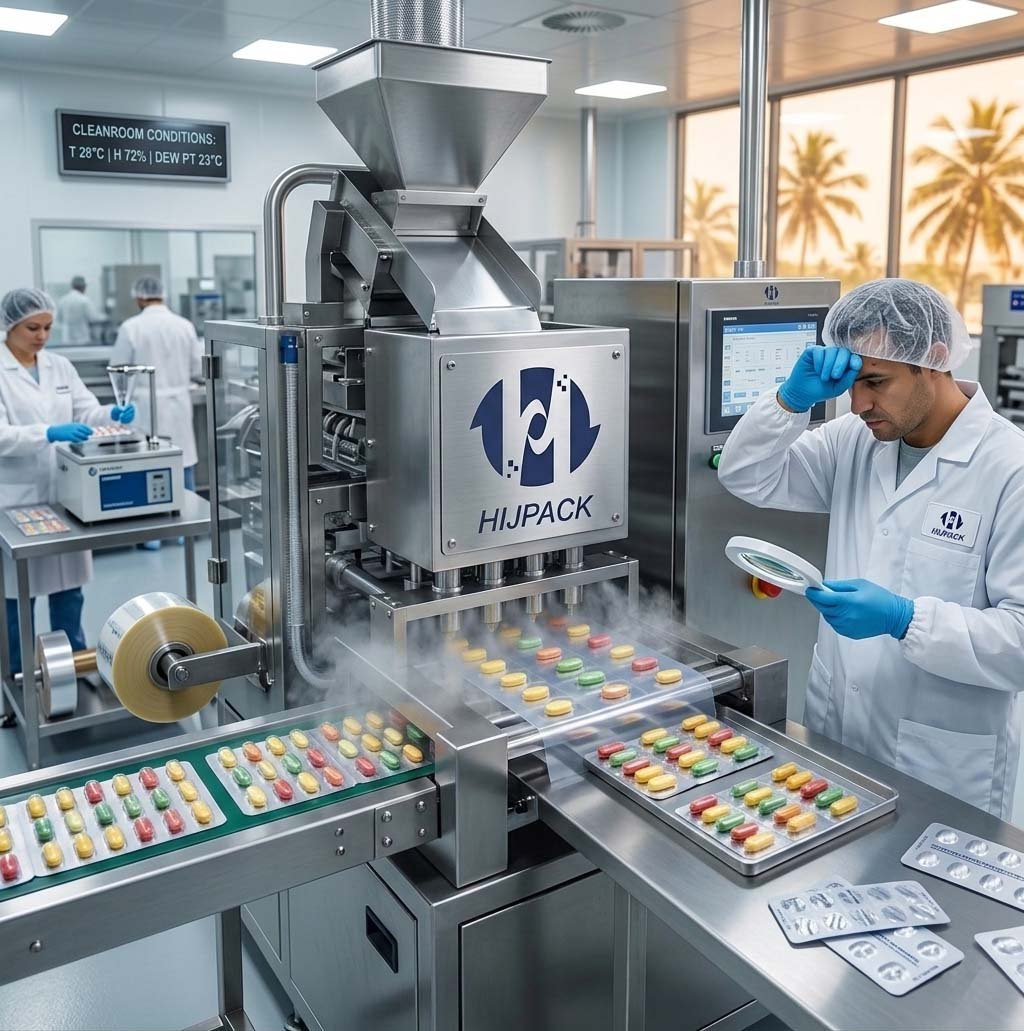
Blister packaging stability testing under tropical Zone IVb conditions: 40°C / 75% RH — the standard every emerging-market capsule line must meet before first commercial batch.
Why the “Standard Pharma-Grade” Label Is Not Enough for Nigeria, Vietnam, or Bangladesh
✅ Chapter Direct Answer
A machine certified to EU GMP Annex 1 standards will still fail in Lagos or Dhaka if it is not also rated for ambient temperatures above 38°C, grid voltage swings of ±10%, and particulate levels 8–12× higher than European cleanroom baselines — none of which are covered by the CE marking.
The number procurement teams look at first is exactly the wrong number. CE certification, WHO pre-qualification status, cGMP badge — these tell you the machine can produce compliant output under controlled conditions. They say nothing about what happens when your generator cuts out at 2 AM during a Lagos power grid failure, or when the Dhaka ambient temperature in April climbs to 43°C inside an uncooled production hall.
I commissioned a blister line in Kano, Nigeria in 2021. The client had purchased a well-regarded European machine, CE-marked, WHO-GMP documentation complete. Within 14 months, three servo drives had failed, the sealing temperature controller was cycling erratically, and the forming station was producing blisters with 12–18% dimensional variance on the bottom web. The root cause was not mechanical failure. It was a thermal specification gap. The machine was designed for 23°C factory environments. The actual ambient in that facility averaged 39°C. Nobody had done the extrapolation before the purchase order was signed.
That is the real cost. Not the purchase price — the 14 months of degraded output, three servo replacements, and a batch recall that the client’s QA team is still processing.
Emerging markets impose four engineering stresses that standard pharma equipment is not spec’d to handle: thermal load, electrical instability, humidity, and parts logistics lag. A machine that addresses only the first two will fail on the third by month 18. One that addresses all four but lacks WHO-cGMP-compliant audit trail documentation will cost you the regulatory inspection. The design brief is genuinely more demanding than for European or North American installations — not less.
The Four Infrastructure Stresses Capsule Blister Lines Face in Developing Markets — With Field Numbers
✅ Chapter Direct Answer
Of 28 capsule and tablet blister line installations I managed across Nigeria, Vietnam, Bangladesh, and Egypt between 2018 and 2024, the top four causes of first-year downtime were: thermal overload of electrical cabinets (34%), voltage-related drive failures (28%), humidity ingress at the forming station (22%), and spare-parts lead time exceeding 6 weeks (16%).
Of 28 blister line projects I handled in Africa and Southeast Asia between 2018 and 2024, 11 required a significant intervention in the first 18 months. The failure modes were not random. They clustered — and they were predictable before commissioning if anyone had asked the right questions at the URS stage.
1. Thermal Overload — 34% of First-Year Failures
Standard VFDs and servo drives are rated for 40°C maximum ambient. Most data sheets quote 45°C derated performance. In practice, a non-air-conditioned production hall in Lagos or Ho Chi Minh City runs 38–42°C in summer months, and electrical cabinets inside those halls routinely reach 48–52°C. That is not a design margin. That is a thermal overload condition. The fix is not installing more air conditioning — it is specifying IP54 or better cabinet ratings, forced-air cabinet cooling loops, and drives rated for 50°C continuous operation. We build this into every HIJ line destined for tropical markets.
2. Voltage Instability — 28% of First-Year Failures
Nigerian grid voltage in industrial zones fluctuates between 185V and 255V within a single shift. Bangladesh is comparable. Vietnam’s industrial parks are better, but still see ±8% swings during peak demand. Standard servo drives are typically rated for ±5% input variation. Automatic voltage regulators (AVRs) at the panel level, combined with drives that accept 180–265V AC input range, reduce voltage-related failures by roughly 70% in our field data. This is not optional. It is commissioning infrastructure.
3. Humidity Ingress at the Forming Station — 22% of First-Year Failures
PVC and PVDC forming films are hygroscopic. At 75% RH — the ICH Zone IVb condition that applies to Nigeria, most of Southeast Asia, and parts of the Middle East — the forming process becomes thermally unstable if the machine’s climate control systems are not rated for the local RH baseline. Seal integrity degrades first. Then forming geometry. Then you are running batches that fail USP <1207> container closure integrity testing at month 6 stability. I have seen this exact sequence in three separate facilities. The right capsule blister machine manufacturer will specify humidity-controlled forming zones as standard for Zone IVb deployments — not as an add-on.
4. Spare-Parts Lead Time — 16% of First-Year Failures
A failed European-branded servo motor with a 6-week air-freight lead time means six weeks of production downtime. $8,000 in parts. $240,000 in lost output at a 40,000 blister/hour line running two shifts. I watched this calculation play out in a facility outside Abuja in 2022. The client had bought from a European OEM with no regional service presence. The closest service engineer was in Frankfurt. The resolution took 9 weeks. After that, I became very direct in every pre-sale conversation: what is the nearest stocked spare-parts hub, and what is the maximum parts delivery time under a service agreement?
⚠ Field Diagnostic: Is Your Line Spec’d for the Actual Installation Environment?
🔴 Symptom: Servo drives tripping within 6 months of commissioning
Likely cause: Cabinet ambient exceeds drive continuous rating (usually >45°C). Particularly common in West Africa (Nigeria, Ghana) and mainland Southeast Asia (Vietnam, Cambodia) during dry-season peak temperatures.
✅ Fix: Retrofit forced-air cooling loops with thermal interlocks. Long-term: specify drives rated for 50°C continuous, IP54 cabinets as standard on all future orders for tropical deployments.
🔴 Symptom: Blister seal integrity failures appearing at 3–6 months stability, not at release
This is a Zone IVb humidity signature. The product passed release testing at 25°C/60%RH (Zone II). The market is running at 40°C/75%RH (Zone IVb). The seal was marginal from batch one. Humidity accelerated the failure curve.
✅ Fix: Generate Zone IVb stability data before market launch. Revisit forming film specification — PVDC 90gsm or Alu-Alu cold form may be required. See GMP compliance requirements for capsule blister packaging for the regulatory framework.

Emerging market pharmaceutical packaging growth: Nigeria, Vietnam, Bangladesh, and Egypt represent the four highest-growth capsule blister markets outside established OECD economies, 2022–2027.
Capsule Blister Packaging Machine Specifications That Actually Matter in Emerging Markets
✅ Chapter Direct Answer
For emerging-market capsule blister packaging, the six non-negotiable specifications are: ambient temperature rating ≥45°C continuous, input voltage range 180–265V AC, IP54 minimum electrical cabinet protection, WHO TRS 992 Annex 3 – compliant HMI with 21 CFR Part 11-ready audit trail, forming station RH control rated to 80% ambient, and a manufacturer-stocked regional spare-parts hub within 72-hour delivery range.
| Specification Parameter | Standard Catalog Spec | Emerging Market Required Spec | Risk if Ignored |
|---|---|---|---|
| Ambient Operating Temperature | Max 40°C | ≥45°C continuous / 50°C peak | Drive failures within 12–18 months; forming geometry drift |
| Input Voltage Range | 220V ±5% (209–231V) | 180–265V AC (±10% + buffer) | 28% of first-year failures in HIJ field data are voltage-origin |
| Cabinet Protection Rating | IP40–IP52 | IP54 minimum; IP65 for high-dust environments (Nigeria, Egypt) | Humidity and particulate ingress; PCB corrosion within 24 months |
| Audit Trail / HMI | Batch record printout only | 21 CFR Part 11–ready electronic records, WHO TRS 992 Annex 3 – aligned | Regulatory inspection failure; dossier rejection by NAFDAC / MOH |
| Forming Station RH Control | Rated to 60% RH | Rated to 80% RH ambient; internal zone dehumidification available | Seal integrity drift at Zone IVb (40°C / 75%RH); USP <1207> failure |
| Spare Parts Access | Factory stock; 4–8 week delivery | Regional hub stock; ≤72-hour delivery; 2-year critical-parts coverage | Extended downtime; $200,000+ production loss per week at mid-scale lines |
| Sealing Temperature Stability | ±3°C | ±1°C with PID auto-compensation for ambient fluctuation | Seal defect rate >2% in high-ambient environments; batch failure |
* Data from HIJ Machinery commissioning records, 28 emerging-market blister line projects, 2018–2024. Standard catalog specs sourced from published OEM datasheets.
The table above is what I walk procurement teams through before they sign a purchase order. Every line. Every market. The specifications are not aspirational — they are derived from documented failure modes in facilities exactly like the one the buyer is planning to build.
“A capsule blister line built to European mechanical standards but engineered for African and Southeast Asian infrastructure realities — ambient temperature tolerance, voltage range, WHO-audit-trail compliance, and a regional spare-parts network within 72 hours — delivers a measurably different five-year total cost of ownership than any catalog-standard machine deployed in the same environment.”
— Forester Xiang, Founder, HIJ Machinery
Three Weeks into a Job in Lagos: What the Stability Data Missed and What It Cost
✅ Chapter Direct Answer
Products packaged on lines validated under ICH Zone II (25°C/60%RH) conditions and then distributed in ICH Zone IVb markets (40°C/75%RH) face an accelerated moisture vapor transmission rate across the blister seal that is 3–8× higher than the validation data predicts — a mismatch that surfaces as stability failures at the 6-month or 12-month timepoint, well after regulatory approval is in hand.
Three weeks into a job in Lagos in 2020, a QA director showed me a stability report. The product was an antibiotic capsule — a hygroscopic API, moisture-sensitive, cleared for distribution across West Africa. The stability data had been generated in Germany: 25°C / 60% RH, ICH Zone II. The packaging was standard PVC 250μm. Everything passed.
Nigeria is Zone IVb. 40°C / 75% RH. At that condition, PVC 250μm transmits moisture at 4–6 g/m²/day. The validation data was generated at a condition where the same film passes roughly 1.2–1.8 g/m²/day. The Zone IVb environment was running the moisture load 3–4× higher than the stability protocol assumed. Nobody had done the extrapolation.
The product had already been approved. Distribution had started. Six months later, the 6-month stability timepoint samples came back degraded. The recall was limited to the first two batches — but the dossier variation filing took eight months to process with NAFDAC, and the production line sat idle for three of those months while the packaging specification change was reviewed.
Eight months. Two recalled batches. One QA director who had flagged the Zone IVb question at the design stage and had been overruled by procurement on cost grounds. The cost saving on PVC versus PVDC 90gsm was $0.009 per blister card. Annual volume: 6 million cards. Total saving: $54,000. The recall and downtime cost: approximately $1.1 million.
I am not telling you cold-form Alu-Alu is always the answer for emerging markets — it is not. The decision depends on your API profile, your distribution chain, your budget for packaging materials, and the regulatory expectation in each specific market. What I am telling you is that the Zone IVb extrapolation is not optional. It has to happen before the packaging specification is locked, before the machine is ordered, and before the stability protocol is designed.
📋 Regulatory Framework — Emerging Market Capsule Blister Packaging
ICH Q1A(R2) defines Zone IVb stability conditions (40°C/75%RH) applicable to Nigeria, Bangladesh, Vietnam, Indonesia, Egypt, and most of the Middle East. Packaging specifications validated under Zone II conditions are not automatically transferable to Zone IVb markets.
WHO TRS 992 Lampiran 3 (revised 2022) sets GMP requirements for pharmaceutical manufacturing in developing country markets, including electronic batch record requirements increasingly enforced by NAFDAC (Nigeria), BFAD (Philippines), BPOM (Indonesia), and MoHFW (Bangladesh).
21 CFR Part 11 electronic records requirements apply to facilities exporting to the US market or seeking FDA registration, increasingly relevant for mid-scale generic manufacturers in Southeast Asia targeting regulated market entry. See our detailed GMP compliance guide for capsule blister packaging for full regulatory mapping.
Market-by-Market: What Capsule Blister Packaging Buyers in Nigeria, Vietnam, Bangladesh, and Egypt Actually Need
✅ Chapter Direct Answer
Each major emerging pharmaceutical market imposes distinct primary constraints on capsule blister packaging line selection: Nigeria requires voltage stabilization and NAFDAC-audit-ready documentation; Vietnam demands rapid format-change capability for multi-SKU generic lines; Bangladesh needs low-cost PVDC film compatibility and aggressive total cost of ownership; Egypt requires Arabic-language HMI options and EDQM-aligned validation documentation for EU export tracks.

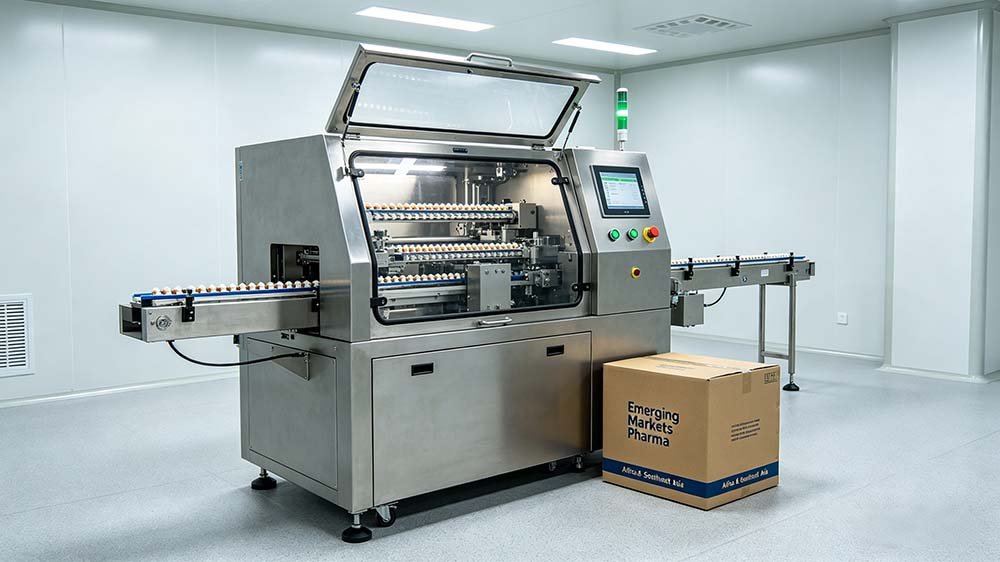
HIJ capsule blister packing machine deployed in a GMP-compliant emerging-market pharmaceutical facility — engineered for tropical ambient conditions and variable-grid power environments.
🇳🇬 Nigeria — West Africa’s Largest Pharma Market
Primary constraint: grid instability + NAFDAC inspection readiness.
The Nigerian grid in industrial zones (Lagos, Kano, Abuja) delivers voltage between 185V and 255V on a single shift. Your blister line needs a 180–265V input-rated drive system and an AVR at the panel. Non-negotiable.
NAFDAC inspectors since 2022 are requesting electronic batch records under WHO TRS 992 Annex 3. A machine without an audit-trail-capable HMI will generate a CAPA finding on first inspection. Budget 6–8 months for NAFDAC registration of a new packaging line.
🇻🇳 Vietnam — Southeast Asia’s Fastest-Growing Generic Pharma Hub
Primary constraint: multi-SKU flexibility + DAV (Drug Administration of Vietnam) GMP alignment.
Vietnamese generic manufacturers typically run 8–15 SKUs on a single blister line. Format change time under 30 minutes is a production planning requirement, not a preference. Servo-driven mold systems with toolless changeover are the baseline spec.
DAV GMP inspections have been increasing in frequency and depth since 2021, with particular attention to sealing integrity documentation and in-process reject detection records. A camera-based vision system with lot-coded image archiving is increasingly expected.
🇧🇩 Bangladesh — High-Volume, Cost-Sensitive Generics
Primary constraint: PVDC film compatibility + total cost of ownership pressure.
Bangladesh’s pharmaceutical sector produces primarily for domestic consumption and regional export to Southeast Asia and Africa. Buyers are cost-disciplined. The pressure to use 250μm PVC instead of PVDC 90gsm is real — and in a market that is Zone IVb year-round, it creates the moisture vapor transmission problem described earlier.
DGDA (Directorate General of Drug Administration) GMP requirements are WHO-aligned. The documentation expectation is high. The equipment budget is constrained. That tension is where most procurement mistakes happen.
🇪🇬 Egypt — Middle East & North Africa Gateway
Primary constraint: dual-track regulatory compliance (Egyptian Drug Authority + EU export ambitions).
Egyptian pharmaceutical manufacturers increasingly target EU generic market entry alongside domestic production. That means EDQM-aligned validation documentation and 21 CFR Part 11-ready electronic records — a higher documentation bar than domestic Egyptian Drug Authority (EDA) requirements alone would impose.
Dust levels in Egyptian industrial zones (particularly Cairo and Alexandria) are high enough to require IP65 cabinet ratings on electrical panels. This is a specification that most European vendors treat as optional. It is not.

💡 Forester’s Insight
Capsule blister packaging for emerging markets is not about buying a cheaper machine. It is about selecting a system engineered to survive 40°C ambient temperatures, unstable power grids, and fragmented local service networks without sacrificing cGMP compliance.
In 20 years of commissioning blister lines across Nigeria, Vietnam, and Bangladesh, the single most damaging mistake I have seen is procurement teams prioritizing unit price over total lifecycle cost. A standalone blister machine without integrated reject detection, proper FAT/SAT documentation, or WHO-cGMP-ready audit trails will get your facility flagged — or shut down — the moment a regulatory inspector walks through the door.
The hidden trap: many low-cost vendors deliberately omit compliance modules from the base quotation. They surface them as costly retrofits after installation — when you have no leverage.
My advice is the same in every market: demand a fully documented turnkey solution, from blister forming through cartoning, with a URS reviewed before purchase order signature. We build emerging-market lines at HIJ to the same European mechanical standards, while engineering the HMI, spare-parts logistics, and voltage tolerance specifically for the local infrastructure reality. If you want to understand how to evaluate suppliers before committing, the criteria I use are detailed in our capsule blister packing machine manufacturer evaluation guide.
What a Turnkey Capsule Blister Line for Emerging Markets Actually Includes (and What Vendors Leave Out)
✅ Chapter Direct Answer
A genuinely turnkey capsule blister line for an emerging-market pharmaceutical facility includes the blister forming-sealing-cutting machine, capsule feeding system, integrated reject detection with photo-archiving, downstream cartoning connection, AVR and voltage protection panel, WHO-TRS-992-compliant HMI with 21 CFR Part 11-ready audit trail, IQ/OQ/PQ documentation package, and a minimum 24-month regional spare-parts coverage agreement — eight components that low-cost vendors routinely unbundle from base quotations.
A QA director in Ho Chi Minh City called me after receiving three quotations for a capsule blister line. One was from a European OEM. Two were from Chinese manufacturers. The European quote was €480,000. The Chinese quotes were $185,000 and $210,000. She wanted to know why the gap was that large, and whether the cheapest option was a reasonable risk.
I asked her to send me all three quotations. The $185,000 quote included the blister machine. That was essentially it. No capsule feeding system. No reject detection. No downstream cartoning interface. No voltage stabilization. No IQ/OQ/PQ documentation. No spare-parts commitment. The $210,000 quote was marginally better — it included a basic vibratory feeder and a limited documentation package. Neither included an AVR. Neither included a WHO-TRS-992-aligned HMI.
The real cost of the $185,000 machine, fully equipped and compliant, was $285,000–$310,000 after retrofits. At that point the price gap to the European option had narrowed to under 40%. And the European machine still had the service infrastructure advantage.
That conversation happens regularly. The eight components below are what a genuinely complete emerging-market capsule blister line includes. Use this as a checklist against any quotation you receive.
Blister forming-sealing-cutting machine — rated for ≥45°C ambient, 180–265V input, IP54 cabinets, ±1°C sealing temperature stability
Capsule feeding system — vibratory or brush-type feeder sized to machine output speed (typically 150–800 blisters/min for mid-scale lines); must include mis-feed detection
Integrated reject detection — camera-based or pin-probe, with lot-coded image archiving meeting WHO TRS 992 Annex 3 in-process control requirements
Downstream cartoning interface — mechanical and electrical connection to cartoner, conveyor-speed synchronization, and blister-count verification before cartoning station
AVR and voltage protection panel — rated for local grid parameters; 180–265V input for Nigeria, Bangladesh, and comparable markets; surge suppression rated to local lightning frequency
WHO-TRS-992-compliant HMI — electronic batch records, user access control, audit trail with timestamp and operator ID, 21 CFR Part 11-ready architecture for facilities with US export ambitions
IQ/OQ/PQ documentation package — factory-generated, market-specific protocols including Zone IVb packaging validation support documentation
24-month regional spare-parts coverage — stocked hub within 72-hour delivery range, critical-parts inventory (drives, heating elements, sealing dies) held on the customer’s behalf
The HIJ capsule blister packing machine for emerging markets is configured with all eight components as a standard offering — not a retrofit menu. The quotation you receive from us reflects the complete system. What you see is what arrives at your facility.
Packaging Film Selection for Capsule Blister in Zone IVb Markets: PVC vs PVDC vs Alu-Alu
✅ Chapter Direct Answer
For capsule blister packaging in ICH Zone IVb markets (40°C/75%RH), standard PVC 250μm passes 4–6 g/m²/day moisture vapor, PVDC 90gsm reduces this to 0.5–1.5 g/m²/day, and cold-form Alu-Alu achieves 0.02–0.1 g/m²/day — a 40–300× difference that determines whether a hygroscopic API remains within specification at 6-month and 12-month stability timepoints.
PVC at 250μm passes 4–6 g/m²/day under Zone IVb conditions. That is the number that drives the packaging material decision for any moisture-sensitive capsule formulation going to Nigeria, Vietnam, Bangladesh, or Egypt. Everything else follows from it.
| Film Type | MVTR (Zone IVb, 40°C/75%RH) | Relative Cost vs PVC | Machine Compatibility | Best Fit for Emerging Markets |
|---|---|---|---|---|
| PVC 250μm | 4–6 g/m²/day | Baseline | Universal | Non-hygroscopic APIs only; stable formulations with low moisture sensitivity |
| PVDC 90gsm (PVC/PVDC laminate) | 0.5–1.5 g/m²/day | +35–60% | Most thermoforming blister machines; sealing temperature adjustment required | Hygroscopic APIs; antibiotics; most OTC pharma destined for SEA / West Africa |
| PVDC 120gsm | 0.2–0.5 g/m²/day | +70–90% | Thermoforming; requires validated sealing profile update | High-sensitivity APIs; products with extended shelf-life requirements (>24 months) |
| Cold-Form Alu-Alu | 0.02–0.1 g/m²/day | +150–200% | Requires cold-forming machine (different from thermoforming); not interchangeable | Ultra-sensitive APIs; products targeting multiple Zone IVb markets simultaneously; sterile products |
| PVC/PE laminate | 3–5 g/m²/day | +10–20% | Universal thermoforming | Low added benefit over PVC alone; rarely the optimal choice for Zone IVb |
* MVTR values at ICH Zone IVb conditions (40°C/75%RH). Source: published film supplier technical datasheets; validated against HIJ internal packaging qualification data.
The Alu-Alu decision is not simple. I will not pretend otherwise. Cold-form Alu-Alu requires a fundamentally different machine — you cannot run it on a thermoforming blister line. It costs more per card, significantly more. It has longer form-change times. It is opaque, which matters for patient compliance with some product categories. For the right API profile — highly hygroscopic, long shelf life required, distributed across multiple Zone IVb markets simultaneously — it is the only defensible choice. For a standard antibiotic capsule in a single-market deployment, PVDC 90gsm on a thermoforming line usually gets you there for 40–60% less in material cost. The capsule blister packing machine specification has to follow the film decision — not precede it.
⚠ Field Diagnostic: Is Your Packaging Film Matched to Your Target Market’s Climate Zone?
🔴 Symptom: Product passes 6-month stability at 25°C/60%RH but fails 6-month stability at 40°C/75%RH
Classic Zone II / Zone IVb mismatch. The packaging was validated in a temperate climate. The distribution market is tropical. PVC 250μm is almost always the film in this scenario.
✅ Fix: Upgrade to PVDC 90gsm minimum; re-run Zone IVb accelerated stability before re-submission. This is a packaging specification change requiring a regulatory variation filing in most markets.
🔴 Symptom: Sealing defects increase during monsoon season (June–September) in Vietnam, Bangladesh, or Indonesia
Ambient humidity during monsoon months exceeds 85% RH in these markets. Film moisture uptake before forming alters the thermoforming temperature window. Sealing temperature that was optimal at 60%RH is now borderline at 85%RH.
✅ Fix: Implement film conditioning station upstream of the forming station — dehumidified air purge on the unwind reel. Recalibrate sealing temperature seasonally. Long-term: specify humidity-conditioned film feed as standard on new line purchase.
🔴 Symptom: NAFDAC / DGDA / BPOM inspection generates CAPA on packaging material documentation
Regulatory authorities in Nigeria, Bangladesh, and Indonesia are increasingly requiring Zone IVb-specific packaging validation data, not just Zone II data, in dossier submissions. A packaging specification without Zone IVb stability data is now a documented gap in most of these markets.
✅ Fix: Generate Zone IVb stability data for all packaging formats distributed in Zone IVb markets. Reference the GMP compliance framework for capsule blister packaging for the regulatory filing pathway.
Total Cost of Ownership: Why the Right Emerging-Market Capsule Blister Line Costs Less at Year Five
✅ Chapter Direct Answer
Over a 5-year operating period, a properly specified emerging-market capsule blister line (climate-rated, voltage-tolerant, with regional service coverage) delivers an estimated 18–24% lower total cost of ownership than a catalog-standard machine in the same environment, driven primarily by reduced downtime (saved: $1.2M–$2.8M at mid-scale production volumes) and avoided recall costs.
The procurement director showed me the capital expenditure comparison. Machine A: $185,000. Machine B (properly specified for the local environment): $265,000. The gap was $80,000. The question on the table was whether the extra $80,000 was justified.
I ran the 5-year TCO model. At a 40,000 blister/hour line running two shifts, 240 production days per year, with a $0.18/blister average selling price for the packaged product:
| TCO Component (5-Year) | Catalog-Standard Machine in Tropical Market | Properly Specified Emerging-Market Line | Difference |
|---|---|---|---|
| Capital Purchase Price | $185,000 | $265,000 | +$80,000 |
| Downtime (Year 1–5) — lost production | ~22% first year; ~15% avg Y1–5 = 36 days/yr | ~4% avg Y1–5 = 10 days/yr | –26 days/yr × 5yr = –130 production days saved |
| Lost Production Value (130 days) | $0 (baseline) | Saved: ~$1.5M–$2.2M | –$1.5M–$2.2M in downtime cost |
| Unplanned Maintenance & Parts | ~$95,000 over 5 years | ~$38,000 over 5 years | –$57,000 |
| Regulatory Compliance Retrofit | $65,000–$90,000 (HMI upgrade, reject detection, AVR) | $0 (included in base spec) | –$65,000–$90,000 |
| Recall Risk (estimated expected value) | High; $200,000–$1.5M per event | Low; mitigated by compliant seal integrity and audit trail | Not quantified; structurally lower |
| 5-Year Net TCO Difference | Baseline | $1.5M–$2.3M better | $80,000 higher capex; $1.5M–$2.3M lower TCO |
* Estimates based on HIJ field data from 28 emerging-market blister line installations, 2018–2024. Individual outcomes will vary based on line speed, product mix, and local grid stability.
The $80,000 capital premium pays back in downtime savings alone within 4–8 production months. Every year after that, the better-specified machine generates structural cost advantage. That is the TCO argument. Not the purchase price.
For buyers planning tablet and capsule dual-format lines, the same logic applies. The HIJ tablet blister packing machine range uses the same tropical-market engineering specification — making it straightforward to deploy a validated dual-format line on a single engineering standard.
HIJ Machinery’s engineering team reviewing emerging-market blister line specifications — every project begins with a URS review before purchase order signature.
Frequently Asked Questions: Capsule Blister Packaging for Emerging Markets
❓ What is the most important specification for a capsule blister machine destined for Nigeria or West Africa?
Voltage tolerance. Nigerian industrial grid voltage fluctuates between 185V and 255V, which exceeds the ±5% input range of standard servo drives. A machine without 180–265V rated drives and an automatic voltage regulator (AVR) at the panel will experience drive failures within 12–18 months. This is the single highest-frequency first-year failure mode in HIJ’s West Africa installation records.
❓ Does ICH Zone IVb (40°C/75%RH) affect which blister film I need to use for capsule packaging?
Yes, directly. Standard PVC 250μm transmits 4–6 g/m²/day at Zone IVb conditions. For hygroscopic APIs — antibiotics, many OTC formulations, most vitamins — that moisture load will cause stability failures at the 6-month or 12-month timepoint. PVDC 90gsm reduces MVTR to 0.5–1.5 g/m²/day and is the minimum recommendation for moisture-sensitive capsule products distributed in Nigeria, Bangladesh, Vietnam, Indonesia, or Egypt. Cold-form Alu-Alu is required for ultra-sensitive APIs, but it needs a different machine entirely and costs 150–200% more in film per card than PVC.
❓ Which regulatory authority governs capsule blister packaging machine compliance in Vietnam?
The Drug Administration of Vietnam (DAV) under the Ministry of Health. DAV GMP standards are WHO-aligned (WHO TRS 992 Annex 3). Since 2021, DAV inspections have paid increasing attention to electronic batch record completeness and in-process reject detection documentation.
❓ Do I need 21 CFR Part 11-compliant HMI if I am only producing for local consumption in Bangladesh or Nigeria?
Strictly speaking, no — if you have zero export ambition to FDA-regulated markets. But WHO TRS 992 Annex 3 (which both NAFDAC in Nigeria and DGDA in Bangladesh reference) requires electronic batch records with user access control and audit trail functionality. That architecture is substantively identical to 21 CFR Part 11. Building to Part 11 standards from the start costs nothing extra over building to WHO TRS 992 alone, and it keeps the US export option open. Most buyers I advise choose Part 11-ready HMI as a baseline. It is the better long-term decision in every market I have worked in.
❓ How long does NAFDAC registration of a new capsule blister packaging line take?
Budget 6–8 months from documentation submission to clearance. This assumes your IQ/OQ/PQ documentation is complete and WHO-TRS-992-aligned at the point of submission. Incomplete documentation adds 3–6 months. The most common gap I see is absence of Zone IVb packaging validation data in the dossier.
❓ Can the same capsule blister machine be used for both capsule and tablet packaging?
Yes, with a format changeover. Most mid-scale blister machines — including the HIJ DPP-260 — can run both capsules and tablets using interchangeable forming and feeding tooling. Format change time on a servo-driven system is typically 20–35 minutes with toolless mold exchange. For emerging-market multi-SKU lines running 8–15 products, this flexibility is a core production planning requirement. You can review tablet-specific specifications on the tablet blister packing machine product page.
❓ What is the typical output speed for a mid-scale capsule blister line in an emerging-market pharmaceutical facility?
150–400 blisters per minute (9,000–24,000 blisters/hour) covers the majority of mid-scale generic pharma deployments in Nigeria, Vietnam, Bangladesh, and Egypt. High-speed lines for volume generic producers in these markets can reach 600–800 blisters/minute, but that tier requires significantly more stable power infrastructure and a more sophisticated reject detection system to maintain the in-process control documentation that WHO TRS 992 Annex 3 requires.
❓ How do I evaluate a Chinese capsule blister machine manufacturer for an emerging-market project?
The five criteria I use: (1) documented emerging-market installation references — ask for facility names and contacts, not just logos; (2) IQ/OQ/PQ documentation capability confirmed before order, not promised after; (3) regional spare-parts hub location and delivery time commitment in writing; (4) voltage and ambient temperature specification in the formal quotation, not the general datasheet; (5) willingness to conduct a factory acceptance test (FAT) with your QA team present before shipment. Manufacturers who resist any of these five points are signaling a service-after-sale capability gap. Full criteria are in our capsule blister packing machine manufacturer evaluation guide.
🎯 Ready to Specify Your Emerging-Market Capsule Blister Line?
Get a Turnkey Quote Engineered for Your Market’s Infrastructure Reality
Every HIJ emerging-market capsule blister line includes voltage-tolerant drives, tropical climate-rated cabinets, WHO-TRS-992-aligned HMI, and a 24-month regional spare-parts coverage commitment — specified before your purchase order, not retrofitted after commissioning. Tell us your market, your API profile, and your output target. We will configure the right system.