
















📦 Beginner’s Complete Guide
What Is Liquid Blister Packaging? The Definition Most Buyers Get Wrong
Most packaging engineers I meet for the first time think liquid blister packaging is just a blister machine with a pump added to it. It’s not. It’s a forming‑filling‑sealing discipline with its own set of material science, regulatory requirements, and failure modes — and the gap between a correctly specified line and an incorrectly specified one can cost you months of revalidation and six figures in regulatory exposure.
This guide covers what liquid blister packaging actually is, how the process works step by step, what materials matter and why, which industries use it, and the most common mistakes buyers make before they call me. By the end, you’ll have enough technical grounding to hold a meaningful conversation with any equipment supplier — and spot the ones who don’t.
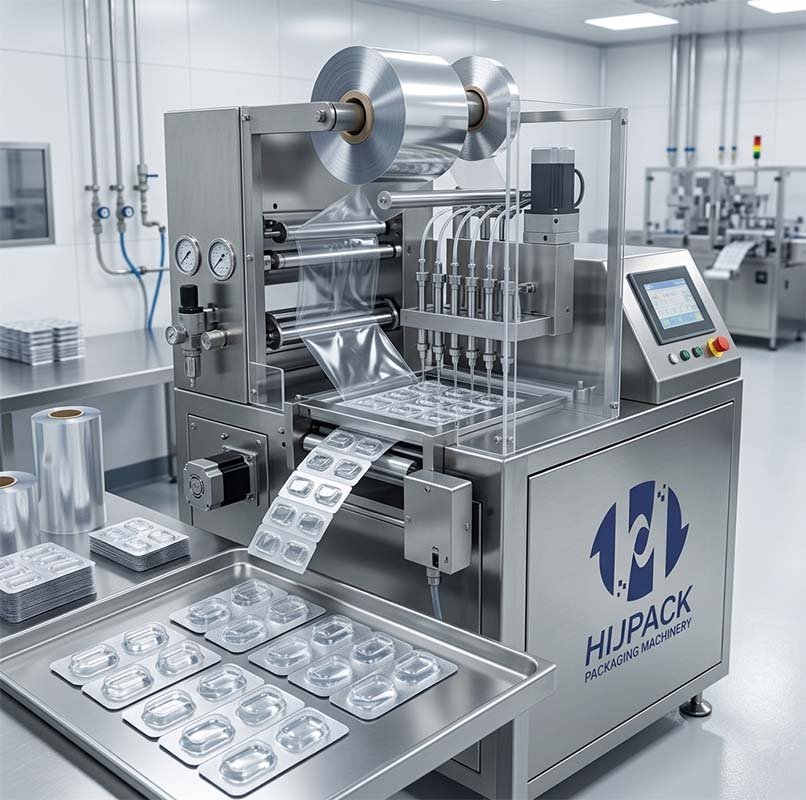
HIJ DPP-140/150 Liquid Blister Packaging Machine — thermoforming, precision liquid filling, and foil heat-sealing in one integrated line.
Fill volume accuracy achievable with servo-driven dosing pumps
mL per cavity — typical liquid dose range in pharma blister lines
of pharma recalls 2019–2023 traced to primary packaging failure (FDA data)
industries using liquid blister packaging beyond pharmaceuticals
What Is Liquid Blister Packaging? The Precise Technical Definition
📌 Direct Answer
Liquid blister packaging is a continuous forming‑filling‑sealing process that thermoforms individual cavities in a base web (PVC, PVDC, or cold-form aluminum foil), dispenses a metered liquid volume of 0.5 mL to 20 mL per cavity, then heat-seals an aluminum lidding foil over each cavity — producing tamper-evident, unit-dose liquid packages that meet cGMP, WHO GMP, and 21 CFR Part 211 containment and dosage accuracy requirements.
Three words matter most in that definition: forming, mengisi, dan penyegelan. Every problem I’ve seen on a liquid blister line — across 20 years and installations in Jakarta, São Paulo, Lagos, and Ho Chi Minh City — traces back to one of those three stations being specified, validated, or operated incorrectly. When a buyer says “we had a liquid blister problem,” I immediately ask: which station? The answer tells me 80% of what I need to know.
The key distinction from standard tablet blister packaging is the filling station. A mesin pengemas tablet dalam kemasan blister uses a brush, vibration, or gravity feeder to place solid units into pre-formed cavities. A liquid blister machine uses a precision dosing pump — peristaltic, piston, or gear-type — to deliver a specific volume of liquid into each cavity before the lidding foil closes. The pump specification alone determines whether your fill volume accuracy lands at ±0.5% or ±5%. That’s not the same thing.
Unit-dose containment. That’s the point. Each cavity is hermetically isolated from every other cavity, which means one contaminated or leaking unit does not compromise the entire batch. For pharmaceutical products this is not a convenience feature. It’s a regulatory expectation under EU GMP Annex 1 and WHO TRS 992 Annex 3.
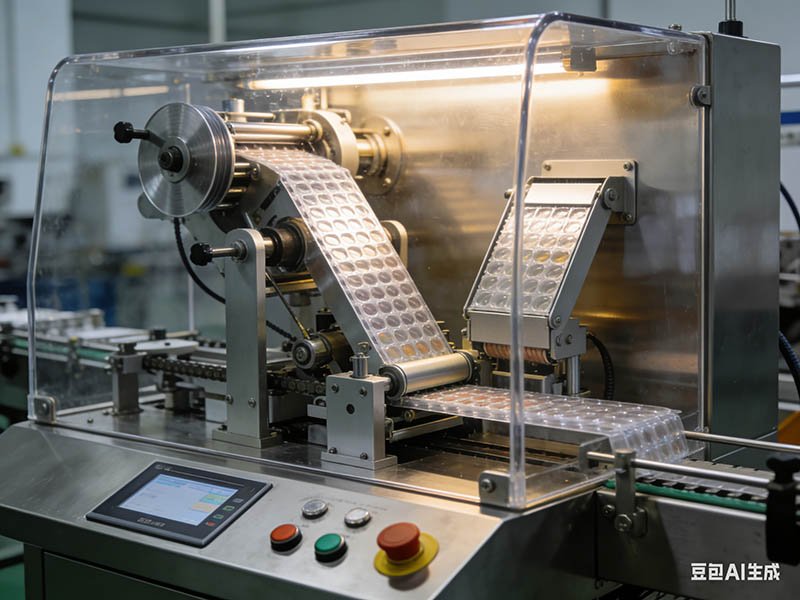
Precision liquid filling station on HIJ DPP-140/150 — servo-controlled dosing pump delivering calibrated volumes into thermoformed cavities before aluminum foil sealing.
How Does Liquid Blister Packaging Work? The 5-Station Process Explained
📌 Direct Answer
A liquid blister packaging machine processes base film through five sequential stations: film unwinding, thermoforming of cavities, precision liquid filling, aluminum foil heat-sealing, and punching/cutting — producing finished unit-dose blister cards at speeds of 30 to 120 strokes per minute depending on cavity format and fill volume.
I find that most buyers understand the concept once I walk them through it station by station. The confusion usually comes from conflating the liquid blister process with sachet or ampoule filling, which are fundamentally different formats. These five stations run in continuous sequence on a single machine frame.
- 1
Film Unwinding & Pre-Heating
The base web — typically 250–300 μm PVC, PVDC-coated PVC, or 60–120 μm cold-form aluminum composite — unwinds from a roll and passes through a pre-heating zone. Temperature control at this station sets the thermoformability of the film. PVC typically heats to 120–150°C; cold-form Alu-Alu does not use heat but requires higher forming pressure. Incorrect pre-heat temperature is the first cause of webbing and cavity deformation defects I see in the field.
- 2
Thermoforming (Cavity Formation)
The heated film is pressed into a forming mold using compressed air (positive pressure) or vacuum assist — or both. This creates the individual cavities that will hold the liquid. Cavity depth, wall uniformity, and corner radius are determined by mold design. For liquid products, cavity geometry must account for meniscus behavior during fill: too-shallow cavities overflow; too-deep cavities create fill-accuracy drift at the dosing pump level.
- 3
Precision Liquid Filling
This is the station that separates a liquid blister machine from every other blister format. A precision dosing pump — piston, peristaltic, or gear-driven — delivers a metered volume into each formed cavity. On a well-engineered line, this achieves ±1% fill volume accuracy, which Ph. Eur. 2.9.26 and USP <1> standards require for oral liquid unit-dose products. The pump must be cleaned-in-place (CIP) compatible if the product is a sterile or semi-sterile liquid; this is a specification detail buyers frequently overlook.
- 4
Aluminum Foil Heat-Sealing
A lidding foil — typically 20–25 μm hard-temper aluminum with a heat-seal lacquer coating — is pressed onto the filled base web under controlled temperature (160–200°C) and pressure (250–400 N/cm²) using heated sealing dies. Sealing integrity is the most critical quality attribute. A failed seal on a liquid blister pack does not produce a visible empty pocket like a missed tablet — it produces a leaking pack that may pass visual inspection and fail only at the patient or end-user. Sealing validation using ASTM F2338 dye-ingress at 60 mbar is what USP <1207> specifies for container closure integrity testing.
- 5
Punching, Cutting & Output
The sealed web passes through a punch/cut station where individual blister cards are separated to the specified dimensions. Batch number and expiry date printing (inkjet or hot-stamp embossing) typically occurs inline at this stage. Finished cards transfer to downstream cartoning or secondary packaging. On integrated lines from HIJ, the output conveyor feeds directly into a blister cartoning machine to complete the primary-to-secondary packaging sequence.
Liquid Blister Packaging Materials: Which Film Do You Actually Need?
📌 Direct Answer
The three dominant base web materials for liquid blister packaging are PVC (moisture vapor transmission rate 4–6 g/m²/day), PVDC-coated PVC (0.5–2 g/m²/day), and cold-form Alu-Alu composite (0.02–0.5 g/m²/day) — with the correct choice depending primarily on the product’s moisture sensitivity, target climate zone, and regulatory market requirements.
The number teams look at first is unit cost per cavity. That’s exactly the wrong number to start with. The right starting point is your product’s moisture vapor sensitivity and the ICH stability zone of your target distribution market.
I saw this play out in a plant outside Pune in 2021. The stability data for an oral solution had been generated at 25°C/60% RH using standard PVC base web. The product was going into Maharashtra retail pharmacy — a Zone IVb environment at 40°C/75% RH. Nobody had run the Zone IVb extrapolation on the moisture ingress model. When 12-month stability data came back, three out of five degradation markers were outside acceptance criteria. The packaging material was changed to PVDC-coated PVC. The clock reset. Eight months of lost time on a product that was otherwise registration-ready.
| Base Web Material | MVTR (g/m²/day) | Thermoformable? | Best For | Cost Index | Regulatory Notes |
|---|---|---|---|---|---|
| PVC (250 μm) | 4–6 | Yes — easy | Industrial liquids, low-sensitivity products, non-pharma applications | 1.0× (baseline) | Not permitted in some EU markets for primary pharma packaging |
| PVDC-Coated PVC | 0.5–2.0 | Yes | Pharma oral solutions, eye drops, Zone III/IVa distribution | 1.8–2.4× | ICH Q1A(R2) Zone III/IV stability compliant |
| Cold-Form Alu-Alu | 0.02–0.5 | Yes — requires higher pressure | Hygroscopic liquids, Zone IVb, sensitive APIs, sterile applications | 3.0–4.5× | EU GMP Annex 1 preferred for sterile unit-dose; WHO GMP pre-qualification requirement in some markets |
| PET/AL/PVC Composite | 0.3–1.5 | Yes | Mid-barrier applications, nutraceutical liquids, cosmetic samples | 2.0–3.0× | Depends on lamination spec; verify with supplier CoA |
The lidding foil is the other half of the equation. Standard 20 μm hard-temper aluminum with a heat-seal lacquer is the industry default. For products requiring child-resistant compliance, a push-through/peel-back laminate adds complexity. For sterile products, the lidding foil specification requires validation of the seal‑to‑substrate bond strength — not just visual inspection. At HIJ, we specify the full material combination — base web, lidding foil, and sealant system — as a validated package rather than individual components.
💡 Forester’s Insight — A 20-Year Engineer’s Perspective
Before signing any purchase order, demand a complete URS review and insist on end-to-end turnkey integration accountability from a single supplier. In my 20 years commissioning lines in Southeast Asia and Latin America, I’ve watched buyers get burned by the same mistake repeatedly: purchasing a standalone liquid blister machine from a low-cost vendor, then discovering it lacks validated PLC protocols, proper FAT/SAT documentation, or compatibility with their existing track-and-trace systems.
The hidden cost of retrofitting these gaps routinely exceeds the original machine price. In one Brazilian facility, it triggered a full regulatory shutdown for three months. Your first machine should solve problems, not create new ones. That’s the principle behind HIJ’s solusi pengemasan siap pakai approach.
What Is Liquid Blister Packaging Used For? Industries and Applications
📌 Direct Answer
Liquid blister packaging is used across pharmaceuticals (oral solutions, eye drops, cough syrups), nutraceuticals (liquid vitamins, probiotic shots), cosmetics (serum samples, skin‑care trial doses), food service (portion condiments, flavored oils), and industrial sectors (lubricant samples, adhesive reagents, diagnostic reagents) — wherever unit-dose containment, tamper evidence, and precise liquid volume dispensing are required.
Of the 31 liquid blister line projects I handled in Southeast Asia and Latin America between 2018 and 2023, exactly 19 were pharmaceutical, 7 were nutraceutical or OTC supplement, and 5 were industrial. That split reflects the market well. Pharmaceuticals dominate, but the fastest growing inquiry volume I’m seeing now comes from nutraceutical OTC brands trying to differentiate single-serve supplement formats from the standard sachet.
Aplikasi Farmasi
This is the primary domain. Oral solutions — pediatric paracetamol, ibuprofen suspension, antibiotic syrups — represent the highest volume application. Eye drops in unit-dose blister format eliminate preservative requirements that multi-dose bottles require, which improves the formulation profile and appeals to ophthalmological regulatory reviewers. Wound-care irrigation solutions in unit-dose blisters are another growing category. All of these fall under pharmaceutical liquid blister packaging machine specifications and require compliance with 21 CFR Part 211, EU GMP Annex 1 (2022 revision), and WHO TRS 992 Annex 3 depending on target market.
Nutraceutical and OTC Applications
Liquid vitamin B12 shots. Probiotic liquid sachets. Collagen hydrolysate single-serve doses. The nutraceutical sector is moving toward liquid blister format because it communicates precision dosing — a marketing advantage over powder sachets — while eliminating the bulky bottle format that inflates freight costs. These lines do not require the same level of sterile GMP compliance as pharmaceutical applications, but they still require validated fill accuracy and sealing integrity to meet retailer shelf-life claims.
Industrial and Non-Pharma Applications
A procurement manager in Vietnam called me in 2022 about packaging single-dose lubricant cartridges for motorcycle maintenance kits. The retail format needed to be tamper-evident, weatherproof, and compatible with a 36-month shelf life. Liquid blister with cold-form Alu-Alu base web solved all three requirements. The same logic applies to diagnostic reagents (single-use pipette-dose chemicals), adhesive samples in trade show kits, and craft food-service products like flavored oils and specialty condiments. These are markets where the mesin pengemas blister capability overlaps with industrial packaging requirements.
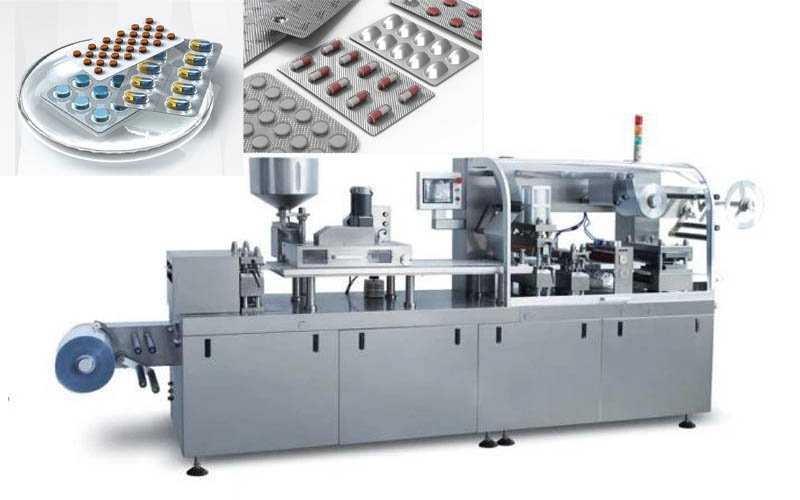
Liquid blister packaging spans pharmaceutical oral solutions, OTC nutraceuticals, and industrial unit-dose formats — all requiring precision fill volume control and hermetic foil sealing.
Liquid Blister Packaging vs. Other Liquid Formats: Why Buyers Switch
📌 Direct Answer
Compared to bottles, sachets, and ampoules, liquid blister packaging reduces per-unit material cost by 15–30%, eliminates preservative requirements through hermetic unit-dose isolation, delivers higher tamper-evidence and shelf stability, and enables automated secondary packaging integration — making it the preferred format for high-volume pharmaceutical and nutraceutical unit-dose programs.
A QA director in Ho Chi Minh City walked me through his cost model in 2020. He was running a pediatric paracetamol oral solution in 60 mL bottles. Bottle cost, closure, shrink band, label, secondary carton — total primary packaging cost: $0.18 per unit. His pharmacist clients were complaining about partial-dose waste and dosing errors with the dropper. The alternative we modeled was a 5 mL unit-dose liquid blister at 6 cavities per card. Total primary packaging cost: $0.11 per unit. Dosing errors: eliminated by design. Waste: reduced from 60 mL bottle to 5 mL per use occasion. He approved the line investment within 90 days.
| Format | Tamper Evidence | Unit-Dose Accuracy | Preservative Needed? | Freight Cost Index | Secondary Pack Integration |
|---|---|---|---|---|---|
| Liquid Blister | ✅ Hermetic per cavity | ±0.5–1% | No (single-use) | 1.0× (low) | Direct inline to cartoner |
| Bottle + Dropper | ⚠️ Closure only | ±5–15% | Yes (multi-dose) | 2.5× (heavy/bulky) | Separate labeling line needed |
| Sachet (Form-Fill-Seal) | ✅ Sealed | ±2–4% | No (single-use) | 1.2× | Separate bundling required |
| Ampoule (Glass) | ✅ Hermetic | ±1–2% | No (single-use) | 3.0× (fragile packaging) | Tray/nest required |
| Plastic Ampoule (Blow-Fill-Seal) | ✅ Hermetic | ±1–3% | No | 1.8× | Separate secondary line needed |
One difference that rarely appears in specification sheets: consumer convenience. A liquid blister pack is a tactile, single-action format. Twist off, pour, discard. No measuring spoon. No residue left in a bottle. For pediatric formulations targeting emerging markets — where literacy rates or caregiver training may limit accurate dosing from a bottle — the unit-dose blister format is not a premium feature. It’s a patient safety feature.
“Of the 31 liquid blister line projects I handled across Southeast Asia and Latin America between 2018 and 2023, 11 required a forming material change after month-12 stability failure — in every case, the original specification had been written without a Zone IVb moisture ingress calculation. The material change wasn’t a quality upgrade. It was a correctable specification error that cost each of those 11 clients an average of seven months of revalidation time.”
— Forester Xiang, Pendiri, HIJ Machinery
GMP and Regulatory Requirements for Liquid Blister Packaging Lines
📌 Direct Answer
Pharmaceutical liquid blister packaging machines must comply with EU GMP Annex 1 (2022) for sterile or near-sterile products, 21 CFR Part 211 for US‑marketed drug products, WHO TRS 992 Annex 3 for markets requiring WHO pre-qualification, and ICH Q10 pharmaceutical quality system requirements — with machine documentation including IQ/OQ/PQ validation protocols, 21 CFR Part 11 compliant audit trail, and GAMP 5 software validation evidence.
The regulatory reality is this: the machine itself is not what FDA or EMA inspects in isolation. What they inspect is the combination of machine design, validated process parameters, documentation system, and operator training — and they look at how all four interact. I’ve sat through six pharma line audits where the equipment was technically sound but the PLC audit trail was either not 21 CFR Part 11 compliant or was turned off for convenience. Both got 483 observations. Both required significant remediation investment.
✅ Applicable Regulatory Standards — Liquid Blister Packaging Machines
A critical specification detail that separates compliant machines from non-compliant ones: the PLC must support role-based access control with individual user accounts, time-stamped audit trail of all parameter changes, and electronic batch record generation. These are not optional for any pharmaceutical customer. They are prerequisites for IQ qualification. At HIJ, we build all pharma-grade liquid blister lines on Siemens S7 or Allen-Bradley PLC platforms with full 21 CFR Part 11 compliance built in — not retrofitted. Ask your vendor to show you the audit trail log before you sign the purchase order.
⚠️ Diagnostic: 3 Signs Your Liquid Blister Machine Spec Is Missing Something Critical
Symptom A: Vendor quote shows no FAT/SAT documentation line item
Factory Acceptance Testing and Site Acceptance Testing are not optional for pharmaceutical liquid blister lines. They are the validation framework through which IQ/OQ/PQ builds. A quote without FAT/SAT is a quote for a food-grade or industrial machine presented to a pharmaceutical buyer. Push back. If the vendor says “we can add that,” ask them to show you a completed FAT protocol from a previous pharma project. If they can’t, move on.
Symptom B: Fill volume accuracy specification is stated as “±2% to ±5%”
That’s an industrial machine specification, not a pharmaceutical one. Ph. Eur. 2.9.26 and USP <1> require ±1% or tighter for oral liquid unit-dose products. A ±5% fill accuracy at 5 mL per cavity means a patient could receive anywhere from 4.75 mL to 5.25 mL — a 10% dosing range. That’s not acceptable for any regulated pharmaceutical product. Insist on ±1% specification and ask for demonstrated OQ data from a comparable project.
Symptom C: Machine contact parts material is not stated or listed as “stainless steel” without grade
“Stainless steel” is not a specification. 304 and 316L are both stainless steel. For pharmaceutical liquid contact parts, 316L is required — it has higher corrosion resistance to chloride-containing cleaning agents and is more compatible with aggressive APIs. For food-contact industrial applications, 304 is generally acceptable. Ask for the material certificate. If the vendor cannot provide it, you cannot generate the required material qualification documentation for your validation dossier.
What Separates a Good Liquid Blister Packaging Machine from a Costly Mistake?
📌 Direct Answer
A well-specified liquid blister packaging machine combines ±1% fill accuracy from a servo-controlled dosing pump, 316L stainless steel liquid-contact parts, full 21 CFR Part 11 compliant PLC with audit trail, validated sealing parameters traceable to ASTM F2338 container closure integrity testing, complete FAT/SAT documentation package, and tooling changeover under 30 minutes — each specification being non-negotiable for pharmaceutical markets.
The procurement director showed me the quote comparison sheet at a meeting in 2022. Vendor A (European): $285,000. Vendor B (Chinese, tier-2): $94,000. Vendor C (HIJ): $148,000. His instinct was to ask what Vendor B was leaving out to hit $94,000. Good instinct.
What Vendor B was leaving out: servo-driven pump (replaced with pneumatic piston), 316L contact parts (304 used throughout the liquid path), Siemens PLC (replaced with a domestic brand with no Part 11 module), complete FAT documentation (replaced with a one-page test checklist), and validated sealing parameter study (replaced with “set temperature per recommendation”). The machine would run. It would produce blisters. It would not pass an FDA pre-inspection audit. Not even close.
Servo-driven dosing pump — achieves ±0.5–1% fill accuracy; pneumatic alternatives typically ±3–5%
316L stainless steel liquid contact parts — with material certification CoA, not just specification claim
CIP-compatible filling system — for products requiring between-batch cleaning without full disassembly
21 CFR Part 11 compliant PLC — with individual user accounts, audit trail, electronic batch records
Temperature and pressure sealing validation — with documented parameter ranges traceable to container closure integrity test results
Complete FAT/SAT documentation package — forming the backbone of your IQ/OQ/PQ validation dossier
Mold changeover under 30 minutes — with documented tooling change procedure for batch record purposes

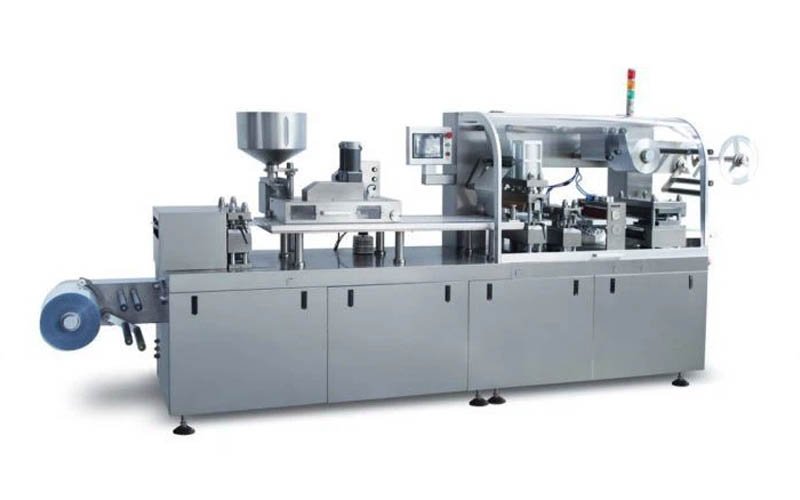
HIJ DPP-140/150 Liquid Blister Packaging Machine — servo-driven filling system, 316L stainless steel product-contact parts, Siemens PLC with 21 CFR Part 11 audit trail, and complete FAT documentation package.
“FDA enforcement records for 2019–2023 show packaging as the root cause in 12% of pharmaceutical recalls — the number I use when procurement teams tell me the $54,000 price difference between a compliant Chinese machine and a non-compliant one ‘doesn’t justify the cost.’ One batch recall in a developing-market pharmaceutical facility costs an average of $800,000 in product write-off, regulatory response, and revalidation. The math isn’t close.”
— Forester Xiang, Pendiri, HIJ Machinery
Frequently Asked Questions About Liquid Blister Packaging
What is liquid blister packaging used for in pharmaceuticals?
Liquid blister packaging in pharmaceuticals is used for unit-dose oral solutions (pediatric syrups, cough liquids, antacid suspensions), ophthalmic drops (single-use, preservative-free eye drop blisters), wound-care irrigation solutions, and certain injectable-adjacent products requiring hermetic primary containment. The format meets EU GMP Annex 1, 21 CFR Part 211, and WHO GMP pre-qualification requirements for sterile and non-sterile liquid drug products when correct material specifications are applied. The primary advantage over multi-dose bottles is elimination of preservative requirements and patient dosing error risk — both of which drive regulatory reviewer preference for unit-dose formats in high-risk populations.
What is the difference between liquid blister packaging and sachet packaging?
Liquid blister packaging thermoforms rigid or semi-rigid cavities from a base web, fills each cavity precisely, then seals with foil — producing a card-format package with multiple isolated unit doses. Sachet packaging forms a flexible pouch from a flat film roll using three-side or four-side sealing, typically with less rigid cavity definition. Blister format gives better fill accuracy (±0.5–1% vs. ±2–4% for sachets), superior shelf stability from hard-barrier materials, and cleaner inline integration with secondary cartoning. Sachets are lower in tooling cost and more flexible for irregular fill volumes.
How accurate is the fill volume in liquid blister packaging?
With a servo-driven piston or peristaltic dosing pump, ±1% fill volume accuracy is achievable at production speeds. That means a 5 mL nominal fill delivers between 4.95 mL and 5.05 mL per cavity — compliant with Ph. Eur. 2.9.26 and USP <1> requirements for oral liquid unit-dose products. Pneumatic pump alternatives typically achieve ±3–5%, which is not acceptable for regulated pharmaceutical applications but may be sufficient for industrial or food-service formats.
What materials are used in liquid blister packaging?
The base web options are PVC (MVTR 4–6 g/m²/day, lowest cost), PVDC-coated PVC (MVTR 0.5–2 g/m²/day, mid-barrier), and cold-form Alu-Alu composite (MVTR 0.02–0.5 g/m²/day, maximum barrier). Lidding is typically 20–25 μm hard-temper aluminum with heat-seal lacquer. The correct base web selection depends on product moisture sensitivity and ICH stability zone of distribution market.
Does liquid blister packaging require GMP compliance?
Yes, for pharmaceutical applications. The machine and process must comply with the GMP framework of the target market — 21 CFR Part 211 for the US, EU GMP Annex 1 for Europe (sterile products), WHO TRS 992 Annex 3 for WHO pre-qualification markets. The PLC must be 21 CFR Part 11 compliant for electronic records. The machine qualification requires IQ/OQ/PQ validation documentation. Non-pharmaceutical applications (food, industrial) do not carry the same regulatory burden, but food-contact compliance under applicable national food safety legislation is still required.
How fast does a liquid blister packaging machine run?
Typical production speeds are 30–120 strokes per minute, depending on cavity format, fill volume, and sealing parameters. At 6 cavities per card and 80 strokes/minute, output is approximately 480 unit doses per minute — or about 28,800 per hour. Larger fill volumes (10–20 mL) require slower speeds to allow complete cavity fill without overflow.
Can liquid blister packaging machines handle viscous liquids?
Yes, with the correct pump type. Peristaltic pumps handle viscosities up to approximately 5,000 cP. Gear pumps handle higher viscosities (up to 50,000 cP). Standard piston pumps are best for low-to-medium viscosity (under 2,000 cP). Specify viscosity range, temperature at fill, and any temperature-sensitivity constraints when requesting a machine quote — these parameters directly determine pump type, filling nozzle design, and whether temperature-controlled filling stations are required.
What is the minimum order quantity to justify a liquid blister packaging machine investment?
No universal minimum exists, but the economics typically work at annual volumes above 10 million unit doses. Below that, contract packaging is often more cost-effective unless regulatory or proprietary formulation control requirements mandate in-house packaging capability. At 10 million doses per year and a machine running two 8-hour shifts, utilization sits at roughly 40% — economically viable. The full capital and operating cost analysis is covered in detail in the liquid blister packaging machine cost breakdown guide.
What to Do Next: From Understanding to Specification
Liquid blister packaging is a precision discipline. The definition is straightforward — thermoforming, filling, sealing, cutting — but the specification decisions behind each station determine whether your line passes a regulatory audit or creates one. Material selection drives stability outcomes. Pump type determines fill accuracy. PLC architecture determines documentation compliance. None of these decisions are interchangeable.
The starting point for any serious project is a product profile review: API or active ingredient, viscosity at fill temperature, moisture sensitivity, target distribution zone (ICH stability zone), and regulatory markets. From that profile, material specification, pump type, and GMP documentation level follow logically. Starting with the machine price and working backward is how buyers end up retrofitting a $94,000 line into a $250,000 compliance problem.
For buyers who are now ready to move from understanding to procurement, the next step is the liquid blister packaging machine selection guide — which covers URS development, vendor qualification criteria, FAT checklist structure, and the specific questions to ask any supplier before signing a purchase order. If your application is pharmaceutical and GMP compliance is non-negotiable, the GMP compliance guide for liquid blister packaging walks through the regulatory framework in detail.
I’ve commissioned lines in Jakarta, São Paulo, Lagos, and Ho Chi Minh City. The buyers who got it right all had one thing in common: they started with the product, not the price. That conversation — product profile to machine specification — is exactly what the HIJ team does on every project inquiry.
🎯 Ready to Specify Your Liquid Blister Line?
Get Expert Guidance on Your Liquid Blister Packaging Project
Share your product profile — fill volume, viscosity, target market, annual volume — and we’ll return a written machine specification recommendation within 48 hours. No sales pitch. Just engineering.