















Single-serve honey is one of the fastest-growing formats in the honey market — hotels, cafes, airlines and on-the-go consumers all want a clean, no-drip portion. But honey is one of the hardest products to portion-pack: it is thick, it strings, it crystallizes, and it traps air. After specifying single-dose lines for honey and food producers in 30+ countries, here is exactly how to package honey into single-serve sachets that look premium and survive the shelf.
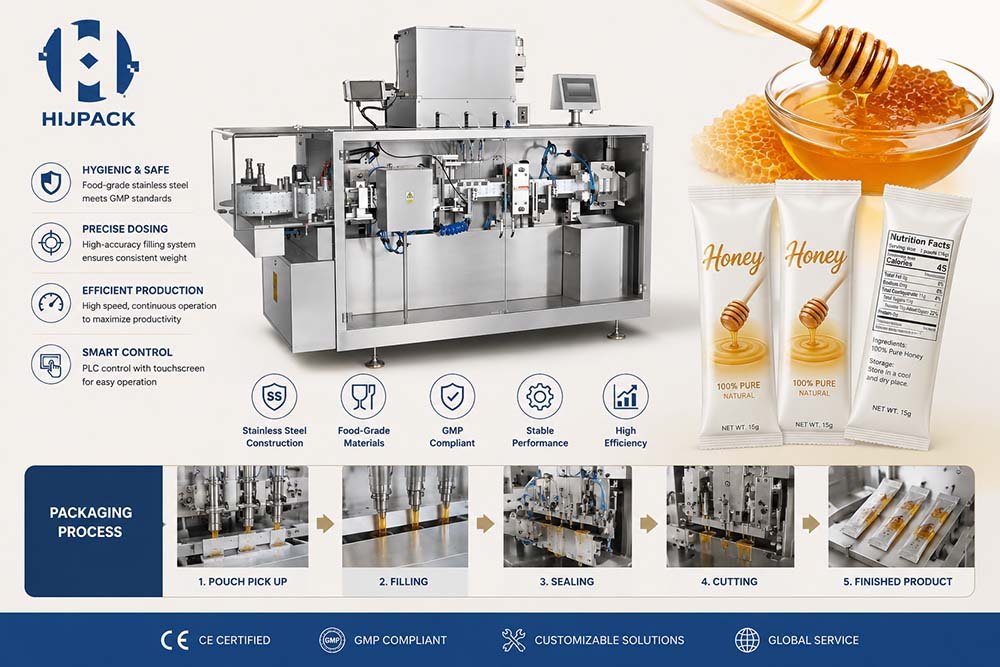
To package honey in single-serve sachets you need a machine that heats the honey to keep it flowing, doses it accurately despite its viscosity, and seals a high-barrier film against moisture and crystallization. An easy-snap card-style sachet — opened with one hand, no scissors — is the premium format: the HIJ CD120 fills 0.5–20 ml of honey at ±0.1 g with built-in heating, from about US$42,000.
Key Takeaways
- Honey’s viscosity and stringing make heated dosing essential — a built-in heating jacket keeps it pourable and cuts the tail cleanly.
- Barrier film matters: honey is hygroscopic, so a PET/AL aluminum laminate protects against moisture pickup and premature crystallization.
- The easy-snap card sachet is the premium single-serve format — one-hand open, no mess, strong shelf presence versus a floppy stick pack.
- Typical single-serve honey portions are 5–15 g; the easy-snap sachet honey packaging machine covers 0.5–20 ml in one format range.
- Date coding and batch tracking are built in — essential for food traceability and export compliance.
About the author — Forester Xiang
Forester combines deep technical knowledge with 20+ years of global market experience. Having personally audited 100+ cosmetic, pharmaceutical and food packaging factories across 30+ countries, he helps clients buy not just a machine, but a complete, compliant, and profitable packaging solution.
Why Honey Is Hard to Portion-Pack
Honey is difficult to sachet because it is highly viscous, stringy, hygroscopic and prone to crystallization — four properties that defeat general-purpose liquid packing machines. Each one has a specific fix:
1High Viscosity
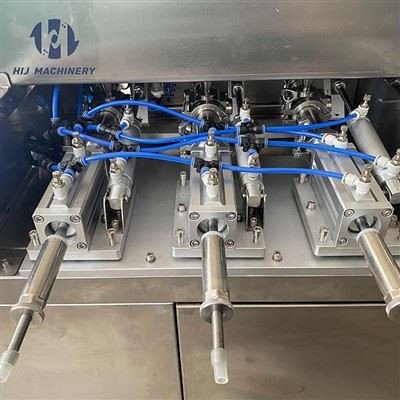
At room temperature honey is thick and slow to flow, so volumetric fillers under-dose or jam. The fix is gentle heating: a built-in heating jacket warms the honey to a controlled temperature where it flows freely without degrading its enzymes or flavor, so every sachet hits its target weight.
2Stringing at the Nozzle
Honey forms a long string between the nozzle and the pack, which falls into the seal area and causes leaks. A clean cut-off at the end of each dose — combined with the right fill temperature — severs the string and keeps the seal zone clean.
3Crystallization Over Time
Honey naturally crystallizes, and moisture pickup accelerates it. A high-barrier film — PET/AL aluminum laminate — blocks moisture and keeps the honey liquid and clear far longer than a thin mono-plastic film would.
4Air Inclusion
Whipped-in air shows as bubbles in a clear sachet and looks like a defect to consumers. Heating reduces viscosity enough for air to escape before filling, and bottom-up dosing avoids folding new air into the portion.
The mistake I see most from new honey brands is buying a generic liquid sachet machine and assuming honey is “just a thick liquid.” Without heating, the first hour runs fine — then the honey in the hopper cools, viscosity climbs, and dose weight drifts down by the afternoon. Heated dosing is not an upgrade for honey; it is the baseline.
Which Single-Serve Format for Honey?
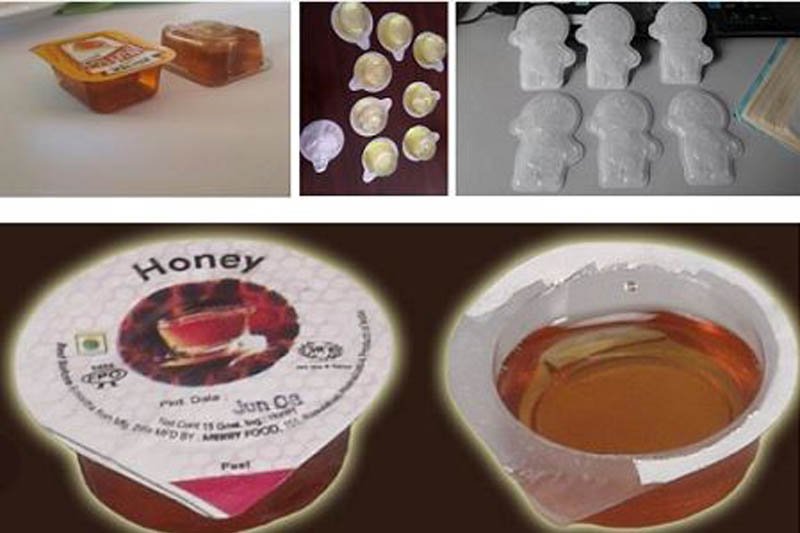
Single-serve honey ships in three main formats. For premium positioning and a clean consumer experience, the easy-snap card sachet wins:
| Format | Easy-Snap Card Sachet | Stick Pack | Flat Sachet |
|---|---|---|---|
| Opening | One-hand snap, no scissors | Tear (often messy) | Tear corner |
| Mess / drip | Minimal — rigid card controls flow | Prone to drip | Prone to drip |
| Shelf presence | Premium, rigid, brandable face | Low, floppy | Low |
| Portion range | 0.5–20 ml | Usually small | Small–medium |
| Best for | Hotels, cafes, retail, gifting | On-the-go, low cost | Bulk foodservice |
The easy-snap card format is produced by the easy-snap sachet honey packaging machine (CD120). For a deeper format comparison across products, see our guide to cosmetic and food sachet packaging machines.
How the Packaging Process Works, Step by Step
- Heat & hold: honey is warmed in a jacketed hopper to a controlled temperature so it flows freely.
- Film forming: the composite film is unwound, formed and embossed into the card-style sachet shape.
- Heat sealing: three sides of the sachet are sealed, leaving the top open for filling.
- Dosing: the exact honey volume (0.5–20 ml) is filled at ±0.1 g, with a clean cut-off to stop stringing.
- Tail seal & snap line: the top is sealed and the easy-snap perforation is formed.
- Coding & cut: date/batch code is printed and the finished sachet is punched out, ready to pack.
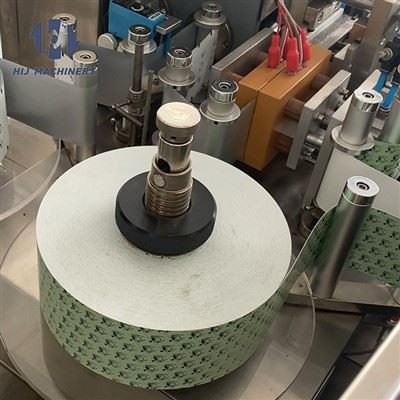
The machine for the job — HIJ CD120
- Built-in heating & mixing — keeps honey flowing and homogeneous
- 0.5–20 ml fill at ±0.1 g accuracy, 10–80 sachets/min
- PET/AL, PET/PE, PS/PE films — aluminum laminate for crystallization-resistant barrier
- Date coding & batch tracking built in for food traceability
- 304/316 stainless contact parts, packs up to 100 × 120 mm, from about US$42,000 FOB
See full specs on the easy-snap sachet honey packaging machine page, or compare budgets in our cosmetic packaging machine price guide.
Don’t let the sample fool you. Buyers pick a format from a photo, but honey behaves differently in each. I always tell honey brands to send real product and run a trial: a stick pack that looked elegant in the catalog drips down the consumer’s hand because there is nothing rigid to control the pour. The easy-snap card holds its shape — that rigidity is the whole reason it reads premium and stays clean.
Domande frequenti
What machine packages honey into single-serve sachets?
A card-style sachet packing machine with built-in heating, such as the HIJ CD120 easy-snap sachet honey packaging machine. It heats the honey to keep it flowing, doses 0.5–20 ml at ±0.1 g accuracy, and seals an easy-snap card sachet that opens with one hand — no scissors and no drip.
Why does honey need a heated filling machine?
Honey is highly viscous at room temperature, so unheated fillers under-dose, jam and string. A built-in heating jacket warms it to a controlled temperature where it flows freely — without overheating, which would degrade enzymes and flavor — so every sachet hits its target weight consistently through the whole production run.
What film stops honey from crystallizing in the sachet?
A high-barrier PET/AL aluminum-laminate film. Honey is hygroscopic, and moisture pickup accelerates crystallization; the aluminum layer blocks moisture and light, keeping the honey clear and liquid far longer than a thin mono-plastic film. The CD120 runs PET/AL, PET/PE and PS/PE composite films.
What size are single-serve honey portions?
Typical single-serve honey portions are 5–15 g (roughly 4–11 ml), the standard for hotels, cafes and on-the-go packs. The CD120 covers 0.5–20 ml in one adjustable format range, so you can run small tasting portions and larger retail servings on the same machine.
How much does a honey sachet machine cost?
The HIJ-CD120 easy-snap sachet machine starts at approximately US$42,000 FOB China, including date coding, material heating and mixing, and a chiller. Final pricing depends on mold size, film type and optional automated feeding. See the price guide for budgets across machine types.
Launching a Single-Serve Honey Line?
Send me your portion size, target output and film preference. I’ll confirm the right CD120 configuration and run your honey samples at the Factory Acceptance Test before you commit.