















📊 Cost Intelligence Report
Liquid Blister Packaging Machine Cost Breakdown: What You’re Actually Paying For
The sticker price tells you almost nothing. A $35,000 machine can cost you $58,000 by the time it passes FAT.
A $28,000 unit with missing GMP documentation can cost you a market authorization. This breakdown covers every
cost layer — from base hardware to validation, tooling, integration, and the hidden charges most vendors
never put in writing.
Base machine price range (USD, pharma-grade)
Typical hidden cost premium above invoice price
Average timeframe when hidden costs surface post-purchase
🎯 Direct Answer
A liquid blister packaging machine for pharmaceutical use costs between $25,000 and $85,000 USD
for the base unit. Total cost of ownership — including mold tooling ($3,000–$18,000), IQ/OQ/PQ
validation ($8,000–$30,000), FAT/SAT ($4,000–$12,000), PLC integration, and annual spare parts —
typically runs 30 to 55% above the invoice price. Entry-level industrial liquid blister machines
start near $18,000, but these rarely include the compliance documentation pharma buyers require.
The Number Teams Look at First Is Exactly the Wrong Number
A procurement team in São Paulo sent me an RFQ comparison last year. Three vendors, three prices: $29,000,
$34,000, $41,000. They wanted to know which one to pick. I told them the prices didn’t matter yet.
None of the three quotes included tooling. Two of them had no FAT clause. One vendor had no CE documentation
at all — which would have blocked import into Brazil. The real cost gap between those machines was closer
to $22,000 than the $12,000 they saw on paper.
Liquid blister packaging machine cost is multi-layered. The base hardware is one slice. Tooling, validation,
integration, and after-sales are the rest. Miss one layer during budgeting and you’re renegotiating
mid-project — usually when your timeline is already under pressure.
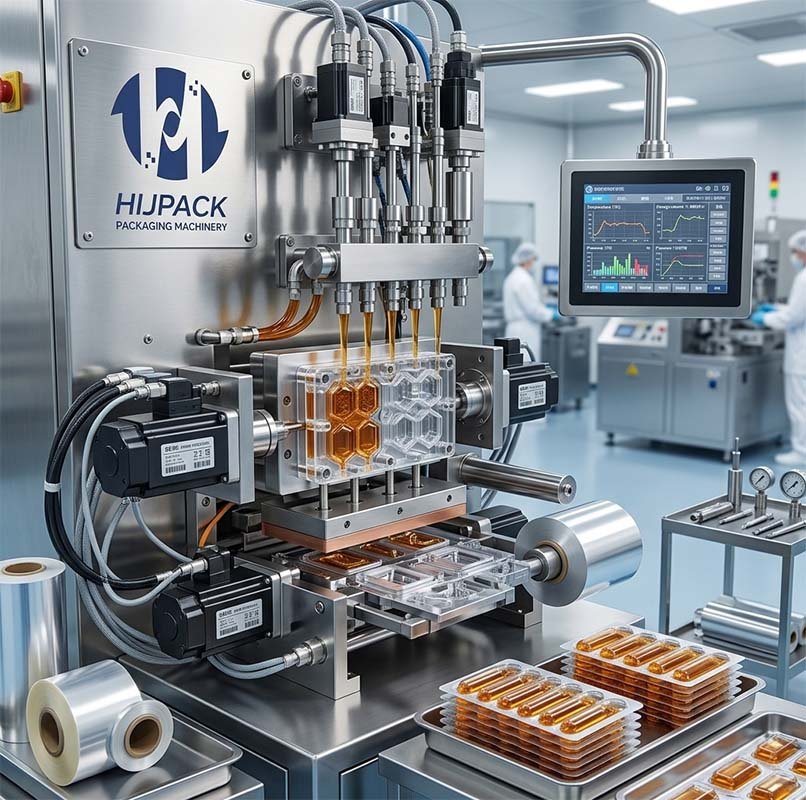
Cost factor layers in a liquid blister packaging machine investment — base hardware is rarely the largest line item over a 3-year horizon.
How Liquid Blister Packaging Machine Pricing Is Structured
Most vendors quote a machine price, not a project price. That distinction is the gap where budgets go wrong.
A complete cost model for a liquid blister packaging line covers five distinct layers — each with its own
supplier, timeline, and negotiation dynamics.
Layer 1 — Base hardware: The machine itself, including forming station, liquid filling system, heat sealing unit, die-cutting station, and control panel. This is what the quote shows.
Layer 2 — Tooling & molds: Product-specific forming molds, sealing dies, and cutting punches. Usually sold separately. Often the biggest surprise on delivery.
Layer 3 — Validation package: DQ, IQ, OQ, PQ documentation — mandatory for pharma. Varies enormously by vendor depth and your regulatory jurisdiction.
Layer 4 — FAT / SAT / commissioning: Factory acceptance test, site acceptance test, on-site installation, and operator training. Travel and engineering time add up fast.
Layer 5 — Annual running costs: Spare parts, preventive maintenance, film material qualification, and potential third-party integration for line connectivity.
Liquid Blister Packaging Machine Price Ranges: The Full Spectrum
📊 Direct Answer
Liquid blister packaging machines range from $18,000 for basic semi-automatic industrial units to over $120,000
for high-speed GMP-certified pharmaceutical lines with integrated vision inspection, 21 CFR Part 11 compliant
HMI, and full validation documentation packages.
Of the 31 liquid blister line projects I handled in Southeast Asia and Latin America between 2018 and 2023,
the base machine price accounted for an average of 63% of total project spend on pharma builds — and only
71% on industrial builds where validation was absent. The remaining 29–37% split across tooling,
commissioning, and integration. That ratio is consistent enough to use as a planning anchor.
| Machine Tier | Base Price (USD) | Output Speed | GMP Compliance Level | Typical Buyer |
|---|---|---|---|---|
| Entry Semi-Auto | $18,000 – $28,000 | 20 – 40 blisters/min | None / basic CE | Industrial, food, non-pharma OEM |
| Mid-Range Auto (Pharma) | $28,000 – $55,000 | 40 – 80 blisters/min | WHO GMP, EU GMP Annex 1 | Generic pharma, CMOs, mid-volume |
| High-Speed GMP | $55,000 – $85,000 | 80 – 150 blisters/min | 21 CFR Part 211, EU GMP, 21 CFR Part 11 HMI | FDA-registered pharma, Class II+ products |
| Turnkey Line (High-Speed + Integration) | $85,000 – $120,000+ | 150+ blisters/min | Full GAMP 5, 21 CFR Part 11, EU Annex 11 | MNC pharma, regulated export markets |
Base hardware price ranges only. Tooling, validation, and FAT/SAT excluded. Prices reflect 2024–2025 market data from HIJ project quotations and industry benchmarks.
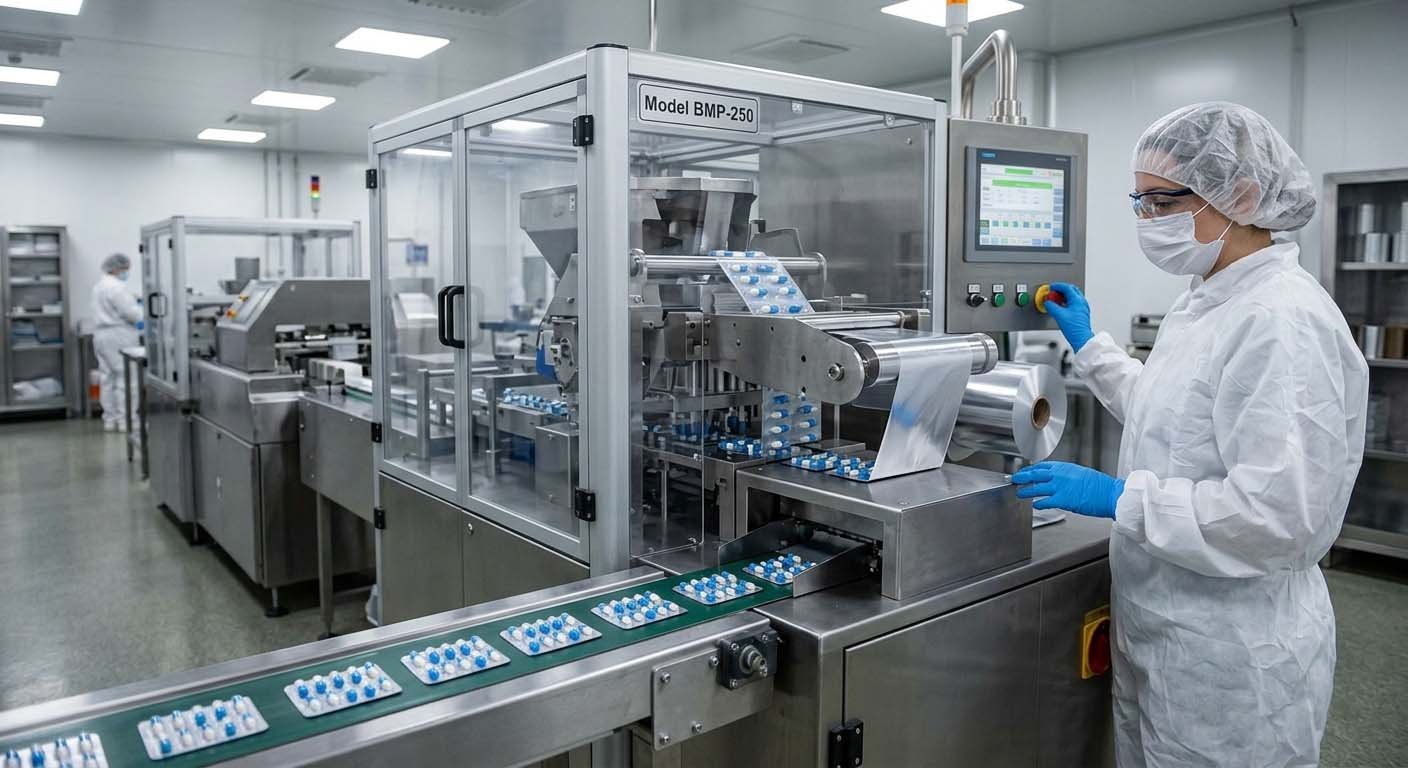
Price tier overview for liquid blister packaging machines — pharma-grade units require compliance documentation that significantly impacts total investment.
Tooling Cost: The Line Item Nobody Puts in the Budget
📊 Direct Answer
Custom tooling for a liquid blister packaging machine — forming molds, sealing dies, and cutting punches —
costs between $3,000 and $18,000 per product SKU depending on cavity complexity, material, and whether
the vendor manufactures tooling in-house or subcontracts it.
A QD manager in Jakarta called me in 2021. They’d received the machine. The vendor had invoiced
separately for tooling — $11,400 for three forming mold sets. Nobody had budgeted it.
The PO had been approved at $38,000. The actual first-year spend landed at $54,200. I’ve
seen this pattern on at least a dozen projects.
Tooling complexity drives cost more than machine price. A simple rectangular cavity for a 5ml liquid unit
might run $3,500 per mold set. A contoured oval cavity with a secondary liquid dosing volume — common
for syrups and cough preparations — can reach $15,000 per set when the forming station requires
matched-temperature upper and lower die plates with anti-stiction coating.
Tooling Cost Factors That Move the Number
| Tooling Component | Low End (USD) | High End (USD) | Key Driver |
|---|---|---|---|
| Forming mold set | $2,200 | $9,500 | Cavity count, depth, material (Al vs. steel) |
| Heat sealing die | $800 | $3,200 | Sealing pattern complexity, anti-stick surface |
| Cutting / punching die | $600 | $2,800 | Blister card geometry, edge tolerance |
| Format change kit (multi-SKU) | $1,800 per additional SKU | $8,000 per SKU | Number of product formats, changeover mechanism |
Tooling prices are per product format. Multi-product lines require separate tooling sets for each SKU.
⚠️ Budget Trap Diagnosis: Tooling Edition
⚠️ SYMPTOM: Vendor quote shows only machine price, no tooling line
CAUSE: Standard vendor practice is to quote tooling as a separate commercial discussion after PO signature — often with a different lead time and sometimes a different supplier entirely.
✅ FIX: Require a full Bill of Materials (BOM) before signing, explicitly listing all tooling components, delivery schedule, and whether tooling is manufactured in-house or subcontracted.
⚠️ SYMPTOM: Tooling delivered 6 weeks after machine arrives on-site
CAUSE: Tooling is usually made-to-order after machine delivery, because cavity dimensions are finalized from the installed machine’s forming station geometry. If the vendor subcontracts tooling, lead time extends further.
✅ FIX: Specify contractual tooling delivery deadline tied to machine delivery milestone. HIJ manufactures tooling in-house, parallel to machine build — delivering both simultaneously.
GMP Validation Cost: Where the Budget Surprise Lives for Pharma Buyers
📊 Direct Answer
IQ/OQ/PQ validation for a liquid blister packaging machine costs between $8,000 and $30,000 USD depending on
regulatory jurisdiction, documentation depth, and whether the vendor provides a pre-written validation master
plan (VMP) or the buyer must generate all protocols independently after delivery.
The stability report landed in March. An Indian generics manufacturer had commissioned a liquid blister line
for eye drops — a product heading to two regulated European markets. CDSCO approval was in hand.
The EU distributor then asked for the validation dossier. The vendor had provided an IQ checklist.
Two pages. That was it. The buyer spent the next four months writing OQ and PQ protocols from scratch,
hiring an external CRO for $24,000 to generate the performance qualification data. The machine had cost $42,000.
The validation remediation cost $24,000 on top of that.
Per pharmaceutical liquid blister packaging,
regulatory bodies including FDA (21 CFR Part 211), EMA (EU GMP Annex 1, 2022 revision), and WHO (TRS 992 Annex 3)
all require documented evidence that the equipment performs consistently within defined parameters.
That evidence is the validation package. Without it, your line cannot legally produce regulated product.
Validation Cost Breakdown by Document Type
| Validation Document | Vendor-Supplied Cost | Independent CRO Cost | Time Required |
|---|---|---|---|
| Design Qualification (DQ) | $1,000 – $3,000 | $4,000 – $8,000 | 2 – 4 weeks |
| Qualificazione dell'installazione (IQ) | $1,500 – $4,000 | $3,000 – $7,000 | 3 – 5 days on-site |
| Qualificazione operativa (OQ) | $2,000 – $6,000 | $6,000 – $12,000 | 1 – 2 weeks |
| Qualificazione delle prestazioni (PQ) | $3,000 – $8,000 | $8,000 – $18,000 | 2 – 6 weeks |
| Full VMP + All Protocols (Turnkey) | $8,000 – $22,000 | $20,000 – $45,000 | 4 – 12 weeks |
Vendor-supplied validation costs apply when the equipment manufacturer provides pre-written protocol templates aligned to the machine’s own specifications. Independent CRO costs are significantly higher because protocols must be generated from observation. For more on validation requirements, see our guide on IQ OQ PQ validation for liquid blister packaging machines.
📋 Compliance Standards Referenced in Validation
21 CFR Parte 211
OMS TRS 992 Allegato 3
ICH Q10
GAMP 5
ISO 9001:2015
21 CFR Part 11 (HMI)
EU GMP Annex 11

💡 Forester’s Insight
The sticker price on a liquid blister packaging machine is rarely the real cost — what kills your ROI
is what happens after the invoice is paid.
In my 20 years of auditing packaging lines across Southeast Asia and Latin America, I’ve watched buyers
celebrate a “budget win” on a standalone liquid blister machine, only to spend 40% more within
18 months on third-party PLC integration, non-compliant tooling replacements, and FAT/SAT rework that no one
budgeted for. The darkest hidden cost? Machines shipped without proper cGMP documentation — your FDA
or EMA audit fails, your line shuts down, and the vendor has already moved on.
Cheap upfront almost always means expensive later.
Before signing any PO, demand a full URS alignment meeting and insist on seeing the validation documentation
package — not just a spec sheet. At HIJ, our turnkey philosophy means we price in compliance,
integration, and after-sales accountability from day one, so you’re never negotiating alone with
three vendors pointing fingers at each other.
FAT, SAT & Commissioning: The Costs That Appear After You’ve Signed
📊 Direct Answer
Factory acceptance testing (FAT), site acceptance testing (SAT), on-site installation, and operator training
for a liquid blister packaging machine add $4,000 to $12,000 USD for domestic installations, and $8,000
to $22,000 for international projects when travel, accommodation, and per diem engineering costs are included.
Three weeks into a job in Jakarta in 2019, I got a call from the engineering manager. The vendor’s FAT
technician had arrived — but the machine still showed a forming temperature deviation of ±8°C
across the cavity plate. Not within spec. The technician stayed four extra days to resolve it. His hotel,
per diem, and rework time added $6,200 to a line item the buyer had budgeted as zero.
FAT happens at the vendor factory before shipment. SAT happens at your facility after installation. Both are
required under EU GMP Annex 15 for validated pharmaceutical equipment. If the FAT reveals problems, you delay
shipment. If the SAT reveals problems, you’ve already paid freight on a machine that isn’t
producing. Budget both as real line items — not optimistic assumptions.
Domestic FAT/SAT + commissioning (within same country)
International FAT/SAT including engineer travel & lodging
Average on-site commissioning time (1–2 shift operation)

Liquid blister packaging machine at HIJ factory during FAT protocol execution — forming temperature uniformity, fill volume accuracy, and seal integrity are verified before shipment.
In 20 years, I have never seen a liquid blister packaging project where the total cost matched the
initial quote. The question is not whether hidden costs exist — they always do.
The question is whether you’ve structured a vendor relationship where those costs are
your vendor’s problem to solve, not yours to absorb.
— Forester Xiang, HIJ Machinery
PLC Integration & Annual Running Costs: The 5-Year Picture
📊 Direct Answer
Annual running costs for a pharmaceutical liquid blister packaging machine — covering spare parts,
preventive maintenance, film qualification, and PLC calibration — average $6,000 to $18,000 USD per
year. Lines requiring third-party PLC integration or vision inspection connectivity can add a one-time
integration cost of $8,000 to $25,000.
Siemens S7-1500 PLC calibration runs approximately $800–$1,400 per annual service visit for a
mid-range liquid blister line. Allen Bradley ControlLogix units in North America-bound builds sit at a
similar range. Those numbers are predictable. What’s not predictable — and what nobody budgets —
is the third-party integration cost when your new liquid blister machine needs to communicate with an
existing MES, SCADA, or vision rejection system that the vendor didn’t build.
I saw this in a plant outside Pune in 2019. The stability data had been generated in Germany at
25°C/60% RH. The product was going to Maharashtra. The new liquid blister machine had a
Mitsubishi PLC. The plant’s existing MES ran on Siemens protocol. Nobody had done the integration
mapping before purchase. The integration consultant billed $18,700. Six weeks of delay. The procurement
manager told me it was the worst purchasing decision of his career — not because the machine was bad,
but because nobody had modeled the integration cost.
5-Year Total Cost of Ownership Model
| Cost Category | Year 1 (USD) | Years 2–5 (Annual) | 5-Year Total |
|---|---|---|---|
| Base machine (mid-range pharma) | $42,000 | — | $42,000 |
| Tooling (3 SKUs) | $18,000 | $3,000 (wear & replacement) | $30,000 |
| Validation (IQ/OQ/PQ) | $15,000 | $3,500 (periodic revalidation) | $29,000 |
| FAT / SAT / commissioning | $12,000 | — | $12,000 |
| PLC integration & MES connectivity | $14,000 | $1,200 (calibration) | $18,800 |
| Spare parts & preventive maintenance | $4,000 | $7,500 | $34,000 |
| 5-Year TCO Total | $105,000 | — | $165,800 |
Illustrative model based on a mid-range pharma liquid blister machine at $42,000 base price. Actual figures vary by market, regulatory jurisdiction, and vendor documentation quality. Review GMP compliance requirements for liquid blister packaging to understand how regulatory depth affects validation spend.
China vs. European Liquid Blister Machine Pricing: What the Gap Actually Means
📊 Direct Answer
Chinese-manufactured liquid blister packaging machines cost 35 to 65% less than equivalent European units
at the base hardware level. The total cost gap narrows to 15–30% when validation documentation quality,
spare parts lead time, and after-sales support are factored in — and can disappear entirely when
integration remediation costs are added.
European machines — Uhlmann, IMA, Marchesini — command premium prices for a reason: integrated
validation packages, globally stocked spare parts, and regulatory familiarity in FDA and EMA markets.
A comparable Chinese machine at 40% lower base price may require the buyer to generate validation documentation
independently, source spare parts from China with 8–12 week lead times, and fund on-site integration
from a local system integrator.
That gap is real. It’s not dishonest. It’s just rarely modeled correctly before purchase.
I won’t tell you the Chinese machine is always the right answer — it depends on your regulatory
jurisdiction, your in-house engineering capability, and your tolerance for extended commissioning timelines.
What I will say is that the right Chinese vendor — one who provides CE marking, ISO 9001:2015
certification, full IQ/OQ/PQ documentation, and has a track record of WHO GMP pre-qualified builds —
can close 80% of that quality gap at 50% of the European price point.
For buyers comparing vendors, the
liquid blister packaging vs. bottle filling comparison
is equally important — choosing the wrong packaging format entirely eliminates any equipment cost savings.
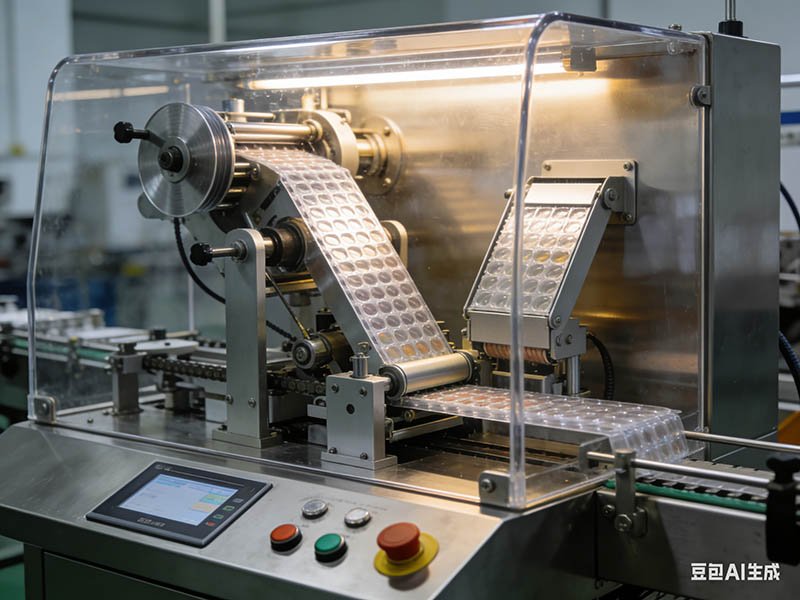
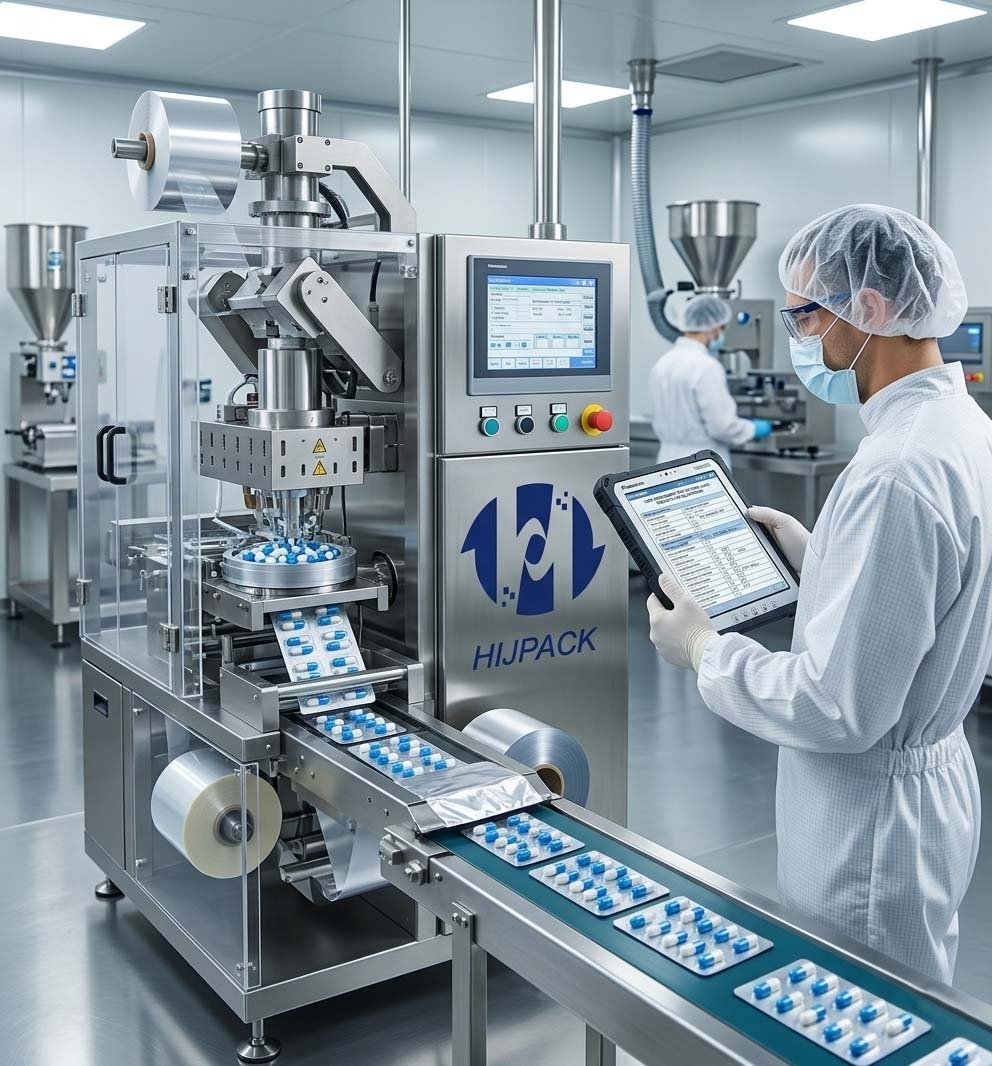
A pharma-grade liquid blister packaging machine from HIJ Machinery — CE certified, ISO 9001:2015 compliant, with full IQ/OQ/PQ documentation package included as standard.
⚠️ Vendor Selection Diagnostic: Price vs. Total Cost
⚠️ SYMPTOM: Vendor quotes 30% below market average with no explanation
CAUSE: Price undercuts typically reflect absent validation documentation, subcontracted tooling, non-standard PLC (difficult to integrate), or no genuine CE marking. At least one of these will surface post-delivery.
✅ FIX: Request the validation documentation sample before signing. Ask which PLC brand is used. Verify CE certificate number directly with the notified body. A price undercut without documentation savings is a hidden cost, not a discount.
⚠️ SYMPTOM: Vendor cannot provide reference projects in your target regulatory market
CAUSE: FDA, EMA, CDSCO, and ANVISA all have market-specific nuances in their GMP inspection approach. A vendor with no track record in your jurisdiction means their documentation may not satisfy your reviewer’s specific expectations.
✅ FIX: Ask for three client references in your regulatory market, with contact permission. Verify that at least one has passed a GMP inspection using the vendor’s equipment and documentation. This one step filters out 80% of high-risk vendors.
What to Negotiate Before Signing: A 10-Point Budget Protection Checklist
📊 Direct Answer
Before signing a PO for a liquid blister packaging machine, buyers should negotiate 10 specific items
to protect their budget — including tooling BOM, validation document ownership, FAT/SAT scope,
PLC brand specification, spare parts commitment, and penalty clauses for commissioning delays.
The procurement director in Casablanca showed me the sheet. Base machine: $36,000. Total project budget approved: $36,000.
I asked what was in the tooling line. Blank look. I asked what the validation plan was. “The vendor
provides documentation.” I asked to see the sample. It was a two-page inspection report.
The full project cost, properly modeled, was $58,400. That conversation took 40 minutes. I’m still
not sure I convinced them to delay the PO — but they did renegotiate three of the following items.
- Full BOM including all tooling components — itemized, with unit prices and lead times confirmed in writing before contract signature.
- Validation document package sample — request an actual sample IQ protocol from a previous project. Two-page checklists are not IQ documentation.
- FAT scope and cost cap — define what “passed FAT” means in measurable terms (filling accuracy ±1%, seal integrity at specified bar, temperature uniformity ±3°C), and who covers extended engineer time if FAT fails first round.
- PLC brand and version specification — written into the contract. Siemens S7-1500, Allen Bradley ControlLogix, or Mitsubishi iQ-R are all different integration worlds. Specify before signing, not after delivery.
- SAT completion timeline — define a contractual date by which the machine must reach specified production OEE. Include liquidated damages for delay beyond that date.
- Spare parts commitment letter — 5-year availability guarantee for all critical wear parts (sealing elements, pump heads, forming station heaters). Many vendors stop stocking parts 3 years post-sale.
- CE certificate verification — request the notified body number, verify it directly, and confirm the machine model is specifically listed on the certificate (not just the manufacturer).
- Film compatibility guarantee — the vendor should commit in writing that the machine runs standard PVC/PVDC/Alu-Alu film from at least two alternative film suppliers, not proprietary film only.
- Operator training scope — minimum hours on-site, both operator and maintenance technician. Training delivered in your team’s working language, not just English-language manuals.
- Remote diagnostics capability — confirm whether the PLC supports remote access for fault diagnosis. This reduces emergency service call costs from $2,000–$5,000 per visit to near zero for software-resolvable faults.
Liquid Blister Packaging Machine Cost: Frequently Asked Questions
How much does a liquid blister packaging machine cost?
A pharmaceutical-grade liquid blister packaging machine costs between $25,000 and $85,000 USD for the
base unit. Entry-level industrial units start near $18,000. High-speed turnkey lines with full GMP
validation documentation, integrated vision inspection, and 21 CFR Part 11 HMI exceed $120,000.
Total cost of ownership — including tooling, validation, FAT/SAT, and first-year spare parts —
typically runs 30 to 55% above the base machine price. Budget both the sticker price and the
project cost before approving a PO.
What is included in a liquid blister packaging machine quote?
Standard vendor quotes include the base hardware only — forming station, liquid filling system,
sealing unit, cutting station, and control panel. Tooling, validation documents, FAT/SAT, freight,
and integration are almost always separate. Always request an all-in project cost breakdown.
How much does tooling cost for a liquid blister packaging machine?
Tooling for a liquid blister packaging machine costs $3,500 to $18,000 per product SKU depending on
cavity geometry, forming depth, material choice (aluminum vs. steel molds), and whether the vendor
manufactures tooling in-house. A three-SKU pharma line commonly spends $14,000–$22,000 on tooling
alone — a line item that most initial quotes omit entirely. Require an itemized tooling BOM with
unit prices before signing any contract.
Do I need to budget for IQ OQ PQ validation separately?
Yes. For pharma applications, IQ/OQ/PQ validation is mandatory under 21 CFR Part 211, EU GMP Annex 1
(2022), and WHO TRS 992. Vendor-supplied validation packages cost $8,000–$22,000 and are substantially
cheaper than independent CRO-generated protocols, which run $20,000–$45,000. Confirm before purchase
whether your vendor provides pre-written protocol templates or only a post-installation checklist.
Full detail on what validation costs and what it requires is covered in our
IQ OQ PQ validation guide for liquid blister packaging machines.
Why are Chinese liquid blister packaging machines cheaper than European ones?
Chinese machines cost 35–65% less at base hardware level primarily due to lower manufacturing labor costs,
higher domestic supply chain integration, and different default validation documentation standards. The quality
gap has narrowed significantly over the past decade for CE-certified, ISO 9001:2015 compliant Chinese vendors
with WHO GMP track records. The risk is not the hardware — it’s the documentation and after-sales
support model. Buyers who evaluate Chinese machines purely on hardware price and ignore the total cost of
ownership often close the gap with unexpected remediation costs within 18 months of installation.
What is the annual running cost of a liquid blister packaging machine?
Plan for $6,000–$18,000 per year. Spare parts, preventive maintenance, annual PLC calibration, and
periodic revalidation are the main cost drivers. Lines with vision inspection systems, servo motor assemblies,
and high-precision liquid filling pumps sit at the higher end. Remote diagnostics capability can significantly
reduce emergency service costs.
Is FAT included in the machine price?
Rarely. FAT scope and cost should be negotiated explicitly and written into the contract. Budget $4,000–$12,000
for domestic FAT/SAT and $8,000–$22,000 for international projects including engineer travel.
What hidden costs should I watch for when buying a liquid blister packaging machine?
The five most common hidden costs are: (1) tooling quoted separately after PO signature, (2) validation
documents that are checklists rather than full protocols requiring expensive CRO remediation, (3) PLC
brand mismatch with existing plant systems requiring third-party integration, (4) spare parts with 8–12
week lead times from overseas suppliers creating unplanned downtime, and (5) film compatibility restrictions
locking buyers into proprietary film supply. Each of these can add $5,000–$25,000 to project cost
individually. Combined, they are why the actual project cost commonly exceeds the initial quote by 30–55%.
Know Your Real Cost Before You Sign
Get a full project cost breakdown from HIJ Machinery — base hardware, tooling, validation package,
FAT/SAT scope, and 5-year spare parts commitment, all in one transparent quote. No hidden line items.
No surprises after the PO.