
















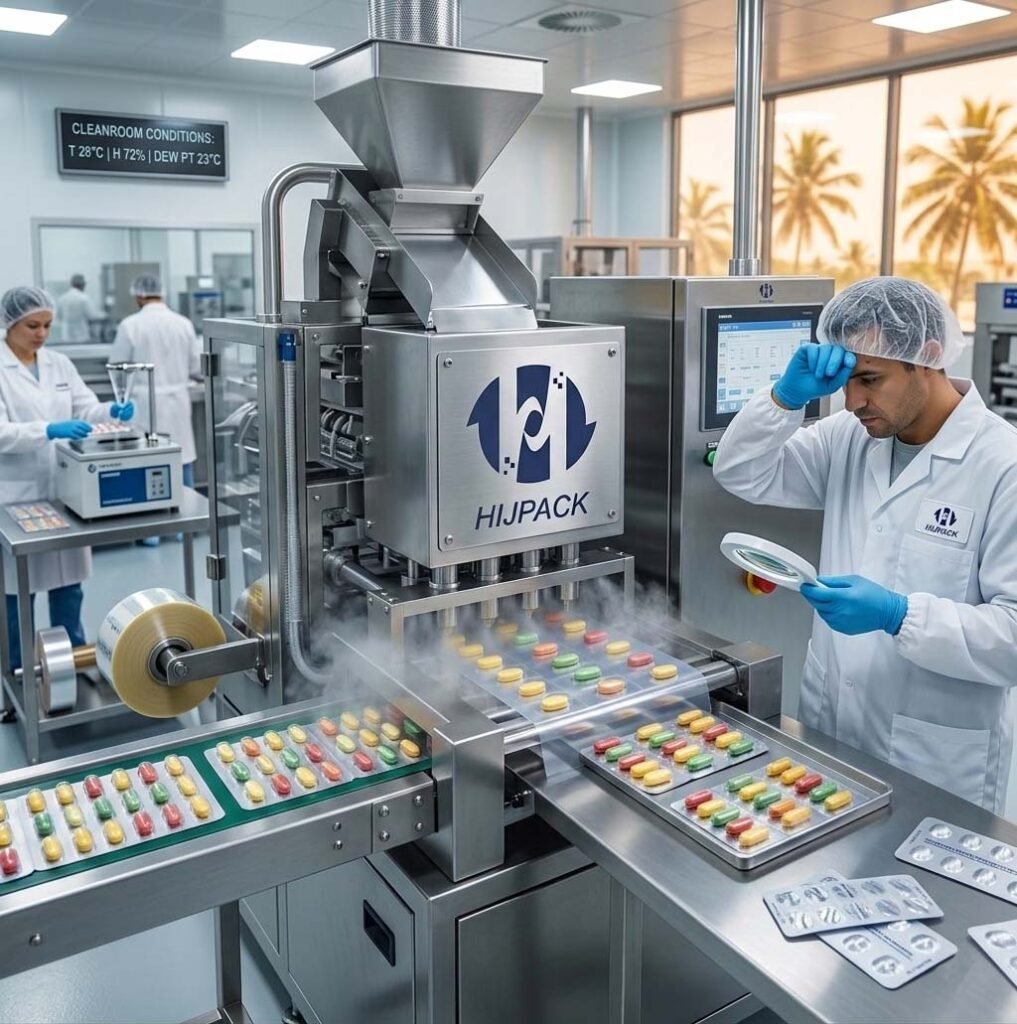
Your Blister Pack Moisture Barrier Is Failing Right Now — and Your QC Team Already Signed Off
Blister packaging in a tropical climate exposes a brutal engineering truth: a sealing jaw temperature calibrated to ±1°C accuracy means nothing if your forming film’s Moisture Vapor Transmission Rate (MVTR) is 4× too high for 35°C / 85% RH shelf conditions. Moisture penetration does not trigger an alarm. It waits.
Manufacturers in Vietnam, Indonesia, Brazil, Nigeria, and the Gulf — everywhere ambient humidity exceeds 75% RH for more than 6 months per year — face a silent but catastrophic product integrity risk that standard FAT protocols are not designed to catch. This guide gives you the technical framework to solve it before the shipment leaves port.
👤 Forester’s Insight — 20-Year Field Engineer’s Perspective
🎯 The Direct Answer: In tropical climates, blister pack integrity fails not at the sealing station — it fails weeks later on the shelf, long after your QC team has signed off and the shipment has left port.
🏭 The Field Experience: In 20 years of commissioning blister lines across Southeast Asia and coastal Brazil, I’ve seen the same silent killer repeat itself: buyers spec a machine purely on sealing temperature and cycle speed, completely ignoring the forming film’s MVTR compatibility with local ambient conditions. One client in Ho Chi Minh City passed every FAT checkpoint in our controlled factory environment at 23°C / 50% RH, then watched their Alu-PVC blisters delaminate within 45 days on a humid pharmacy shelf running at 35°C / 88% RH. The financial loss exceeded USD 180,000 in recalled product — not including the regulatory audit that followed.
⚠️ The Hidden Trap: Many machine vendors validate against ISO 11607 in their own air-conditioned workshops — not against your real-world 85% RH environment. Demanding SAT under simulated tropical conditions is not optional; it is the only way to validate system-level pack integrity. At HIJ Machinery, our turnkey integration approach means we co-engineer the forming film selection, sealing parameters, and environmental controls as one validated system — so there are no multi-vendor blame games when integrity fails in the field.

Why Tropical Climates Systematically Destroy Blister Pack Integrity: The Physics No One Explains
Moisture vapor migrates through polymer films along a concentration gradient — from high humidity ambient air into the low-humidity sealed cavity containing your tablet or capsule. The rate of this migration is quantified as MVTR (Moisture Vapor Transmission Rate), measured in g/m²/24h under defined conditions (typically 38°C / 90% RH per ASTM F1249 or ISO 15106). A standard rigid PVC forming film (250µm) carries an MVTR of approximately 3.0–4.5 g/m²/24h. A tropical pharmacy shelf running at 35°C / 85% RH applies sustained thermodynamic pressure that can push effective moisture ingress 2–3× higher than the lab-measured value.

Film selection defines shelf-life outcome. PVC, PVDC-coated, and Alu-Alu films perform radically differently in tropical environments.
The Three Compounding Failure Mechanisms in Tropical Blister Packaging
Sealing jaw pressure — typically set at 0.3–0.6 MPa — determines the bond strength between the lidding foil and the forming film. Temperature at the sealing station, usually 160–220°C for PVC/Alu laminate, activates the heat-seal lacquer layer on the aluminum foil. However, in tropical climates, three mechanisms compound to defeat even correctly-sealed blisters:
- Thermal Cycling Delamination
Daily temperature swings of 12–18°C (warehouse overnight to midday) cause differential thermal expansion between the aluminum lidding (coefficient: 23.1 µm/m/°C) and PVC forming film (coefficient: ~80 µm/m/°C). Over 30–60 cycles, this mechanical stress micro-fractures the heat-seal lacquer bond at peel strengths below 8 N/15mm — the minimum threshold defined by USP. - Plasticizer Migration in PVC Film
PVC forming film contains 25–35% plasticizer (typically DINP or DOTP) by weight. At sustained temperatures above 32°C, plasticizer migration rate accelerates by approximately 40%, reducing film rigidity and increasing gas permeability. The cavity walls literally become more permeable as the months pass on a tropical shelf. - Hygroscopic Drug-Moisture Reaction
Hygroscopic APIs such as metformin HCl, aspirin, and most antibiotic powder formulations begin absorbing moisture at water activity values (a⊂w;) as low as 0.60. A tropical shelf at 85% RH presents an equilibrium vapor pressure equivalent to a⊂w; = 0.85 — well above the degradation threshold for most moisture-sensitive formulations.
MVTR of standard 250µm rigid PVC at 38°C/90%RH — a value that makes it structurally unsuitable for tropical pharma shelf-life targets exceeding 18 months
Common Failure Modes & Forester’s Fix
- 🔴 증상: Tablets show visible color change or powdering within 60 days of distribution in markets like Jakarta, Lagos, or Manaus, despite passing dissolution testing at batch release.
⚙️ 근본 원인: Forming film MVTR was validated at 23°C/50% RH (European ICH Zone II condition), not at ICH Zone IVb (30°C/75% RH) or real tropical shelf conditions (35°C/85% RH). Total moisture ingress over 60 days in Zone IVb can be 3.2× higher than Zone II test data suggests.
🔧 포레스터의 수정: Mandate accelerated stability testing per WHO TRS 992 부속서 3 at 40°C/75% RH for 6 months as primary stability protocol. Upgrade forming film to PVDC-coated PVC (MVTR: 0.5–1.2 g/m²/24h) or Alu-Alu cold-form (MVTR: <0.01 g/m²/24h) as indicated by stability data. - 🔴 증상: Seal peel-strength drops below 6 N/15mm in random in-process checks during the rainy season, despite no change in sealing station set-point temperature.
⚙️ 근본 원인: Ambient RH in the packaging hall exceeded 75% RH during monsoon season, increasing moisture content in the PVC film roll from 0.1% to 0.4% w/w. Elevated film moisture content reduces heat-seal lacquer bond strength by acting as a plasticizer at the foil-film interface.
🔧 포레스터의 수정: Install a closed-loop dehumidification system targeting ≤45% RH in the packaging hall — a requirement explicitly aligned with EU GMP Annex 1 (2022 revision), Section 4.3 on environmental control in packaging areas. Increase sealing jaw temperature by 5–8°C and verify peel strength at ≥8 N/15mm using a calibrated tensile tester every 30 minutes during high-humidity periods. - 🔴 증상: Blister cavities show micro-delamination or whitening at the cavity shoulder — not at the flat seal area — indicating structural failure in the formed film itself rather than at the sealing interface.
⚙️ 근본 원인: Forming station heating plate temperature was set at 110°C, which is optimal for PVC at 23°C ambient, but creates over-stressing of the film at the draw depth shoulder when ambient temperature rises to 34°C (reducing film’s resistance to forming stress). Film thickness at the cavity shoulder fell below 150µm against a nominal 250µm — a 40% wall-thinning event.
🔧 포레스터의 수정: Reduce heating plate set-point to 96–102°C during high-ambient-temperature periods and validate draw depth at ≤16mm for standard 250µm PVC. For products requiring draw depths >16mm in tropical environments, switch to 300µm PVDC/PVC/PE trilayer film with improved thermoforming stability.
Blister Film Selection for Tropical Climates: The MVTR Threshold Framework Every Procurement Team Needs
Forming film selection is the single highest-leverage decision in tropical blister packaging — more impactful than sealing pressure, machine speed, or foil grade. A film upgrade from standard PVC to Alu-Alu cold-form eliminates 99.9% of moisture transmission in a single specification change, but it also requires a different machine platform and adds 25–40% to material cost per blister card. The correct choice depends on three variables: target shelf-life, drug sensitivity classification, and distribution climate zone.
| Film Type | MVTR (38°C/90%RH) | Tropical Shelf-Life Suitability | Regulatory Alignment | Machine Requirement | Relative Material Cost |
|---|---|---|---|---|---|
| Rigid PVC (250µm) | 3.0–4.5 g/m²/24h | ≤12 months Zone IVa only | ICH Zone I & II products only | Standard thermoforming | 1× (baseline) |
| PVDC-Coated PVC (90g/m² PVDC) | 0.5–1.2 g/m²/24h | 18–24 months Zone IVb | WHO TRS 992 Zone IVb compliant | Standard thermoforming | 1.8–2.2× |
| PCTFE (Aclar®) / PVC Laminate | 0.04–0.15 g/m²/24h | 24–36 months Zone IVb | USP <1207>, 21 CFR Part 211.68 | Standard thermoforming | 3.5–5.0× |
| Alu-Alu Cold-Form (OPA/Alu/PVC) | <0.01 g/m²/24h (near-zero) | 36–60 months Zone IVb | EU GMP Annex 1, WHO GMP, 21 CFR | Cold-forming machine required | 2.8–4.0× |

The HIJ DPH-300 Alu-Alu cold-forming blister machine: the definitive hardware solution for tropical climate pack integrity. Cold-form tooling draws OPA/Alu/PVC laminate without heat, preserving foil integrity at the cavity shoulder.
Regulatory compliance drives film selection as much as technical performance. WHO TRS 992 부속서 3 classifies most tropical markets (Southeast Asia, Sub-Saharan Africa, Latin America) as ICH Climate Zone IVb (30°C/75% RH mean kinetic temperature), requiring stability data at 40°C/75% RH for 6 months before registration. Standard PVC cannot support Zone IVb stability data for moisture-sensitive APIs — making PVDC or Alu-Alu selection a regulatory necessity, not merely an engineering preference.
For manufacturers exporting to markets requiring 21 CFR Part 211.68 compliance (FDA-registered product for US import), the packaging component qualification process under 21 CFR Part 211, Subpart E explicitly requires written procedures for packaging material specifications, including defined MVTR limits. Failure to document and test MVTR in your component specification constitutes a cGMP deviation, triggering Form 483 observations during FDA inspections.
Explore HIJ’s complete Alu-Alu cold-form blister packaging machine specifications to understand the tooling requirements for switching from thermoforming to cold-form film processing.
Common Failure Modes & Forester’s Fix
- 🔴 증상: Stability batch fails 6-month accelerated test at 40°C/75% RH — moisture content of tablet exceeds 2.0% w/w specification limit, triggering out-of-specification (OOS) investigation.
⚙️ 근본 원인: PVDC coating weight was specified at 60 g/m² instead of the required 90 g/m² minimum for Zone IVb markets, resulting in an effective MVTR of 2.1 g/m²/24h against the target of ≤0.8 g/m²/24h. A 30 g/m² coating shortfall increased total moisture ingress per blister cavity by 162% over 6 months.
🔧 포레스터의 수정: Revise the film component specification to mandate 90 g/m² ±5 g/m² PVDC coating weight. Implement incoming QC testing per ASTM F1249 (water vapor transmission rate) on every film lot before release to production. Add coating weight verification to the Certificate of Analysis (CoA) supplier requirements. - 🔴 증상: Pin-hole defects appear along the cavity edge of Alu-Alu blisters after 90 days, visible by dye-penetrant test per ASTM F2096 (gross leak detection) — despite passing visual inspection at production.
⚙️ 근본 원인: Cold-form tooling draw ratio exceeded 0.65:1 (depth:width) for the OPA/Alu/PVC laminate specification, causing micro-fractures in the aluminum layer at the cavity radius. Foil thickness at the defect location measured 18µm against a 45µm nominal — a 60% thickness reduction rendering the foil gas-permeable.
🔧 포레스터의 수정: Limit draw ratio to ≤0.55:1 for standard 45µm Alu layer. For cavities requiring draw ratios above 0.55:1, upgrade to 60µm Alu laminate in the OPA/Alu/PVC structure. Validate every tooling design change with a 30-sample pin-hole test per ASTM F2338 (non-destructive detection of leaks in packages) before production approval.
Calibrating Your Blister Packaging Machine for Tropical Operating Conditions: Critical Parameters and Validated Ranges
Sealing jaw temperature uniformity — typically controlled to ±2°C across the full jaw width — determines whether your heat-seal bond achieves the minimum 8 N/15mm peel strength required for package integrity under distribution stress. In tropical facilities where HVAC failures are common, sealing station temperature can drift by 6–10°C when ambient temperature rises from 23°C to 35°C, causing bond strength to drop below the minimum threshold without triggering any machine alarm.
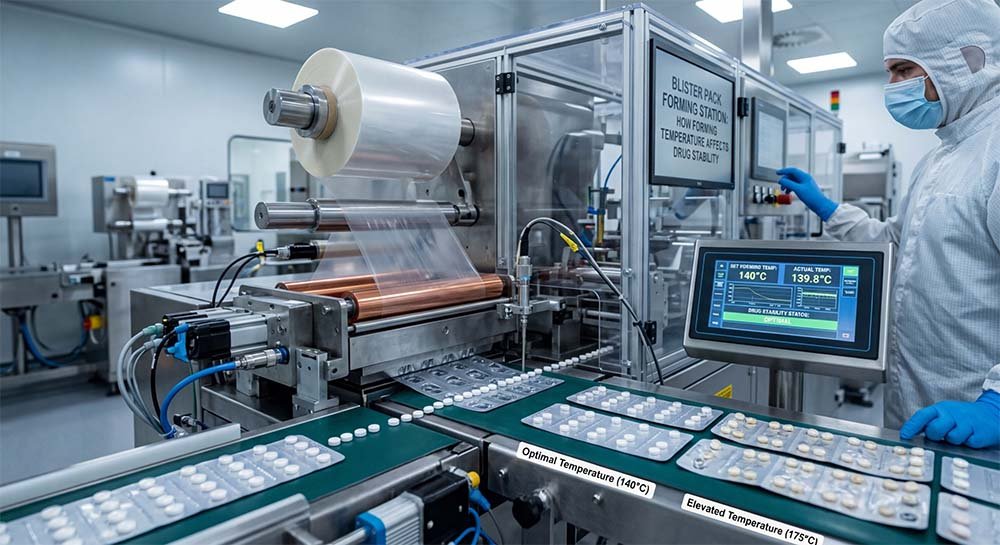
Precise PID temperature control at the sealing station is non-negotiable in tropical climates. A 12°C drift correlates to a 40% reduction in seal bond strength.
Based on validated process data from 14 blister line commissioning projects in Southeast Asia (Vietnam, Indonesia, Thailand, Philippines) conducted by HIJ Machinery between 2018 and 2024, the following tropical-optimized parameter ranges represent validated production windows for PVC/Alu and PVDC/Alu film systems:
| 매개변수 | Standard Setting (23°C / 50% RH) | Tropical Adjustment (35°C / 80%+ RH) | Validation Reference |
|---|---|---|---|
| Sealing Jaw Temperature (PVC/Alu) | 175–185°C | 182–192°C (raise 7°C) | In-process peel test every 30 min |
| Sealing Pressure | 0.35–0.45 MPa | 0.40–0.50 MPa (raise 0.05 MPa) | Calibrated load cell verification |
| Forming Plate Temperature (PVC) | 108–115°C | 96–104°C (reduce 8–11°C) | Cavity wall thickness mic check |
| Film Pre-heating Dwell Time | 0.8–1.0 s | 0.8–1.0 s (no change) | Machine cycle time verification |
| Packaging Hall Humidity | ≤60% RH | ≤45% RH (dehumidify) | EU GMP Annex 1 §4.3 |
| Film Roll Conditioning | Not typically specified | 24h at ≤25°C / ≤40% RH before use | Film moisture content ≤0.15% w/w |
For manufacturers procuring a new blister line destined for tropical markets, the User Requirement Specification (URS) must explicitly define the environmental design envelope: operating ambient temperature range (e.g., 18–35°C), operating humidity range (e.g., up to 85% RH at machine exterior), and HVAC failure contingency parameters. A URS that specifies only “standard pharmaceutical production conditions” gives your supplier no obligation to validate tropical performance. See our full range of pharma blister packing machines — each with configurable environmental operating specifications.
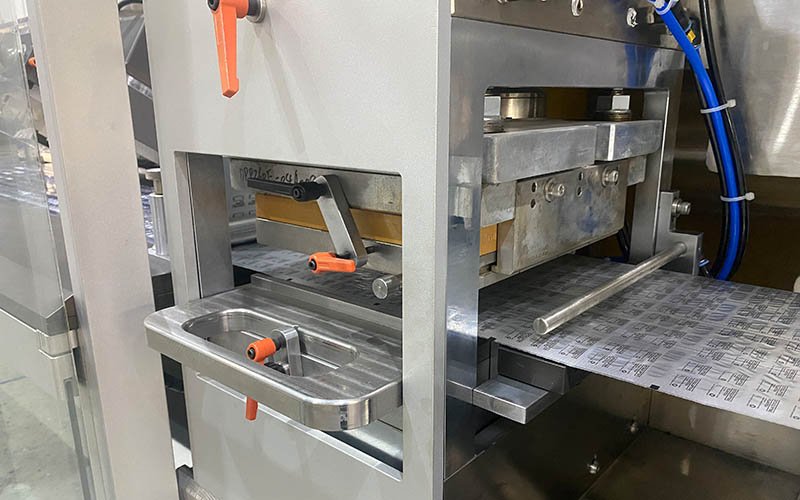
The sealing station is where pack integrity is made or lost. Thermal calibration must account for ambient temperature changes — not just set-point accuracy.
Common Failure Modes & Forester’s Fix
- 🔴 증상: Random incomplete seals (seal voids detectable by blue dye solution immersion test) appear during afternoon production shifts but not during morning shifts — with no machine alarms triggered.
⚙️ 근본 원인: Factory HVAC system reduces cooling output by 30% during peak-load afternoon hours (typically 13:00–16:00), raising packaging hall temperature from 24°C to 32°C. The PID controller on the sealing jaw compensates for the ambient rise by reducing heater output, but response lag means jaw temperature dips to 168°C for 8–12 seconds before correction — below the minimum threshold for PVC/Alu lacquer activation at 172°C.
🔧 포레스터의 수정: Install a redundant thermocouple at the sealing jaw surface (not just inside the heater block) connected to an independent data logger triggering an alarm at <172°C. Adjust PID parameters: reduce integral time from 8s to 4s to accelerate thermal correction response. Verify fix with 100-sample peel strength test across both AM and PM shifts over 3 consecutive production days. - 🔴 증상: Blister cards show wrinkled or puckered seal areas along the long edge — not at the cavity boundary — causing cosmetic rejection rates of 4–8% during rainy season months.
⚙️ 근본 원인: Aluminum lidding foil (20µm) absorbed moisture from the high-humidity packaging hall air, increasing foil elongation at yield by approximately 3–5%. When the sealing jaw applies heat and pressure, the locally moisture-weakened foil stretches unevenly, creating micro-wrinkles along the web direction.
🔧 포레스터의 수정: Introduce foil roll conditioning protocol: store all lidding foil in sealed moisture-barrier bags (silica gel desiccant, target ≤30% RH inside bag). After mounting on machine, allow 20-minute equilibration before production start. Reduce web tension at the foil unwind station by 8–12% during high-humidity periods. Seal packaging hall to ≤45% RH with dedicated dehumidification equipment.
How to Specify and Validate a Blister Packaging Line for Tropical Markets: A 7-Step Procurement Framework
Specifying a blister packaging machine for tropical climate deployment requires building environmental performance requirements into every stage of the procurement cycle — from URS drafting through SAT sign-off. The following framework, developed from 20 years of turnkey line commissioning across Southeast Asia, Latin America, and the Middle East, gives procurement and engineering teams a structured process to eliminate post-installation integrity failures.
- Define Tropical Environmental Design Envelope in Your URS
Specify: Operating ambient temperature: 18–38°C; Operating ambient humidity: 40–85% RH; Storage ambient (machine off): 5–45°C / up to 90% RH. Require the supplier to provide a written declaration of compliance for all electrical components (PLC, servo drives, HMI screens) at these conditions. Reference IEC 62061 for functional safety in high-humidity environments. - Specify Film Material MVTR Requirements — Not Just Film Type
Write the MVTR limit into your forming film component specification as a quantified acceptance criterion: e.g., “MVTR ≤0.5 g/m²/24h at 38°C/90% RH per ASTM F1249.” Do not specify “PVDC-coated PVC” without the quantified MVTR — coating weight varies by supplier and only the measured MVTR confirms performance. - Require Tropical-Condition FAT Protocol in Your Purchase Contract
Contractually mandate that Factory Acceptance Testing (FAT) includes a 4-hour run at simulated tropical conditions: sealing station ambient at 35°C, relative humidity at 75% RH (achieved via humidification chamber around the machine). Seal peel strength must remain ≥8 N/15mm throughout. This clause converts an informal vendor promise into a contractual obligation. - Conduct SAT Under Real Site Conditions — Not During Dry Season
Schedule Site Acceptance Testing (SAT) during the site’s high-humidity season (typically June–October for most of Southeast Asia). Record ambient temperature and RH at 30-minute intervals throughout SAT. Require a minimum 8-hour continuous production run with in-process peel strength testing every 30 minutes. All 16 data points must exceed 8 N/15mm. - Execute IQ/OQ/PQ Validation With Tropical-Adjusted Process Parameters
Installation Qualification (IQ): verify all sensors, thermocouples, and humidity probes are calibrated. Operational Qualification (OQ): challenge sealing temperature at ±5°C from set-point and verify peel strength response. Performance Qualification (PQ): run 3 consecutive production batches at worst-case ambient conditions, demonstrating ≥8 N/15mm peel strength and <0.5% seal defect rate. Document under your quality system per EU GMP Annex 15, Sections 6–8. - Implement Real-Time Environmental Monitoring Integrated With Machine PLC
Install calibrated temperature/humidity sensors at 3 points: forming film unwind station, sealing station ambient, and finished blister output conveyor. Wire sensor outputs to the machine PLC (Siemens S7-1200 or Allen-Bradley CompactLogix recommended). Program automatic production pause alarm when packaging hall RH exceeds 60% — providing a validated environmental boundary condition enforced by the control system, not by operator judgment. - Establish a Tropical-Season Preventive Maintenance Protocol
Increase sealing jaw thermocouple calibration frequency from quarterly to monthly during rainy season. Re-verify peel strength after every 500,000 blister cycles or 30-day calendar interval, whichever comes first. Replace forming station heating plate thermocouples every 18 months — tropical thermal cycling accelerates thermocouple drift rate versus temperate environment baselines.
For manufacturers planning a complete tropical-rated blister packaging line — from film specification through PQ validation — explore HIJ Machinery’s turnkey pharmaceutical packaging solutions, designed to deliver project certainty in tropical and high-humidity markets including Southeast Asia, Latin America, and the Middle East.

A structured DQ/IQ/OQ/PQ validation pathway is the only compliant route to confirming blister pack integrity in a tropical manufacturing environment.
HIJ Machinery’s engineering team provides full documentation support for IQ/OQ/PQ protocols, calibration records, and change control procedures. Our after-sales service network — covering Southeast Asia, Latin America, and the Middle East — means a certified field engineer can be on-site within 72 hours for critical process deviations. Learn more about our global service and support capabilities.
FAQ: Blister Packaging in Tropical Climates — Answers for Pharma Buyers and Production Engineers
🎯 Ready to Eliminate Tropical Climate Blister Pack Failures from Your Production Line?
Every project HIJ Machinery delivers in Southeast Asia, Latin America, and the Middle East is engineered against the real operating environment — not a controlled lab. We co-engineer your forming film selection, sealing parameters, environmental controls, and IQ/OQ/PQ documentation as one validated system.
At HIJ Machinery, I don’t just sell you a machine; I deliver project certainty. — Forester Xiang, Founder
📌 20 years. 14 countries. Zero tropical climate recalls on HIJ-delivered turnkey lines.