

















 PVC vs PVDC vs Alu-Alu Blister Packaging Material Guide
Every pharmaceutical procurement team eventually faces the same three-word question on a technical questionnaire: PVC, PVDC, or Alu-Alu? It sounds like a materials science elective. It is, in reality, a product liability decision that will follow your drug product through its entire shelf-life dossier — from ICH Q1A accelerated stability chambers straight through to your regulatory submission, your blister machine RFQ, and ultimately your patients’ medicine cabinets.
Choose incorrectly, and you will not discover the mistake at the purchasing stage. You will discover it 12–18 months later, in a stability failure report, in an FDA 483 observation, or in a field complaint that triggers a batch recall. By that point, re-validation costs, lost batches, and regulatory remediation will dwarf whatever you saved on film cost per square metre. This guide exists to prevent exactly that outcome — and to give you the engineering vocabulary to make the right specification before you issue a single machine RFQ.
🔥 Forester’s Insight: A 20-Year Engineer’s Perspective
- The Direct Answer
Your blister material choice is not a packaging decision — it is a product liability decision. PVC suits standard, non-hygroscopic oral solids at ambient storage conditions. PVDC coatings add meaningful moisture barrier for moderately hygroscopic APIs where thermoforming is still acceptable. Alu-Alu cold-form foil is non-negotiable for moisture-sensitive, light-sensitive, oxygen-sensitive, or controlled substances requiring maximum hermetic protection and tamper evidence. - The Field Experience
“In my 20 years commissioning blister lines across Southeast Asia and Latin America, I have watched procurement teams downgrade from Alu-Alu to PVC purely on material cost — only to face catastrophic stability failures at ICH Q1A long-term testing, triggering batch recalls and FDA 483 observations. I personally witnessed a mid-size generics manufacturer in Indonesia lose an entire 18-month stability study for a widely prescribed anti-diabetic tablet because the procurement manager switched forming film from Alu-Alu to 250 µm PVC/PVDC without re-issuing the machine URS. The humidity excursions at 40°C/75% RH were enough to degrade the active beyond specification. The regulatory remediation cost was six times the material saving.” - The Hidden Trap
The trap nobody tells you: switching forming film mid-project does not just mean ordering different roll stock. It means full tooling replacement on your forming station, revised PLC temperature profiles for thermoforming vs. cold-forming, re-qualification of your sealing parameters, and a fresh FAT/SAT validation cycle. Many standalone machine vendors will happily quote you a “universal” blister machine — then quietly inform you post-sale that Alu-Alu cold-forming requires a completely different mechanical architecture. Lock your material specification before you issue RFQs, not after.
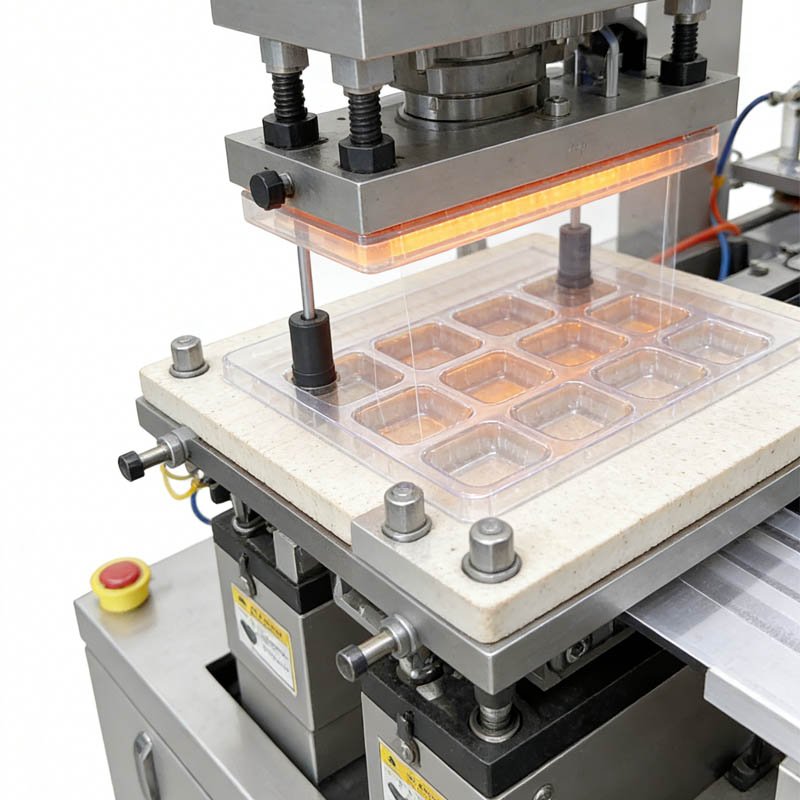
Fig. 1 — Thermoforming station with PVC/PET film loaded on a HIJ pharma blister line. Film architecture at this station is the primary determinant of barrier performance across the product’s entire shelf life.
The Engineering Reality: PVC, PVDC, and Alu-Alu Foil Decoded
Before any machine selection discussion can occur, the forming film and lidding foil must be specified in engineering terms. The three dominant material systems each represent a fundamentally different barrier philosophy, process architecture, and regulatory positioning.
PVC (Polyvinyl Chloride) — The Baseline Standard
Plain PVC forming film, typically supplied in gauges between 200 µm and 300 µm, is the industry’s cost-optimised baseline for oral solid dosage (OSD) forms that carry no special sensitivity to moisture or oxygen. Its water vapour transmission rate (WVTR) falls in the range of 3.0–5.0 g/m²/day at 38°C/90% RH — adequate for tablets and capsules with no hygroscopic liability. Thermoforming temperatures sit between 100°C and 130°C, achievable with standard heated tooling and straightforward PLC temperature control loops. The material offers excellent clarity for visual tablet inspection, broad compatibility with standard aluminium foil lidding at sealing temperatures of 160°C–200°C, and well-understood die-cutting characteristics. Where PVC fails: any API with a documented hygroscopic classification of Class II or higher (per ICHQ1A), any photosensitive molecule, or any product requiring oxygen barrier will exceed its protection envelope within a standard 24-month shelf life at Zone IVb conditions (40°C/75% RH).
PVDC (Polyvinylidene Chloride) Coated Films — The Performance Middle Ground
PVDC is applied as a functional coating to a PVC or PCTFE substrate, with coating weights typically ranging from 40 gsm to 120 gsm. The barrier uplift is significant: a PVC/PVDC laminate at 90 gsm coating weight can achieve a WVTR as low as 0.3–0.8 g/m²/day — a 5–10× improvement over plain PVC. Oxygen transmission rate (OTR) also drops substantially, extending protection to moderately oxygen-sensitive APIs. The critical machine parameter for PVDC is forming temperature management: PVDC’s thermoforming window is narrower than plain PVC (typically 130°C–160°C), requiring PLC-controlled zone heating with tighter tolerance — ±2°C across the forming plate versus ±5°C tolerable with plain PVC. Exceeding the upper temperature limit causes PVDC phase separation, compromising barrier integrity in a manner invisible to the naked eye and only detectable through laboratory WVTR testing. This is precisely why your machine’s temperature control architecture must be specified to the film — not the other way around. From a regulatory perspective, PVDC is acceptable under WHO GMP, EU GMP Annex 1, and US cGMP 21 CFR Part 211, provided the stability data supports the chosen specification.
Alu-Alu Cold-Form Foil — The Hermetic Standard for High-Value APIs
Alu-Alu (cold-form aluminium) blister systems use a forming web composed of a laminate typically structured as OPA (oriented polyamide) / Aluminium / PVC, with total thickness ranging from 120 µm to 200 µm. The defining characteristic is near-zero water vapour and oxygen transmission: WVTR values are routinely measured at <0.005 g/m²/day, and OTR approaches 0 cm³/m²/day — effectively hermetic under any ICH climatic zone. The process is fundamentally different from thermoforming: cold-forming uses mechanical deep-drawing of the aluminium laminate over a plug-assist forming die at ambient temperature, requiring forming forces of 1,500–3,000 N depending on cavity geometry and pocket depth. This demands a dedicated cold-forming machine architecture — the DPH (Deep Push Head) mechanical design — with servo-controlled forming pressure, lubricated forming dies, and significantly higher tooling precision tolerances than a thermoforming line. Cavity depth limitations are a key design constraint: maximum cavity depth for Alu-Alu is typically 9–12 mm, versus 15–20 mm achievable in thermoforming, making product geometry a primary driver in the material selection decision. Light barrier is absolute. Tamper evidence is intrinsic. From a regulatory standpoint, Alu-Alu is the mandatory specification for Schedule H/H1 controlled substances across multiple national pharmacopoeias, and is the de facto standard for temperature-sensitive biologics, nitrate-based cardiovascular drugs, and any molecule with a photodegradation pathway defined in its ICH Q1B study.
Side-by-Side Technical Comparison
| 매개변수 | PVC (250 µm) | PVC/PVDC (90 gsm) | Alu-Alu (Cold-Form) |
|---|---|---|---|
| WVTR (g/m²/day @ 38°C/90%RH) | 3.0–5.0 | 0.3–0.8 | <0.005 |
| OTR (cm³/m²/day) | 10–20 | 2–5 | ~0 |
| Light Barrier | None | None | Complete |
| Forming Process | Thermoforming | Thermoforming | Cold-Forming |
| Forming Temp. | 100–130°C | 130–160°C | Ambient |
| Max. Cavity Depth | 15–20 mm | 15–18 mm | 9–12 mm |
| Material Cost Index | Low (1×) | Medium (2–3×) | High (5–8×) |
| Machine Architecture | Standard thermoform | Standard thermoform | Dedicated DPH cold-form |
| ICH Zone IVb Suitability | 제한적 | 보통 | Full |
| Typical Applications | Standard OSD, nutraceuticals | Hygroscopic tablets, effervescents | High-value API, controlled substances, biologics |
The table above makes clear that PVC vs. PVDC vs. Alu-Alu is not a linear cost-performance spectrum — it is a three-way branch point in your product development decision tree, with each branch leading to a different machine architecture, tooling investment, and validation pathway. Selecting the wrong branch on a commercial blister line running at 200–400 blisters/minute represents a qualification liability that cannot be corrected by swapping a film roll.

Fig. 2 — HIJ DPH-300 dedicated cold-forming Alu-Alu blister machine. Note the deep-draw forming die assembly and servo-controlled forming pressure system — mechanical requirements that cannot be retrofitted onto a thermoforming platform. (View HIJ Alu-Alu Blister Packing Machine)
Multi-Vendor Line Assembly vs. Turnkey: The Validation Nightmare Nobody Prices In
The engineering specifications above have a direct, high-stakes implication for how you procure your blister packaging line. In markets where procurement is driven by unit price comparison — a dynamic I encounter constantly across Latin America and Southeast Asia — pharmaceutical manufacturers routinely attempt to assemble blister lines from multiple vendors: one supplier for the thermoforming machine, a separate vendor for the feeder system, a third for the cartoner, and an integrator to connect them all. The material cost savings on paper are real. The total project cost in practice is almost always higher.
⚠ The Common Multi-Vendor Pitfall
When your API stability data comes back requiring an upgrade from PVC to Alu-Alu forming film, every parameter tied to your forming station changes simultaneously: forming die geometry, mechanical pressure settings, film tension control, pre-heating (or its absence), and sealing foil compatibility. If the thermoforming machine and the downstream feeder were sourced from different vendors, neither vendor is contractually responsible for the integrated performance qualification. Your IQ/OQ/PQ documentation becomes a negotiation between three parties, none of whom own the overall OEE target. FDA 483 observations for inadequate process validation are the predictable outcome.
✅ The HIJ Turnkey Standard
At HIJ, every blister line is engineered as a single integrated system validated across all three foil formats from the URS stage. Forming station tooling, sealing temperature profiles, feeder compatibility, and downstream cartoner integration are specified against your API and material selection simultaneously. FAT and SAT protocols are built into the project scope — not sold as optional extras. One contract, one validation package, one engineering team accountable for OEE from day one. (Explore HIJ Turnkey Packaging Solutions)
- Tooling Re-investment Risk: A complete forming die set for Alu-Alu cold-forming costs between USD 8,000 and USD 25,000 depending on cavity count and geometry. If you commissioned a thermoforming platform based on a PVC specification and later need Alu-Alu, this tooling is not transferable — you are effectively purchasing a new machine architecture. The HIJ standard is to confirm forming film specification, cavity layout, and product dimensions in the URS before any tooling fabrication begins.
- Sealing Parameter Divergence: Alu-Alu lidding foil (typically 20–25 µm aluminium with heat-seal lacquer) requires sealing station temperatures of 180°C–220°C and dwell times of 0.3–0.8 seconds, versus standard PVC/alu sealing at 160°C–190°C. Multi-vendor lines frequently suffer from sealing station incompatibilities that manifest as intermittent seal failures — detectable only through peel strength testing per ASTM F88, not visually. The HIJ DPP-250 pharma blister machine and the HIJ DPP-260 automatic blister packing machine both feature independently controlled sealing zone PID loops calibrated to the specific lidding foil specified in the URS.
- Regulatory Documentation Gap: WHO GMP and cGMP 21 CFR Part 211 both require documented evidence that packaging materials and packaging operations are controlled to validated parameters. A multi-vendor line without unified IQ/OQ/PQ documentation creates a compliance gap that regulators will identify during inspection. HIJ’s turnkey delivery includes a complete validation dossier structured to WHO Technical Report Series 902, Annex 6 standards.
Forming Station Architecture: The Critical Divergence Point Between Thermoforming and Cold-Forming
The most technically consequential machine decision driven by material selection is the forming station architecture. In a thermoforming blister machine, a heating plate assembly brings the PVC or PVC/PVDC forming web to its glass transition temperature (Tg), at which point positive air pressure (typically 4–6 bar) forces the softened film into the forming die cavity. The process requires precise temperature uniformity across the heating plate — measured in practice by thermal mapping with ±2°C tolerance for PVDC systems. The HIJ DPP-250 thermoforming platform uses ceramic far-infrared heating elements with embedded thermocouple feedback, providing zone-to-zone temperature uniformity of ±1.5°C at full production speed, a specification critical for PVDC barrier integrity.
Cold-forming Alu-Alu uses a fundamentally different mechanism. The forming web is drawn mechanically into the die cavity by a plug-assist draw punch operating at ambient temperature. The aluminium layer deforms plastically — permanently — while the OPA outer layer provides the formability and the PVC inner layer provides the heat-seal surface. Forming speed in cold-form machines is inherently lower than thermoforming (typically 60–120 strokes/min versus 100–200 strokes/min for thermoforming) due to the mechanical forming force requirements and the need to prevent micro-cracking of the aluminium layer. This speed differential must be reflected in your production capacity planning and OEE calculations at the line design stage — not as an afterthought during site acceptance testing.
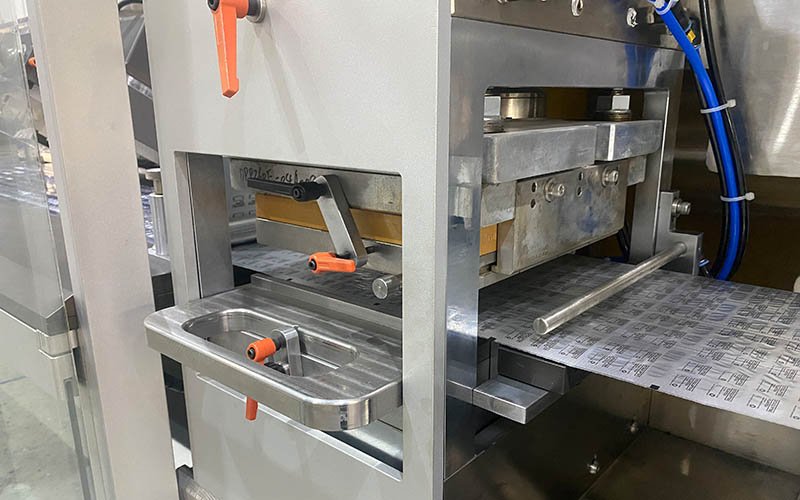
Fig. 3 — HIJ blister machine sealing station: independent PID-controlled heating zones pressing aluminium lidding foil to the forming web. Temperature and pressure parameters must be engineered to the specific foil system specified in the URS — a parameter set that differs significantly between PVC/alu thermoforming and Alu-Alu cold-form systems.
Material Selection Decision Framework: A Practical URS Checklist
Based on 20 years of pre-sales technical consultations and post-commissioning field visits, I have distilled the material selection decision into a practical engineering checklist that should be embedded in every blister line URS before a single RFQ is issued:
Material Specification Pre-RFQ Checklist
- ICH Q1A classification of API: Hygroscopic Class I → PVC acceptable; Class II → PVC/PVDC minimum; Class III/deliquescent → Alu-Alu mandatory.
- ICH Q1B photostability: Any measurable photodegradation pathway → Alu-Alu mandatory (opaque lidding alone is insufficient for full hermetic light exclusion).
- Target ICH climatic zone: Zone I/II → PVC or PVDC; Zone III/IVa → PVDC minimum; Zone IVb (40°C/75% RH) → Alu-Alu for sensitive APIs.
- Product geometry / cavity depth: Depth >12 mm → thermoforming required; depth ≤9 mm → cold-form feasible.
- Regulatory jurisdiction: Schedule H/H1 controlled substance (India CDSCO), narcotic/psychotropic (DEA/NDPS) → Alu-Alu mandatory per pharmacopoeial specification.
- Shelf-life target: 36+ months at Zone IVb → Alu-Alu strongly recommended regardless of hygroscopic class.
- Tamper-evidence requirement: Child-resistant / senior-friendly push-through requirements → affects lidding foil lacquer specification and peel-force balance.
Once this checklist is completed and locked, the machine RFQ can be issued with a fully defined forming film specification, enabling vendors to quote tooling, temperature profiles, and validation scope correctly. This is the single most effective intervention to prevent mid-project material switches and the cascade of revalidation costs that follow. For manufacturers targeting pharmaceutical-grade blister packing machines certified to WHO GMP and CE standards, this specification work must precede equipment selection — never follow it.
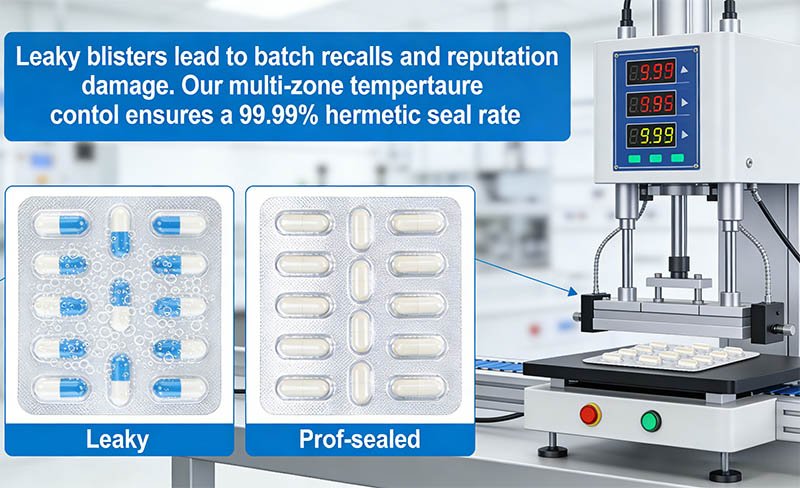
Fig. 4 — Seal integrity validation during FAT: peel strength testing per ASTM F88 on a completed Alu-Alu blister pack. This test must be conducted for every foil combination and sealing parameter set defined in the machine URS. HIJ includes documented FAT/SAT seal integrity protocols for all three forming film architectures as a standard deliverable in our turnkey project scope. (Learn about HIJ’s FAT/SAT & Validation Support)
자주 묻는 질문
Q1: Can I run both PVC/PVDC thermoforming and Alu-Alu cold-forming on the same blister machine by changing tooling?
No — not without a fundamental machine architecture change. Thermoforming and cold-forming require different mechanical forming station designs: a thermoforming machine uses a heated platen and pneumatic pressure to form softened film, while a cold-forming machine uses a mechanical punch-and-die draw system at ambient temperature. These are not interchangeable via tooling swap alone. Some manufacturers market “combination” platforms, but in practice these involve significant mechanical reconfiguration, a full re-qualification of forming parameters, and a separate set of validated PLC recipes for each foil system. At HIJ, we recommend separate dedicated machines for thermoforming (DPP-250/DPP-260 for PVC/PVDC) and cold-forming (DPH-300 for Alu-Alu) to ensure validated performance and GMP compliance on each product. If your product portfolio genuinely spans both forming technologies, our turnkey team can design a shared secondary packaging (cartoning) infrastructure to optimise your total capital investment while maintaining material-specific forming line integrity.
Q2: What is the regulatory risk of using PVC/PVDC instead of Alu-Alu for a Zone IVb market, and how do I assess it properly?
The regulatory risk is quantifiable — and must be quantified through your ICH Q1A long-term stability programme before commercial launch. The standard protocol requires 12-month real-time data at 40°C/75% RH for Zone IVb, with 6-month accelerated data at the same conditions. If your API shows a degradation trend — even a statistically marginal one — at the 6-month accelerated checkpoint in PVC/PVDC packaging, your regulatory authority (CDSCO, BPOM, TGA, FDA, or others) will require a package specification upgrade to Alu-Alu before registration approval. The critical risk is that by the time this failure is identified, your machine procurement process may already be well advanced with a thermoforming specification. This is why our engineering team’s first recommendation is always: run a parallel accelerated stability study in both PVC/PVDC and Alu-Alu during product development — before machine procurement begins. The incremental cost of a parallel stability study is negligible compared to the cost of machine respecification post-procurement.
Q3: How does blister material selection affect downstream cartoning machine compatibility, and is this typically addressed in a standard machine quotation?
Blister material selection significantly affects downstream cartoner compatibility in two ways. First, Alu-Alu cold-form blisters have a stiffer, less flexible structure than thermoformed PVC blisters due to the aluminium laminate — this requires different blister push/insert mechanisms at the cartoner infeed and adjusted gripper tension settings. Second, Alu-Alu blister packs are typically thicker and heavier per unit area, requiring adjusted conveyor speed calibration and photoelectric detection sensitivity settings on the blister cartoning machine. In a standard multi-vendor quotation, these integration parameters are almost never addressed because neither the blister machine vendor nor the cartoner vendor has contractual responsibility for the combined system. In a HIJ turnkey project, cartoner integration is designed against the specific blister pack dimensions, weight, and stiffness profile confirmed in the URS — and validated during FAT with actual product samples before shipment.
Conclusion: Delivering Project Certainty Through Material-First Engineering
The PVC vs. PVDC vs. Alu-Alu decision is the single highest-leverage technical choice in pharmaceutical blister packaging line design. It determines your machine architecture, tooling investment, PLC parameter set, validation scope, regulatory dossier, and ultimately your product’s ability to survive ICH long-term stability testing in the climatic zones where your patients live. Getting it wrong is not recoverable without significant capital expenditure, timeline delay, and regulatory remediation.
The engineering principle is straightforward: material specification must precede machine procurement. Your forming station tooling, sealing temperature profiles, and PLC-controlled process parameters must be engineered around your material choice from day one. Attempting to retrofit a material change onto a commissioned line — as I have seen in dozens of plants across Southeast Asia and Latin America — is invariably more expensive than specifying correctly at the outset.
The strategic advantage of a HIJ turnkey blister packaging solution is precisely this: our engineering engagement begins at the URS stage, before any tooling is fabricated or any machine architecture is locked. We validate across all three foil formats, deliver FAT/SAT protocols as a standard project deliverable, and provide a single validation dossier that supports your regulatory submission without requiring multi-vendor negotiation. Whether your product requires a standard DPP-250 thermoforming line for PVC/PVDC applications or a dedicated Alu-Alu cold-form blister machine for your highest-value APIs, HIJ engineers the solution to your specification — not a catalogue option mapped to your budget.
At HIJ Machinery, I don’t just sell you a machine; I deliver project certainty. The blister material decision is where that certainty begins.
Ready to Lock Your Blister Material Specification?
Send us your URS or API stability summary. Our engineering team will review your material requirements, specify the correct machine architecture, and provide a documented Turnkey Quote within 48 hours — with FAT/SAT protocols included.