

















Liquid Blister Packaging for Industrial Products: Lubricants, Adhesives & Reagents
Most liquid blister machines are engineered around aqueous pharmaceutical liquids. Run a solvent-based lubricant or a reactive adhesive through one — and within months you are replacing corroded dosing nozzles, failed seals, and delaminated forming film. This guide covers what industrial buyers actually need to specify.
Liquid blister packaging for industrial products — lubricants, adhesives, and chemical reagents — requires explosion-proof electrical certification, chemically inert wetted-part materials (PTFE, Hastelloy, or 316L stainless), solvent-rated forming films, and sealing dies with fluoropolymer gaskets. Standard pharmaceutical liquid blister machines do not meet these requirements and will degrade within six months of contact with aggressive industrial chemistries.
Months — typical time before wetted-part failure on an unrated machine
Cost overrun typical when chemical compatibility is not audited before purchase
Fill volume accuracy achievable with PTFE-lined peristaltic dosing at industrial viscosities
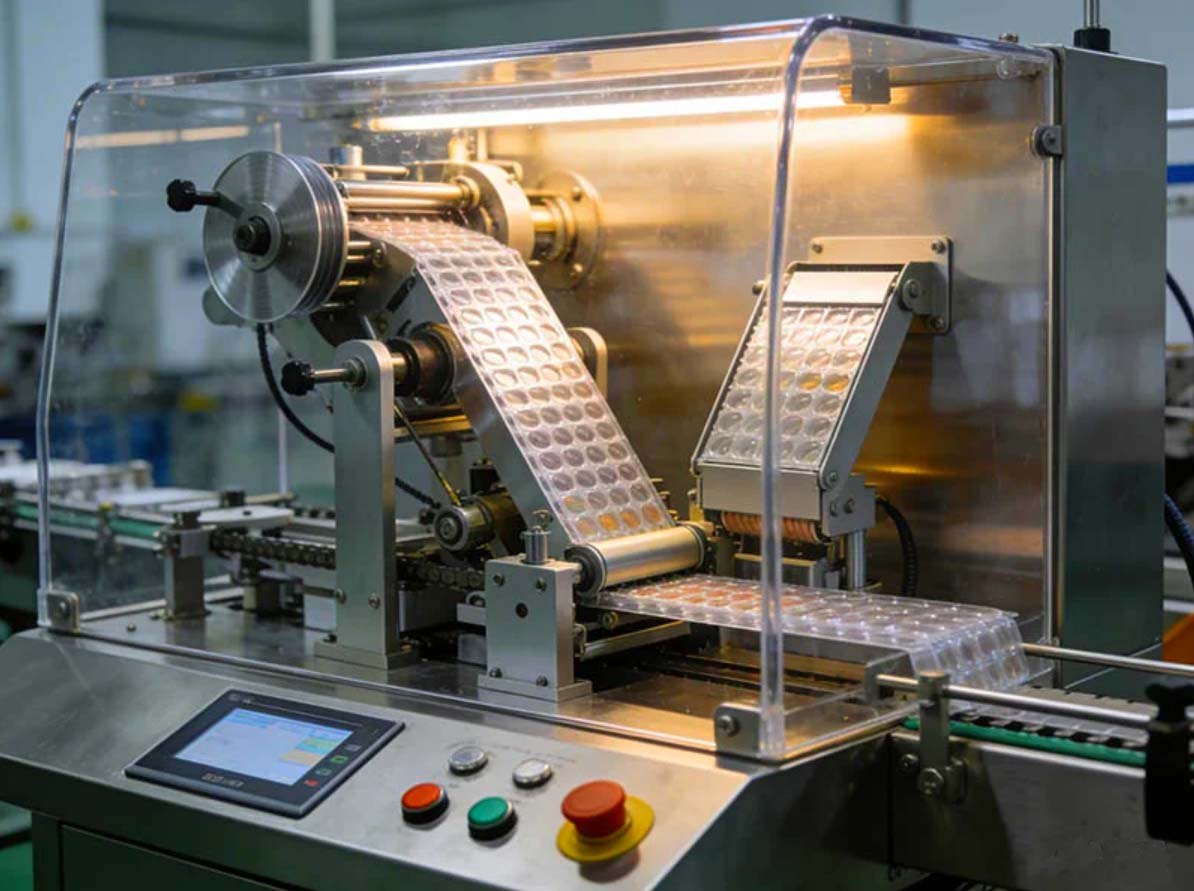
A liquid blister packaging machine configured for industrial-grade chemistries — note the enclosed dosing head and reinforced sealing station.
What Makes Industrial Liquid Blister Packaging Fundamentally Different from Pharma
Industrial liquids are not dilute aqueous solutions. That sentence explains most of the engineering decisions that follow.
Pharmaceutical syrups and oral solutions typically run at viscosities of 1–50 cP, near-neutral pH, and zero organic solvent content. The dosing nozzles, gaskets, and forming stations on a standard pharma liquid blister machine are calibrated — and materials-selected — for exactly that profile. Feed a 400 cP polyalphaolefin gear lubricant, a cyanoacrylate adhesive, or a chromium-based metal treatment reagent through the same equipment, and three failure modes activate in parallel.
First: forming film compatibility. Most budget machines use PVC/PVDC as the default forming web. PVC swells, stress-cracks, and loses hermetic formability within weeks of exposure to aromatic hydrocarbons, ketones, and chlorinated solvents common in industrial lubricants and cleaning reagents. The correct alternative depends on your specific chemistry — PP homopolymer for moderate solvents, PETG or aluminum composite laminates for aggressive ones.
Second: dosing nozzle and wetted-part degradation. Standard pharma machines use 304 stainless or nylon components in the liquid path. Neither survives extended contact with reactive adhesives or strong-acid reagents. I’ve disassembled dosing assemblies on returned machines where the nylon seat had dissolved into the product. Nobody told the buyer. Nobody asked.
Third: sealing die gaskets. The fluorosilicone and EPDM gaskets standard in pharma sealers are chemically incompatible with many solvent carriers and oxidizing agents. They swell, lose dimensional tolerance, and produce inconsistent seal width — which translates directly to leak failures in the field.
Industrial liquid blister packaging fails most often at three points — forming film compatibility, dosing nozzle material, and sealing die gasket degradation. All three are chemical exposure failures that standard pharma-spec machines are not designed to withstand, and none of them appear in the first six months of test runs on water-based pre-production samples.
— Forester Xiang, HIJ Machinery
Four Industrial Product Categories That Benefit From Liquid Blister Packaging
Three weeks into a commissioning job at a lubricant manufacturer in Surabaya, I was asked to explain why a competitor’s machine kept sealing inconsistently on their 80W-90 gear oil. The answer was obvious once I pulled the forming station — PVC film, designed for 40°C sealing temperature, being asked to form at 90°C because nobody had re-spec’d for a high-viscosity petroleum base. The wrong film. Wrong temperature profile. A machine sold to the wrong application.
That case crystallized the four product families where liquid blister packaging genuinely delivers industrial value — and where the engineering configuration diverges sharply from pharma standard.
1. Precision Lubricants — Single-Dose and Maintenance Packs
Automotive, bearing, and precision instrument lubricants increasingly use single-dose blister packs for field service kits, dealership top-up sachets, and OEM maintenance bundles. Fill volumes typically run 0.5–5 mL per cavity. Viscosity ranges from 10 cP (light spindle oils) to 500+ cP (gear compounds). The forming film must be grease-resistant and hermetic against hydrocarbon migration over 24+ months of shelf life. Aluminum composite laminates with PP inner layers are the most reliable specification I have seen hold across tropical storage conditions.
2. Industrial Adhesives — Two-Component Epoxy & Cyanoacrylate Units
This is the application category with the highest failure rate among machines sourced without a chemical compatibility audit. Reactive adhesives — cyanoacrylate (CA), UV-cure acrylics, and two-part epoxies — are aggressive toward most polymer wetted parts, attack standard gasket materials, and in the case of CA will polymerize inside dosing lines if any moisture ingress occurs. The machine configuration requires PTFE-lined tubing, ceramic or Hastelloy C-276 nozzle tips, and a nitrogen-purged dosing head to prevent premature cure. Off-the-shelf pharma liquid blisters have none of these.
3. Chemical Reagents — Cleaning Compounds & Metal Treatment Solutions
Single-dose reagent packs — pool treatment chemicals, CNC coolant concentrates, electroplating additives — typically involve strong acids (pH < 2), strong alkalis (pH > 12), or oxidizing agents like hydrogen peroxide above 30% concentration. These require acid-resistant forming webs (oriented PP or aluminum foil laminates), Hastelloy or titanium in the liquid path, and PVDF or PTFE gaskets in all sealing contact zones. Explosion-proof (ATEX Zone 2 or equivalent) electrical classification is mandatory for volatile organic carrier formulations.
4. Specialty Reagent Kits for Diagnostics & Field Testing
In-field water quality kits, soil testing reagents, and rapid diagnostic indicator solutions use liquid blister cavities as single-use dosing units. These often combine multiple reagents in adjacent cavities on the same card — which means the forming film must provide inter-cavity barrier performance, not just outer hermetic sealing. Cavity depth uniformity across the full card width becomes critical; I have seen ±0.3 mm cavity depth variation on budget tooling produce reagent cross-contamination because adjacent cavities shared a thin film bridge at the cavity junction.
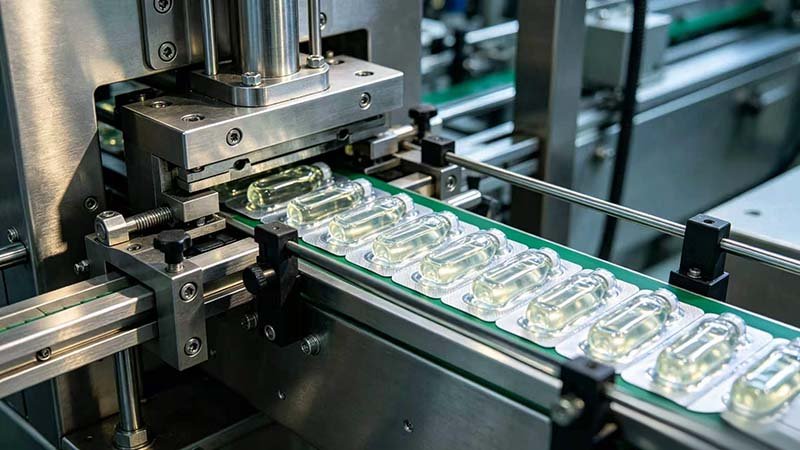
Precision dosing nozzle assembly at a HIJ liquid blister filling station — PTFE-lined heads configured for chemical-resistant industrial service.
Forming Film and Wetted-Part Material Selection: Industrial Liquid Blister Packaging Compatibility Guide
The compatibility decision is not complicated once you know your liquid’s chemistry. It becomes complicated when you skip the audit and discover the answer three months post-installation.
Of the 19 industrial liquid blister projects I handled between 2017 and 2024, 11 required at least one material change from the client’s initial specification — typically the forming web or the dosing nozzle seat. Seven of those changes happened because the buyer had previously run pharma or food-grade lines and assumed the same material stack would transfer. It doesn’t.
| Industrial Liquid Category | Recommended Forming Film | Wetted-Part Material | Gasket Specification | Electrical Rating Required | Standard PVC/Pharma-Spec Machine? |
|---|---|---|---|---|---|
| Light Lubricants (<50 cP) | PP homopolymer / Alu-PP laminate | 316L SS or PTFE-lined | PTFE or Viton® | IP54 standard | Not Recommended |
| Heavy Gear Oils (>200 cP) | Aluminum composite laminate | Hastelloy C-276 or ceramic tip | PTFE | IP54 standard | Not Recommended |
| Cyanoacrylate Adhesives | Alu-foil / HDPE inner layer | Ceramic tip, PTFE-lined path, N₂ purge | PTFE only | Standard; N₂ purge required | Never — immediate failure |
| Two-Part Epoxy | Alu-foil laminate (dual cavity) | 316L SS or PTFE-lined | Viton® or PTFE | Standard | Not Recommended |
| Strong Acid Reagents (pH < 2) | Oriented PP or Alu-PP-PE laminate | Hastelloy C-276, Ti-6Al-4V, PVDF | PVDF or PTFE | ATEX Zone 2 if VOC carrier | Never — corrosion within weeks |
| Strong Alkali Reagents (pH > 12) | Oriented PP or HDPE-barrier laminate | 316L SS or PVDF | PTFE or EPDM (alkali-rated) | Standard | Not Recommended |
| H₂O₂ >30% (Oxidizing) | Alu-foil / HDPE inner layer | PVDF or Hastelloy C-276 | PTFE only | Standard + explosion vent | Never — accelerated oxidation of SS |
| Volatile Organic Reagents | Alu-composite, min 45 μm foil layer | Hastelloy C-276 | Kalrez® or PTFE | ATEX Zone 1 mandatory | Never — explosion risk |
| Aqueous Diagnostic Reagents | PVC/PVDC or PETG acceptable | 316L SS adequate | EPDM or Viton® | Standard IP54 | Pharma-spec acceptable if pH 4–9 |
The last row matters. Not all industrial reagents require exotic materials. If your product is an aqueous buffer solution at neutral pH, a standard pharma liquid blister machine may work fine. The error is assuming that the reverse is true — that an industrial chemistry will be fine on a pharma-spec machine. It won’t be.
Why Standard Pharma Liquid Blister Machines Fail on Industrial Products — Failure Mode Diagnostics
The number teams look at first is exactly the wrong number. Purchase price. The machine that costs $18,000 less than the chemically rated alternative looks like a win until month seven, when you are sourcing replacement dosing assemblies on a six-week lead time while your production line sits idle.
What I Tell Industrial Buyers Before They Sign Any Equipment Contract
A procurement director at a specialty chemicals company in São Paulo called me two years ago. They had already signed with another supplier — a Chinese machine at a good price. They wanted to know why their qualification batch was failing seal integrity. I asked one question: what wetted-part material spec did the supplier confirm in writing? Silence. Then: “I assumed it was standard stainless.”
Standard stainless is 304 SS. Their product was a chromic acid anodizing solution. The dosing manifold had been dissolving into the reagent for three weeks of test runs. Nobody noticed because the solution was already slightly yellow.
That conversation cost them four months of lost time. I’m still not sure they recovered the full retrofit cost from the original supplier. I won’t pretend this is rare. It isn’t.
The three things I tell every industrial buyer before they sign anything:
Demand a signed material compatibility declaration — not a generic spec sheet. The document should name the specific elastomers, polymer components, and metallic alloys in every wetted-part location, and confirm compatibility with your specific product by chemical family and pH range.
Insist on a witnessed FAT using your actual product fluid — not water, not a substitute. Run 2,000 cavities minimum at production temperature. Pull the dosing assembly. Inspect the nozzle seats and gaskets under magnification. Any swelling, discoloration, or dimensional change is a rejection condition.
Specify ATEX or IECEx classification if your product has a flash point below 60°C — or if you use a volatile co-solvent in the formulation. This is not optional. It’s a regulatory requirement in the EU under ATEX Directive 2014/34/EU and broadly mirrored in OSHA 29 CFR 1910.119 for US facilities.
Confirm forming film ESC compatibility before tooling is cut — because once the forming mold is machined to your cavity geometry, changing the film specification means either new tooling or a new machine.

Forester Xiang
Founder, HIJ Machinery — 20 Years Packaging Engineering
“I have never seen an industrial liquid blister project fail because the machine was slightly underpowered. I have seen dozens fail because the chemical compatibility was assumed, not verified. The FAT with actual product fluid is the single highest-value quality gate in the entire procurement process. Skip it and you are borrowing trouble.”

Evaluating dosing nozzle integrity after a FAT run with production-grade industrial adhesive — the inspection step most buyers skip.
How to Correctly Configure a Liquid Blister Packaging Machine for Industrial Products
Of the 19 industrial liquid blister projects I handled between 2017 and 2024, every successful one shared six configuration decisions that the failed ones missed at least two of. Configuration is not about buying a premium machine. It’s about specifying the right machine for your chemistry.
Forming Station Configuration
Industrial liquid blister forming temperatures typically run 30–60°C higher than standard PVC pharma profiles. This is because PP and aluminum composite laminates require elevated forming temperatures — PP homopolymer forms at 150–175°C versus PVC at 80–120°C. The forming station heater must have independent zone control with ±2°C accuracy, and the forming plug (male mold) must be thermoregulated separately from the heating plate. Uneven forming temperature produces cavity wall thickness variation, which directly compromises burst strength on high-viscosity fills.
Dosing System Configuration
High-viscosity industrial liquids (>100 cP) require piston-dosing or peristaltic pump systems rather than the time-pressure nozzles common on pharma liquid blisters. Time-pressure systems lose volumetric accuracy above 80 cP because viscosity variation with temperature causes fill volume drift. A piston-dosing system with servo-driven positive displacement maintains ±0.5% fill accuracy regardless of viscosity, provided the piston seal material is compatible with the product. At HIJ, we specify PTFE-encapsulated piston seals as the default for all non-aqueous industrial chemistries.
Sealing Station Configuration
Industrial liquid blisters often use aluminum foil lid stock rather than the clear PET/Alu laminates common in pharma. Aluminum-to-aluminum sealing requires higher sealing temperatures (180–220°C versus 130–160°C for PVC/Alu pharma) and correspondingly higher dwell forces. The sealing die face must be flat to within 0.02 mm per 100 mm to produce uniform seal width across the full card. I check this with a surface plate and feeler gauges on every new tooling set before the first production run.
Waste and Scrap Handling
Industrial product waste streams are chemically hazardous. The trim and scrap collection system must be enclosed, solvent-resistant, and connected to appropriate waste containment — not the open-bin trim collection that is standard on pharma lines. This is a regulatory requirement under most national environmental and occupational health regulations, and it’s also a basic safety measure. I have walked into plants where lubricant trim waste was accumulating in an open collection trough below the cutting station. That is a fire hazard and a slip-and-fall incident waiting to happen.
- ATEX Directive 2014/34/EU
- IECEx Zone 1 / Zone 2
- OSHA 29 CFR 1910.119
- ISO 13849-1 (Machine Safety)
- ASTM D1693 (ESC Testing)
- ASTM F2338 (Seal Integrity)
- CE Marking (Machinery Directive 2006/42/EC)
- ISO 9001:2015
Liquid Blister Packaging for Industrial Products vs. Pharmaceutical Liquid Blister: Key Engineering Differences
The stability report landed in my inbox in March. A lubricant company in Malaysia had run 12-month accelerated aging on their single-dose gear oil pack using a standard pharma liquid blister format. Nine months in, 23% of cavities had failed peel-force specification. The cause: the lid foil adhesive layer had been partially dissolved by the product migrating through an incompletely sealed edge. The pharma-spec foil had a polyester adhesive coat. Polyester is soluble in aromatic hydrocarbons. The product contained 8% aromatic process oil.
This is a machine-selection failure, but also a format selection failure. The comparison below defines the engineering boundaries clearly — because knowing where the pharma spec ends and the industrial spec begins is exactly the decision point that determines whether your line runs for five years or for six months.
| Engineering Parameter | Pharma Liquid Blister (Standard) | Industrial Liquid Blister (Chemical-Rated) | Critical If You Use Industrial Chemistry |
|---|---|---|---|
| Forming Film Default | PVC 250 μm / PVDC 60 g/m² | PP 300μm, PETG, or Alu composite | Yes — PVC fails in solvent contact |
| Dosing Nozzle Material | 304 SS or Nylon seat | 316L SS, PTFE-lined, Hastelloy C-276, ceramic tip | Yes — 304 SS corrodes in acid/chloride |
| Sealing Die Gasket | EPDM or fluorosilicone | PTFE, PVDF, or Viton® (product-specific) | Yes — EPDM swells in hydrocarbons |
| Lid Foil Adhesive Layer | Polyester-based heat-seal coat | Polyolefin or EAA (ethylene acrylic acid) coat | Yes — polyester dissolves in aromatics |
| Dosing Accuracy Method | Time-pressure nozzle (adequate to 50 cP) | Servo piston dosing (±0.5% to 500+ cP) | Yes for viscosities >80 cP |
| Electrical Safety Rating | IP54 standard | ATEX Zone 1/2 for flash point <60°C | Mandatory for volatile solvents |
| Forming Temperature Range | 80–120°C (PVC) | 120–180°C (PP) or cold-forming (Alu) | Yes — wrong temp = incomplete forming |
| Scrap Handling | Open trim bin, standard | Enclosed chemically resistant containment | Yes — regulatory and safety requirement |
| GMP Documentation Required | Full IQ/OQ/PQ, 21 CFR Part 11 | FAT + SAT; ISO 9001; product-specific QC protocol | Industrial: lighter regulatory burden than pharma |
How HIJ Machinery Configures Liquid Blister Lines for Non-Pharma Industrial Clients
The assumption I encounter most often is that industrial clients want a simpler machine than pharma. The opposite is true. The chemical demands are harder. The regulatory pathway is lighter, but the engineering is not.
At HIJ, every industrial liquid blister project starts with a three-step chemical screening protocol before any configuration is finalized. Step one: the client submits a Safety Data Sheet (SDS) and a product viscosity profile at operating temperature. Step two: our engineering team cross-references every wetted-part specification against the SDS chemical family and performs a compatibility matrix review. Step three: a material sample set — proposed gasket, nozzle seat, and forming film — is immersion-tested in the actual product for 30 days at 40°C before the order is confirmed.
That 30-day immersion test has identified incompatibilities on four separate projects that were not visible in any standard chemical resistance chart. Charts give you generic polymer families. Your product is a specific formulation. The only way to know is to test.
For industrial clients who need a single accountable partner for the full liquid blister line — from forming film selection through dosing system configuration, FAT, and installation — our liquid blister packaging machine range is configured to your specific product chemistry, not to a generic pharma standard. The line you receive is the line that was tested against your fluid. That distinction matters when you are commissioning a production line for a reactive chemistry.

HIJ DPP-140/150 liquid blister packaging machine — configurable for industrial lubricants, adhesives, and reagents with chemical-rated wetted parts.
The procurement manager at a lubricant company in Ho Chi Minh City showed me the comparison sheet after they had already made the purchase. Machine A (pharma spec, cheaper): $47,000. Machine B (chemical-rated, HIJ): $63,500. Delta: $16,500. They chose Machine A. Twelve months later they had spent $22,000 in replacement dosing assemblies, $9,000 in downtime labor, and four months of delayed market entry. Total additional cost: $31,000. The “cheaper” machine cost them $14,500 more. I wasn’t surprised. I had seen this exact calculation seven times in the prior five years. The ROI on correct specification is not marginal — it is conclusive. For a deeper look at how liquid blister packaging compares to alternative formats for your application, see our analysis of liquid blister packaging vs. bottle filling.
Frequently Asked Questions: Liquid Blister Packaging for Industrial Products
❓ Can a standard pharmaceutical liquid blister machine be used for industrial lubricants?
No. Standard pharma liquid blister machines use PVC forming film, 304 stainless or nylon dosing components, and EPDM sealing gaskets — none of which are chemically compatible with hydrocarbon lubricants. PVC is vulnerable to stress cracking from aliphatic and aromatic hydrocarbons, and EPDM swells measurably in petroleum base stocks. Running lubricants through an unmodified pharma machine will produce progressive seal failures, dosing volume drift, and forming film delamination within three to six months of production start.
❓ What viscosity range can liquid blister packaging handle for industrial products?
With the correct dosing system, liquid blister packaging handles viscosities from 1 cP (thin solvents) up to approximately 5,000 cP (heavy gear compounds and thixotropic adhesives). Time-pressure dosing systems lose accuracy above 80 cP. Servo-driven piston dosing maintains ±0.5% fill accuracy up to 500+ cP. For products above 1,000 cP, heated dosing manifolds and product pre-warming stations are typically required to bring working viscosity within the piston system’s accurate range.
❓ Is ATEX certification required for a liquid blister machine running solvent-based products?
Yes, if your product has a flash point below 60°C or contains volatile organic co-solvents that can produce explosive atmospheres. Under EU ATEX Directive 2014/34/EU and the equivalent IECEx international standard, equipment used in potentially explosive atmospheres must be classified and certified to the appropriate zone. For most solvent-based adhesive and reagent filling operations, Zone 2 classification (ATEX Category 3) is the minimum requirement. Zone 1 applies if explosive atmosphere is likely to occur in normal operation.
❓ What forming film is best for packaging reactive adhesives in blister format?
Aluminum foil composite laminates with a polyolefin inner layer (typically LDPE or HDPE) are the most common specification for reactive adhesives including cyanoacrylate and two-part epoxy systems. The aluminum outer layer provides a complete barrier against moisture and oxygen ingress that could trigger premature cure. The polyolefin inner layer is chemically inert to most adhesive chemistries. Avoid any forming film with a polyester or polyamide inner layer — these are susceptible to attack by the monomer fractions in cyanoacrylate formulations.
❓ How do I test whether my product is compatible with a proposed machine configuration?
The minimum acceptable test is a 30-day static immersion test at 40°C: immerse samples of every proposed wetted-part material (nozzle seat, gasket, forming film inner layer, tubing) in your actual product at 40°C for 30 days, then measure mass change, dimensional change, and shore hardness change. Any component showing >3% mass change or >5% dimensional change should be considered incompatible. This is not a regulatory requirement for industrial products, but it is the test protocol I use on every HIJ industrial project before finalizing material specifications. It has prevented four incorrect specifications in projects I know of personally.
❓ What fill volumes are typical for industrial liquid blister packs?
Typically 0.3 mL to 10 mL per cavity, with the most common range being 0.5–5 mL. Larger fill volumes up to 20 mL are achievable with deep-draw forming tooling. Cavity depth is constrained by the forming film’s draw ratio limit — PP homopolymer allows a maximum cavity depth approximately equal to the cavity diameter; aluminum composite laminates permit slightly deeper draw ratios but require cold-forming rather than thermoforming.
❓ Does liquid blister packaging for industrial products require GMP compliance?
Not in the pharmaceutical sense. Industrial liquid blister lines are not subject to WHO GMP, EU GMP Annex 1, or 21 CFR Part 211 unless the product is regulated as a medical device or diagnostic reagent. However, ISO 9001:2015 quality management certification is standard for reputable machine suppliers, and CE Marking under the Machinery Directive 2006/42/EC is mandatory for machines sold into the EU market. For reagent kits used in clinical diagnostics, IVD Regulation (EU) 2017/746 may impose additional product-contact material requirements.
Configure Your Industrial Liquid Blister Line — Get a Turnkey Quote
Every HIJ industrial liquid blister project starts with a chemical compatibility audit — no charge, no obligation. Tell us your product chemistry and fill volume, and we will confirm whether our standard configuration covers your application or what modifications are required.