
















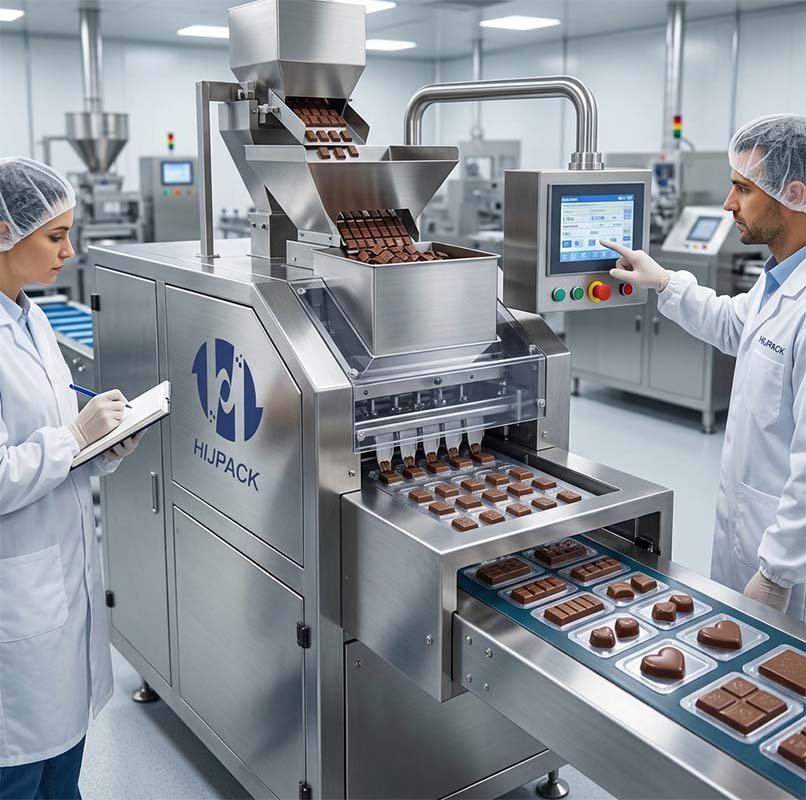
How to Choose a Chocolate Blister Packing Machine: 6 Factors That Separate a Smart Buy from a Costly Mistake
The spec sheet looked fine. The price was 18% below the European alternative. Three months after commissioning, the client in Kuala Lumpur was running a 34% cavity rejection rate — because nobody had accounted for forming temperature drift at 85% relative humidity. This guide covers the six factors you must verify before signing any purchase order for a chocolate blister packing machine.
Choosing the right chocolate blister packing machine comes down to six non-negotiables: temperature-controlled forming stations (100°C–130°C, ±2°C precision), food-grade material certification (EU Regulation 10/2011 or FDA 21 CFR 177), mold cavity compatibility with your chocolate shape, validated line speed matched to real OEE, downstream cartoner integration under a single contract, and documented FAT/SAT protocol from the manufacturer before shipment.
Why Most Buyers Ask the Wrong First Question About Chocolate Blister Packaging Machines
The number teams look at first is exactly the wrong number. Price per unit, quoted in the first email, tells you almost nothing about whether a machine will run reliably on your floor, in your climate, with your specific product. I’ve seen a $210,000 line underperform a $95,000 line — because the cheaper machine was spec’d correctly for the product and the other wasn’t.
Chocolate deforms at 28°C. That single constraint makes chocolate blister packaging mechanically different from pharmaceutical blister packaging — different forming depth requirements, different temperature management philosophy, different loading mechanics. A machine built purely for tablets cannot compensate for the thermal sensitivity of pralines, the variable fat migration between a ganache truffle and a hollow moulded figure, or the surface bloom risk when a forming station runs 4°C above target.
The right first question: “What is the forming temperature range, and how does the control system maintain ±2°C zone precision across a full 8-hour shift?” Everything else follows from that answer.
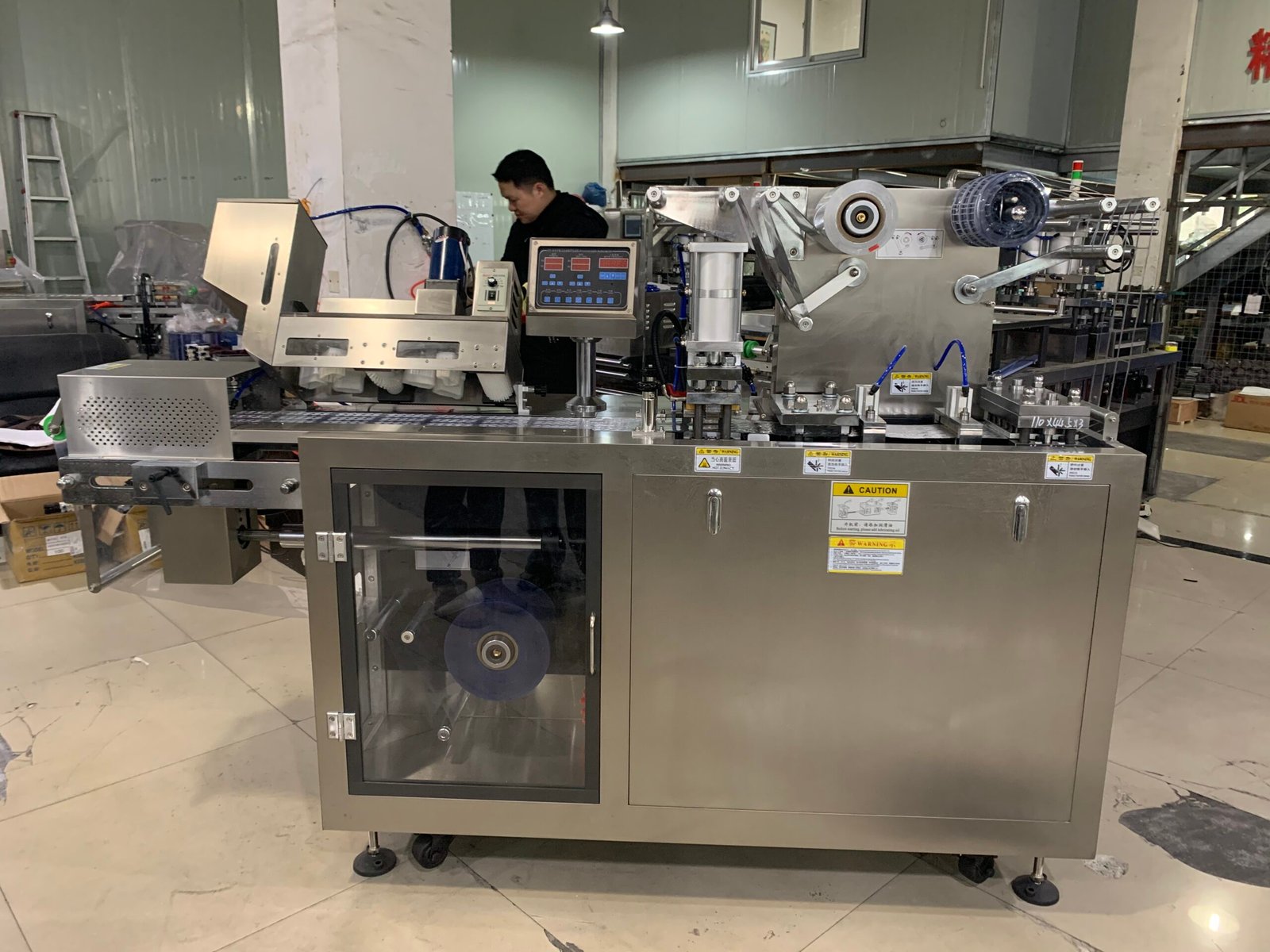
HIJ chocolate blister packing machine — forming station rated 100°C–130°C with ±2°C cavity-level zone precision.
Factor 1: Forming Temperature Control — The Specification That Eliminates Half the Market Immediately
A chocolate blister packing machine must maintain forming temperatures between 100°C and 130°C with ±2°C zone precision — above this range, chocolate deforms before cavity loading; below it, forming film cavities misshape and sealing integrity deteriorates. This single parameter removes more than half of commodity blister machines from consideration the moment you run the verification test.
I was on a factory floor outside Casablanca in 2022. The machine had shipped with a forming temperature rated at 120°C nominal. The actual cavity-level measurement, taken with a calibrated thermocouple during FAT, showed ±8°C variance across the tooling plate. That’s not a forming station. That’s a liability document waiting to happen.
What to demand from any supplier: independent zone control per heating element, PID-regulated feedback loop — not simple on/off relay cycling — and a thermocouple calibration record issued by the factory quality department. If the supplier cannot produce calibration documentation, the temperature specification on their datasheet is decorative.

Heating and forming station — independent PID zone control per element is the minimum standard for food-grade chocolate blister packaging.
Factor 2: Food-Grade Compliance Documentation — What Your Export Market Actually Requires Before Shipment
Food-contact compliance for chocolate blister packaging is governed by EU Regulation 10/2011 for European markets and FDA 21 CFR 177 for the US — and any machine supplier who cannot produce material certificates for every product-contact surface should not progress past your initial shortlist. This is the compliance dimension that the chocolate packaging compliance guide covering FDA, EU, and GMP requirements addresses in detail, and it directly affects which machine platforms qualify for your target market.
Three weeks into a commissioning job in Dubai, a QA director from a premium Belgian chocolate brand flagged that the forming film guide rails were fabricated from an unspecified polymer. The supplier’s response: “It meets food standards.” No certificate. No declaration of conformity. No third-party test report. The customer had to replace the entire guide rail assembly with documented food-grade UHMW-PE. Six weeks added to the timeline. $14,000 added to the budget.
The compliance items to verify before purchase:
All product-contact surfaces: declared material grade with EU 10/2011 or FDA 21 CFR 177 certificate, or equivalent food-contact declaration from an accredited third-party laboratory.
Forming film compatibility trials: documented test records with PVC, PVDC, or food-grade PET at your target forming temperature range, not just at laboratory-standard conditions.
Lubricants and greases: NSF H1 food-grade classification, applied only to non-contact zones, with a written containment design statement from the supplier’s engineering team.
Stainless steel designation: SUS 304 minimum for all surfaces facing the product zone, SUS 316 preferred for high-humidity environments, with mill certificates on request.
CE Declaration of Conformity: covering EU Machinery Directive 2006/42/EC, with a technical file, not a self-declaration without supporting documentation.
EU Regulation 10/2011 governs all plastic materials in contact with food, including forming film and product-contact guide surfaces on chocolate blister lines shipped to European markets. FDA 21 CFR 177 applies for US food-contact material compliance. For HACCP-aligned food facilities, cross-reference ISO 22000:2018 and your importing country’s specific food-contact material notification requirements. Demand original certificates — photocopies without lab letterhead and stamp are not acceptable documentation.
Factor 3: Mold Cavity Compatibility and Changeover Time — The Hidden Productivity Variable in Every Chocolate Line
Mold changeover time on a correctly specified chocolate blister packing machine should be under 30 minutes from last good blister on Product A to first good blister on Product B — machines requiring more than 45 minutes per SKU change erode OEE by 12–18% on a typical multi-format confectionery production schedule, a number that compounds to roughly 400–600 lost production hours per year on a two-shift operation.
A procurement manager in São Paulo called me last year. They had purchased a machine rated for “universal mold compatibility.” Their praline cavity was 38mm × 28mm × 18mm deep. The machine’s maximum validated forming depth was 15mm. The supplier’s suggestion: “Reformulate the chocolate shape.” That conversation ended quickly, but the machine didn’t.
Before specifying any machine, submit your exact cavity dimensions — length, width, depth, corner radius, and draft angle — and demand a written forming depth confirmation signed by the supplier’s engineering department. Chocolate cavities are consistently deeper than pharma tablet cavities: standard pharma blisters run 6–12mm forming depth; artisan praline and hollow figure formats routinely require 18–26mm. These are not interchangeable tooling specifications, and no amount of “adjustment” on site bridges that gap.
Chocolate Blister Packing Machine Key Specifications: Entry-Level vs Mid-Range vs High-Speed Automatic
| Specificatie | Entry-Level Semi-Auto | Mid-Range Automatic 30–80 blisters/min |
High-Speed Automatic 80–150 blisters/min |
|---|---|---|---|
| Forming temp. control | ±5–8°C relay on/off | ±2–3°C PID single zone | ±1–2°C PID multi-zone |
| Max forming depth | Up to 15mm | Up to 22mm | Up to 30mm |
| Mold changeover | 60–90 min | 30–45 min | Under 20 min (quick-release) |
| Downstream integration | Manual offload only | Conveyor output, basic | Cartoner + case-packer interfaced |
| FAT/SAT documentation | Typically none | Basic run-off test | Full URS-referenced FAT + SAT |
| Food-grade compliance docs | Often absent | Machine-level CE only | Full material cert. + DoC |
| Typical price range (USD) | $8,000–$25,000 | $40,000–$90,000 | $90,000–$220,000+ |
Factor 4: Line Speed and Capacity Planning — Why Nameplate Speed Is Only Half the Calculation
Chocolate blister packing machine nameplate speeds range from 30 to 150 blisters per minute depending on format size and feeding mechanism — but actual production throughput on multi-SKU confectionery lines typically runs at 65–80% of nameplate once changeover cycles, temperature stabilization, cleaning intervals, and minor stoppages are factored in. That gap is OEE. It does not appear on any datasheet.
Of the 18 chocolate and confectionery blister line projects I handled between 2019 and 2024, 11 had been initially sized using nameplate speed as the production planning basis. Every one of those 11 required either a capacity upgrade or an additional shift within 18 months. The procurement teams calculated annual volume ÷ machine speed ÷ operating hours. They forgot OEE. Industry-typical for a well-run food blister line: 68–72%.
The correct sizing formula: Required annual output ÷ (nameplate speed × OEE factor × planned uptime hours) = minimum installed capacity. If that result approaches the machine’s rated maximum, specify the next model up. Buffer capacity in packaging equipment costs far less than a capacity retrofit 18 months into production.
A chocolate blister line running at 72% OEE — which is industry-typical for multi-SKU artisan confectionery production — delivers 43,200 completed blisters per 8-hour shift from a 150-blister/min machine. Size to your peak seasonal demand, not your average monthly volume. The capacity gap shows up every December, without fail.
— Forester Xiang, HIJ Machinery
Factor 5: Downstream Integration — The Multi-Vendor Trap That Adds Months and Erases Savings
The most expensive mistake in chocolate blister line procurement is buying the forming machine from one vendor, the cartoner from a second, and the case packer from a third — then discovering on-site that the three PLCs use incompatible communication protocols, conveyor transfer heights don’t match, and no single party accepts responsibility for making the line run as a system.
I’ve watched this scenario play out in Jakarta, in Lagos, and in Guadalajara. The pattern is identical every time. The machine vendor: “Our machine works correctly in isolation.” The unbudgeted systems integrator: $35,000–$70,000 to make everything communicate. The project that was supposed to go live in Month 4 runs its first production batch in Month 11.
The right question to put to every supplier in writing: “Can you provide a dimensioned conveyor interface drawing and PLC communication protocol specification that my downstream cartoner supplier can validate against before we place the order?” If the answer involves the phrase “we’ll sort it out on site,” get that commitment in a contract with a penalty clause, or source from a supplier who owns the full line.

Integrated chocolate blister packing line — single PLC architecture from forming through cartoning eliminates multi-vendor integration disputes.
Cause: Machine was designed as a standalone unit. Conveyor transfer height is typically 750–900mm; mismatches of 40mm or more between blister former output and cartoner infeed require custom transfer sections that were never in the budget.
✔ Fix: Demand a dimensioned conveyor interface drawing, signed by the supplier’s engineering department, before placing any purchase order.
Cause: Proprietary low-cost PLC with no published Modbus, Profibus, or EtherNet/IP documentation. Your downstream cartoner supplier will have no validated integration path.
✔ Fix: Name Siemens S7 or Allen-Bradley explicitly in your User Requirements Specification. Accept no substitution without a written protocol compatibility declaration from both equipment suppliers.
Cause: No documented acceptance criteria. A run-off is not a Factory Acceptance Test. Without pre-agreed pass/fail parameters, you have no contractual leverage when the machine underperforms during on-site commissioning.
✔ Fix: Write your own FAT protocol before the supplier visit. Include: forming temperature variance (±2°C max per zone), cavity fill rate (≥98%), seal integrity (dye ingress per ASTM F2338-adapted food method at 60 mbar), and mold changeover time against your stated target.
Factor 6: Supplier Qualification — Four Verification Points That Separate Equipment Partners from Equipment Vendors
The stability complaint landed in March. A confectionery brand in the Gulf had commissioned a chocolate blister line 14 months earlier, chosen on price. Micro-fractures were developing at the mold parting line — invisible to visual inspection, destructive to shelf-life through micro-leak contamination. The mold had been fabricated from unspecified aluminum rather than the contracted P20 tool steel. Nobody had verified the tooling certificate during FAT. Nobody did.
Supplier qualification for a chocolate blister packing machine purchase requires four verification points, all confirmed in writing before contract signature:
Chocolate or confectionery references: minimum two customers running this specific machine model with a food product for 12+ months, with direct contact information — not pharma references for a food application.
Mold material specification in writing: material grade (P20 steel, H13, or food-grade aluminum alloy 6061-T6 minimum), Rockwell hardness rating, and surface treatment documentation with traceability.
Spare parts lead time commitment: confirmed shipping time for the top 20 consumable and wear parts — forming film guides, sealing dies, cutting punches — with either regional stock or a maximum 7-day international delivery guarantee.
Turnkey integration capability confirmed: written confirmation that the supplier can supply, integrate, and commission the complete line — blister former through secondary packaging — under a single contract with a named project manager and single point of accountability.
The procurement director showed me the evaluation matrix. Column headers: price, delivery time, warranty period. No column for FAT protocol. No column for integration responsibility. No column for spare parts lead time in region. I asked what happened to the last machine they’d bought on those same criteria. It took him a long time to answer. That silence is where most of the real cost in packaging equipment procurement lives — not in the purchase price, but in the 18 months of underperformance, field modifications, and missed production targets that follow a decision made on the wrong criteria.
Pre-Purchase Checklist: 10 Questions to Ask Every Chocolate Blister Packing Machine Supplier
Run every shortlisted supplier through this list in writing. A supplier who cannot answer these questions with documented evidence is not ready to be your equipment partner.
What is the forming temperature range, and what control method maintains ±2°C zone precision? Provide thermocouple calibration records from your factory QC department.
Can you provide EU Regulation 10/2011 or FDA 21 CFR 177 material certificates for every product-contact surface, including forming guides, feed channels, and sealing dies?
What is the maximum validated forming depth for your tooling? Please confirm in writing against our submitted cavity dimensions. (Attach your 3D drawing or dimensional datasheet.)
What is the mold changeover time, measured from last good blister on Product A to first accepted blister on Product B, with a documented changeover procedure?
What PLC platform does the machine use? Provide a protocol interface specification (Modbus, Profibus, or EtherNet/IP) for integration with our downstream cartoner.
Do you provide a documented FAT protocol with pre-agreed pass/fail criteria, including forming temperature variance tolerance, cavity fill rate target, and seal integrity test method?
What is the lead time and regional availability for your top 10 consumable spare parts?
Provide two references from customers running this machine model with chocolate or confectionery products for 12+ months, with direct contact details for the production manager or QA lead.
What is the mold material grade and hardness rating? Provide the mill certificate and surface treatment documentation.
Can you supply and integrate the complete line — blister former, cartoner, and case packer — under a single contract with a single named project manager?
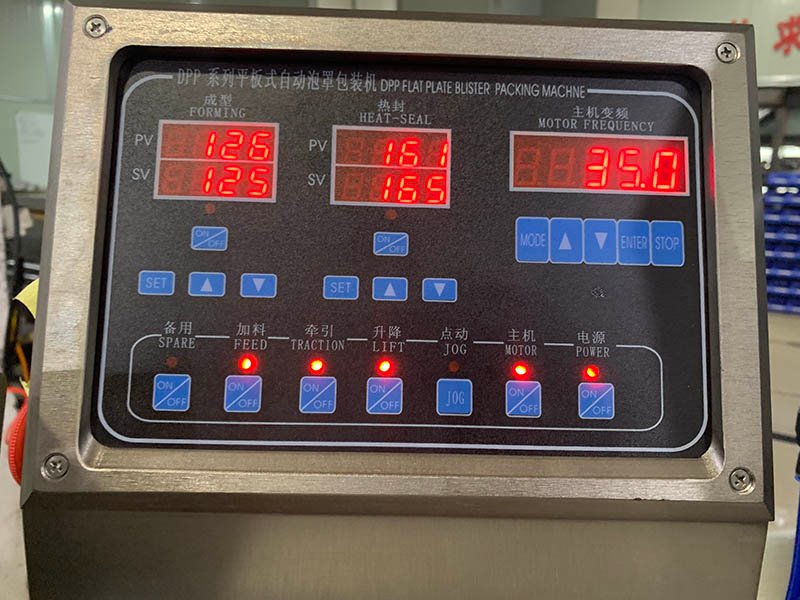
Completed food-grade chocolate blister packs produced on HIJ machinery — validated at 120°C forming temperature with ±2°C zone control.
Frequently Asked Questions: Choosing a Chocolate Blister Packing Machine
What production volume justifies investing in an automatic chocolate blister packing machine?
An automatic chocolate blister packing machine typically becomes cost-justified at annual volumes above 500,000 blisters, where labor savings and packaging consistency gains outweigh capital cost within 24–36 months. Below that threshold, a semi-automatic machine in the $8,000–$25,000 range gives you format flexibility without full-line overhead. The break-even shifts earlier if your target export markets require tamper-evident sealed blister packaging as a compliance condition — in that case, the regulatory requirement drives the investment decision regardless of volume.
Can a pharmaceutical blister packing machine be used for chocolate products?
No. Standard pharma blister machines form to 6–12mm depth at temperatures set for PVC/PVDC pharmaceutical packaging. Chocolate cavities need 14–26mm forming depth, and the thermal loading sequence is fundamentally different — chocolate must enter pre-formed ambient-temperature cavities, not a warm forming zone. Using a pharma machine for food without food-grade re-certification of all product-contact surfaces also creates direct regulatory exposure under EU Regulation 10/2011 and FDA 21 CFR 177.
How long does custom mold fabrication take for a chocolate blister line?
4–8 weeks from approved 3D drawing, depending on cavity complexity. Steel molds take longer than aluminum, but last 3–5 times as long in continuous production. Factor mold lead time into your overall project schedule separately from machine manufacturing — it is the most consistently underestimated timeline item I see across projects.
What forming film works best for chocolate blister packaging?
Food-grade PVC at 200–300μm is the most widely used forming film for chocolate blister packaging globally — clear, cost-effective, and well-suited to standard retail display requirements. PVDC-coated PVC reduces moisture vapor transmission to 0.5–1.5 g/m²/day, making it the right choice for moisture-sensitive fillings or high-humidity distribution environments like Southeast Asia and the Gulf. Food-grade PET is gaining adoption for sustainability-focused European brands but requires careful forming temperature calibration due to its narrower processing window (100–115°C).
Does HIJ Machinery offer turnkey chocolate blister packaging lines with integration support?
Yes. HIJ Machinery engineers complete turnkey chocolate blister lines — from forming and sealing through downstream cartoning and case packing — under a single integration contract with one project manager. We cover URS review, FAT/SAT protocol documentation, and on-site commissioning across 30+ countries. View our turnkey packaging solutions or contact us directly to discuss your line requirements.
Get a Validated Equipment Specification — Free, Before You Commit
Submit your cavity dimensions, target output, and compliance market. Our engineers return a full forming temperature profile, mold recommendation, line architecture, and FAT protocol outline — no purchase obligation.