














💰 Cost Breakdown — Pharma Buyer’s Guide
Capsule Blister Packing Machine Cost: The Full Breakdown Nobody Gives You
The quoted machine price is $58,000. You approve the PO. Fourteen months later, your CFO is looking at a $127,000 spend and asking how that happened. Tooling. Integration. Validation. Spare parts. Air freight for an engineer who flew in because remote commissioning failed. None of it was in the quote. All of it was in the project. This guide breaks down the real cost of a capsule blister packing machine — every line item, every trap, every number I’ve watched buyers miss.
$15K–$300K+
Machine purchase price range (entry to full servo cGMP)
40–80%
Additional cost above machine price (tooling, integration, validation)
55–70%
Typical machine price as share of total project budget
⚡ Direct Answer
A capsule blister packing machine typically costs $15,000–$300,000+ depending on automation level, output speed, and compliance requirements. But the machine price alone represents only 55–70% of total project cost — tooling, integration, validation (IQ/OQ/PQ), operator training, and spare parts consistently add another 40–80% on top. Budget accordingly before you request your first quote.
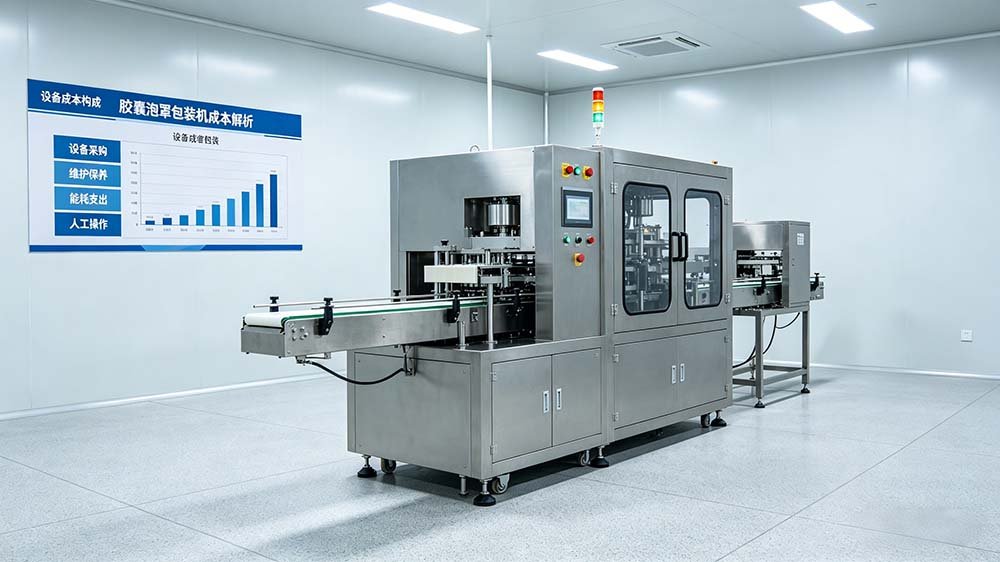
Total cost of ownership for a capsule blister packing machine goes well beyond the quoted machine price.
What Does a Capsule Blister Packing Machine Actually Cost? Price Tiers Explained
⚡ Direct Answer
Capsule blister packing machine prices fall into three tiers: entry-level semi-automatic units at $15,000–$35,000, mid-range automatic lines at $40,000–$120,000, and fully servo-driven cGMP-compliant systems at $130,000–$300,000+. The right tier depends on your output target, regulatory market, and product sensitivity — not just your opening budget.
The number that gets quoted first is almost always the wrong number to anchor your decision. I’ve seen procurement teams build entire budget models around a $38,000 machine price, only to discover the same machine needed $22,000 in custom tooling, a $14,000 servo upgrade to meet Zone IVb stability requirements, and a $9,000 FAT travel cost. Total: $83,000. The original quote: $38,000.
Here is how the three machine tiers break down in real-market terms:
Entry Level
$15K–$35K
Semi-Automatic / Basic Automatic
- Up to 150 blisters/min
- Cam-driven mechanical design
- PVC/Alu forming
- Manual or semi-auto capsule feed
- Limited compliance documentation
- Best for: R&D, OTC, nutraceuticals
Mid Range
$40K–$120K
Fully Automatic Blister Line
- 150–350 blisters/min
- Servo-assisted forming & sealing
- Siemens / Allen-Bradley PLC
- GMP-compliant structural design
- Reject station & vision system
- Best for: generic pharma, exports
High End
$130K–$300K+
Full Servo cGMP Line
- 350–600+ blisters/min
- Full servo axis control
- 21 CFR Part 11 audit trail
- Integrated IQ/OQ/PQ documentation
- SCADA / MES connectivity
- Best for: FDA/EMA regulated markets
One number that rarely appears in vendor catalogues: the mid-range tier has the widest price variance. A $60,000 machine and a $110,000 machine can appear nearly identical on a spec sheet — same output speed, same forming width, same PLC brand. The difference lives in the quality of servo drives, the stainless steel grade on contact parts, the origin of the sealing tooling, and whether the vendor actually has a service engineer who can fly to your country when something goes wrong.
The 7 Hidden Cost Items That Inflate Your Blister Machine Budget by 40–80%
⚡ Direct Answer
Beyond the machine purchase price, seven cost categories consistently inflate total blister packaging project budgets by 40–80%: custom tooling ($8,000–$35,000), downstream integration ($15,000–$60,000), IQ/OQ/PQ validation ($12,000–$45,000), operator training ($3,000–$12,000), spare parts inventory ($5,000–$20,000), film qualification ($2,000–$8,000), and after-sales travel costs ($4,000–$18,000).
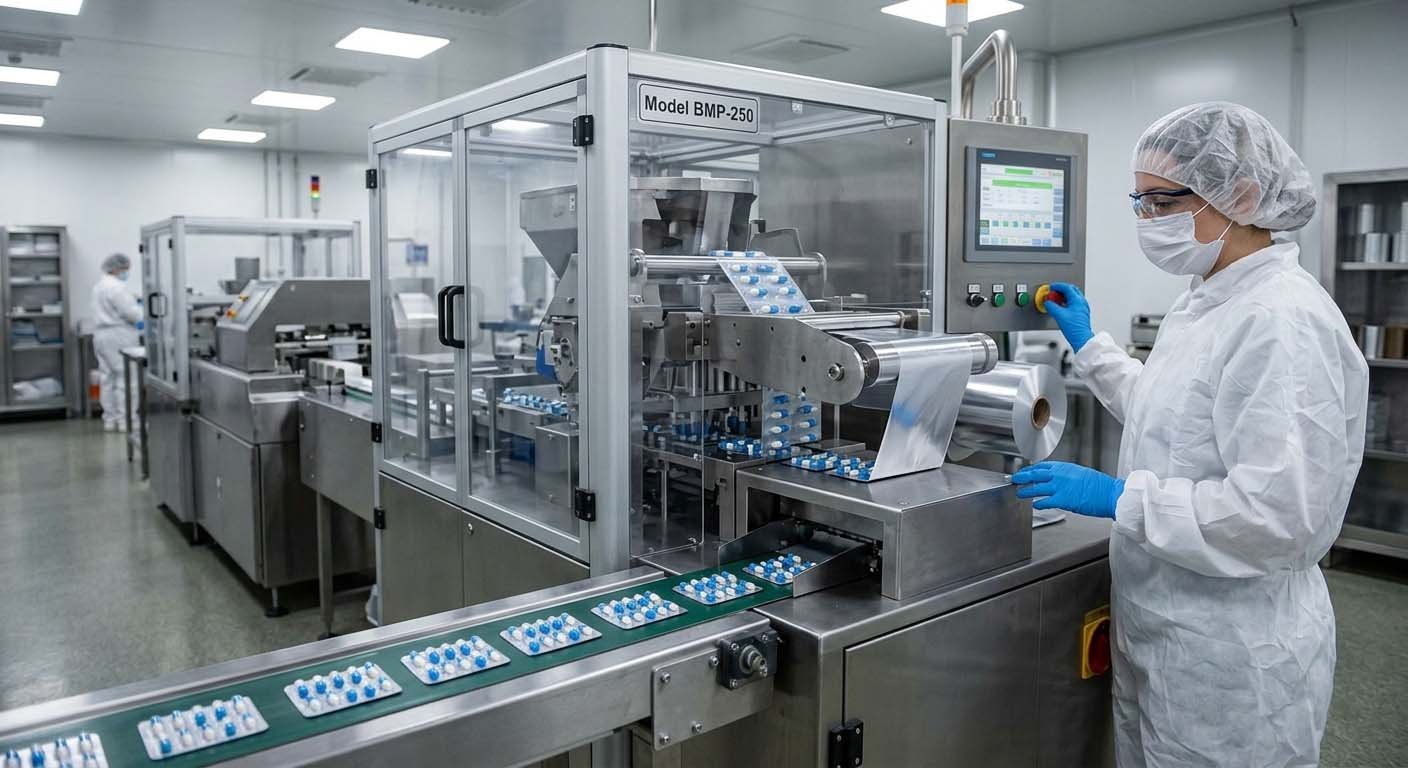
Total project cost for a capsule blister line routinely runs 40–80% above the quoted machine price.
A procurement director in Lagos showed me the sheet in 2022. Machine: $72,000. Approved. Six months later, the project close-out report showed $134,000 spent. She wasn’t incompetent — she was working from a vendor quote that described the machine. Nobody described the project.
1. Custom Tooling and Mold Sets: $8,000–$35,000
Forming molds, sealing dies, and cutting tooling are almost never included in the base machine price. For a standard capsule size 0 or size 1 cavity layout, a full mold set runs $8,000–$15,000 from a quality Chinese toolmaker, and $18,000–$35,000 from a European precision shop. If you have two capsule sizes, multiply accordingly. If your capsule is oval, elongated, or has a non-standard diameter, add a 30–50% premium for custom cavity engineering. This is the single most underestimated line item I encounter.
2. Downstream Integration: $15,000–$60,000
The capsule blister machine is station one. Behind it lives a cartoner, a case packer, a leaflet inserter, and a serialization system — and none of them communicate with each other unless someone engineers that interface. When those components come from three different vendors, your FAT becomes a blame game. I’ve sat in factory floors in Karachi and Jakarta watching three engineers argue about whose PLC protocol was the problem. The blister machine supplier said it was the cartoner. The cartoner supplier said it was the conveyor. Three days. $6,000 in travel expenses. Zero production. Integration costs are real. Budget them.
For context: of 31 blister line projects I handled in Southeast Asia and the Middle East between 2018 and 2024, 19 required unplanned downstream integration work after the initial machine installation. Average additional spend: $22,000 per project.
3. IQ/OQ/PQ Validation: $12,000–$45,000
If your product goes to an FDA, EMA, WHO PQ, or ANVISA-regulated market, you need a documented validation package. Installation Qualification (IQ), Operational Qualification (OQ), and Performance Qualification (PQ) are not optional. They are not things you do after launch. They are the launch. A mid-range blister line shipping to a WHO-approved generic market will need a validation package that costs $12,000–$25,000 in engineering time alone — more if you engage a third-party validation firm. High-end lines targeting FDA-inspected facilities can reach $45,000 in validation spend before a single batch runs.
4. Operator Training: $3,000–$12,000
Every machine has an operator. Every operator needs to be trained. Factory-based training at the vendor site runs $3,000–$6,000 including travel and accommodation for two technicians. On-site training at your facility, with your specific capsule format and your specific film grade, runs $5,000–$12,000. Skip this and your changeover time will be three times longer than spec and your rejection rate will be four times higher for the first six months. I have the downtime logs to prove it.
5. Spare Parts Inventory: $5,000–$20,000
Sealing elements wear. Forming plates crack. Sensors fail. Your machine is in Nairobi or Ho Chi Minh City, and the nearest spare part is in Guangzhou with a 3-week lead time. A first-line spare parts kit — sealing gaskets, heating elements, pneumatic cylinders, key sensors — costs $5,000–$10,000 for a mid-range machine. For a high-speed servo line, budget $15,000–$20,000. This is not optional if you care about uptime.
6. Film Qualification and Compatibility Testing: $2,000–$8,000
Not every PVC or PVDC film from your local distributor will run correctly on a given machine. Seal strength, peel force, forming temperature tolerance, and lidding foil adhesion all need qualification against your specific capsule and your specific API moisture sensitivity. Film trials consume machine time, engineering time, and materials. Budget it. If your product requires Alu-Alu cold-form film, add another $4,000–$8,000 for cold-form qualification — the tolerances are significantly tighter. For a deeper look at how blister film choice affects total cost versus bottle alternatives, the comparison is worth reading before you finalize your packaging format decision.
7. After-Sales Travel and Remote Support Costs: $4,000–$18,000
Something will go wrong in year one. That’s not pessimism — that’s physics. When it does, you need an engineer. If your vendor is in Guangzhou and your plant is in Accra, a single on-site service visit costs $4,000–$8,000 in flights, hotels, and daily rates. If the problem is complex enough to require two visits, double that. Budget for one unplanned service visit per year in your first three years of operation. Build it into your vendor evaluation criteria, not as an afterthought.
The machine price is the ticket to enter the conversation. The real number — the one that determines whether this project succeeds — is the total cost of ownership across 60 months: tooling, integration, validation, consumables, and downtime. I’ve never seen a project where the machine price alone told the full story.
— Forester Xiang, HIJ Machinery
Capsule Blister Machine Cost Comparison: Complete Budget Model by Tier
⚡ Direct Answer
A complete capsule blister packing machine project budget — including machine, tooling, integration, validation, training, and spares — runs $35,000–$65,000 for entry-level, $85,000–$200,000 for mid-range, and $220,000–$500,000+ for high-end cGMP lines. The gap between machine price and total project cost widens at the high end due to validation and regulatory requirements.
| Cost Category | Entry Level ($15K–$35K Machine) | Mid Range ($40K–$120K Machine) | High End ($130K–$300K+ Machine) |
|---|---|---|---|
| Machine Purchase Price | $15,000–$35,000 | $40,000–$120,000 | $130,000–$300,000+ |
| Custom Tooling & Molds | $3,000–$8,000 | $8,000–$20,000 | $18,000–$35,000 |
| Downstream Integration | $0–$8,000 | $12,000–$35,000 | $30,000–$60,000 |
| IQ/OQ/PQ Validation | $0–$5,000 | $12,000–$25,000 | $25,000–$45,000 |
| Operator Training | $2,000–$4,000 | $4,000–$8,000 | $6,000–$12,000 |
| Spare Parts (Year 1) | $2,000–$5,000 | $5,000–$12,000 | $12,000–$20,000 |
| Film Qualification | $1,000–$3,000 | $2,000–$5,000 | $4,000–$8,000 |
| After-Sales Travel (Est.) | $2,000–$5,000 | $4,000–$10,000 | $6,000–$18,000 |
| TOTAL PROJECT BUDGET | $25,000–$73,000 | $87,000–$235,000 | $231,000–$498,000+ |
The numbers in the high-end row surprise most buyers. $300,000 machine. $498,000 total project. That 66% premium above machine price is not unusual for a line going into an FDA-inspected facility in a regulated market — where validation alone can consume 10–15% of project cost, integration engineering runs $40,000+, and the spare parts strategy needs to cover 18 months of forward visibility. I won’t tell you the high-end decision is simple. It involves your API profile, your target market regulatory requirements, your production volume forecast, and sometimes your relationship with a very specific regulatory reviewer who asks very specific questions about your sealing temperature validation data.

Forester Xiang
Founder, HIJ Machinery — 20 Years in Pharma Packaging Equipment
“The conversation I have most often with procurement teams goes like this: they’ve received three quotes. The cheapest is 40% below the others. They want to know if the cheap one is ‘good enough.’ My answer is always the same — good enough for what? If it’s good enough for a domestic OTC market with no export ambition, maybe. If it needs to pass a WHO GMP inspection in 18 months, it will not survive that audit. The price difference between a $55,000 machine and an $85,000 machine is real. The cost difference between a failed GMP audit and a passed one is not measurable in the same currency. I tell buyers: don’t optimize the machine price. Optimize the total project outcome.”
What Drives Capsule Blister Machine Price? 6 Technical Factors That Move the Number
⚡ Direct Answer
Six technical specifications drive capsule blister packing machine price more than any other variable: output speed (blisters/min), drive technology (servo vs. cam), forming method (thermoforming vs. cold-form Alu-Alu), PLC and HMI grade, compliance documentation package, and after-sales support geography. Each factor can move the machine price by 15–60%.
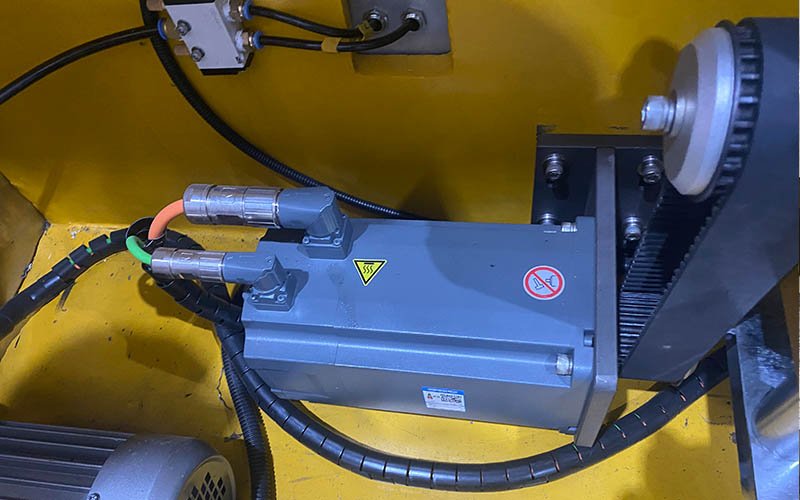
Servo motor systems increase machine price by 20–40% versus cam-driven designs — but deliver the precision and audit trail that cGMP markets require.
Output Speed: The Primary Price Driver
Speed is mechanical complexity made visible. A 150-blister/min machine has a fundamentally different cam geometry, forming station mass, and sealing pressure system than a 400-blister/min machine. The relationship between speed and price is not linear — it accelerates. Going from 150 to 250 blisters/min adds roughly 25–35% to machine cost. Going from 250 to 400 blisters/min adds another 40–60%. Most emerging-market pharma lines I’ve commissioned run between 200 and 350 blisters/min. That’s the sweet spot for output versus capital cost. The calculation is simple: your production requirement in blisters per shift divided by your planned OEE target (typically 75–85% for a new line) gives you the minimum rated speed you actually need. Don’t buy 600 blisters/min for a 200-blister/min production requirement. The maintenance cost alone will not justify it.
Servo vs. Cam-Driven: A 20–40% Price Gap with Regulatory Consequences
Cam-driven machines are cheaper. Servo-driven machines are more expensive. That sentence is true and completely insufficient for making a purchasing decision. Here is what the price difference actually buys you: a servo-driven machine can record every cycle parameter — sealing temperature deviation by 0.1°C, forming pressure variance, reject event timestamps — in a 21 CFR Part 11-compliant audit trail. A cam-driven machine cannot. If your product goes to any FDA, EMA, or TGA-regulated market, the audit trail is not optional. The regulatory reviewer will ask for it. The $25,000 premium for servo technology is not a machine upgrade. It’s the cost of market access.
Thermoforming vs. Cold-Form Alu-Alu: Forming Method and Its Cost Impact
Standard PVC thermoforming machines cost 30–45% less than equivalent cold-form Alu-Alu machines. Cold-form presses operate at much higher forming forces, require hardened tooling with tighter tolerances, and run at slower speeds — all of which add cost. But Alu-Alu blister film reduces moisture vapor transmission to 0.02–0.5 g/m²/day, versus 4–6 g/m²/day for standard PVC. For a hygroscopic capsule API destined for Southeast Asia or Sub-Saharan Africa — ICH Zone IVb markets where ambient humidity runs at 75% RH — that’s not a packaging decision. It’s a stability protocol decision. Buying the cheaper thermoforming machine and then failing your 40°C/75% RH stability study 12 months later costs more than buying the Alu-Alu machine from the start.
PLC and HMI Grade: The Compliance Premium
Siemens S7-1500, Allen-Bradley CompactLogix, or Omron CJ2M — these are the PLC platforms that validation engineers can actually validate. Budget platforms with proprietary or undocumented firmware cannot be qualified under EU GMP Annex 11 or 21 CFR Part 11. The PLC hardware premium over budget alternatives is typically $3,000–$8,000 on a mid-range machine. The cost of a failed computer system validation during a regulatory inspection is not calculable in the same unit. Choose compliant hardware. It’s not a luxury for the right markets.
Cost Trap Diagnostic: Where Budgets Break
🔴 “We got a quote for $45,000 but the project ended at $110,000.”
Root cause: The $45,000 quote covered the machine only. Tooling ($14,000), validation ($22,000), integration conveyor ($12,000), and one unplanned service visit ($7,000) were not scoped. This is the single most common budget failure pattern in blister line procurement across emerging markets.
Fix: Before approving any machine quote, demand a line-item project scope that includes tooling, validation protocol costs, integration engineering, and first-year after-sales provisions. Compare total project cost, not machine price.
🔴 “Our machine passed FAT but failed the GMP audit 8 months later.”
Root cause: FAT was conducted at the vendor’s facility in controlled conditions. IQ/OQ/PQ was never formally completed at the customer’s site. The audit reviewer asked for site validation data. It didn’t exist. Eight months of production were at regulatory risk.
Fix: Budget and schedule IQ/OQ/PQ as a distinct project phase with its own timeline, its own engineering resource, and its own budget line — before you order the machine, not after installation. Review the full validation process in our IQ/OQ/PQ validation guide for capsule blister machines.
🔴 “The machine ran fine in China but can’t maintain sealing temperature above 38°C ambient.”
Root cause: The machine was FAT-tested in a 22°C controlled factory environment. The customer’s plant in West Africa runs at 36–40°C ambient without full air conditioning. Sealing station thermal stability degrades above 35°C ambient. This is an engineering spec failure, not an operator error.
Fix: Specify the maximum ambient temperature of your facility in your URS. Request thermal performance data at your ambient range. For tropical markets, require testing at 38–40°C. If the vendor can’t provide it, that’s your answer.
ROI and Total Cost of Ownership: How to Evaluate a Capsule Blister Line Over 5 Years
⚡ Direct Answer
A properly specified capsule blister packing machine typically achieves ROI within 18–36 months for generic pharma producers operating at 70%+ OEE. Total 5-year cost of ownership — including machine depreciation, consumables, maintenance, and downtime — typically runs 2.2x–3.5x the initial machine purchase price, making consumable cost and uptime rate more important than purchase price in long-term budget planning.
The ROI conversation always starts the same way. A production manager hands me a spreadsheet that shows the machine paying for itself in 14 months. I look at the model and find two things missing: unplanned downtime cost and consumable inflation. Those two variables can shift the ROI timeline from 14 months to 28 months — and they do, regularly.
Here is a simplified TCO model for a mid-range capsule blister line running at $70,000 machine price:
| Cost Category | Year 1 | Year 2–3 (Annual) | Year 4–5 (Annual) | 5-Year Total |
|---|---|---|---|---|
| Machine + Tooling | $88,000 | $0 | $0 | $88,000 |
| Validation (IQ/OQ/PQ) | $18,000 | $4,000 (revalidation) | $4,000 | $34,000 |
| Film & Foil Consumables | $24,000 | $26,000 | $28,000 | $132,000 |
| Maintenance & Spare Parts | $8,000 | $10,000 | $14,000 | $56,000 |
| After-Sales Support | $7,000 | $4,000 | $3,000 | $21,000 |
| Unplanned Downtime (Est.) | $12,000 | $8,000 | $6,000 | $40,000 |
| TOTAL 5-YEAR TCO | $371,000 | |||
The $88,000 machine becomes a $371,000 five-year investment. That’s 4.2x the machine price. The biggest single driver is consumables — film and foil costs that compound annually. The second biggest is unplanned downtime, which correlates directly with machine quality. A cheaper machine with 15% higher downtime rate will cost more over five years than a machine priced $20,000 higher with 5% downtime. The math is clear. The decision shouldn’t be difficult.
📋 Regulatory Standards That Affect Machine Specification & Cost
- WHO GMP TRS 992 Annex 3
- EU GMP Annex 1 (2022)
- EU GMP Annex 11 (CSV)
- 21 CFR Part 11 (Audit Trail)
- 21 CFR Part 211 (cGMP)
- ICH Q1A(R2) Stability
- ISO 13849-1 (Machine Safety)
- USP <1207> (Container Closure)
The compliance cost embedded in your machine price is not waste. A WHO TRS 992-compliant machine documentation package — which includes design qualification records, material certificates for contact parts, and a pre-validated IQ template — is worth $8,000–$15,000 of engineering time. When a WHO GMP inspector visits and asks for it, you hand it over. Without it, you generate it from scratch under inspection pressure. That conversation does not go well. I’ve watched it happen in Jakarta in 2021. The WHO reviewer cited Annex 3 Sections 11.2 and 14.1 directly. The dossier went back. Six months later.
How to Use This Cost Breakdown When Evaluating Capsule Blister Machine Suppliers
⚡ Direct Answer
When comparing capsule blister packing machine suppliers, request a line-item quotation covering machine, tooling, integration scope, validation support, training, spare parts kit, and after-sales terms — then compare total project cost, not machine price. Suppliers unable to quote on total scope scope are not equipped to manage your project.
HIJ Machinery provides full-scope quotation documentation including tooling, integration, and validation cost breakdown — not just machine price.
A quotation is a test. Not of the machine — of the vendor. The way a supplier responds to your RFQ tells you everything about how they’ll behave during commissioning. If they send you a one-page price sheet with a machine number and a total, they’ve told you they don’t think about your project — they think about their transaction. That’s not a partner. That’s a parts supplier.
A competent supplier will respond to your URS — User Requirement Specification — with a structured proposal that covers:
Machine specification against your URS: output speed at your OEE target, forming width for your capsule format, forming film compatibility, compliance certification scope
Tooling and mold set pricing: itemized by cavity layout, capsule size, number of sets included
Integration scope definition: which downstream handoff points are included, which require third-party coordination, and what the PLC communication protocol is
Validation support terms: what DQ/IQ/OQ/PQ documentation is provided, in what format, and what on-site validation engineering support is included
Spare parts recommendation: first-year critical spare list with pricing, lead times, and in-country availability
After-sales terms: warranty period, response time commitment, remote support capability, on-site visit cost structure
For a detailed guide on what to look for when evaluating Chinese suppliers specifically — including audit questions, documentation standards, and red flags — our guide to evaluating a capsule blister machine manufacturer in China covers the process in full. The key point: a price comparison without a scope comparison is not an evaluation. It’s a lottery.
Vendor Evaluation: Warning Signs in Quotations
🔴 Vendor quotes machine only, states “tooling additional, TBD.”
What it means: They haven’t reviewed your capsule format, your cavity layout, or your forming film requirements. The tooling price will arrive after you’ve committed to the machine.
Action: Request tooling pricing upfront as a condition of RFQ. If they can’t provide it without a full DQ, accept that process — but get the number before PO issuance, not after.
🔴 Validation documentation listed as “compliant per customer request” with no detail.
What it means: The vendor has no pre-built validation template. You will generate validation documents from scratch, with your own engineering team, against a machine that was never designed with validation in mind.
Action: Ask for a sample IQ/OQ template from a previous project. If they can’t provide one, factor $15,000–$25,000 in third-party validation engineering into your project budget. Don’t reduce your compliance standard to match the vendor’s capability.
Of 31 blister line projects I handled between 2018 and 2024 in Southeast Asia and the Middle East, 26 had final costs at least 35% above the original machine quote. In 9 of those cases, the final cost was more than double. The pattern is consistent: buyers compare machine prices, vendors quote machine prices, and nobody talks about project costs until the invoices start arriving.
— Forester Xiang, HIJ Machinery
Capsule vs. Tablet Blister Machine Costs: Key Differences That Affect Your Budget
⚡ Direct Answer
Capsule blister packing machines generally run 8–15% higher in machine cost than equivalent tablet blister machines at the same output speed, primarily due to more complex cavity geometry and tighter forming tolerances required for capsule shells. Tooling costs are also 10–20% higher for capsule formats. If your product mix includes both tablets and capsules, specify a dual-format machine to avoid purchasing two separate lines.
Capsules present a unique mechanical challenge: they are dimensionally longer and more variable than tablets, they have a gelatin shell that responds differently to forming temperature, and they require a different feeder geometry to achieve consistent cavity placement. These differences add engineering cost. They are not large differences — 8–15% at machine level — but they compound into tooling, changeover time, and operator training requirements.
If your production line runs both capsules and tablets, the economically rational decision is a dual-format machine rated for both. The price premium over a single-format machine is typically 12–18%, but you eliminate the need for a second machine line, a second tooling set, a second validation package, and a second operator training cycle. For producers running two or more solid dosage forms, the dual-format approach almost always delivers a lower 5-year TCO. For a full cost and specification comparison, our tablet blister packing machine page covers the tablet-specific engineering parameters.
Frequently Asked Questions: Capsule Blister Packing Machine Cost
How much does a capsule blister packing machine cost in 2025?
A capsule blister packing machine costs between $15,000 for a basic semi-automatic entry unit and $300,000+ for a fully servo-driven, cGMP-compliant line with 21 CFR Part 11 audit trail capability. Mid-range fully automatic machines — the most common choice for generic pharma and OTC producers — typically range from $40,000 to $120,000. These are machine-only prices. Total project cost including tooling, validation, integration, and after-sales support typically runs 40–80% higher.
What is included in a capsule blister machine price quote?
Most vendor quotes cover the machine unit only. Standard inclusions are the main forming/sealing mechanism, the PLC and HMI, electrical cabinet, and basic safety guarding. Standard exclusions are custom tooling and molds, downstream conveyors, validation documentation, on-site installation, operator training, and first-year spare parts. Always request a full project scope document alongside the machine price.
Why are Alu-Alu capsule blister machines more expensive than PVC thermoforming machines?
Cold-form Alu-Alu machines are 30–45% more expensive than thermoforming PVC machines of equivalent output because the cold-forming process requires significantly higher press forces (typically 80–120 kN versus 20–40 kN for thermoforming), hardened precision tooling with tighter dimensional tolerances, and a slower cycle rate to allow aluminum laminate to form without tearing. For hygroscopic APIs targeting ICH Zone IVb markets (40°C/75% RH), the moisture barrier performance of Alu-Alu film — 0.02–0.5 g/m²/day versus 4–6 g/m²/day for PVC — justifies the premium.
How much does capsule blister machine tooling cost?
Tooling costs for a standard capsule size 0 or size 1 format run $8,000–$15,000 from a quality Chinese toolmaker. European precision tooling runs $18,000–$35,000. Non-standard capsule geometries (oval, elongated, or specialty size) add 30–50% to tooling cost. A full production tooling set typically includes forming mold, sealing die, cutting die, and capsule feed guide — all of which must be matched to your specific capsule supplier’s dimensional tolerances.
Is a cheaper capsule blister machine always a false economy?
Not always. For domestic OTC markets with no export requirement and no GMP audit obligation, a $20,000–$35,000 cam-driven machine may deliver adequate performance. The economy becomes false when: (1) your market requires GMP certification and the machine cannot support validation; (2) the machine’s downtime rate is high enough to absorb the cost savings in lost production; (3) the vendor has no after-sales infrastructure in your region and service calls cost $8,000+ per visit. Match machine grade to regulatory requirement and production criticality, not to budget alone.
What ROI timeline is realistic for a capsule blister packing machine?
18–36 months for a properly specified mid-range machine operating at 70%+ OEE, producing for a commercially active pharma or OTC product. ROI timelines extend to 36–60 months when initial production volume is below design capacity, when significant downtime occurs in year one, or when validation rework delays commercial production. The most reliable way to shorten ROI is to specify correctly from the start — right machine, right tooling, right film — rather than to buy cheap and upgrade later.
How much does capsule blister machine validation (IQ/OQ/PQ) cost?
IQ/OQ/PQ validation for a capsule blister packing machine costs $12,000–$45,000 depending on market requirements. WHO GMP market validation runs $12,000–$20,000. FDA-inspected facility validation runs $25,000–$45,000. These figures cover engineering time, protocol development, and execution — they do not include any equipment modification required to achieve validation. A vendor who provides a pre-built validation template and on-site validation support can reduce these costs by 20–30%.
Should I buy a standalone blister machine or a turnkey line?
Standalone is cheaper upfront. Turnkey is cheaper over three years. The integration cost of connecting a standalone blister machine to separately sourced downstream equipment — cartoner, leaflet inserter, case packer — typically runs $15,000–$60,000 and introduces multi-vendor accountability gaps during commissioning. Single-vendor turnkey eliminates that gap. For a new pharmaceutical production line where launch date and regulatory compliance are both critical, turnkey procurement from a single accountable supplier almost always delivers lower total project cost and shorter time to first commercial batch.
🎯 Get Your Full Project Budget
Stop Comparing Machine Prices.
Start Comparing Total Project Costs.
Tell us your capsule format, your output requirement, your target market, and your regulatory standard. We’ll send you a full-scope project cost breakdown — machine, tooling, integration, and validation — so you’re comparing the right numbers from day one.
The purchase price of a capsule blister packing machine is the starting point of a much larger financial commitment. Tooling, integration, validation, training, spare parts, and after-sales support consistently add 40–80% to the machine price — and in 9 of 31 projects I’ve directly managed, the final project cost exceeded double the original machine quote. The buyers who navigated those projects well were not the ones with the biggest budgets. They were the ones who demanded a full project scope before committing to any vendor. That conversation starts with the right questions. This guide is the starting point.
For the next step in your decision process: compare blister packaging against bottle packaging to validate your format choice before investing in any machine — or explore how to evaluate a capsule blister machine manufacturer in China when you’re ready to shortlist suppliers.