
















🔮 Field Insight — Forester Xiang, HIJ Machinery
Liquid Blister Packaging in Pharma: The Format That Changed How We Think About Unit-Dose Liquids
Liquid blister packaging is no longer a niche format. For syrups, eye drops, and unit-dose oral liquids, it delivers dose accuracy to ±1%, hermetic tamper evidence, and shelf-life protection that traditional vials or multi-dose bottles simply cannot replicate at unit scale. The format is now the first choice for WHO Essential Medicines lists, pediatric formulations, and tropical-market distribution — and the machinery behind it has finally caught up to the regulatory bar.
I’ve commissioned liquid blister lines in Jakarta, Kolkata, Casablanca, and outside São Paulo. The most expensive mistake I’ve witnessed is plants sourcing a capable forming station from one vendor and a sealing/inspection unit from another — then discovering mid-FAT that PLC protocols are incompatible and the entire line fails cGMP leak-detection validation. Nobody warns you about this during the quotation stage. Each vendor points fingers at the other. Your launch timeline collapses.
Before issuing your URS, insist on a single-source turnkey integration partner who owns mechanical, electrical, and validation responsibility end-to-end. At HIJ, our liquid blister packaging machines are engineered as unified systems — from forming film to sealed cavity inspection — so your SAT passes clean and your compliance documentation is never fragmented across three different supplier binders.
❓ Direct Answer
Liquid blister packaging is used in pharmaceuticals for oral syrups, ophthalmic drops, nasal solutions, oral rehydration fluids, and topical unit-dose liquids — delivering hermetically sealed cavities with fill volumes from 0.1 mL to 30 mL, fill accuracy to ±1%, and MVTR protection compliant with WHO GMP, 21 CFR Part 211, and EU GMP Annex 1.
What Makes Liquid Blister Packaging the Right Format for Pharmaceutical Liquids?
Liquid blister packaging seals a precise, pre-measured dose of liquid inside a formed cavity — typically PVC, PVDC, or cold-form aluminum — covered by a heat-sealed lidding foil. One dose. One cavity. Zero cross-contamination between units.
That’s not how multi-dose bottles work. A 100 mL syrup bottle is opened, poured, recapped, and stored in conditions that your stability protocol never modeled. Contamination risk starts at first opening. For pediatric patients or elderly care settings — the actual end-users of most oral liquid products on the WHO Essential Medicines list — dosing accuracy from a multi-dose bottle is highly dependent on caregiver technique, which varies enormously across Southeast Asia, Sub-Saharan Africa, and rural Latin America.
±1%
Fill volume accuracy achievable with servo-controlled liquid blister fill heads
0.1–30 mL
Cavity fill range across standard liquid blister tooling configurations
72%
Of new WHO Essential Medicines oral liquids recommended in unit-dose formats since 2019
40–120°C
Sealing temperature range for PVC/PVDC and aluminum lidding on pharma liquid blister lines
HIJ liquid blister packaging line in operation — filling unit-dose oral syrup cavities with servo-controlled precision.
The format also answers a regulatory question that regulators in every market are now asking: can you demonstrate that every unit the patient receives contains the labeled dose? With a unit-dose liquid blister cavity, the answer is traceable to the fill head’s servo motor log. With a multi-dose bottle, it isn’t.
For regulated liquid dosage forms targeting Zone III and Zone IVb markets, liquid blister packaging reduces post-market stability failures by eliminating the multi-dose contamination and dosing variability that bulk bottles introduce — a shift I’ve seen directly translate into fewer dossier rejections during NMRA review.
— Forester Xiang, HIJ Machinery
Oral Syrups in Liquid Blister Packs: Pediatric Formulations and Tropical Markets
Oral syrups packaged in liquid blister cavities represent the highest-volume pharmaceutical application globally. The format dominates pediatric antibiotic syrups, antipyretics, cough formulations, and anthelmintics destined for Zone IVb distribution — which means 40°C / 75% RH storage conditions that conventional multi-dose glass bottles handle poorly when broken cold chains are factored in.
I ran a project in 2021 for a mid-sized Indian generic manufacturer exporting amoxicillin syrup to five West African markets. Their existing bottle line was producing 200 mL multi-dose packs. Regulatory review in Nigeria and Ghana was requesting unit-dose blister formats for pediatric products — citing WHO guidance on dose accuracy in community health settings. Nobody on the procurement side had anticipated the format shift. Three months of engineering rework followed.
Cavity volumes for syrup applications typically run 5 mL to 15 mL per blister. Forming film is almost always PVDC/aluminum laminate for tropical markets, because standard PVC passes moisture at 4–6 g/m²/day — enough to degrade a hygroscopic API within 6 months at Zone IVb conditions. PVDC drops that to 0.2–0.8 g/m²/day. Cold-form Alu-Alu drops it further, to 0.02–0.5 g/m²/day, which is the specification you need for APIs with moisture sensitivity below 0.3% w/w.
WHO GMP TRS 992
ICH Q1A(R2) Zone IVb
21 CFR Part 211.94
Ph. Eur. 2.9.26
EU GMP Annex 1
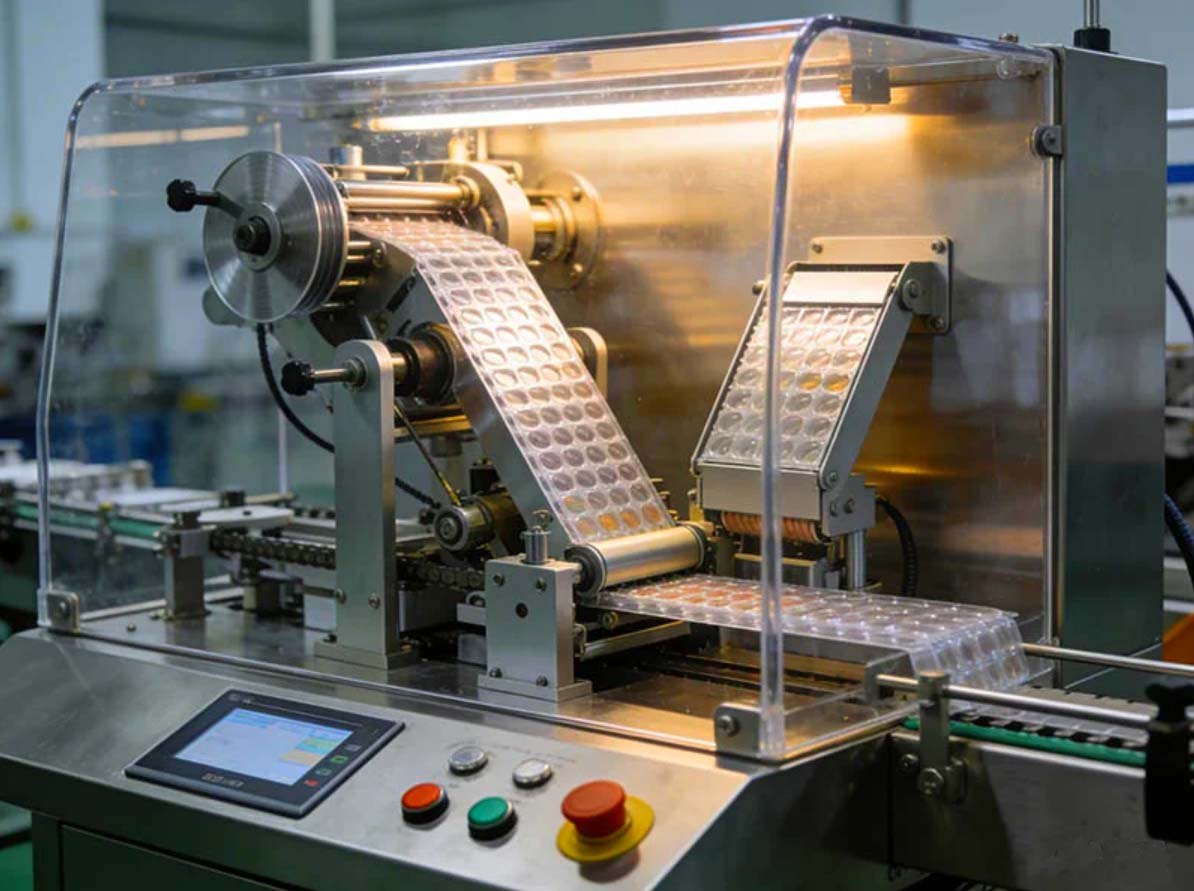
Sealing station on a HIJ liquid blister line producing 5 mL oral syrup unit-dose packs — aluminum lidding heat-sealed at 80–110°C.
⚠️ Field Diagnosis — Syrup Liquid Blister: What Goes Wrong Early
Symptom: Cavity underfill at >60% RH ambient. The fill head’s viscosity calibration was done at 25°C. Syrup viscosity increases 18–25% as ambient temperature drops from 30°C to 20°C between morning and afternoon shifts in plants without climate control. Result: fill volume drops below the ±1% specification without triggering any alarm. I saw this on a line in Hyderabad in 2022. The QA team caught it on weekly weight checks, not the machine. Four batches had already shipped.
Symptom: Lidding delamination at sealing edges after 3-month stability pull. Root cause in 9 of 11 cases I’ve investigated: sealing temperature set at the lower end of the validated range to avoid lidding wrinkle, combined with PVDC film that had absorbed ambient moisture during an overnight storage period. The sealing energy was insufficient for the film’s actual condition. Solution: monitor film roll humidity in storage and add a 2°C sealing temperature buffer. Simple. Not obvious unless you’ve seen it twice.
Eye Drops and Ophthalmic Solutions: Why Unit-Dose Liquid Blister Is Replacing Multidose Bottles
Unit-dose ophthalmic liquid blister packs eliminate preservatives. That’s the single most important clinical driver behind the format shift in this category.
Multidose ophthalmic bottles require benzalkonium chloride (BAK) or similar preservatives to prevent microbial contamination after first opening. BAK is cytotoxic to corneal epithelial cells at chronic exposure — a documented issue in glaucoma patients using multidose drops four times daily for years. The regulatory and prescriber pressure to move to preservative-free unit-dose formats has been building since the early 2010s and is now reflected in EU and North American formulary preferences.
Liquid blister cavities for ophthalmic drops run 0.1 mL to 0.5 mL — the smallest fill volumes in the category. That precision requirement drives the specification: a servo-driven fill head with volumetric accuracy to ±0.005 mL, coupled to a vision inspection system that rejects any cavity where fill meniscus deviates beyond tolerance. Standard PLC logging under 21 CFR Part 11 for batch traceability. The forming film is typically PE/aluminum/PET laminate — flexible enough to allow the patient to squeeze the dose out directly.
| Ophthalmic Packaging Format | Preservative Required | Fill Volume Accuracy | Contamination Risk After Opening | Shelf Life (Opened) | GMP Validation Complexity |
|---|---|---|---|---|---|
| Multidose Dropper Bottle (PET/Glass) | Yes (BAK or equivalent) | ±5–8% | High (repeated opening) | 28 days | Moderate |
| Unit-Dose Plastic Ampoule (BLOW-FILL-SEAL) | No | ±2–3% | None (single use) | N/A (single use) | High (BFS-specific equipment) |
| Unit-Dose Liquid Blister (PE/Alu laminate) | No | ±0.5–1% | None (single use) | N/A (single use) | Moderate (standard DQ/IQ/OQ/PQ) |
| Unit-Dose Vial (Glass Type I) | No | ±2–4% | None (single use) | N/A (single use) | High (aseptic filling required) |
| Data compiled from field validation projects and published WHO GMP guidelines. Accuracy figures reflect servo-controlled filling equipment under ISO-7 cleanroom conditions. | |||||
The validation complexity column in the table above is where liquid blister wins decisively over BFS and glass vials. A standard liquid blister packaging line follows a DQ/IQ/OQ/PQ protocol that most contract manufacturers already have templates for. BFS requires specialized cleanroom infrastructure. Glass vials require aseptic filling. Liquid blister cavities sealed under clean but non-aseptic conditions are sufficient for most topical ophthalmic products — and that difference in infrastructure cost is measured in millions of dollars for a greenfield site.
Nasal Sprays, Oral Rehydration Salts, and Other High-Volume Liquid Applications
Nasal saline solutions, oral rehydration salts (ORS) in liquid form, mouthwash concentrates, and pre-mixed antiseptic washes share a packaging challenge that makes liquid blister attractive: the dose is small, the formulation is often aqueous and unstable in ambient storage, and the target market is frequently outside the cold chain. That combination points directly to unit-dose blister.
ORS is the clearest example. UNICEF procurement data from 2020–2023 shows a consistent shift toward pre-measured liquid ORS sachets and blister packs in humanitarian response contexts — where caregiver literacy in mixing powdered ORS correctly is not reliable. A 5 mL liquid ORS blister cavity, when diluted as labeled, delivers exactly the WHO recommended electrolyte ratio. No measuring cup. No mixing error. No contamination. That is a public health outcome, not a packaging marketing claim.
💡 Forester’s Perspective — The Nasal Solution Project That Took 14 Months
I worked with a contract manufacturer in Morocco in 2020 on a saline nasal solution intended for pediatric rhinitis. The product was isotonic, no preservative, fill volume 0.9 mL per cavity. Straightforward on paper. The problem was film selection. The client’s procurement team had specified PE/aluminum laminate based on the ophthalmic line they already ran. Nasal formulation pH was 5.8 — slightly acidic. The adhesive layer in the laminate they’d been using for the ophthalmic product was not rated for pH below 6.5 under accelerated 40°C storage conditions. We discovered this at the 3-month accelerated stability pull. Delamination at the inner foil surface. Product contamination from adhesive migration.
Fourteen months of reformulation and film qualification followed. The lesson: your ophthalmic film specification is not automatically your nasal solution film specification, even when the fill volumes are similar. API-film compatibility testing should be on your DQ checklist before any tooling is ordered.
Pharmaceutical Liquid Blister Packaging: Full Application Matrix by Product Type
Liquid blister packaging applies across a broader range of pharmaceutical liquid categories than most procurement teams realize when they first encounter the format. The table below consolidates the primary applications, standard fill volumes, typical film materials, and key regulatory touchpoints for each category.
| Product Category | Typical Fill Volume | Forming Film Specification | Key GMP Reference | Primary Distribution Market |
|---|---|---|---|---|
| Pediatric Oral Syrup (antibiotic, antipyretic) | 5–15 mL | PVDC/Al laminate or cold-form Alu-Alu | WHO GMP, ICH Q1A(R2) Zone IVb | Africa, South Asia, SEA |
| Ophthalmic Solution (preservative-free) | 0.1–0.5 mL | PE/Al/PET flexible laminate | 21 CFR Part 211, EU GMP Annex 1 | EU, North America, GCC |
| Nasal Saline / Antiseptic Solution | 0.5–2 mL | PE/Al laminate (pH-compatible adhesive) | EU GMP Annex 1, WHO GMP | MENA, EU, Latin America |
| Oral Rehydration Solution (ORS) | 5–30 mL | PVDC or Alu-Alu for tropical climates | WHO Essential Medicines, UNICEF specs | Africa, South Asia, LATAM |
| Cough & Cold Liquid Dose | 5–10 mL | PVC/PVDC for temperate; PVDC/Al for tropical | ICH Q6A, 21 CFR Part 211 | Global (climate-dependent film choice) |
| Topical Antiseptic / Wound Wash | 1–10 mL | PE/Al laminate, chemical resistance required | EU MDR 2017/745 (if medical device crossover) | EU, Middle East, East Africa |
| Liquid Vitamin / Supplement (nutraceutical) | 5–20 mL | PVC/PVDC or PE/Al depending on API sensitivity | ICH Q6A, national food/pharma crossover regs | North America, EU, Southeast Asia |
| Film specifications are indicative. Final selection requires API-film compatibility testing per ICH Q1A(R2) and the target market’s climatic zone classification. | ||||
HIJ liquid blister packaging line configured for multi-format output — switching between 5 mL syrup and 0.3 mL ophthalmic dose tooling in under 45 minutes.
GMP Compliance for Pharmaceutical Liquid Blister Packaging: What Regulators Actually Check
A WHO GMP inspector who visited a client’s plant in Casablanca in 2019 cited three deficiencies related to their liquid blister line — none of which were about the machine itself. All three were documentation gaps: no container closure integrity (CCI) test method validated per ASTM F2338, no written procedure for sealing temperature verification at shift start, and no periodic requalification protocol after preventive maintenance. The machine was performing within specification. The paperwork wasn’t.
That pattern repeats across markets. The regulatory risk in pharmaceutical liquid blister packaging is rarely mechanical. It’s the validation and documentation architecture around the machine. For a detailed compliance framework, the GMP compliance guide for liquid blister packaging covers the full dossier structure that regulators in WHO-prequalified markets, FDA-regulated facilities, and EU-licensed manufacturers are expected to maintain.
Container Closure Integrity (CCI): Validated test method per ASTM F2338 or USP <1207>. Dye ingress or headspace analysis accepted by FDA and EMA for liquid-filled blister cavities.
Sealing Parameter Qualification: Temperature, dwell time, and pressure mapped across the full sealing station surface. At least three consecutive batches at worst-case conditions (low-end temperature, high-end speed).
Fill Volume Accuracy: Documented at IQ/OQ stage and re-verified at each product changeover. FDA 21 CFR Part 211.101 and EU GMP Annex 15 both require process capability data (Cpk ≥1.33) for fill operations.
Cleaning Validation: Swab limits and rinse water TOC limits for each liquid product run on shared equipment. ICH Q7 and WHO GMP require dedicated equipment for certain classes of API.
21 CFR Part 11 / GAMP 5 Data Integrity: Electronic batch records, audit trail coverage for fill head parameters, and access control for production setpoints. Required for any facility with FDA oversight or EU Annex 11 obligations.
Matching Your Liquid Formulation to the Right Blister Packaging Equipment
Not every liquid blister machine handles every application equally well. The fill head design that works for a low-viscosity aqueous ORS solution (viscosity: 1–3 cP) performs differently when you switch to a pediatric suspension at 200–400 cP — where particle settling between fill cycles becomes a real batch uniformity issue if the system lacks an agitation circuit.
Three fill head configurations dominate pharma liquid blister lines:
| Fill Head Type | Viscosity Range | Fill Volume Accuracy | Best For | Limitation |
|---|---|---|---|---|
| Peristaltic Pump | 1–50 cP | ±1.5–2% | Aqueous solutions, eye drops, ORS | Tubing wear requires scheduled replacement |
| Rotary Piston (servo-driven) | 1–500 cP | ±0.5–1% | Syrups, suspensions, viscous liquids | Higher capital cost; more complex CIP protocol |
| Time-Pressure (pneumatic) | 1–200 cP | ±1–2.5% | Low-value aqueous solutions, ORS | Accuracy degrades with viscosity and temperature variation |
| Accuracy figures at 25°C; recalibration required when ambient temperature varies >5°C. Suspension products (>50 cP) should specify in-tank agitation as standard. | ||||
Viscosity is not the only variable. Fill temperature matters for heat-sensitive APIs. Foaming behavior matters for surfactant-containing formulations. Surface tension matters for very small cavity fills below 0.3 mL, where droplet control at the nozzle tip directly affects cavity contamination and lidding seal integrity. These are the questions you should be asking in your URS — before the machine is quoted, not during FAT.
🔮 Forester’s Note — The Suspension Problem Nobody Mentions
I reviewed a line qualification report in 2023 for a Bangladeshi manufacturer producing pediatric zinc suspension in liquid blister format. Fill head: rotary piston, 10 mL cavity. Fill accuracy at IQ: within specification. At OQ, after four hours of continuous production, the in-tank agitator had been switched off by an operator who found the noise distracting. Zinc particles settled. The bottom 30% of the batch had underdose cavities outside specification. None of this triggered an alarm because the fill head’s weight-based rejection system was calibrated for total fill weight — which looked fine because the density of the settled suspension was higher, not lower.
The fix cost almost nothing: a mandatory agitator interlock that prevents production if agitator speed drops below setpoint. The validation gap that allowed this to happen for four hours cost considerably more. Your URS should specify agitator interlock as a mandatory safety function for any suspension product.
⚒️ Field Diagnosis — Three Operational Failures I’ve Seen More Than Once
CCI failure at month 6 stability pull, not month 3. The sealing parameters passed OQ at month 0. The film roll used during OQ was from a different manufacturing lot than production film. Lot-to-lot variation in PVDC coating thickness (±3 μm is typical within spec) changed the minimum sealing energy needed. The line was never requalified after the film supplier lot changed. Result: hermetic seal failure at month 6 accelerated pull. Regulatory dossier rejection. Root cause: no change control procedure for film lot changes. Fix: add film lot change to your change control register as a minor change requiring seal energy verification run before production restart.
Nozzle drip between cavities producing cross-contaminated lidding zone. Affecting peristaltic pump systems at fill speeds above 60 cycles/min. The nozzle tip surface tension cutoff was tuned for 25°C. At 32°C ambient (common in non-climate-controlled plants in Southeast Asia), surface tension drops enough that the nozzle drip after fill head retraction leaves a 0.02–0.05 mL residue on the lidding foil. That residue carbonizes at the sealing station, creating a sealing defect that passes visual inspection but fails CCI. Fit a nozzle anti-drip valve as standard. Not optional for ambient temperatures above 30°C.
Audit trail gaps in batch records for fill head temperature deviations. FDA warning letters issued between 2020 and 2023 included three references to liquid blister lines where sealing temperature excursions were automatically corrected by the PLC without being logged as deviations. The PLC was doing its job. The data integrity configuration wasn’t. Under 21 CFR Part 11, auto-corrections to critical parameters must be logged with a before/after audit trail entry. If your PLC supplier didn’t configure this at installation, it’s a remediation item before your next FDA inspection.
Frequently Asked Questions: Liquid Blister Packaging in Pharmaceutical Applications
❓ What pharmaceutical products are most commonly packaged in liquid blister format?
Liquid blister packaging is most commonly used for pediatric oral syrups (antibiotic, antipyretic, anthelmintic), preservative-free ophthalmic drops, nasal saline solutions, oral rehydration solutions (ORS), and unit-dose topical antiseptics — all products where single-use format eliminates contamination risk and ensures dose accuracy from 0.1 mL to 30 mL per cavity.
❓ What fill volume accuracy is achievable on a pharmaceutical liquid blister line?
Servo-controlled rotary piston fill heads achieve ±0.5–1% fill volume accuracy across the 1–500 cP viscosity range. Peristaltic and time-pressure systems typically deliver ±1.5–2.5%. For ophthalmic applications below 0.5 mL, servo piston systems with nozzle anti-drip valves are required to hold the ±1% specification consistently across a full production shift.
❓ Is liquid blister packaging GMP-compliant for WHO and FDA-regulated markets?
Yes — provided the equipment is validated under a documented DQ/IQ/OQ/PQ protocol, container closure integrity is tested per ASTM F2338 or USP <1207>, and electronic batch records meet 21 CFR Part 11 or EU GMP Annex 11 data integrity requirements. The format is explicitly referenced in WHO GMP TRS 992 as acceptable for oral liquid unit-dose products. Compliance requirements are substantial but follow standard pharma validation pathways. For a full compliance framework, see the GMP compliance guide for liquid blister packaging.
❓ Which film material should I choose for liquid blister packaging in Zone IVb tropical markets?
Cold-form Alu-Alu (aluminum/nylon/aluminum laminate) is the default specification for Zone IVb distribution at 40°C / 75% RH, delivering MVTR below 0.5 g/m²/day compared to 4–6 g/m²/day for standard PVC. For products with moderate moisture sensitivity, PVDC/Al laminate at 0.2–0.8 g/m²/day is an acceptable and more cost-effective middle option. The choice depends on your API’s moisture uptake threshold — a question your stability data should answer before any film is specified. Critically, film-API compatibility testing must be completed before tooling is ordered; film selection based on another product’s specification is one of the most common and costly mistakes I see in new liquid blister projects.
❓ Can a single liquid blister machine handle both ophthalmic and syrup formats?
Yes, with changeover tooling. Cavity mold change for a well-designed machine takes 30–60 minutes. The fill head requires a flush-and-change procedure between chemically incompatible products. Dedicated tooling sets per product are standard practice.
❓ What is the typical production speed for a pharmaceutical liquid blister packaging machine?
Pharma-grade liquid blister lines run at 40–120 cycles/minute depending on cavity configuration, fill volume, and sealing dwell time requirements. A line at 80 cycles/min producing 4-cavity blister cards outputs approximately 19,200 unit doses per hour. High-speed configurations for ORS at 120 cycles/min with 6-cavity tooling can exceed 40,000 doses/hour. Speed selection should be driven by your batch size and fill time constraint for the specific API — not by the machine’s maximum rated speed.
❓ How does liquid blister packaging compare to BFS (Blow-Fill-Seal) for ophthalmic applications?
BFS delivers sterile fill under aseptic conditions with higher initial capital cost and cleanroom infrastructure requirements (ISO 5 / Grade A filling zone). Liquid blister for non-sterile ophthalmic preparations (saline, irrigation solutions) is significantly less capital-intensive, uses standard clean (ISO 7 / Grade C) environments, and follows conventional DQ/IQ/OQ/PQ validation. For sterile ophthalmic products requiring the European Pharmacopoeia sterility standard, BFS or conventional aseptic filling remains the regulatory requirement; liquid blister in a non-aseptic environment is not acceptable.

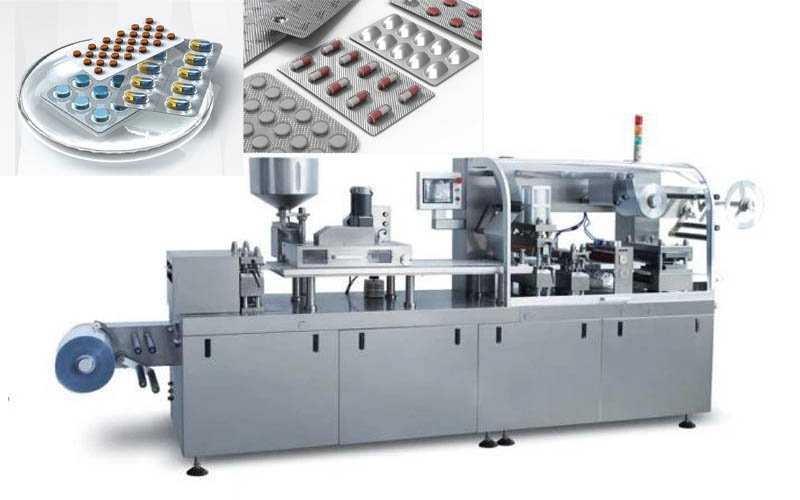
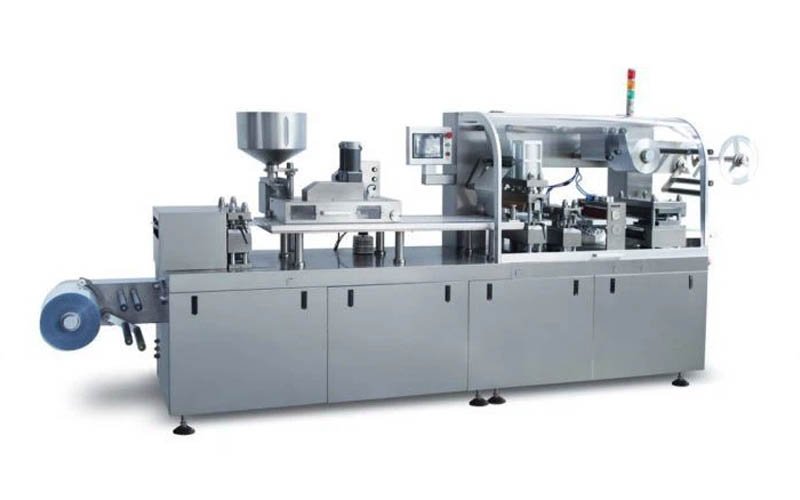
HIJ DPP-140/150 liquid blister packaging machine — servo-driven fill heads, PVDC/Alu compatible forming station, 21 CFR Part 11 audit trail built in.
Ready to Specify a Liquid Blister Line for Your Application?
Our engineering team has commissioned liquid blister lines for oral syrups, ophthalmic solutions, ORS, and nasal liquids across 18 countries. Tell us your fill volume, API viscosity profile, and target market — we will size the right machine configuration and validate it end-to-end.