
















📋 Pharmaceutical Packaging Format Decision Guide
Blister Packaging vs. Strip Packaging vs. Bottle Filling: Which Is Right for Your Drug?
Selecting the wrong primary packaging format for your pharmaceutical product locks your API into a stability failure path that no downstream QC protocol can fully rescue. The decision between blister packaging, strip packaging, and bottle filling hinges on four non-negotiable variables: your API’s Water Vapor Transmission Rate (WVTR) requirement, your target market’s cGMP regulatory framework, your SKU count and serialization architecture, and your total cost of ownership across a 5-year production horizon.
According to Forester Xiang’s 20-year field audit experience across Southeast Asia and Latin America, over 60% of mid-size pharmaceutical manufacturers who switch packaging formats post-launch face line replacement costs exceeding $250,000 USD — a risk eliminated by locking in a cross-functional packaging format review before your URS is finalized.
Manufacturers who switch format post-launch
Average line replacement cost
Primary packaging formats compared
Forester’s field engineering experience

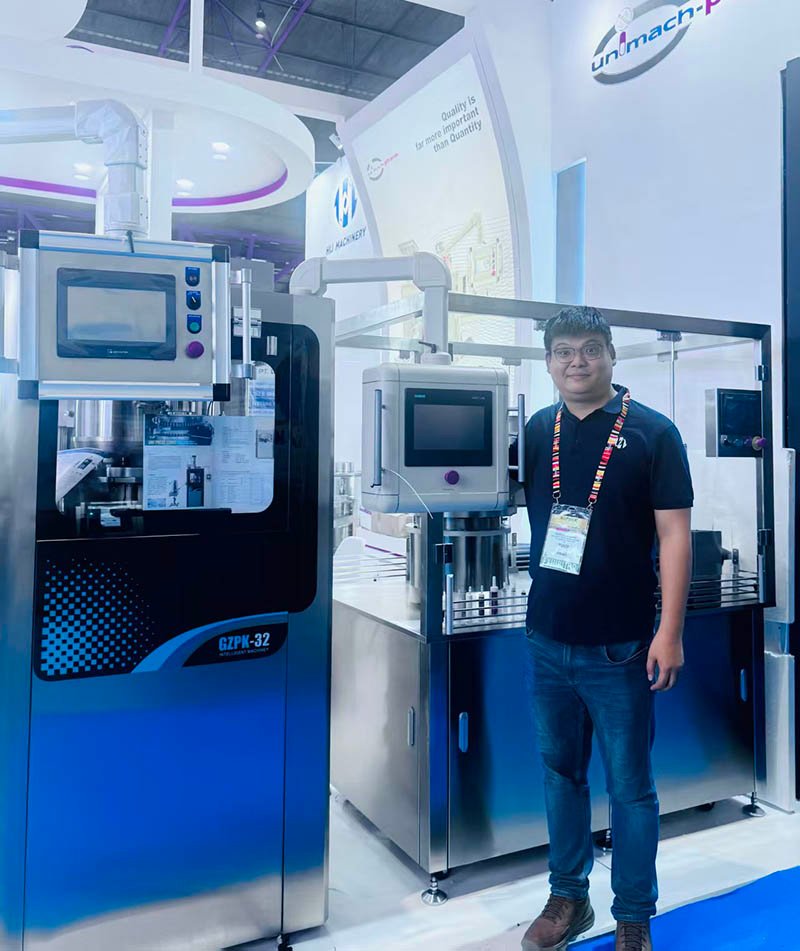 Forester’s Insight: A 20-Year Engineer’s Perspective
HIJ Machinery | Pharmaceutical Packaging Expert🎯 The Direct Answer
The “right” packaging format isn’t a marketing decision — it’s a regulatory, stability, and supply-chain decision that must be locked in before you finalize your production line investment.
🌍 The Field Experience
In my 20 years auditing pharmaceutical plants across Southeast Asia and Latin America, I’ve watched mid-size manufacturers pour capital into blister lines, only to discover 18 months later that their moisture-sensitive API demanded strip packaging with a superior WVTR barrier — a switch that cost them an entire line replacement. One client in Indonesia invested $180,000 USD in a PVC thermoforming blister line in 2019, only to have their stability data for a hygroscopic antibiotic fail the 6-month accelerated study at 40°C / 75% RH. The result: complete line retirement and a $230,000 alu-alu cold-form replacement project.
⚠️ The Hidden Trap
Most equipment vendors will happily sell you a machine without ever reviewing your URS, stability data, or target market’s cGMP compliance requirements. They sell iron; they don’t protect your registration dossier. At HIJ Machinery, our pre-sales engineering team conducts a full Turnkey integration assessment — matching your drug’s API stability profile to the right packaging format, then building FAT/SAT protocols and IQ/OQ/PQ documentation around it. Your packaging decision becomes a competitive asset, not a costly correction.
What Are Blister Packaging, Strip Packaging, and Bottle Filling — and How Do They Differ?
Blister packaging, strip packaging, and bottle filling each represent a distinct primary containment strategy, and each delivers a radically different barrier performance, cost structure, and regulatory compliance footprint. Choosing incorrectly at the product development stage forces a revalidation event under 21 CFR Part 211.94 that can delay market entry by 12 to 18 months.

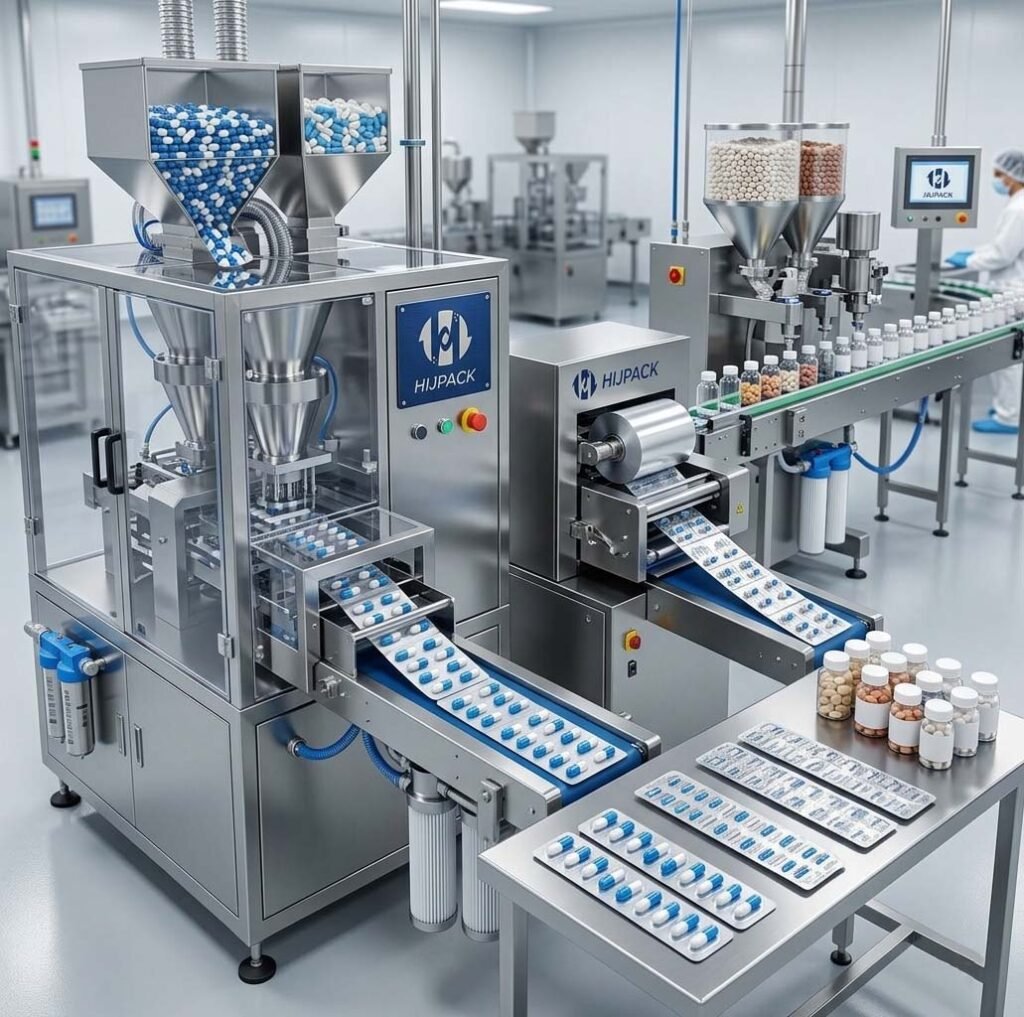
Thermoforming blister packaging line producing unit-dose pharmaceutical packs — the most common primary packaging format for solid oral dosage forms globally.
Blister Packaging: Unit-Dose Thermoforming or Cold-Form Containment
Blister packaging forms individual cavities in a forming web — either PVC/PVDC (thermoforming) or aluminum/aluminum (cold-form) — and seals each cavity with an aluminum lidding foil using heat, pressure, and dwell time typically set between 150°C and 220°C at 200–400 kPa. Each tablet, capsule, or pill occupies a hermetically sealed pocket. The patient ruptures the foil backing to access a single unit dose, which makes blister packs the gold standard for unit-dose integrity, patient compliance, and tamper evidence.
- PVC/PVDC thermoform blister: WVTR 0.1–2.0 g/m²/day — suitable for most standard oral solids
- PVC/Aclar thermoform blister: WVTR <0.02 g/m²/day — suitable for moderately hygroscopic APIs
- Alu-Alu cold-form blister: WVTR <0.005 g/m²/day — the highest barrier for highly hygroscopic or light-sensitive APIs
- Typical output speed: 200–600 blisters/min depending on cavity count and format size
Strip Packaging: Continuous Heat-Seal Foil Pouches
Strip packaging heat-seals individual dose units between two continuous foil or film webs — typically aluminum/polyethylene laminates — forming a connected strip of sealed pouches. The process applies sealing temperatures of 120°C to 180°C continuously without a forming station. Strip packs deliver excellent moisture and light barriers at a lower machine investment cost than alu-alu blister lines, but sacrifice the rigid cavity structure that prevents tablet movement and breakage during transit.
- WVTR: 0.01–0.05 g/m²/day depending on laminate construction
- Typical output: 400–1,200 strips/min — higher throughput than blister for simple tablet/capsule formats
- Regulatory note: Strip packs are dominant in South Asian and Middle Eastern markets but face scrutiny under EU GMP Annex 1 (2022 revision) for sterile-adjacent applications requiring validated hermetic seals
Bottle Filling: High-Volume Solid Oral Dose Containment
Bottle filling counts, fills, and caps HDPE or glass bottles with 30, 60, 90, or 500+ unit doses per container. Integrated desiccant insertion, induction sealing, and cotton wadding manage the headspace environment. Bottle lines achieve the lowest per-unit packaging cost at scale — often 40–60% lower than blister per tablet — but shift the moisture burden to the bulk container, requiring desiccant sizing per ICH Q1B stability guidelines and container closure validation per USP <1207>.
- Per-unit cost advantage: 40–60% lower than blister packaging at volumes above 10 million tablets/month
- Serialization complexity: Bottle-level serialization requires aggregation to bundle/case under DSCSA (US) or FMD (EU) — more complex than blister unit-dose serialization
- Primary regulatory reference: USP <661> Containers — Plastics; 21 CFR Part 211.94(a) for container-closure integrity
Common Failure Modes & Forester’s Fix
- 🔴 Symptom: Thermoform blister packs show visible moisture absorption (tablet color change, capsule softening) within 3 months of production.
⚙️ Root Cause: PVC forming web selected with WVTR of 1.5 g/m²/day for an API requiring <0.05 g/m²/day; sealing station dwell time set at 0.4 seconds instead of validated 0.6 seconds, producing micro-channel seal defects.
🔧 Forester’s Fix: Upgrade forming web to PVC/Aclar 220A (WVTR 0.017 g/m²/day); recalibrate sealing jaw temperature to 185°C ± 3°C, increase dwell time to 0.65 seconds, and re-validate per ASTM F2338 bubble emission test before release. - 🔴 Symptom: Strip pack seals peel at less than 2.5 N/15mm on peel adhesion testing — below the ICH Q6A specification minimum of 4.0 N/15mm.
⚙️ Root Cause: Sealing roller temperature drifted 15°C below setpoint due to failed thermocouple; foil laminate humidity conditioning not performed before production run.
🔧 Forester’s Fix: Replace Type-K thermocouple; recalibrate roller temperature to 155°C ± 2°C; mandate 24-hour foil conditioning at 22°C / 45% RH before each production run; add in-line peel-force monitoring every 500 strips.
Blister vs. Strip vs. Bottle Filling: Full Pharmaceutical Packaging Comparison Matrix
The table below synthesizes the critical decision variables that pharmaceutical manufacturing directors, formulation scientists, and packaging engineers must evaluate. Every cell is based on validated field data from HIJ Machinery’s project portfolio spanning 40+ countries.

Material comparison: PVC, PVDC/Aclar, and alu-alu cold-form foils — each delivering a distinct WVTR barrier profile that determines API stability over shelf life.
| Decision Variable | 📦 Blister Packaging | Strip Packaging | Bottle Filling |
|---|---|---|---|
| Moisture Barrier (WVTR) | PVC0.1–2.0 g/m²/day Alu-Alu<0.005 g/m²/day |
0.01–0.05 g/m²/day | Desiccant-dependent; 0.1–2.0 g/day for HDPE container |
| Unit-Dose Integrity | ✅ Excellent — each unit hermetically sealed | ✅ Good — individual dose pockets | ⚠️ Bulk container — once opened, entire contents exposed |
| Patient Compliance Aid | ✅ High — date/day printing on foil | Moderate — strip perforations aid counting | Low — relies on patient counting |
| Machine CapEx Range | $45,000–$380,000+ USD | $18,000–$120,000 USD | $60,000–$500,000+ USD (full line) |
| Per-Unit Packaging Cost | $0.008–$0.045/unit | $0.005–$0.020/unit | ✅ $0.002–$0.008/unit (lowest) |
| Serialization Complexity | ✅ Low — unit-dose level | Low–Moderate | High — aggregation required |
| GMP Regulatory Fit | ✅ Global — EU, US, WHO GMP | Strong in Asia, Middle East; scrutiny in EU for sterile | Global — dominant in North America |
| Suitable Dosage Forms | Tablets, capsules, softgels, liquids, suppositories | Tablets, capsules — standard sizes only | All solid oral dosage — unlimited count |
| Tablet Breakage Risk | ✅ Very Low — rigid formed cavity | Low–Moderate — no rigid cavity | Moderate — tablet-on-tablet contact in bulk |
| Format Changeover Time | 30–90 min (mold + tooling change) | ✅ 15–40 min (web width adjustment) | 45–120 min (bottle size + filler changeover) |
| Validation Burden | IQ/OQ/PQ + seal integrity (ASTM F2338) | IQ/OQ/PQ + peel force testing | IQ/OQ/PQ + container-closure integrity (USP <1207>) |
| Best Market Fit | EU, Southeast Asia, Latin America, Middle East | South Asia, Middle East, Africa | North America, OTC global retail |
💡 Forester’s Key Insight on the Comparison Matrix
No single format wins across all variables. Alu-alu blister packaging dominates moisture-sensitive APIs; strip packaging wins on throughput economics for simple tablet/capsule formats in price-sensitive markets; bottle filling is unbeatable for OTC high-volume stable molecules. The winner is determined by your specific API stability data, not industry convention.
Common Failure Modes & Forester’s Fix
- 🔴 Symptom: Comparison table outputs mislead procurement team into selecting blister over bottle for an OTC antacid tablet, inflating per-unit cost by 5× versus bottle format.
⚙️ Root Cause: Format decision made by marketing team without API stability data review; no WVTR requirement established; regulatory market analysis not completed before equipment RFQ issued.
🔧 Forester’s Fix: Mandate a pre-investment cross-functional review (formulation + regulatory + engineering + supply chain) before issuing any packaging line RFQ. At HIJ, our pharmaceutical turnkey packaging line integration process includes this review as Step 1 — no equipment quotation is issued until the format decision is validated against stability and market data. - 🔴 Symptom: Bottle-filled product returns from US distributor with 12% tablets showing chipping defects — a recall risk under 21 CFR Part 211.192.
⚙️ Root Cause: Bottle fill height set at 95% capacity, creating excess headspace for tablet movement; cotton wadding compressed to only 40% of bottle neck diameter instead of validated 80%.
🔧 Forester’s Fix: Reduce fill count to achieve maximum 85% volume fill ratio; recalibrate cotton inserter to deliver 78–82% neck compression; add in-line vision inspection to detect missing/damaged tablets before capping.
Deep Dive: When Blister Packaging Is the Optimal Choice for Your Pharmaceutical Product
Blister packaging is the globally dominant primary packaging format for solid oral dosage forms, capturing approximately 65% of all pharmaceutical unit-dose packaging by volume, precisely because it delivers the optimal combination of moisture barrier performance, patient compliance support, and regulatory acceptance across the EU, WHO GMP, and US FDA frameworks simultaneously.

HIJ DPP-250 thermoforming pharma blister packaging machine — capable of processing PVC, PVDC, PVC/Aclar, and OPA/Alu/PVC forming webs at speeds up to 260 blisters/min.
Thermoforming Blister vs. Cold-Form Alu-Alu: The Internal Format Decision
Within the blister format family, thermoforming (PVC-based webs) and cold-form (alu-alu) represent two distinct manufacturing processes with fundamentally different capital costs, material costs, and barrier performances. Thermoforming heats the PVC web to 120–160°C and vacuum-forms it over a die to create cavities. Cold-form mechanically deforms an aluminum laminate at ambient temperature — no heat, no forming station required — producing a completely opaque, near-zero WVTR barrier.
CapEx: $45,000–$180,000 USD
Web cost: $0.8–$2.5/m² (PVC/PVDC)
WVTR: 0.1–2.0 g/m²/day
Speed: up to 600 blisters/min
Best for: Standard oral solids, non-hygroscopic APIs, price-sensitive markets
CapEx: $120,000–$380,000+ USD
Web cost: $4.5–$9.0/m² (OPA/Alu/PVC)
WVTR: <0.005 g/m²/day
Speed: up to 300 blisters/min
Best for: Hygroscopic APIs, light-sensitive drugs, high-humidity tropical markets
CapEx: $60,000–$500,000+ USD
Container cost: $0.04–$0.35/bottle (HDPE)
WVTR: Desiccant-managed
Speed: up to 200 bottles/min
Best for: OTC high-volume stable molecules, North American retail distribution
Under EU GMP Annex 1 (2022 revision) Section 8.3, primary packaging materials for sterile and near-sterile products must undergo a formal packaging material qualification that includes container-closure integrity testing — a requirement that favors the sealed-cavity architecture of alu-alu blister packs over strip or bottle formats for injectable-adjacent solid dosage forms.
HIJ Machinery’s alu-alu cold-form blister packaging machine and the DPP-250 thermoforming pharma blister machine both ship with validated sealing station temperature uniformity reports (±2°C across the sealing jaw width) and IQ/OQ documentation packages as standard — not optional add-ons.
Common Failure Modes & Forester’s Fix
- 🔴 Symptom: Alu-alu blister packs show pinhole perforations in the formed aluminum web, detected by ASTM F2338 bubble emission testing — rejection rate reaching 3.2% of total production output.
⚙️ Root Cause: Cold-forming punch force set 18% above the validated parameter for the 0.045mm OPA/Alu/PVC laminate; forming die clearance worn beyond the 0.02mm tolerance limit after 8 million cycles without maintenance.
🔧 Forester’s Fix: Recalibrate forming punch force to validated 12–14 kN; measure forming die cavity clearance — replace if wear exceeds 0.025mm; implement 500,000-cycle die inspection interval; perform ASTM F2338 bubble emission test on first 50 blisters of every production run as an in-process control. - 🔴 Symptom: Blister sealing station produces “cold spots” — areas of unsealed foil visible under backlighting — affecting 0.8% of output, triggering a 21 CFR Part 211.192 investigation.
⚙️ Root Cause: Heating element degradation in sealing jaw produced a 12°C temperature differential across the jaw face; sealing pressure uniformity not verified at last maintenance cycle.
🔧 Forester’s Fix: Map sealing jaw temperature profile with a 9-point thermal mapping exercise (center + 8 peripheral points); replace degraded cartridge heater; verify jaw pressure uniformity using pressure-sensitive film at 5 points across the sealing width; document findings in the process deviation log per WHO TRS 992 Annex 3 requirement.
How to Choose Between Blister, Strip, and Bottle Packaging: A 6-Step Engineering Decision Framework
Selecting the optimal pharmaceutical primary packaging format requires a structured, cross-functional evaluation that integrates formulation science, regulatory strategy, supply chain economics, and equipment investment analysis. Execute these 6 steps before issuing a single RFQ to any equipment vendor.
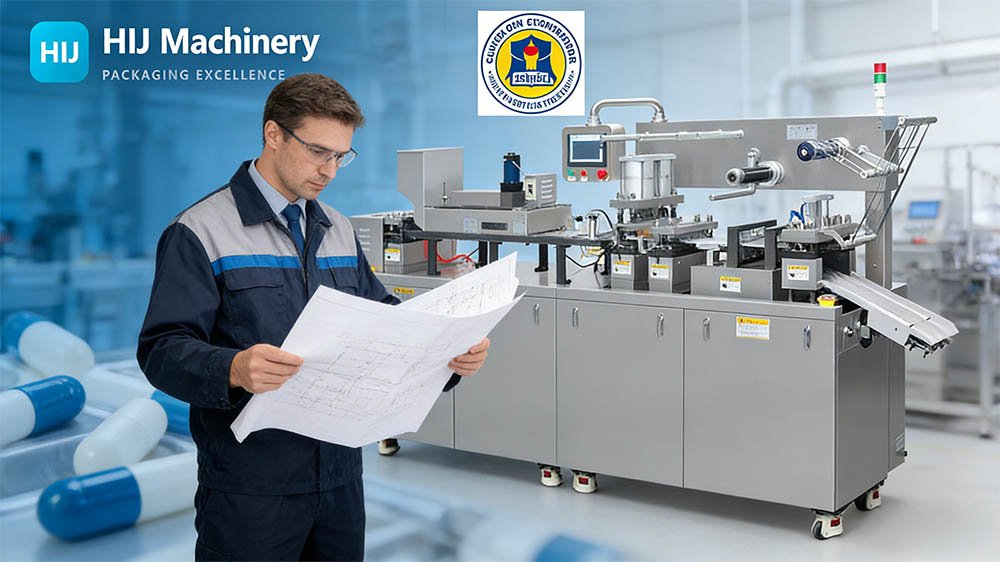
Pre-investment engineering review: matching API stability data and URS requirements to the right packaging format before equipment procurement — the most cost-effective intervention in any packaging project.
-
1Establish Your API’s WVTR Requirement from Stability Data
Pull your ICH Q1B 6-month accelerated stability data (40°C / 75% RH). If your API shows >0.5% moisture uptake at 6 months under PVC blister conditions, your WVTR target must be ≤0.05 g/m²/day — which rules out standard PVC thermoforming and points toward PVC/Aclar, strip packaging, or alu-alu cold-form. Document this threshold in your URS as a hard specification, not a preference.
-
2Map Your Target Market’s Regulatory Packaging Requirements
EU markets require packaging compliance with EU GMP Annex 15 (qualification and validation of packaging operations) and increasingly with Annex 1 (2022 revision) for sterile-adjacent products. US FDA requires compliance with 21 CFR Part 211.94 (drug product containers and closures). WHO GMP TRS 992 Annex 3 governs markets in Southeast Asia, Latin America, and Africa. Each framework has specific container-closure integrity (CCI) testing, artwork approval, and serialization requirements that eliminate certain formats from consideration.
-
3Calculate Total SKU Count and Dose Variant Architecture
If your product launches with 3+ dose strengths and 5+ pack sizes, blister packaging offers the fastest format changeover (30–90 min tooling swap) and the best serialization architecture for track-and-trace compliance. Strip packaging handles 1–2 standard tablet/capsule sizes efficiently. Bottle filling accommodates unlimited count-per-bottle but requires separate validation for each fill count. Count your 3-year SKU roadmap — not just your launch SKU — before selecting your format and equipment platform.
-
4Model 5-Year Total Cost of Ownership (TCO), Not Just CapEx
A standard PVC blister line at $65,000 CapEx may carry $0.022/unit material cost versus an alu-alu line at $220,000 CapEx with $0.038/unit material cost — but if your API requires alu-alu barrier, the PVC line produces zero saleable product. Model TCO including: machine CapEx, tooling & molds ($8,000–$45,000), forming web material cost, lidding foil cost, validation cost ($15,000–$60,000), and annual maintenance ($3,000–$18,000). At 5 million units/year production, a $16/1,000 unit material cost difference equals $80,000/year — often exceeding the CapEx gap between format options within 3 years.
-
5Assess Downstream Serialization and Track-and-Trace Integration
Under DSCSA (US) and FMD (EU Falsified Medicines Directive), every saleable unit must carry a 2D DataMatrix barcode at the item level. Blister packs serialize at the individual blister card level — the simplest aggregation hierarchy. Strip packs require perforated strip counting for item-level coding. Bottles require item + bundle + case aggregation — a 3-level serialization tree that demands additional hardware investment ($12,000–$35,000 per line for aggregation stations). Factor this into your TCO model in Step 4.
-
6Issue Your URS and Request FAT/SAT + IQ/OQ/PQ Documentation Commitments
Your User Requirement Specification must lock in: format type, WVTR target, output speed (units/hr), changeover time target, compliance standards (21 CFR Part 11 audit trail if applicable), and IQ/OQ/PQ documentation scope. Demand that every vendor respond to your URS point-by-point in their technical proposal — not with a generic brochure. At HIJ Machinery, every equipment quotation includes a URS deviation log: any parameter where our standard machine specification deviates from your URS is flagged and resolved before contract signature — eliminating post-installation surprises.
Which Packaging Format Dominates in Southeast Asia, Latin America, and the Middle East?
Regional pharmaceutical packaging format preferences are shaped by climate conditions (temperature/humidity profiles), regulatory frameworks, healthcare distribution infrastructure, and pharmacist/patient dispensing habits — not by universal engineering optimization. Understanding these regional dynamics prevents costly misalignment between your packaging investment and your target market’s commercial reality.
Average annual humidity: 75–85% RH. Dominant format: PVC/PVDC blister for standard oral solids; alu-alu blister growing rapidly for generics targeting EU export. WHO GMP TRS 992 compliance is the baseline regulatory requirement. Bottle filling is used primarily for OTC vitamins and minerals in modern retail.
Regulatory frameworks: ANVISA (Brazil), COFEPRIS (Mexico) — both aligned with WHO GMP with increasing convergence toward EU GMP standards for export products. Dominant format: blister packaging across the board (70%+ market share for prescription products). Alu-alu blister demand growing at 12% annually driven by hygroscopic antibiotic generics.
High ambient temperature (35–45°C) and humidity demand superior barrier packaging. Dominant format: alu-alu blister and strip packaging for prescription products; bottle filling for OTC. Saudi SFDA and UAE MOH increasingly align packaging requirements with EU GMP Annex 1 for imported generics — creating strong demand for cold-form blister capability.
HIJ Machinery has delivered complete pharmaceutical packaging turnkey solutions to manufacturers in 40+ countries across these three regions. Our field engineering team has conducted on-site FAT and SAT qualifications in cleanroom environments compliant with ISO 14644-1 Class 7 (equivalent to EU GMP Grade C) — providing direct reference data for format selection decisions in tropical and arid climates.

Complete blister packing line integrated with downstream cartoning — a standard HIJ Machinery turnkey configuration for pharmaceutical manufacturers in Southeast Asia and Latin America.
Common Failure Modes & Forester’s Fix
- 🔴 Symptom: Blister-packed antibiotic tablets shipped from a Latin American manufacturer to Middle East distributor fail shelf-life testing at 18 months — moisture content 2.3× above specification.
⚙️ Root Cause: Product packed on PVC/PVDC blister line (WVTR 0.35 g/m²/day) for a market with average storage condition of 35°C / 70% RH; accelerated stability data was generated at 25°C / 60% RH (European climate) — inapplicable to the target market zone 4B condition.
🔧 Forester’s Fix: Requalify packaging under ICH Q1F Zone 4B conditions (40°C / 75% RH); upgrade to OPA/Alu/PVC alu-alu cold-form blister with WVTR <0.005 g/m²/day; issue a CMC variation to the registration dossier updating the primary packaging specification. - 🔴 Symptom: Strip-packed capsules arrive at Southeast Asian pharmacy with visible delamination of the foil/film laminate — product at risk of moisture ingress before patient dispenses.
⚙️ Root Cause: Strip pack laminate adhesive specified for 15–25°C storage; exposed to 38°C warehouse temperatures during last-mile distribution; sealing bond strength under heat drops from 6.2 N/15mm to 2.1 N/15mm at 40°C.
🔧 Forester’s Fix: Specify high-temperature adhesive laminate (bond strength ≥5.0 N/15mm at 40°C); require supplier to provide thermal cycling adhesion data from −10°C to 45°C before material approval; add distribution simulation testing per ISTA 2A to packaging validation protocol.
Frequently Asked Questions: Blister vs. Strip vs. Bottle Packaging for Pharmaceuticals
What is the main difference between blister packaging and bottle packaging for pharmaceuticals?
Blister packaging hermetically seals each individual tablet or capsule in a formed cavity sealed with aluminum lidding foil, providing unit-dose integrity, patient compliance support, and superior moisture barrier performance per sealed unit. Bottle packaging fills multiple dose units into a single HDPE or glass container with a desiccant insert. Blister packaging offers better per-unit tamper evidence and serialization simplicity; bottle filling delivers lower per-unit cost at high volumes (40–60% cheaper per tablet than blister at >10 million units/month). The choice depends on your API’s moisture sensitivity, your target market’s dispensing model, and your serialization compliance requirements under DSCSA or FMD.
When should I use alu-alu blister packaging instead of standard PVC blister?
Use alu-alu (cold-form aluminum/aluminum) blister packaging when your API’s ICH Q1B stability study demonstrates moisture sensitivity requiring a Water Vapor Transmission Rate (WVTR) below 0.05 g/m²/day — a threshold standard PVC blister (0.1–2.0 g/m²/day) cannot achieve. Alu-alu is mandatory for highly hygroscopic APIs (e.g., many antibiotics, effervescent tablets, some cardiac medications), light-sensitive APIs, and products destined for Zone 4B climate markets (Southeast Asia, Latin America, Middle East) stored at 40°C / 75% RH. Alu-alu blister achieves WVTR <0.005 g/m²/day but carries 2–3× higher material cost and 15–30% lower production speed than thermoforming blister lines.
Is blister packaging or strip packaging better for moisture-sensitive drugs?
For moisture-sensitive drugs, alu-alu cold-form blister packaging (<0.005 g/m²/day WVTR) and aluminum/polyethylene strip packaging (0.01–0.05 g/m²/day WVTR) both outperform standard PVC thermoform blister. Alu-alu blister provides a slightly superior and more consistent barrier due to the fully enclosed rigid cavity that eliminates edge-seal micro-channels — the main failure point in strip packaging under high humidity. Strip packaging offers lower machine CapEx ($18,000–$120,000 vs. $120,000–$380,000) and faster throughput for simple tablet/capsule formats, making it the preferred choice in price-sensitive markets where alu-alu CapEx is prohibitive. For EU-registered products requiring EU GMP Annex 15 packaging qualification, alu-alu blister is the more defensible choice in regulatory submissions.
How much does a pharmaceutical blister packaging machine cost compared to a bottle filling line?
A pharmaceutical blister packaging machine ranges from $45,000 USD for a semi-automatic PVC thermoforming unit to $380,000+ USD for a fully automatic alu-alu cold-form line with integrated serialization, vision inspection, and IQ/OQ/PQ documentation. A complete bottle filling line — including tablet counter, filler, desiccant inserter, capper, labeler, and induction sealer — ranges from $60,000 USD for a basic semi-automatic configuration to $500,000+ USD for a fully integrated high-speed GMP line at 150 bottles/min. When comparing TCO over 5 years, bottle filling typically wins on per-unit packaging material cost (savings of 40–60% per tablet vs. blister), but requires larger minimum batch sizes to justify the line efficiency. HIJ Machinery’s pre-sales engineering team provides free TCO modeling as part of every equipment consultation.
What GMP validation steps are required when changing from bottle filling to blister packaging?
Switching primary packaging format from bottle filling to blister packaging requires a complete revalidation sequence: (1) Design Qualification (DQ) — verify the new blister line meets your updated URS; (2) Installation Qualification (IQ) — verify correct installation per manufacturer’s specification; (3) Operational Qualification (OQ) — verify machine operates within defined parameters (sealing temperature ±3°C, sealing pressure ±5%, output speed ±2%) at empty and loaded conditions; (4) Performance Qualification (PQ) — 3 consecutive production runs at commercial speed with full in-process and release testing; (5) Container-Closure Integrity (CCI) validation per ASTM F2338 or equivalent; (6) ICH Q1A(R2) stability bridging study for the new packaging configuration — minimum 3-month accelerated and 6-month real-time data required for most regulatory submissions. This process takes 6–12 months and costs $25,000–$80,000 in validation activities. At HIJ Machinery, our standard equipment delivery includes pre-prepared IQ/OQ document templates calibrated to your specific machine serial number — reducing validation timeline by 4–6 weeks.
Which pharmaceutical packaging format is best for export markets in Southeast Asia and the Middle East?
For pharmaceutical export to Southeast Asia (Zone 4 climate: 30°C / 65–75% RH) and the Middle East (Zone 4B: 40°C / 75% RH), alu-alu cold-form blister packaging is the technically optimal choice for any API with a known moisture sensitivity. PVC thermoforming blister is adequate for API products with WVTR tolerance >0.1 g/m²/day in these climates, provided the shelf-life claim is supported by Zone 4B stability data. Strip packaging (aluminum laminate) is commercially dominant in South Asia and widely accepted across Middle Eastern markets, offering a pragmatic barrier-to-cost balance. Bottle filling is used primarily for OTC vitamins/minerals and high-volume retail formats where moisture sensitivity is low. HIJ Machinery has installed and validated packaging lines for pharmaceutical manufacturers in Thailand, Indonesia, Vietnam, Saudi Arabia, UAE, Colombia, and Brazil — providing direct market intelligence on local regulatory acceptance of each format.
Stop Guessing. Get a Format Decision Backed by 20 Years of Field Data.
Whether your API demands alu-alu cold-form blister, a strip packaging line, or an integrated bottle filling system — HIJ Machinery’s pre-sales engineering team will cross-reference your stability data, target market regulations, and 5-year production plan to deliver a format recommendation with full TCO modeling, before you commit a single dollar to equipment.