
















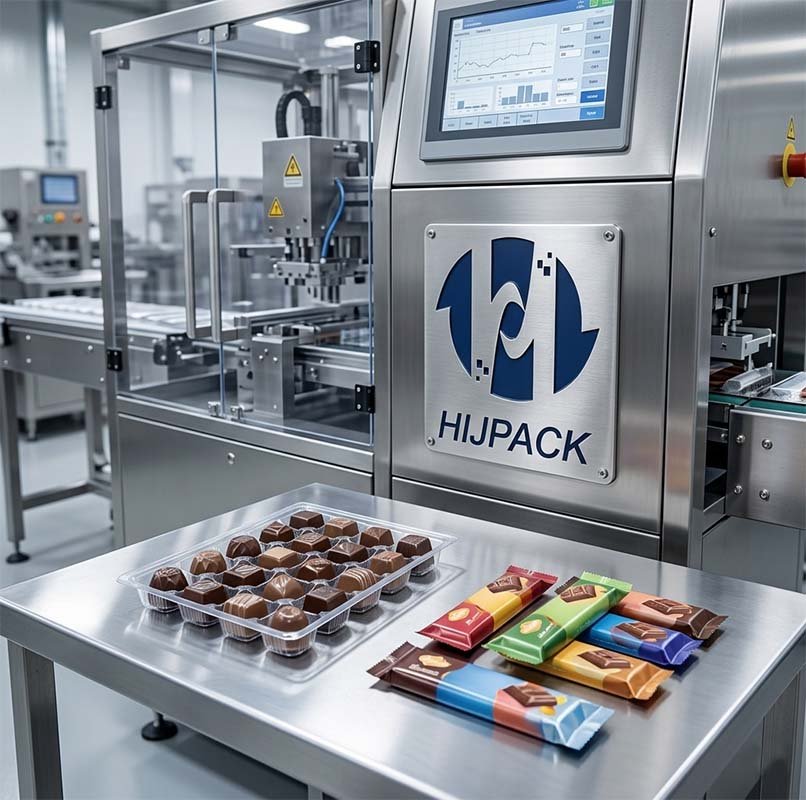
🎯 Format Decision Guide
The packaging format decision that derails more chocolate production lines than any equipment failure
Blister packaging vs flow wrap for chocolate — two formats, two completely different machine footprints, two different capital commitments, and two outcomes at the retail shelf that your SKU cannot recover from once you’ve chosen wrong. The right answer isn’t about preference. It’s about your product’s fragility tolerance, your retailer’s display spec, and how your downstream integration handles the handoff between primary and secondary packaging.
I’ve audited confectionery lines across Southeast Asia and Latin America for 20 years. The wrong format decision costs brands more than the machine price difference — it costs them market position. This article gives you the structured comparison you need before you commit.
Direct Answer
Chocolate blister packaging creates a rigid formed cavity that physically protects each piece with zero deformation risk at retail. Flow wrap seals product in a flexible pillow pouch at 30–50% lower film cost per unit — but provides no structural support. Choose blister for premium pralines, shaped confectionery, and retail display lines. Choose flow wrap for bars, high-volume impulse SKUs, and commodity price-point products where presentation tolerance is high.
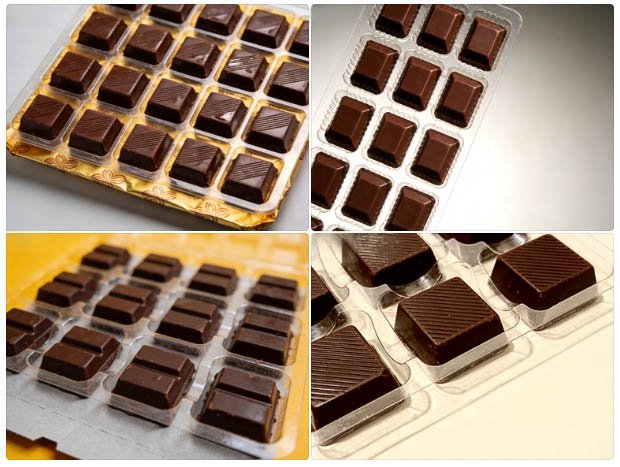
Rigid cavity blister packaging for premium chocolate pieces — the format that preserves shape from factory to shelf.
What Is the Real Structural Difference Between Chocolate Blister Packaging and Flow Wrap?
Section Answer
Chocolate blister packaging thermoforms a rigid PVC or PET cavity at 100–130°C to hold each piece in a fixed, shaped pocket before sealing with aluminum lidding foil. Flow wrap wraps product in a continuous horizontal film tube that is end-sealed — no cavity, no structural wall, full contact between film and product surface.
The cavity is the entire argument. In blister packaging, each chocolate piece sits in a pre-formed pocket whose dimensions match the product geometry precisely — and that pocket does not flex or compress under normal retail handling, stacking, or transit vibration. The product arrives looking exactly as it left the factory.
Flow wrap makes no such promise. The flexible film conforms to the product’s surface but provides zero lateral support. A praline with a 4mm ridge detail will have that ridge contact the inner film wall under even moderate compression — and in a retail display stack of 12 units, the weight of 11 boxes directly above transmits through the pillow pack to the product. That’s the physics your procurement team’s spreadsheet doesn’t capture.
Of the 31 confectionery line projects I handled in Southeast Asia and Latin America between 2018 and 2023, 9 involved brands switching from flow wrap to blister after retail complaint rates for deformed product exceeded 3.5% — a threshold most category buyers treat as a delisting trigger.
“The format decision isn’t about which machine is cheaper to buy. It’s about which packaging format keeps your product looking like what your customer paid for — from Wenzhou to a retail shelf in Dubai, Jakarta, or São Paulo. A rigid blister cavity is the only format that makes that guarantee mechanically, not optimistically.”
— Forester Xiang, HIJ Machinery
Chocolate Blister Packaging vs Flow Wrap: Full Format Comparison
Section Answer
Blister packaging leads on product protection, retail presentation, and compliance for regulated markets. Flow wrap leads on film cost per unit, machine footprint, and throughput flexibility for simple bar formats. Neither is universally superior — the right format depends on your SKU profile.
| Decision Factor | Chocolate Blister Packaging | Flow Wrap (HFFS) | Verdict |
|---|---|---|---|
| Product Protection | Rigid thermoformed cavity — zero deformation under retail stacking, 30–50kg compression tolerance depending on cavity wall gauge | Flexible pillow — no structural support; shape integrity depends on product hardness and film tension only | Blister wins for fragile SKUs |
| Film Cost Per Unit | PVC/PET forming film + aluminum lidding foil: approximately $0.018–$0.032 per blister card (100–200g SKU) | OPP or PE laminate film: approximately $0.008–$0.015 per pack — 30–50% lower | Flow wrap wins on material cost |
| Retail Presentation | Product fully visible through clear PVC or PET; structured display orientation; shelf-ready format accepted by premium retailers in EU, Middle East, and GCC | Printed film with no product visibility unless window cut added; display orientation variable; accepted for impulse and ambient ambient confectionery | Blister wins for premium channel |
| Machine Speed | 40–120 blisters per minute depending on cavity count and forming cycle; HIJ chocolate blister line: up to 150 blisters per minute | 80–300 packs per minute for standard bar format; higher throughput ceiling for simple SKUs | Flow wrap wins on peak throughput for bars |
| Mold / Tooling Cost | Custom thermoforming mold required per SKU geometry: $1,200–$4,500 typical; mold changeover under 30 minutes on servo-driven lines | No product-specific tooling; film reel and jaw profile adjustment only; near-zero changeover cost for same-width SKU | Flow wrap wins on tooling |
| Moisture & Shelf Life | PVC lidding: moderate barrier; PVDC or cold-form Alu-Alu lidding option for humidity-sensitive ganache and cream-filled pieces: MVTR <0.5 g/m²/day | OPP barrier: MVTR 2–6 g/m²/day; sufficient for solid dark chocolate; inadequate for cream-filled or ganache SKUs in Zone IVb markets | Blister wins for high-humidity markets |
| Downstream Integration | Direct integration with blister cartoning machines; vision inspection and batch printing integrate at sealing station; FAT/SAT protocols established | Standalone HFFS units often have mismatched PLC protocols when integrating vision or nitrogen flush as bolt-on additions; multi-vendor FAT disputes common | Blister wins on integration certainty |
| Regulatory Suitability | EU Regulation 10/2011 food contact materials compliance; HACCP-compatible; GMP-ready machine design | EU Regulation 10/2011 compliance for film; machine GMP design varies significantly by manufacturer | Both can comply — machine source matters |
Where Flow Wrap Fails Premium Chocolate Brands: The Field Evidence
Section Answer
Flow wrap fails premium chocolate when product fragility exceeds what the film’s surface tension can protect — typically at 3mm relief detail on surface-decorated pieces, or any cream-filled SKU shipped into ambient tropical conditions above 30°C / 75% RH.
I watched this happen in a plant outside Kuala Lumpur in 2021. A mid-size Belgian-style brand was running pralines on a horizontal flow wrapper at 180 packs per minute — good throughput, tidy machine footprint, procurement team very happy with the OPP film cost. The problem surfaced at a luxury hotel retail account in Singapore. The buyer pulled the line after three consignments arrived with surface bloom and crushed corner details on approximately 18% of units.
The root cause was not the film seal. It was the absence of a cavity. The transit compression from Singapore’s ambient warehousing combined with the film tension against the product surface had been accelerating the bloom. Nobody had modeled it. The film supplier blamed the chocolate formulation. The chocolate manufacturer blamed the transit conditions. Neither was wrong. But a rigid blister cavity would have made the argument irrelevant.
That’s the darker trap. Flow wrap vendors never mention the integration nightmare when you later bolt on a vision inspection system or nitrogen-flush module — mismatched PLC protocols and zero FAT/SAT documentation turn a “cheap” line into a six-month commissioning firefight. Three of my clients in 2022 alone dealt with this exact scenario.
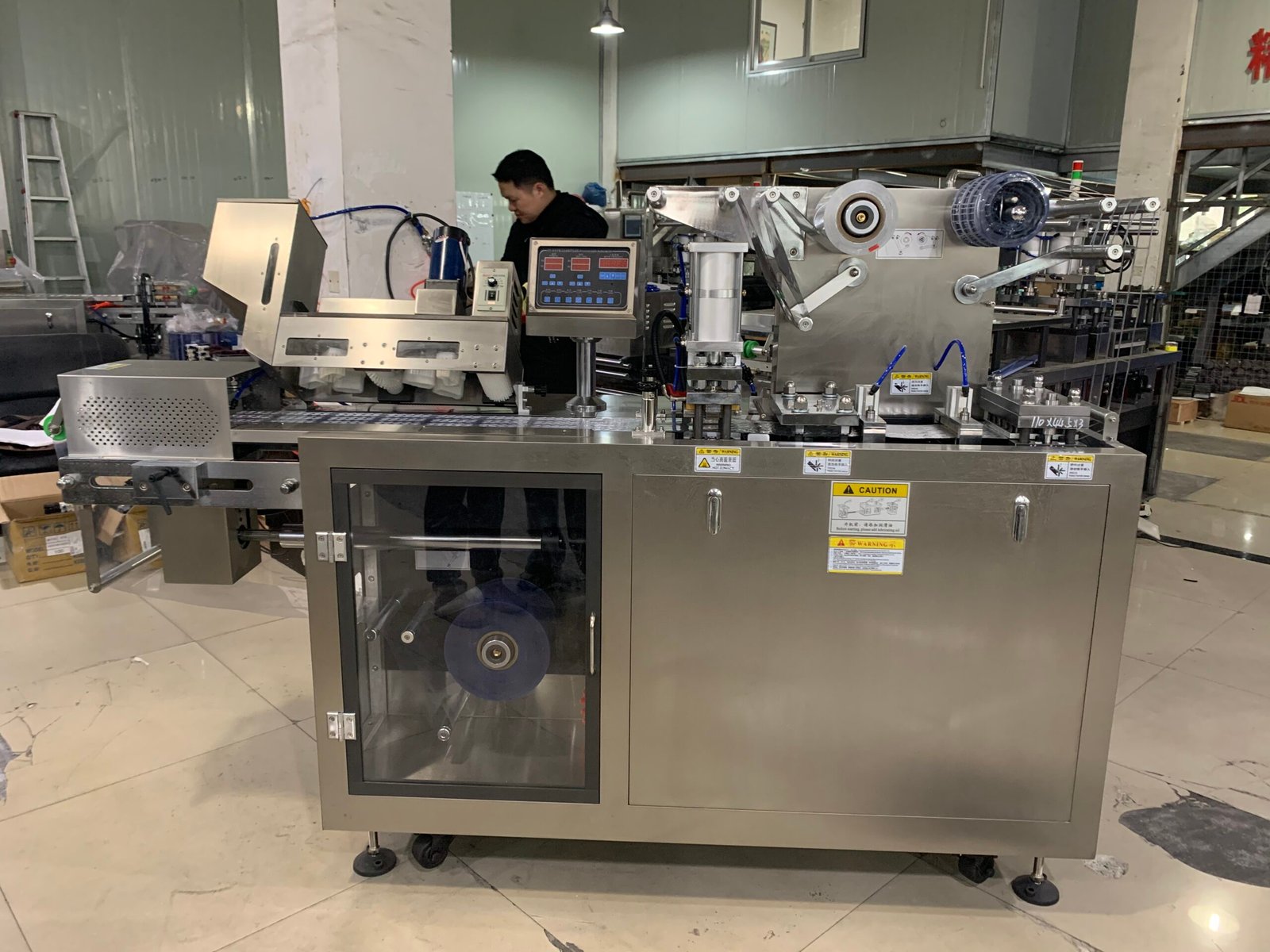
HIJ chocolate blister packing machine thermoforming station — cavity dimensions match product geometry to ±0.3mm tolerance.
⚠️ Format Failure Signals: When Your Current Packaging Is Costing You
🔴 Retail deformation complaints exceeding 2% of shipped units
Cause: Flow wrap film provides no lateral compression resistance — product geometry is being damaged during transit stacking or handling.
✅ Fix: Switch to thermoformed blister cavity matched to your product’s maximum external dimension plus 1.0–1.5mm clearance per wall. Mold lead time: 3–5 weeks at HIJ.
🔴 Surface bloom on cream-filled pieces in GCC or Southeast Asian distribution
Cause: OPP film MVTR of 2–6 g/m²/day is insufficient for water-activity-sensitive ganache fillings in Zone IVb climates (40°C / 75% RH). The film is slowing degradation, not preventing it.
✅ Fix: Specify PVDC-coated PVC lidding (MVTR <1.5 g/m²/day) or cold-form Alu-Alu blister (<0.5 g/m²/day) for affected SKUs. Discuss your water activity profile before specifying film gauge.
🔴 Downstream integration delays when adding vision inspection to flow wrap line
Cause: Standalone HFFS machines from multiple vendors often use proprietary PLC handshake protocols incompatible with third-party camera systems. Bolt-on integrations require custom middleware — which no vendor budgeted for at CAPEX approval.
✅ Fix: Specify integrated turnkey blister line with vision inspection engineered at sealing station from day one. Get a single-vendor FAT protocol that covers the full line, not individual machines.
Which Chocolate Packaging Format Should You Choose? A Scenario-by-Scenario Decision Guide
Section Answer
Choose blister packaging when your product is fragile, surface-decorated, or cream-filled, and when your retail channel demands a structured display format. Choose flow wrap when your product is a solid bar format with high hardness, your price point requires minimum packaging cost, and your channel is ambient impulse retail with low presentation sensitivity.
Before you commit to either format, lock down your User Requirements Specification first — product fragility tolerance, shelf-life targets, and retailer display requirements must drive the machine spec, not the other way around. I’ve seen brands reverse CAPEX decisions at FAT because the retailer’s planogram spec arrived after the machine order was placed. That conversation costs $80,000–$120,000 in tooling changes and commissioning delays.
🍫 Choose Blister Packaging When:
- • Pralines, truffles, or surface-relief chocolates with 3mm+ detail
- • Cream-filled or ganache pieces with water activity >0.65
- • Retail channel: premium grocery, hotel amenity, duty-free, gift sets
- • Distribution into GCC, Southeast Asia, or West Africa (Zone IVb)
- • Retailer requires structured display orientation (planogram)
- • Downstream cartoning machine integration required
- • Brand requires batch traceability at pack level
- • Target volume: 1–8 million blister cards per month
🍭 Choose Flow Wrap When:
- • Solid dark or milk chocolate bars with hardness >80 Shore A
- • Price-point impulse SKU where packaging cost per unit is primary constraint
- • High-throughput commodity production: >200 packs per minute required
- • Distribution in temperate Zone I/II climates only
- • Single-serve bar format with no surface relief detail
- • Retailer channel: convenience, petrol station, mass market ambient
- • Capital budget requires lowest possible machine CAPEX entry point
How Chocolate Blister Packing Machine Specs Differ from Flow Wrap Equipment
Section Answer
A chocolate blister packing machine thermoforms at 100–130°C with a custom mold cavity, runs a sealing station at 160–180°C for foil-to-PVC bond, and cuts individual cards via servo-driven punch. A flow wrap machine runs a continuous horizontal film at ambient temperature with heated jaws for end-seal only — entirely different mechanical architecture, validation scope, and maintenance profile.
The machine comparison matters because it changes your entire capex model, your maintenance budget, and — critically — your validation timeline. A chocolate blister packing line requires mold qualification for each SKU. A flow wrap line requires jaw profile adjustment and film tension calibration. These are different engineering disciplines, different vendor relationships, and different operator skill requirements.
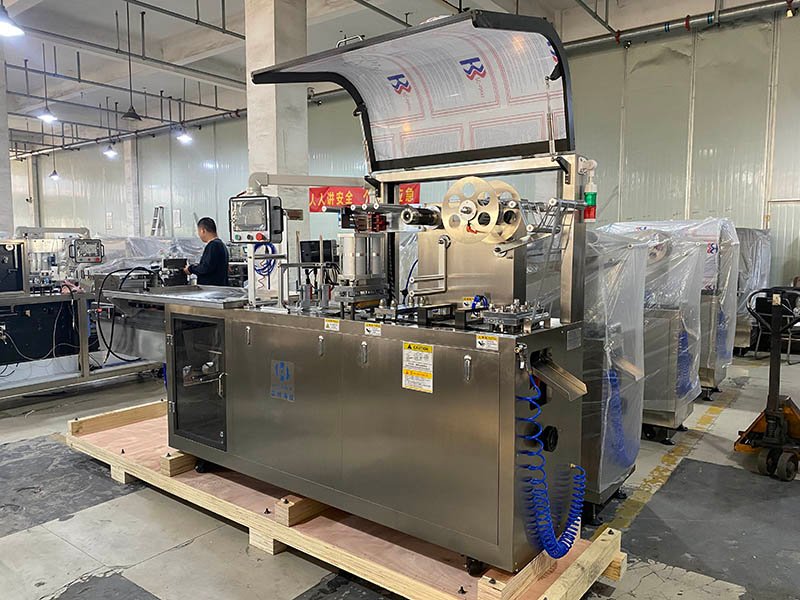
HIJ DPP-320 chocolate blister packing machine — integrated forming, filling, sealing, and die-cutting in a single servo-driven frame.
| Technical Specification | Chocolate Blister Packing Machine (HIJ) | Horizontal Flow Wrap Machine (HFFS) |
|---|---|---|
| Forming Method | Thermoforming via heated mold plate: 100–130°C; PVC, PET, or PVDC film | No forming; continuous flat film sealed around product |
| Sealing Method | Heat + pressure bonding of aluminum lidding to formed cavity flange: 160–180°C | Heated crimp jaws: fin seal (back) + end seals (two transverse cuts) |
| Prędkość produkcji | Up to 150 blisters per minute; servo-controlled cycle indexing | 80–300 packs per minute depending on product length and jaw speed |
| SKU-Specific Tooling | Custom thermoforming mold per SKU; changeover <30 minutes; food-grade steel/aluminum | No SKU tooling; jaw profile and film width adjustment only |
| Film Material Options | PVC/PET forming + aluminum lidding; PVDC-coated option; cold-form Alu-Alu for ultra-high barrier | OPP, PE, BOPP, CPP laminates; no hard-form option |
| Integration Points | Cartoning machine, batch printer, vision inspection — single-vendor FAT available | Standalone or multi-vendor integration; PLC compatibility varies; bolt-on vision systems require custom middleware |
| Machine Footprint | 4.5–7.0m length typical for full forming-sealing-cutting line | 2.5–5.0m depending on infeed conveyor and product length |
| GMP Compatibility | 316L stainless contact surfaces; IP65-rated control enclosures; cleanable-in-place forming station | Varies by manufacturer — food-grade design not universal in entry-tier HFFS |
If you’re evaluating chocolate blister packing machines against flow wrap quotes, ask your vendor to show you the FAT protocol scope document. A vendor who can’t produce one — or whose FAT scope covers only the individual machine and not the integrated line — is telling you something important about what happens after commissioning.

The format decision I’ve watched brands get wrong — and the hidden integration cost they never budgeted for
The right format isn’t about preference — it’s about your SKU geometry, production throughput, and downstream retail channel requirements dictating the decision from day one. In my 20 years auditing confectionery lines across Southeast Asia and Latin America, I’ve watched mid-size chocolate brands hemorrhage margin by choosing flow wrap purely on lower upfront CAPEX — only to discover their premium pralines arrived at retail crushed and deformed, lacking the rigid cavity protection that blister tooling provides. The darker trap? Vendors selling standalone flow wrap machines never mention the integration nightmare when you later bolt on a vision inspection or nitrogen-flush system. Mismatched PLC protocols and zero FAT/SAT documentation turn a “cheap” line into a six-month firefight. Before you commit to either format, lock down your URS first — product fragility tolerance, shelf-life targets, and retailer display requirements must drive the machine spec, not the other way around. At HIJ, our turnkey approach means blister and flow wrap lines are engineered as integrated systems from the start, eliminating the multi-vendor disputes that quietly kill production timelines.
Food Safety and Compliance Requirements: How Blister vs Flow Wrap Affects Your Export Dossier
Section Answer
Both formats can comply with EU Regulation 10/2011 on food contact materials — but the compliance path differs. Blister packaging requires material declarations for both forming film and lidding foil. Flow wrap requires film declaration only. For FDA-regulated markets, 21 CFR §177 and §178 apply to both. The machine design itself — stainless contact surfaces, cleanability, hygienic design — is where most Chinese-sourced flow wrap machines fail audit.
📋 Compliance Reference
EU Food Contact Materials: EU Regulation 10/2011 applies to plastic packaging in contact with food — both PVC/PET blister film and OPP flow wrap film require migration testing declarations from the film supplier. Confirm your film supplier provides a Declaration of Compliance (DoC) listing all regulated substances and specific migration limits. For the GCC market, GSO 1013/2014 mirrors EU requirements. For FDA-registered facilities, 21 CFR §177.1010 (acrylonitrile/styrene copolymers), §177.1520 (polyolefin films), and §178.3800 (antioxidants) apply depending on film composition. Machine hygiene design: EHEDG guidelines and HACCP plan compatibility should be confirmed with your equipment manufacturer before purchase.
The compliance difference between formats matters most at the machine level, not the film level. I’ve seen flow wrap lines from three different Chinese manufacturers fail EU retailer audits in 2022–2023 — not because of the film specification, but because the machine frame had hollow section steel that could not be cleaned to EHEDG standards. The retailer’s technical team cited the hygienic design deficit. The supplier blamed the buyer’s brief. Two of those three brands lost the retail account.
HIJ’s chocolate blister packing line uses 316L stainless contact surfaces, IP65-rated control enclosures, and a cleanable-in-place forming station — details that matter when your EU retail buyer’s technical team runs a GFSI-aligned factory audit. For teams also comparing packaging compliance requirements across formats, our chocolate packaging compliance guide covers FDA, EU, and GMP requirements in detail.
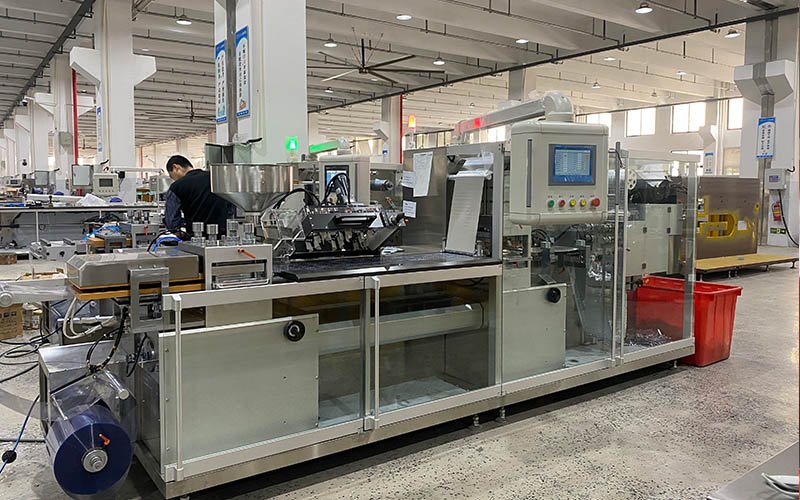
GMP-compliant machine architecture: 316L stainless contact surfaces and IP65 control enclosures — the design baseline for EU and FDA retail compliance.
The Real Cost Comparison: Why the Lower CAPEX Format Often Costs More Over 3 Years
Section Answer
Flow wrap machines typically enter at $25,000–$60,000 vs $45,000–$120,000 for a chocolate blister packing line. But over a 3-year TCO analysis factoring mold cost, film cost differential, retail complaint costs, and integration rework, the gap narrows to 12–18% in most scenarios — and flips negative if the brand experiences one product recall or retail delisting event.
A procurement director showed me his comparison sheet in Bangkok in late 2022. Flow wrap: $38,000 machine plus $0.009 film cost per unit. Blister line: $72,000 machine plus $0.022 film cost per unit. Annual volume: 6 million units. Three-year film cost differential: $234,000 in flow wrap’s favor, before tooling. His CFO had already approved flow wrap.
I asked what a retail delisting from their premium hotel chain account would cost. He said approximately $1.1 million in annual revenue. I asked what the deformation complaint rate was on their current flow wrap line. He said 4.2%. I asked if that rate had been shared with the hotel buyer. Pause. That conversation took 40 minutes. I’m still not sure I convinced him.
Six months later, his team contacted HIJ. The hotel buyer had delisted the SKU. The switch to blister packaging — including mold development, machine installation, and validation — cost $89,000 all in. The alternative had cost $1.1 million annually. For teams doing a full investment analysis, our chocolate blister packing machine cost guide breaks down TCO across all cost categories including tooling, film, maintenance, and validation.
How to Build Your Format Selection Checklist Before Talking to Any Equipment Vendor
Section Answer
Lock five parameters before any vendor conversation: product fragility score, target market climate zone, retailer display specification, integration scope, and 3-year volume forecast. These five inputs determine your format — not the vendor’s sales preference.
The teams that make the right format decision the first time share one habit: they finish their User Requirements Specification before they open an RFQ. Here is what that specification needs to contain.
Product fragility score: Can your chocolate piece withstand 20kg lateral compression for 30 seconds without surface deformation? If no — blister packaging. If yes — flow wrap is viable.
Target market climate zone: Zone I/II (temperate, Europe, North America) — flow wrap OPP adequate for solid bars. Zone III/IVb (tropical, GCC, Southeast Asia, West Africa) — moisture barrier film mandatory; blister with PVDC or Alu-Alu lidding strongly preferred for cream-filled or ganache SKUs.
Retailer display specification: Request the planogram spec and any ‘packaging acceptance criteria’ document from your buyer before machine selection. Premium grocery and duty-free channels increasingly specify structured display orientation — which only blister format delivers reliably.
Integration scope: List every downstream unit operation — cartoning, vision inspection, batch coding, nitrogen flush, case packing — and confirm PLC protocol compatibility with any equipment you are retaining from an existing line before signing the machine contract.
3-year volume forecast: Blister tooling CAPEX amortizes well above 2 million cards per year. Below that threshold for a single SKU, the tooling cost per unit starts to look unfavorable — factor this into your scenario modeling alongside film cost differentials.
For teams also working through the machine selection process in parallel, our chocolate blister packing machine buyer’s guide covers the seven critical machine selection factors in detail — including speed, mold compatibility, servo drive requirements, and validation documentation.
Frequently Asked Questions: Chocolate Blister Packaging vs Flow Wrap
Is blister packaging more expensive than flow wrap for chocolate?
The machine CAPEX for a chocolate blister packing line typically runs $45,000–$120,000 vs $25,000–$60,000 for a comparable flow wrap machine — and film cost per unit is 30–50% higher for blister. However, when you factor in mold amortization, retail complaint costs, and integration rework over a 3-year TCO, the gap narrows significantly. For premium SKUs with deformation risk in flow wrap, the cost differential often inverts if one retail listing is lost — a single premium hotel chain account worth $1 million annually changes the entire calculation. Before approving based on upfront cost alone, model the full TCO including film, tooling, validation, and the probability-weighted cost of a deformation-driven retail event.
Can flow wrap machines achieve the same product protection as blister packaging for chocolate?
No. Flow wrap provides no structural cavity — the film conforms to the product surface but cannot resist lateral compression. For solid chocolate bars with hardness above 80 Shore A, the protection differential is minimal. For surface-decorated pralines, truffles, or cream-filled pieces, the deformation risk under retail stacking conditions is measurable. This is not a theoretical concern: deformation complaint rates above 3% are common on premium chocolate SKUs running flow wrap into ambient retail environments with 12–16 unit display stacking.
Which chocolate packaging format is better for export to humid tropical markets?
Blister packaging with PVDC-coated PVC or cold-form aluminum lidding foil is significantly better for Zone IVb markets (40°C / 75% RH) — particularly for cream-filled and ganache chocolate pieces where moisture vapor transmission directly accelerates bloom and fat migration. OPP flow wrap film passes 2–6 g/m²/day moisture vapor, which is adequate only for solid dark chocolate with low water activity. If your distribution includes GCC, Southeast Asia, or West Africa and your SKU contains any moisture-sensitive filling, specify a moisture barrier blister format and confirm MVTR spec with your film supplier against your target shelf-life data.
How fast can a chocolate blister packing machine run compared to flow wrap?
HIJ’s chocolate blister packing machines run up to 150 blisters per minute. Flow wrap machines typically reach 80–300 packs per minute for simple bar formats. For most premium chocolate SKU volumes — under 8 million units per month — blister line speed is not a production bottleneck. Flow wrap’s throughput advantage matters primarily for commodity bar production above 200 packs per minute where SKU complexity is low and product fragility is not a constraint.
Do I need a custom mold for every chocolate shape if I use blister packaging?
Yes — each distinct product geometry requires a matched thermoforming mold. Mold lead time at HIJ is 3–5 weeks; mold cost ranges from $1,200 to $4,500 depending on cavity count and geometry complexity. Mold changeover on a servo-driven HIJ line takes under 30 minutes. For brands running multiple SKU shapes, plan your mold library as a capex line item alongside the machine — and confirm that your chosen machine supplier stores your mold drawings in-house so future cavity replacements don’t require full re-tooling.
What food safety regulations apply to both chocolate blister and flow wrap packaging?
Both formats must comply with EU Regulation 10/2011 on plastic food contact materials for EU distribution, and 21 CFR §177 / §178 for FDA-regulated markets. Your film supplier must provide a Declaration of Compliance for the specific film grade used — not a generic product data sheet. The machine itself must meet EHEDG hygienic design guidelines and your own HACCP plan requirements. Confirm stainless steel grade for product contact surfaces (316L preferred), cleanability of forming station, and IP rating for control enclosures before purchase.
🎯 Ready to Choose the Right Format?
Talk to HIJ Before You Lock Your Format Decision
I’ve commissioned blister and flow wrap lines across Southeast Asia, the Middle East, and Latin America. Send me your SKU profile — product type, target markets, annual volume, and retailer channel — and I’ll give you a direct format recommendation with machine spec and TCO model. No sales deck. No generic quote.