
















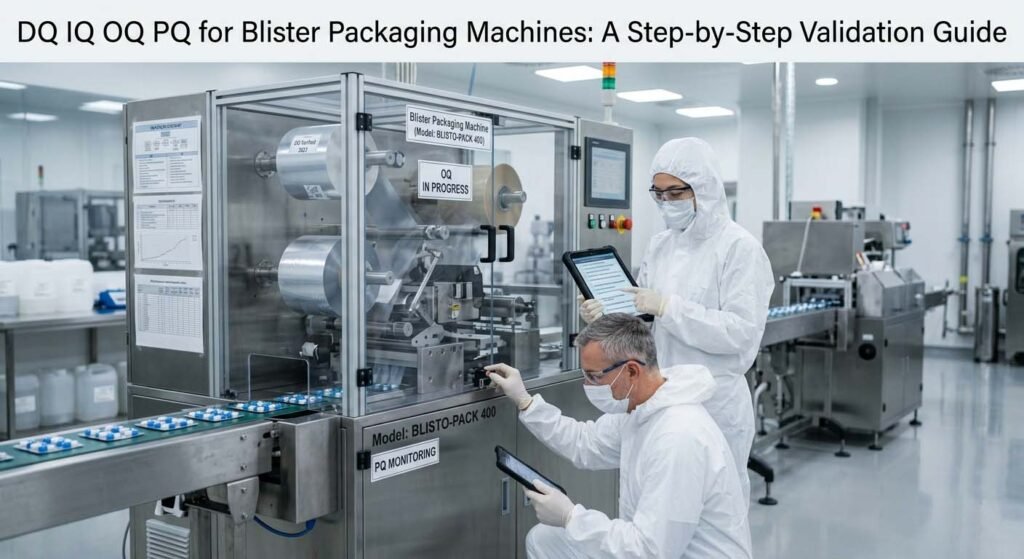
You have invested six figures in a new blister packaging line. Your U.S. registration timeline is locked. Your commercial launch date is set. Then your FDA inspector walks in, opens the audit trail on your HMI, and asks a single question: “Show me the complete, unmodified electronic batch record for lot 2024-XY-003, including every parameter change, who made it, and the exact timestamp.”
If your machine cannot answer that question instantly — with cryptographically protected, non-repudiable data — your line is not 21 CFR Part 11 compliant. It doesn’t matter what the vendor’s brochure says. What matters is what the machine actually does on the floor, under audit pressure, at 2 AM when a deviation report is raised. This guide was written to close that gap.

Forester Xiang — Founder, HIJ Machinery | 20 Years Pharma Packaging Engineering
- The Direct Answer: DQ, IQ, OQ, and PQ are not bureaucratic paperwork — they are your legal and operational shield. Skipping or rushing any single phase is the fastest way to fail an FDA or EU GMP audit and halt your entire production line.
- The Field Experience: “In my 20 years commissioning blister packaging lines across pharmaceutical plants in Southeast Asia and Latin America, I’ve seen the same catastrophic mistake repeated. Procurement teams approve a machine based on price, then discover the vendor cannot provide a single traceable URS or FAT protocol. The DQ phase collapses immediately. Worse, some suppliers deliver equipment with completely undocumented PLC ladder logic — making OQ acceptance criteria and PQ statistical sampling plans impossible to execute. One client in Colombia spent nine months and an additional $180,000 USD attempting to reverse-engineer validation documentation for a ‘budget’ machine. That machine sat idle for three quarters. The so-called savings evaporated on the first regulatory inspection.”
- The Hidden Trap: Many suppliers will hand you a generic IQ template downloaded from the internet and call it “validation support.” The trap is that a generic IQ checklist references no machine-specific instrument calibration tags, no equipment serial numbers, no utility connection verification against your site’s P&ID drawings, and no vendor-specific FAT acceptance data. When your QA auditor cross-references the IQ against the actual installed equipment, every discrepancy becomes a formal observation — and observations delay product release. Demand machine-specific, protocol-driven documentation. At HIJ, our maszyny do pakowania w blistry ship with complete cGMP-compliant validation dossiers and dedicated FAT/SAT support, eliminating multi-vendor finger-pointing and keeping your qualification timeline on track.

What Are DQ, IQ, OQ, and PQ? The Four-Phase Validation Framework Explained
The validation of pharmaceutical packaging equipment is governed by a globally recognized four-stage qualification framework, codified in ICH Q7, EU Annex 15, and the FDA’s 2011 Process Validation Guidance. Each stage builds upon the previous and together they form an unbroken chain of documented evidence that your maszyna do pakowania w blistry is correctly selected, correctly installed, performs within defined operational limits, and consistently produces output that meets your product’s quality specifications. Understanding what each phase demands — and what evidence it must generate — is the first line of defense against regulatory findings.
The framework is sequential and interdependent. You cannot meaningfully execute an IQ without an approved DQ. You cannot run an OQ without a completed and signed-off IQ. And you absolutely cannot perform a PQ without verified OQ data confirming that the process window is defined and stable. Regulators treat this sequencing as non-negotiable. Attempting to compress phases or execute them in parallel — a common cost-cutting tactic — creates documentation gaps that inspectors are specifically trained to identify during Pre-Approval Inspections (PAIs) and routine GMP audits.
DQ — Design Qualification
Documented verification that the proposed design of the equipment meets all defined User Requirements (URS). Executed before purchase order.
- URS vs. Functional Design Spec (FDS) traceability matrix
- cGMP compliance gap analysis
- Material contact surface verification (316L SS, USP Class VI)
- Regulatory jurisdiction compliance check (FDA / EU GMP / WHO)
IQ — Installation Qualification
Documented evidence that the equipment has been installed correctly in accordance with its specifications and manufacturer’s recommendations.
- Equipment identification (serial #, model, software version)
- Utility connections vs. P&ID verification
- Calibration status of all critical instruments
- Spare parts and lubricant inventory documentation
OQ — Operational Qualification
Documented evidence that the equipment operates within predefined operational limits across its full design range, including worst-case scenarios.
- Temperature / pressure / speed setpoint verification
- Alarm and interlock functional testing
- 21 CFR Part 11 audit trail verification
- Worst-case high / low boundary testing with statistical acceptance criteria
PQ — Performance Qualification
Documented evidence that the process, operated within established parameters, consistently produces a product meeting all predetermined specifications.
- Minimum 3 consecutive production batches
- Seal integrity testing (dye ingress, vacuum decay)
- Blister leak rate and burst strength data
- In-process and final product sampling plans (AQL per ISO 2859)
Phase 1 — Design Qualification (DQ): Getting the Right Machine Before You Buy
Design Qualification is the phase that separates disciplined pharmaceutical procurement from speculative purchasing. The DQ begins with a finalized User Requirements Specification (URS) — a controlled document authored by your QA, engineering, and production teams that defines every functional, technical, and regulatory requirement the blister packaging machine must satisfy. The URS is not a wish list; it is a binding specification against which every supplier proposal is scored in a formal DQ assessment.
A rigorous DQ for a pharma blister packaging machine will typically address the following domains: product contact materials (all surfaces in contact with product or primary packaging material must be 316L stainless steel or validated polymers compliant with USP Class VI, FDA 21 CFR 177, or equivalent); environmental suitability (the machine design must be compatible with your cleanroom classification — typically ISO 7 or ISO 8 — with respect to particle shedding, cleanability, and smooth-surface construction per cGMP structural design guidelines); control system architecture (PLC and HMI specifications must define the required electronic batch record capabilities, including 21 CFR Part 11 compliance features: user authentication, electronic signatures, immutable audit trail, role-based access control, and encrypted data storage); and output and OEE targets (the DQ must specify minimum rated speed, nominal speed, target Overall Equipment Effectiveness %, and acceptable reject rates expressed as Defects Per Million Opportunities — DPMO).
Critically, the DQ must result in a signed traceability matrix — a document that cross-references every URS requirement to the corresponding clause in the supplier’s Functional Design Specification (FDS) or equipment specification sheet, with objective evidence that each requirement is met, partially met, or not met. Any “partially met” or “not met” item must be resolved via a formal deviation or change request before the Purchase Order is issued. At HIJ, our engineering team works collaboratively with customers to execute this traceability matrix as part of our pre-order technical review process — because a machine built to your exact URS is the only machine worth commissioning.

Phase 2 — Installation Qualification (IQ): Building the Documented Foundation
Installation Qualification is the systematic, documented verification that the blister packaging machine has been delivered, assembled, and installed exactly as specified — and that every instrument and utility connection that affects product quality has been confirmed against approved engineering documents. IQ is not an unboxing checklist. It is a formal GMP record that becomes a permanent part of your equipment qualification file.
A cGMP-compliant IQ protocol for a blister packaging machine will typically cover the following critical elements:
| IQ Check Item | Acceptance Criterion | Evidence Required | Priority |
|---|---|---|---|
| Equipment Identification | Serial no., model no., software version match approved specs | Equipment nameplate photo, software version screenshot | Critical |
| Material Contact Surfaces | 316L SS certificate or USP Class VI polymer CoA on file | Mill certificates, CoA, surface roughness Ra ≤0.8 µm | Critical |
| Utility Connections (Electrical) | Voltage, frequency, amperage match P&ID and machine spec | Electrical panel verified against approved wiring diagram | Critical |
| Compressed Air Supply | Pressure: 0.5–0.8 MPa, dry, oil-free, per ISO 8573-1 Class 1 | Compressed air quality test certificate, gauge calibration tag | Critical |
| Instrument Calibration Status | All critical instruments calibrated with valid NIST-traceable certificate | Calibration tags on all temperature sensors, pressure transducers, load cells | Critical |
| Lubricant Verification | Only food-grade (NSF H1) or approved lubricants used near product contact zones | Lubrication schedule and product CoA on file | Standard |
| Safety Interlock Verification | All guards, E-stops, and safety circuits functional per machine safety manual | Safety check test results with pass/fail record | Critical |
| Spare Parts & Documentation | Approved spare parts list, SOPs, and operator manuals received and filed | Received goods checklist signed by QA and Engineering | Standard |
One of the most overlooked IQ items is the calibration status of thermocouple temperature sensors at the forming and sealing stations. These sensors directly control the heating plate temperature — the single most critical process parameter in thermoforming blister production. If the thermocouple reading drifts even ±3°C from calibrated value, your forming depth and seal integrity data become suspect, and your OQ thermal mapping study is invalidated. Every HIJ machine ships with factory-calibrated temperature sensors and full calibration certificates included in the IQ documentation package.
Phase 3 — Operational Qualification (OQ): Defining and Proving Your Process Window
Operational Qualification is where the validation effort transitions from documentation review to live equipment testing. The OQ protocol defines a series of structured experiments designed to prove that the blister packaging machine operates consistently and reproducibly within its specified operational range — including, critically, at worst-case boundary conditions. The OQ does not run with your commercial product; it runs with representative materials (or qualified placebo/surrogate materials) under conditions that stress the process to its design limits.
For a pharmaceutical blister packaging machine, the OQ test matrix will typically span the following critical process parameters (CPPs):
- Forming Station Temperature: Three setpoints tested — nominal, nominal −5°C (worst-case low), nominal +5°C (worst-case high). Each setpoint must achieve temperature uniformity ±2°C across the full forming platen width, with a minimum 10-minute soak time at each setpoint before data collection. Acceptance criterion: forming depth CV ≤3% across all cavities within a single blister card.
- Sealing Station Temperature and Dwell Time: Heat-seal integrity is the primary product protection parameter. OQ must demonstrate seal strength (N/15 mm peel force per ASTM F88) meets acceptance criteria across the full sealing platen at both high and low boundary temperatures and at minimum and maximum machine speeds (cycles per minute).
- Machine Speed (CPM — Cycles Per Minute): Tested at minimum rated speed, nominal production speed, and maximum rated speed. For each speed setpoint: tablet/capsule miscount rate must be zero; empty blister detection system sensitivity must be verified; and reject system actuation accuracy must be confirmed (no false rejects, no missed rejects).
- Alarm and Interlock Functional Testing: Every alarm condition defined in the machine’s Functional Design Specification must be deliberately triggered and its response documented. This includes temperature deviation alarms, material web break detection, empty blister detection reject confirmation, and E-stop response time.
- 21 CFR Part 11 Audit Trail Integrity: For any machine supplying product to the U.S. market — or any market accepting FDA-standard documentation — the OQ must include a dedicated protocol section verifying that the electronic batch record system creates immutable, time-stamped, user-attributed records for every parameter change, alarm event, and production start/stop. Attempts to modify or delete records must be tested and must fail.
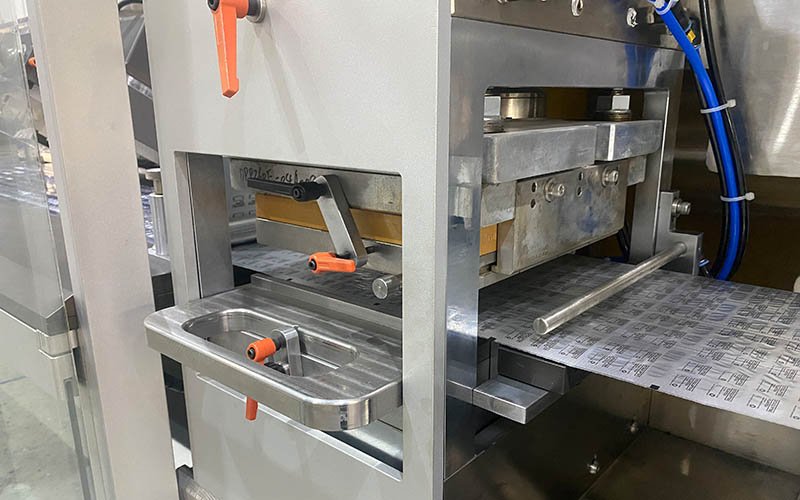
The OQ is also the phase where your engineering team must formally validate the mold changeover procedure — a critical operational parameter that is frequently underestimated. For high-mix production environments, the OQ should include a timed, documented mold change study with verification that post-change forming geometry meets specification (cavity depth tolerance ±0.1 mm) and that the warm-up protocol is sufficient to restore thermal uniformity to OQ acceptance criteria before production resumes. HIJ’s quick-change mold system, available across our DPP-250 oraz DPP-260 platforms, reduces changeover time to under 30 minutes — and ships with a pre-written OQ mold change procedure as standard.
Phase 4 — Performance Qualification (PQ): The Proof That Your Process Is in Control
Performance Qualification is the final — and most commercially consequential — phase of the blister packaging machine validation lifecycle. Where OQ proves the machine can operate within defined parameters using representative materials, PQ proves that the complete process, operated by your production personnel under real manufacturing conditions, consistently produces product that meets every predefined quality attribute. PQ is the document your regulatory authority will review most intensely during a Pre-Approval Inspection.
The global pharmaceutical industry standard for PQ of packaging equipment requires a minimum of three consecutive, successful production batches — with batch size equivalent to or representative of commercial batch size. “Consecutive” is critical: the three batches must be executed without interruption for process adjustments that fall outside the approved operating range. Any such adjustment constitutes a process change, resets the batch count, and requires documented deviation investigation before restarting the PQ sequence.
For each PQ batch, the protocol must define and collect objective evidence for the following:
Seal Integrity Testing
The gold standard method is vacuum decay leak testing per ASTM F2338 or dye ingress testing per ASTM F1929. A defined sampling plan (typically AQL Level II, normal inspection per ISO 2859-1) must be executed at defined intervals — beginning of batch, middle of batch, end of batch, and after any planned stoppage exceeding the defined limit. Accept/reject criteria for seal integrity must be pre-specified in the PQ protocol before data collection begins.
Burst Strength / Peel Force (ASTM F88)
Minimum peel force (N/15 mm) must be specified based on your product’s primary packaging material specification. Statistical analysis (Xbar-R control charts, Cpk calculation) must demonstrate that the process is in statistical control and that the process capability index Cpk ≥1.33 for the sealing parameter.
Count and Fill Accuracy
For tablet and capsule blister packing, 100% in-process vision inspection data (empty cavity detection rejection rate, double-fill detection) must be collected and reconciled against the batch yield. Maximum acceptable empty blister rate post-inspection must be pre-defined (typically 0 units per batch for controlled substances, ≤0.01% for OTC products).
Print Verification (Lot Number / Expiry Date)
Every blister card must carry a legible, correctly formatted lot number and expiry date. PQ must include a documented verification of print contrast, character legibility (100% camera inspection data or manual AQL sampling), and correct date-code programming. Incorrect or illegible coding is a critical GMP deficiency under EU Annex 11 and 21 CFR 211.68.
Process Capability (Cpk) Analysis
The PQ summary report must include a statistical process capability analysis for all critical quality attributes (CQAs). Cpk ≥1.33 (equivalent to ≤64 DPMO at ±4σ) is the minimum acceptable threshold for a validated pharma packaging process. Results below this threshold constitute a PQ failure and require root cause investigation before the line may be released for commercial production.
The Multi-Vendor Documentation Nightmare vs. the HIJ Turnkey Validation Advantage
The single most common cause of blister packaging line qualification delays — in my direct experience across more than 100 pharma facilities globally — is not technical failure. It is documentation fragmentation caused by multi-vendor procurement. A typical scenario unfolds like this: the blister machine is sourced from Supplier A; the vision inspection system is integrated by Supplier B; the downstream blister cartoning machine is from Supplier C; the conveyor and track system is from Supplier D. When the IQ team arrives on site, they discover that the vision system’s PLC communicates over Modbus TCP/IP while the blister machine’s Siemens S7 PLC uses PROFINET — and nobody specified the integration protocol in the URS. The audit trail is fragmented across three separate HMIs. OQ testing is impossible to execute as a unified system.
⚠ Multi-Vendor Procurement Pitfalls
- Fragmented audit trails across multiple HMIs — 21 CFR Part 11 compliance impossible to prove as integrated system
- No single vendor accountable for IQ/OQ/PQ documentation package completeness
- Communication protocol mismatches between machines discovered post-installation
- Generic, non-machine-specific IQ/OQ templates provided by individual suppliers
- FAT executed separately for each machine — no integrated line FAT possible
- Warranty voids blamed on adjacent vendor’s equipment during fault events
- Qualification timeline extended 4–9 months beyond original project plan
✓ HIJ Turnkey Validation Standard
- Single unified PLC/HMI architecture across the entire blister line — one audit trail, one validation
- Machine-specific IQ/OQ/PQ protocol templates pre-written for each HIJ machine platform
- Factory Acceptance Test (FAT) executed at HIJ facility with full protocol and sign-off documentation
- Site Acceptance Test (SAT) supported by HIJ engineers on-site at customer facility
- cGMP-compliant structural design with surface roughness certification and material contact documentation included
- Single point of contact for all validation queries — eliminating multi-vendor finger-pointing
- Qualification timeline reliably on-track — average 6–8 weeks from SAT to PQ completion
Nasz Turnkey Packaging Solutions are engineered specifically to eliminate the documentation fragmentation problem. When you procure a complete blister-to-carton line from HIJ — including the Alu-Alu blister packing machine, blister cartoning machine, and downstream case packing — every machine is built to a common electrical and pneumatic standard, communicates over a pre-tested communication protocol, and ships with a unified validation dossier. One FAT. One validation package. One accountable vendor.

FAT, SAT, and 21 CFR Part 11: The Technical Integration Points Most Engineers Underestimate
Factory Acceptance Testing (FAT) is the pre-shipment validation checkpoint executed at the machine manufacturer’s facility. A properly executed FAT runs the core elements of the OQ protocol — under controlled conditions at the factory — before the equipment ever leaves the building. This means temperature uniformity mapping of the forming and sealing stations, alarm and interlock functional testing, and a full 21 CFR Part 11 audit trail demonstration. The FAT report becomes the first objective evidence document in your IQ/OQ file, and it dramatically reduces the risk of discovering critical design deficiencies after the machine has been installed in your cleanroom.
Site Acceptance Testing (SAT) is the on-site re-verification executed after installation and IQ completion. The SAT confirms that transportation and installation have not introduced any changes to the equipment’s calibration or performance status verified during FAT. For any machine requiring cGMP compliance, the SAT should include a side-by-side comparison of FAT and SAT data for all critical instruments, with documented acceptance that delta values fall within predefined SAT acceptance limits (typically ±5% of FAT baseline for temperature sensors, ±2% for pressure transducers).
⚠ Critical Warning — 21 CFR Part 11 PLC Logic Accessibility: During OQ, your QA team must verify that the PLC source code (ladder logic or function block diagram) cannot be modified by production operators without triggering a documented change control record in the audit trail. This requires that PLC programming access be protected behind a separate, role-based engineering password level that is distinct from the production HMI operator password. If this separation does not exist in the machine’s access control architecture, the machine does not meet 21 CFR Part 11 requirements for closed systems — regardless of what the sales brochure claims. Always demand a live demonstration of this feature during FAT.
HIJ machines are equipped with Siemens S7 or Allen-Bradley PLCs with factory-configured, multi-level user access control. The production operator level, quality analyst level, and engineering/maintenance level are segregated by distinct login credentials and permission sets. Every parameter change — at any access level — is automatically recorded in a tamper-proof electronic batch record with the user ID, timestamp (synchronized to an NTP server), previous value, new value, and reason code. This architecture satisfies both 21 CFR Part 11 and EU GMP Annex 11 requirements out of the box, with zero post-installation configuration required from your IT or QA teams.
Często zadawane pytania
The timeline varies based on the complexity of the machine, the completeness of the vendor’s documentation package, and your organization’s internal QA review bandwidth. For a single blister packaging machine with a pre-written, machine-specific validation dossier provided by the vendor, a realistic timeline is: DQ execution 2–3 weeks (prior to PO), FAT 3–5 days at the factory, shipping and installation 3–6 weeks, IQ execution 1–2 weeks on site, OQ execution 2–3 weeks (including thermal mapping and worst-case testing), and PQ execution 3–4 weeks for three consecutive production batches plus data compilation and report authoring. Total: approximately 14–20 weeks from FAT to approved PQ report. This timeline collapses to 6–8 weeks from SAT if the vendor has provided a pre-written, machine-specific IQ/OQ/PQ protocol package — which is standard with all HIJ pharma blister packaging machines.
A qualified vendor should provide, at minimum: (1) Equipment specification sheet with all critical design parameters; (2) Electrical and pneumatic schematic drawings (P&ID equivalent); (3) Wiring diagrams for all control and power circuits; (4) Factory calibration certificates for all temperature sensors, pressure transducers, load cells, and flow meters with NIST-traceable calibration chain; (5) Material certificates for all product-contact components (316L SS mill certs, USP Class VI polymer CoA); (6) FAT protocol and completed, signed FAT test report; (7) Machine-specific IQ and OQ protocol templates pre-populated with equipment serial numbers, instrument tag numbers, and acceptance criteria; (8) Spare parts list and recommended maintenance schedule; (9) Operator and maintenance manual. If your supplier cannot provide all nine categories, treat the missing items as a risk that will surface during your site qualification audit. Our Service & Support team delivers all nine documentation categories as standard with every HIJ machine order.
Yes — and the scope of revalidation is determined by the nature and potential impact of the change, assessed through a formal Change Control process per your site’s Quality Management System. A like-for-like replacement of a non-critical mechanical component (e.g., a conveyor belt, a pneumatic cylinder in a non-product-contact zone) with an identical part may require only a documented Change Control record confirming no impact on validated parameters. However, replacement of any critical instrument (temperature sensor, pressure transducer), modification to PLC software, replacement of the forming or sealing tooling with a different specification, or any change to the machine’s electrical or pneumatic architecture will typically trigger a partial or full OQ re-execution — specifically for the affected process parameters — followed by at least one verification PQ batch. Your internal Validation Plan should define change impact categories and required requalification scope for each category. This document, sometimes called a Validation Maintenance Plan, is as important to auditors as the original PQ report.
Yes — this is called a “bracketing” or “matrix” validation approach, and it is explicitly recognized in EU Annex 15 (2015 revision) and FDA process validation guidance. If you are installing multiple units of the same blister packaging machine model — same hardware version, same software version, same utility requirements — you may be able to leverage a single master validation protocol across all units, with unit-specific execution and data collection records appended as individual IQ/OQ/PQ reports referencing the master protocol. The key requirement is that all units must be demonstrated to be identical in their critical design and performance characteristics. Any unit-specific deviations found during IQ or OQ must be documented, assessed for impact, and resolved before that unit’s qualification can be approved. HIJ supports bracketed validation approaches by providing a single master protocol package for multi-unit orders, reducing your QA team’s protocol authoring burden significantly.
Conclusion: Validation Is Not Overhead — It Is Your Commercial License to Operate
DQ, IQ, OQ, and PQ validation for your blister packaging machine is not a compliance cost to be minimized. It is the documented engineering evidence that your packaging process is under control, your product quality attributes are consistently met, and your organization can defend that position to any regulatory authority on the planet — on demand, at any time, with zero hesitation. Pharmaceutical companies that treat validation as a box-ticking exercise consistently pay the price in the form of failed PAIs, delayed product approvals, costly remediation programs, and the irreplaceable reputational damage that follows a regulatory action.
The difference between a validation program that protects your business and one that exposes it comes down to two decisions: selecting a machine designed for compliance from the ground up, and selecting a vendor who understands that their job is not complete at shipment — it is complete when your PQ is signed, your line is running, and your first commercial batch is released.
At HIJ Machinery, I don’t just sell you a blister packaging machine — I deliver project certainty. That means a machine built to your URS, a FAT executed before shipment, validation documentation that your QA team can use on day one, and engineers who will stand beside you on site until your PQ is done.