

















📋 S6 — URS Guide • Compliance Documentation
Как составить техническое задание (URS) для машины по упаковке таблеток в блистеры
— The GMP-Grade Specification That Protects Your Project Before a Single Bolt Is Tightened
A vague two-page URS is the most expensive document in pharmaceutical equipment procurement. I have watched projects stall for eight months at SAT because nobody defined the reject rate tolerance or the PLC audit-trail format. This guide gives you the exact structure, clause language, and regulatory anchors for a URS that closes every supplier escape hatch — before the contract is signed.
⚡ Прямой ответ
A URS (User Requirement Specification) for a tablet blister packing machine is a formal GMP document that defines production output, sealing integrity standards, forming material compatibility, upstream/downstream integration protocols, PLC data-logging requirements for 21 CFR Part 11, and FAT/SAT acceptance criteria — serving as the legally binding technical contract between your facility and the equipment supplier before purchase order issuance.

A URS is written before the machine exists — the document defines what “acceptable” means, not the supplier.
Why Most Pharma Teams Get the URS Wrong — and What It Costs Them
⚡ Section Direct Answer
An incomplete URS for a tablet blister packing machine gives suppliers a contractual escape hatch at SAT: when performance falls short, they point to undefined parameters. The median cost of a blister line SAT failure — counting downtime, re-validation, and delayed registration — exceeds $180,000 in the first six months.
Three weeks into a commissioning job in Karachi, I sat across from a procurement director and a supplier engineer who were both holding the same two-page document and reading it in entirely different ways. The procurement team had written “output: high speed.” The supplier had built a machine rated at 150 blisters per minute. The plant needed 220. Nobody was lying. The URS had simply not defined the number.
That conversation cost the client fourteen weeks and a renegotiation worth $60,000. It was not the most expensive version of this story I have seen. That happened in a Bangladeshi plant in 2021, where an ambiguous clause on PLC data logging meant the FDA-destined line failed 21 CFR Part 11 review during pre-approval inspection — pushing the NDA timeline by eleven months.
Cheap suppliers particularly benefit from ambiguous URS documents. Ambiguity is their protection. When a clause reads “the machine shall comply with GMP,” that sentence is functionally unenforceable. GMP is a philosophy, not a specification. The URS must name the specific regulation, the specific test method, and the specific numerical pass threshold. Every clause that lacks a number is an invitation to dispute.
⚠ The Three Clauses Teams Always Forget
1. Reject rate tolerance. Without a defined maximum — e.g., “≤0.1% reject rate at rated speed” — the supplier has no obligation to optimize the reject mechanism. I have seen lines running at 2.3% reject rates that passed SAT because the URS never stated the threshold.
2. PLC audit-trail format. If your market requires 21 CFR Part 11, the URS must specify: electronic records format, user access levels (minimum three tiers), audit trail fields, and data export protocol. “The machine shall have a PLC” is not sufficient language.
3. Foil tension parameters. Aluminum lidding foil requires defined tension ranges (typically 5–15 N for 20–25 μm foil) to maintain seal integrity. Without this clause, forming film delamination failures at month-six stability checks become a quality debate instead of a contractual one.
The Four-Pillar URS Structure for a Tablet Blister Packing Machine
⚡ Section Direct Answer
A complete URS for a tablet blister packing machine is built on four pillars: (1) production output and speed requirements, (2) sealing integrity and forming material specifications, (3) upstream/downstream integration and line communication protocols, and (4) regulatory documentation — GMP design, 21 CFR Part 11 data integrity, and IQ/OQ/PQ deliverables.
Over 20 years I have reviewed, written, and disputed more URS documents than I can count. The ones that hold up at FAT and SAT — regardless of supplier country — all share the same four-pillar architecture. The ones that collapse share the same flaw: they describe what the machine looks like instead of what it must prove.
Pillar 1: Production Output & Speed Requirements
This section defines the measurable performance contract. “High speed” is not a specification. The clause must state: rated output in blisters per minute at defined blister dimensions, maximum allowable production variance (±3% is standard), minimum net OEE target (typically ≥85% during SAT), and warm-up time to rated speed from cold start.
For a машина для упаковки таблеток в блистеры running standard 10-tablet cards at 4×2 blister layout, the clause might read: “Rated output: 200–250 blisters/min at 80×57 mm blister card dimensions, ±3% over a 60-minute continuous run test.” That sentence is enforceable. The version without numbers is not.
Pillar 2: Sealing Integrity & Forming Material Specifications
Sealing integrity is where most disputes originate. The URS must define: sealing temperature range and tolerance (±2°C is achievable and should be required), sealing pressure (N/cm²), dwell time, and the test method used to verify integrity. The standard reference is ASTM F2338 for non-destructive dye-ingress testing, which USP <1207> also references for container closure integrity.
Forming material compatibility must be explicit. If your product requires PVDC/PVC laminate at 250 μm or cold-form Alu-Alu foil, the URS names those materials and specifies the forming station parameters that apply to each. A machine qualified on PVC alone cannot be assumed to handle Alu-Alu without additional validation. That assumption has caused re-validation cycles I have personally spent months correcting.
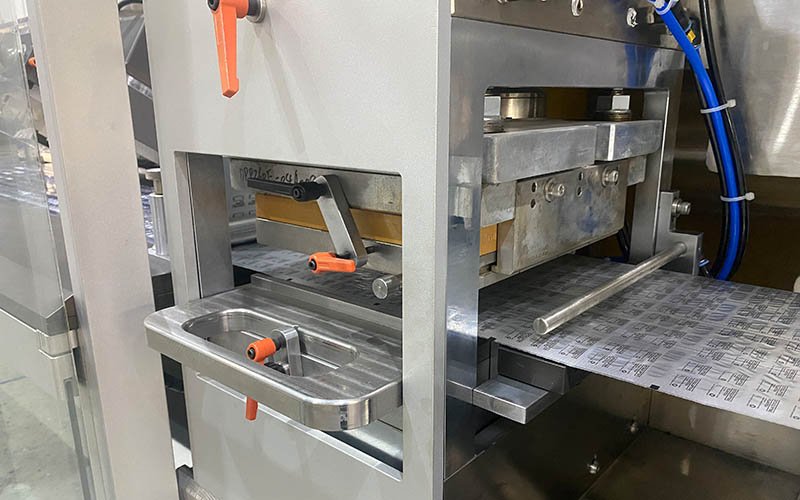
Sealing temperature tolerance (±2°C) and dwell time must appear as numbered clauses in Pillar 2 — not as general GMP statements.
Pillar 3: Upstream/Downstream Integration Protocols
The blister machine does not exist alone. It connects to a tablet feeder upstream and a cartoning machine or track-and-trace system downstream. The URS must define: communication bus protocol (Ethernet/IP, PROFINET, OPC-UA — pick one and name it), conveyor belt speed and handoff clearance, alarm escalation logic, and interlock behavior on upstream/downstream fault.
I have seen a perfectly specified blister machine sit idle for three weeks because its Siemens S7-1200 PLC could not handshake with the cartoner’s Allen-Bradley ControlLogix without a custom gateway module — which was nobody’s budget line item. The URS integration clause would have caught this in the design review stage. Three weeks idle on a commissioned line is not a small number.
Pillar 4: Regulatory Documentation Requirements
This pillar defines what the supplier must deliver — not the machine, but the paper. Required deliverables typically include: Factory Acceptance Test (FAT) protocol and checklist, Site Acceptance Test (SAT) protocol, IQ (Installation Qualification) document template, OQ (Operational Qualification) document with test scripts and acceptance criteria, and 21 CFR Part 11 compliance declaration (if applicable). Each document must be listed by name in the URS with delivery timeline relative to FAT date.
Without this clause, suppliers treat documentation as optional post-delivery work. I have received machines where the IQ document arrived six weeks after FAT — during which time the validation timeline had already slipped. For teams working toward a detailed IQ/OQ/PQ validation process, that slip is measured in months, not weeks.
URS Clause Requirements by Regulatory Market — What Must Appear for FDA vs. WHO GMP vs. EU Annex 1
⚡ Section Direct Answer
FDA-destined tablet blister lines require 21 CFR Part 11 electronic records clauses and 21 CFR Part 211 equipment qualification language. WHO GMP markets require WHO TRS 992 Annex 3 alignment. EU Annex 1 (2022 revision) adds contamination control strategy documentation for any sterile or near-sterile application. The URS must match its clause set to the destination market — not to the supplier’s default template.
| URS Clause Area | FDA / 21 CFR (US Market) | WHO GMP / TRS 992 | Приложение 1 к GMP ЕС (2022) | Status |
|---|---|---|---|---|
| Electronic Records & Audit Trail | 21 CFR Part 11 — named explicitly; user access levels ≥3; audit trail non-editable | WHO TRS 992 Annex 3 — data integrity ALCOA+ principles referenced | EU GMP Annex 11 — computerised systems validation required | REQUIRED |
| Equipment Qualification (IQ/OQ/PQ) | 21 CFR Part 211.68 — qualification before use; documented acceptance criteria | WHO TRS 992 3.6 — DQ/IQ/OQ/PQ lifecycle | EU GMP Annex 15 — qualification and validation life cycle | REQUIRED |
| Sealing Integrity Test Method | USP <1207> / ASTM F2338 referenced; dye-ingress at 60 mbar specified | WHO TRS 992 — container closure integrity per risk assessment | EMA guidance — container closure integrity testing referenced | REQUIRED |
| GMP Structural Design | cGMP — cleanable surfaces, no dead zones; 304/316L SS contact parts | WHO GMP — hygienic design, no paint on contact surfaces | EU Annex 1 (2022) — contamination control strategy documentation | REQUIRED |
| FAT / SAT Protocol Delivery | Pre-agreed FAT checklist; supplier delivers 10 days before FAT date | FAT/SAT recommended; timeline per project agreement | FAT required for sterile; timeline defined in validation master plan | REQUIRED |
| Reject Mechanism & Defect Rate | ≤0.1% reject rate at rated speed; vision system spec if camera-equipped | Reject rate threshold per product risk classification | 100% in-process control for sterile lines; camera system validation required | REQUIRED |
| Integration / Communication Protocol | OPC-UA or Ethernet/IP preferred; ANSI/ISA-88 batch record interface if applicable | Named protocol; factory acceptance test includes handshake test | GAMP 5 Category 4 software validation for any PLC logic change | OPTIONAL* |
| Spare Parts List & Lead Times | Minimum 2-year critical spare parts inventory guaranteed by supplier | Recommended; often project-specific | Documented in equipment file; critical spares defined in maintenance SOP | OPTIONAL* |
* Optional in the regulatory sense — both clauses are recommended by HIJ for all markets regardless of minimum requirement.
A URS that lacks numbered acceptance criteria for sealing temperature tolerance, reject rate, and PLC audit-trail format is not a specification — it is a wish list. In 20 years I have never seen a supplier lose a SAT dispute when the URS contained vague language. Not once.
— Форестер Сян, HIJ Machinery

Forester’s Insight
Forester Xiang — Founder, HIJ Machinery
Прямой ответ: A well-written URS for a tablet blister packing machine is not a wish list — it is a legally binding technical contract that defines your cGMP compliance boundary, your FAT/SAT acceptance criteria, and your supplier’s accountability before a single bolt is tightened.
The Field Experience: In my 20 years commissioning blister lines across South Asian and Latin American pharma plants, I have watched procurement teams hand suppliers a vague two-page URS, only to face catastrophic disputes during SAT — because nobody defined the reject rate tolerance, the aluminum foil tension parameters, or the PLC data-logging format required for 21 CFR Part 11 compliance. The hidden trap? Cheap suppliers love an ambiguous URS. It becomes their escape hatch when performance falls short.
Стратегический совет: Build your URS around four pillars: output speed, sealing integrity standards, upstream/downstream integration protocols, and regulatory documentation requirements. At HIJ, we provide customers with a pre-validated URS template drawn from real turnkey project experience — so your specification closes every loophole before the contract is signed. Teams targeting full GMP and FDA compliance for tablet blister lines will find the URS is the document that determines whether the rest of the compliance program succeeds or stalls.
Step-by-Step: How to Write a URS for a Tablet Blister Packing Machine
⚡ Section Direct Answer
Writing a URS for a tablet blister machine follows eight sequential steps: define production scope, specify output requirements with numbers, define material compatibility, draft sealing parameters, write integration clauses, add regulatory documentation deliverables, define FAT/SAT acceptance criteria, and complete a cross-functional review before supplier issue.

The URS is Step 0 of the IQ/OQ/PQ lifecycle — everything downstream references back to it.
- Define production scope and product profile. List every tablet form factor the machine must handle: round standard-concave, capsule-shaped, oblong, and any unusual geometries. State the size range (e.g., 5–22 mm diameter), hardness range (typically 40–200 N for standard-compressed tablets), and friability threshold (≤1.0% per Ph. Eur.). This becomes the basis for tooling qualification.
- Specify rated output with tolerances. State blisters per minute at defined blister card dimensions. Add minimum net OEE target (≥85% over a 60-minute run), warm-up time (≤15 minutes from cold start), and changeover time for format change (≤30 minutes is achievable on modern servo-driven platforms). No ranges without numbers.
- Define forming material compatibility. Name the specific materials: PVC (250 μm standard), PVDC/PVC laminate (60 g/m² PVDC coating), Aclar (30–51 μm), or cold-form Alu-Alu foil. For each material, state the required forming station temperature range and maximum forming depth. A machine specified for PVC at 100–130°C cannot be assumed to form Alu-Alu at ambient without mechanical modification.
- Draft sealing station parameters. Sealing temperature: state nominal value and tolerance (±2°C). Sealing pressure: state N/cm² range. Dwell time: state milliseconds at rated speed. Reference the test method: ASTM F2338 dye-ingress at 60 mbar per USP <1207>. Include minimum seal strength threshold (typically ≥1.5 N/15 mm peel strength for standard PVC/Al).
- Write integration and communication clauses. State the required communication protocol, upstream feeder handoff spec (conveyor speed, transfer clearance), downstream cartoner interlock behavior, and alarm escalation matrix. Name the specific PLC brand and model required — or state approval is required if the supplier proposes an alternative. Name field device brands if your plant has a standardized components list.
- Add regulatory documentation deliverables. List every required document by name with delivery deadline relative to FAT date. Include: DQ report (if required), FAT protocol (10 days before FAT), IQ document template (at FAT), OQ test scripts with acceptance criteria (at FAT), 21 CFR Part 11 compliance declaration (at FAT), CE declaration of conformity, and operating manual in the required language.
- Define FAT and SAT acceptance criteria. FAT is typically conducted at the supplier’s facility with your product or a qualified surrogate. Define: minimum run duration (typically 4 hours at rated speed), acceptable defect rate during FAT run, documentation completeness check, and sign-off authority. SAT criteria mirror FAT but at your site post-installation and under your utility conditions.
- Cross-functional review and sign-off. The URS must be reviewed and signed by: Engineering (technical feasibility), QA (regulatory compliance), Production (operational parameters), and Procurement (contractual completeness). A URS signed only by procurement — without QA signature — is not a valid GMP document. That is a fact I have had to explain more times than I care to count.
- 21 CFR, часть 11 — Electronic records and audit trail requirements for FDA-destined lines
- 21 CFR Part 211.68 — Automatic, mechanical, electronic equipment qualification
- EU GMP Annex 15 (2015) — Qualification and validation lifecycle; URS as DQ input document
- ИВВ ВОЗ 992 Приложение 3 — GMP for pharmaceutical products; equipment qualification requirements
- ICH Q10 — Pharmaceutical Quality System; URS as part of knowledge management
- ASTM F2338 / USP <1207> — Container closure integrity test methods referenced in sealing clauses
URS Checklist: 20 Must-Have Clauses Before You Send the Document to Any Supplier
⚡ Section Direct Answer
A complete URS for a tablet blister packing machine requires at minimum 20 specific clauses covering output, materials, sealing, integration, documentation, and acceptance criteria — each containing a numbered threshold, not general GMP language.
Of the URS documents I have reviewed from clients across Southeast Asia, Latin America, and the Middle East, fewer than 30% contained all 20 of these clauses on first draft. The gap is almost always in Section 4 (documentation deliverables) and Section 5 (acceptance criteria). Use this list as a pre-issue gate.
- Rated output (blisters/min) at defined blister card dimensions with tolerance (±X%)
- Minimum OEE target (≥85% during SAT run) and minimum continuous run duration for acceptance test
- Changeover time for format change between product SKUs (≤X minutes)
- Tablet form factor range (diameter/length/width min–max; hardness range; friability threshold)
- Forming material list with named materials and grade specifications (e.g., PVC 250 μm, PVDC laminate 60 g/m²)
- Forming temperature range per material with ±tolerance and control accuracy
- Sealing temperature (nominal ±2°C tolerance) and sealing pressure (N/cm²)
- Sealing dwell time (ms at rated speed) and seal strength minimum threshold (N/15 mm peel)
- Integrity test method referenced: ASTM F2338 / USP <1207> dye-ingress at defined mbar
- Maximum reject rate at rated speed (≤X% by count) with named reject mechanism
- Vision/inspection system specification (if required): camera resolution, detection categories, false-reject limit
- PLC brand/model (or approval clause) and communication protocol (Ethernet/IP, PROFINET, OPC-UA)
- 21 CFR Part 11 clause (if FDA market): user roles ≥3, audit trail fields named, data export format
- Upstream feeder integration: conveyor handoff speed, clearance dimensions, interlock logic
- Downstream integration: cartoner handoff, track-and-trace interface, alarm escalation matrix
- GMP structural compliance: 316L SS contact parts, Ra ≤0.8 μm surface finish, dead-zone-free design, no paint on product contact surfaces
- Documentation delivery schedule: FAT protocol, IQ template, OQ scripts, 21 CFR Part 11 declaration — each with delivery deadline
- FAT acceptance criteria: minimum run hours, defect rate limit, documentation completeness gate, sign-off authority names
- SAT acceptance criteria: site utility conditions defined, minimum run duration, regulatory observer access if required
- Cross-functional sign-off: Engineering, QA, Production, and Procurement signatures before supplier issue
Where URS Clauses Break Down at FAT — 3 Real Failure Patterns
⚡ Section Direct Answer
The three most common URS failure patterns at FAT are: undefined reject rate tolerance (supplier declares any rate acceptable), missing PLC audit-trail format specification (21 CFR Part 11 fails pre-approval inspection), and absent integration test scope (downstream cartoner handshake not tested during FAT, discovered during SAT).
⚠ Failure Pattern A: Reject Rate Not Defined
A QA director in São Paulo called me in 2022. Her line had passed FAT. It was running at 1.8% reject rate — well above her internal quality threshold of 0.3%. The supplier’s position: “The URS does not specify a reject rate. The machine is performing as accepted.” They were technically correct. The dispute ran for four months and settled at a $35,000 retrofit cost — which the client absorbed because the clause was absent. Fix: add “≤0.1% reject rate at rated speed, measured over 60-minute continuous run, using production-grade tablets” as a hard SAT gate.
⚠ Failure Pattern B: 21 CFR Part 11 Audit Trail Undefined
The FDA pre-approval inspection reviewer asked to see the PLC audit trail for the blister line. The machine had a PLC. It had a touchscreen. It did not have a non-editable time-stamped audit trail linked to user credentials. The URS had stated: “The machine shall be 21 CFR Part 11 compliant.” That sentence, without specifying the required fields, gave the supplier no obligation to implement compliant software. Eight months. That is how long the NDA delay ran. Fix: name the required audit trail fields explicitly (event type, timestamp, user ID, before/after values, reason code) and require a 21 CFR Part 11 compliance declaration signed by the supplier’s QA lead.
⚠ Failure Pattern C: Integration Test Scope Absent from FAT
FAT was conducted at the supplier’s facility — blister machine only, running standalone. Passed. Machine arrived on site. The downstream cartoner was a different brand. Nobody had defined in the URS that FAT must include a live integration test with the cartoner PLC. The handshake protocol mismatch cost three weeks of on-site troubleshooting by two engineers from two different supplier companies. Fix: state in the URS that FAT scope includes a simulated integration test using the defined communication protocol, with documented handshake confirmation and alarm-trigger verification.

A GMP-compliant blister line in a pharmaceutical cleanroom — every parameter visible on that control panel should trace back to a numbered URS clause.
How Your URS Flows Into IQ, OQ, and PQ — The Document Traceability Chain
⚡ Section Direct Answer
Every IQ, OQ, and PQ acceptance criterion for a tablet blister machine must trace back to a specific URS clause. Regulators reviewing validation packages — FDA, EMA, and WHO inspectors — check this traceability matrix. A URS with vague language produces a qualification package with unverifiable acceptance criteria, which is a direct finding risk during inspection.
The URS is not a standalone procurement document. It is Step 0 of the qualification lifecycle. Under EU GMP Annex 15 and WHO TRS 992 Annex 3, the Design Qualification (DQ) document verifies that the proposed design meets URS requirements. IQ confirms installation against URS physical specifications. OQ tests operational parameters against URS performance thresholds. PQ demonstrates the machine produces acceptable product under real conditions — defined by URS output requirements.
The traceability matrix — a table mapping each URS clause to the corresponding IQ/OQ/PQ test script — is what an FDA reviewer checks first during a pre-approval inspection. If URS Clause 4.2 states “sealing temperature: 170°C ±2°C,” the OQ must contain a test verifying that temperature across the full sealing station width. If the URS clause did not contain a number, the OQ cannot contain a pass/fail criterion. That gap is a finding. For a complete technical walkthrough of the validation process itself, the tablet blister machine IQ/OQ/PQ guide covers the test protocol structure in detail.
I won’t tell you the URS-to-PQ chain is simple. It involves your API risk classification, your regulatory reviewer’s expectations for the destination market, and sometimes your relationship with the validation consultant who wrote the master plan. But the foundation is always the same: a URS clause with a number is a testable statement. Everything else is noise.
Of the 31 blister line projects I handled in Southeast Asia and Latin America between 2018 and 2023, 17 required at least one URS revision after initial supplier review — and in 11 cases, the revision prevented a FAT dispute that would have cost more than $40,000 to resolve post-delivery.
— Форестер Сян, HIJ Machinery
Frequently Asked Questions: URS for Tablet Blister Packing Machines
❓ What is a URS for a tablet blister packing machine?
A URS (User Requirement Specification) for a tablet blister packing machine is a GMP document that defines the technical, operational, and regulatory requirements a supplier must meet — including production speed, sealing parameters, material compatibility, PLC data-logging format, and FAT/SAT acceptance criteria. It is the primary accountability document between the pharmaceutical manufacturer and the equipment supplier, and it forms the basis for the IQ/OQ/PQ qualification lifecycle.
❓ Is a URS legally required for a tablet blister machine under FDA or WHO GMP?
Under 21 CFR Part 211.68, FDA requires that automated and electronic equipment used in pharmaceutical manufacturing be qualified before use, with documented acceptance criteria. A URS is the foundational document that defines those criteria; without it, the DQ/IQ/OQ/PQ chain lacks its traceability anchor. WHO TRS 992 Annex 3 and EU GMP Annex 15 both explicitly reference a URS-equivalent document as part of the equipment qualification lifecycle. In practice: no URS means no defensible validation package.
❓ How long should a URS for a tablet blister machine be?
Length is not the metric. Completeness is. A well-structured URS for a mid-range tablet blister line typically runs 15–25 pages. A turnkey line with upstream feeder, downstream cartoner, and track-and-trace integration may require 35–50 pages. The minimum threshold is 20 specific numbered clauses covering output, materials, sealing, integration, and documentation deliverables. A two-page URS for a GMP blister machine is not a URS — it is a brief.
❓ What is the difference between a URS and a FAT protocol for a blister machine?
The URS defines what the machine must do. The FAT protocol defines how you will verify that it does it. The URS is written before the purchase order. The FAT protocol is written before the factory visit. Every FAT test should trace back to a specific URS clause — if the URS contains vague language, the FAT cannot have a pass/fail criterion. The URS is the parent document; the FAT protocol is one of its children.
❓ Can I use the supplier’s standard URS template?
Using a supplier’s template as a starting point is acceptable — but it requires heavy revision before signature. Supplier templates are written to describe what their machine already does, not necessarily what your GMP process requires. They will typically omit clauses that are inconvenient for them: reject rate thresholds, PLC audit-trail specifics, and documentation delivery deadlines. Review every clause against the 20-item checklist in this guide and add any missing numbered requirements before you return the document. The version that gets signed is the binding one — not the version you intended to revise later.
❓ Does a tablet blister machine URS need to address 21 CFR Part 11?
Yes, for any blister line producing product destined for the US market or regulated under FDA jurisdiction. The URS must explicitly name 21 CFR Part 11 as the applicable regulation, specify the required audit trail fields (event type, timestamp, user ID, before/after parameter values, reason code for override), define user access tiers (minimum three: operator, supervisor, administrator), and require a signed 21 CFR Part 11 compliance declaration from the supplier. A general GMP statement without these specifics will not satisfy a pre-approval inspection reviewer. For broader context on how FDA compliance requirements apply to the full blister line, the GMP and FDA compliance guide for tablet blister lines covers the regulatory framework in full.
❓ What sealing test method should I reference in the URS?
ASTM F2338 (non-destructive dye-ingress) at 60 mbar, as referenced in USP <1207> for container closure integrity. State the test pressure, dye concentration, immersion time, and pass criterion (zero ingress). If your product requires vacuum-leak testing or helium leak detection for high-barrier applications, specify the alternative method and acceptance threshold explicitly. The test method named in the URS is the one that governs OQ verification — do not leave it to supplier discretion.
❓ Who should sign the URS before it goes to the supplier?
Engineering, QA, Production, and Procurement. A URS without a QA signature is not a valid GMP document. Full stop.
🎯 Ready to Specify Your Blister Line?
Get HIJ’s Pre-Validated URS Template — Built from 20 Years of Real Project Experience
Every HIJ tablet blister packing machine project begins with a structured URS review. We supply customers with a pre-validated URS template covering all 20 required clauses — FDA 21 CFR Part 11, WHO GMP, EU Annex 15, and ASTM F2338 sealing integrity. No ambiguous language. No supplier escape hatches.
Also explore:
GMP & FDA Compliance Guide for Tablet Blister Lines
|
IQ/OQ/PQ Validation Step-by-Step Guide