
















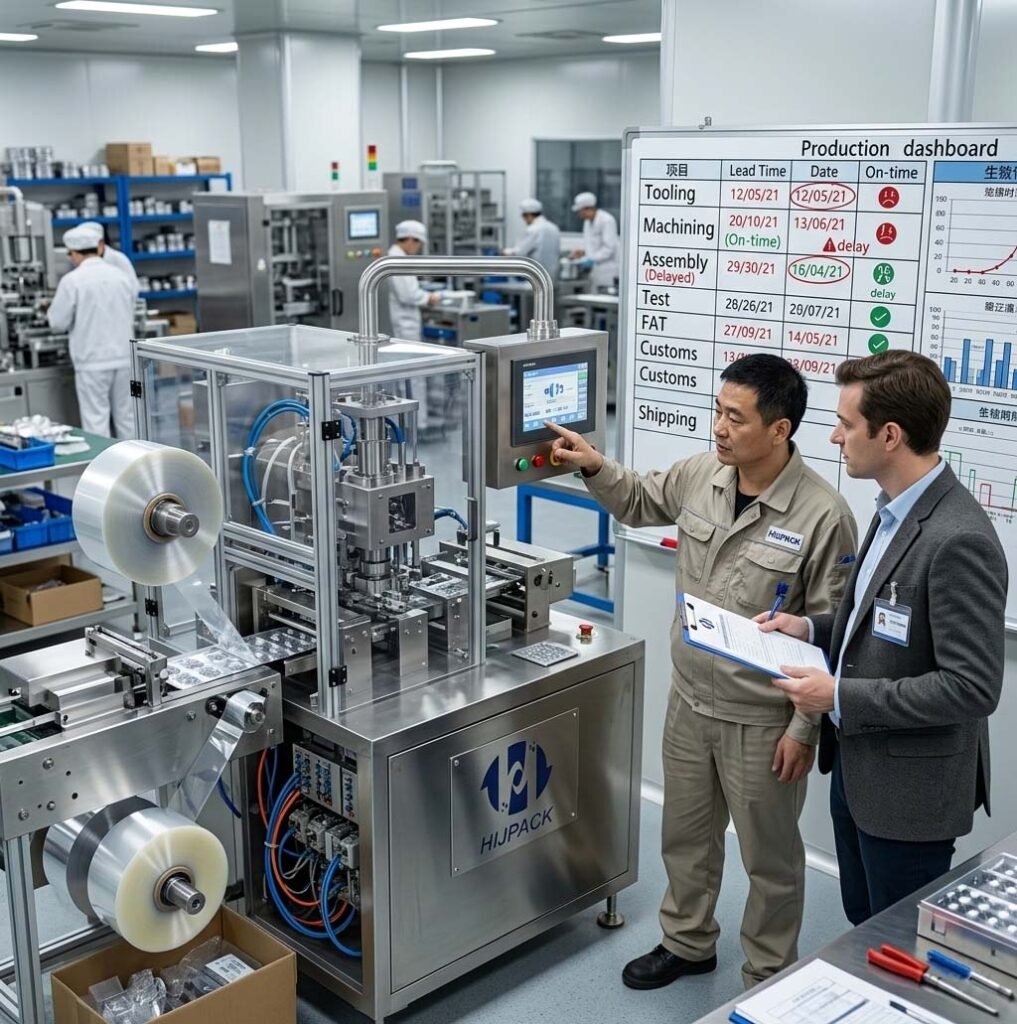
Blister Machine Delivery Time from China: What 90–120 Days Actually Looks Like
Every pharma procurement manager deserves a straight answer before they sign a purchase order. Blister machine delivery time from China is the single most-misrepresented figure in pharmaceutical equipment sourcing — and a miscalculation here can cost you an entire regulatory inspection window.
👤 Forester’s Insight — 20-Year Engineer’s Perspective
“The realistic pharma machine lead time from China is 90–120 days from deposit to FAT — anyone quoting you 45 days is either shipping shelf stock or setting you up for a painful compliance compromise.”
🏭 The Field Experience
In my 20 years of managing blister packaging machine deliveries to pharma clients across Southeast Asia and South America, the single biggest schedule killer is not manufacturing — it is the documentation black hole. Factories routinely under-quote lead time to win the PO, then spend weeks scrambling to produce IQ/OQ templates, CE technical files, and cGMP compliance dossiers they never prepared upfront.
I watched a Brazilian generic drug manufacturer miss an entire FDA pre-inspection window in 2021 because their “60-day delivery” machine arrived on day 97, with zero SAT protocol ready, no 21 CFR Part 11 audit trail configuration, and sealing jaw calibration records in Chinese only. The cost: a six-month production delay and an emergency re-procurement at 40% over budget.
⚠️ The Hidden Trap
Suppliers quoting aggressive lead times often batch your custom tooling order with a standard machine frame they already have in semi-finished stock. The mechanical shell ships on time — but the cGMP documentation package, CE Declaration of Conformity, and validated sealing parameters follow weeks later, or never. Your validation team cannot begin IQ execution without a complete technical file. Every day that documentation lags is a day your IQ/OQ/PQ clock does not start.
💡 The Strategic Advice
Before signing anything, demand a detailed milestone schedule covering mechanical completion date, FAT date, and document package delivery date as contractual line items — not verbal promises. At HIJ Machinery, our Turnkey integration model locks documentation milestones alongside hardware milestones, so your regulatory timeline and your machine timeline advance as one synchronized project.
 Forester Xiang
Founder, HIJ Machinery | 20 Years in Pharma & Food Packaging Equipment
The 6-Phase Blister Machine Lead Time Breakdown: From Deposit to Your Production Floor
A blister packaging machine lead time from China is not a single number — it is a chain of six sequential project phases, each with its own technical dependencies, and each phase capable of compressing or collapsing your entire schedule. Understanding where each week goes is the foundation of realistic project planning under WHO TRS 992 Annex 3 and EU GMP Annex 15 qualification frameworks.

A detailed project milestone schedule is the single most important document you should receive before paying a deposit on any blister packer from China.
- Phase 1
Days 1–14URS Review, Engineering Sign-Off & Tooling DesignThe factory engineering team parses your User Requirement Specification (URS), locks forming cavity dimensions, sealing jaw geometry, and PLC parameter architecture. Any URS deviation log must be resolved and countersigned before steel is cut. Skipping formal URS review is the root cause of 80% of mid-production tooling change orders — each of which adds 7–14 days to your schedule.
- Phase 2
Days 15–50Mechanical Manufacturing & Component ProcurementFrame fabrication, stainless-steel 316L contact surface machining, servo motor procurement (Siemens or Allen-Bradley PLC integration typically adds 5–7 days for import lead time), and forming mold CNC machining run in parallel. A standard DPP-250 or DPP-260 frame reaches mechanical completion in 30–35 days; Alu-Alu cold-form tooling requires 40–45 days due to the precision-tolerance forming station.
- Phase 3
Days 51–70Assembly, PLC Programming & Internal QCMechanical assembly integrates the forming station, sealing station (target sealing jaw temperature: 160–200°C ±2°C for PVC/Alu), die-cutting station, and film feeding system. PLC ladder diagram programming and HMI touchscreen configuration consume 10–14 days for cGMP-compliant 21 CFR Part 11 audit trail activation. Internal QC validates sealing integrity per ASTM F2338 bubble emission test protocol before FAT scheduling.
- Phase 4
Days 71–90Factory Acceptance Test (FAT) & Documentation PackageFAT execution runs the machine at rated speed (≥120 blisters/min for a DPP-260) for a minimum 4-hour witnessed trial. Simultaneously, the document package must be complete: CE Declaration of Conformity, IQ/OQ protocol templates, calibration certificates for sealing temperature sensors, and the spare-parts interchangeability list. At HIJ, documentation delivery is a contractual FAT pre-condition — the FAT report is not signed until every document is verified.
- Phase 5
Days 91–100Export Packaging, Customs Clearance & FreightExport-crating a blister machine to seaworthy standard takes 3–5 days. Ocean freight from Shanghai or Ningbo to Southeast Asian ports runs 12–18 days; to South American ports (Santos, Callao) runs 28–35 days; to Middle Eastern ports (Jebel Ali, Dammam) runs 18–22 days. Air freight compresses this to 5–7 days but adds $3,500–$8,000 USD in shipping cost for a machine in the 1,200–2,800 kg range.
- Phase 6
Days 101–120+Site Acceptance Test (SAT), IQ/OQ Execution & Operator TrainingSAT installation verification, IQ execution (confirming machine-as-built matches design specifications per EU GMP Annex 15 Section 10.3), OQ performance qualification (sealing integrity at ±5% of rated speed), and operator training consume 10–21 days. This phase is routinely excluded from supplier-quoted lead times — yet it is the phase your quality department cannot skip before the machine enters commercial production.
⚠️ Common Failure Modes & Forester’s Fix
- 🔴 Symptom: Machine physically ships on day 60, but FAT report arrives 3 weeks later, stalling your IQ initiation.
⚙️ Root Cause: Supplier separated documentation preparation from manufacturing — IQ/OQ templates were drafted by a third-party compliance writer post-production, not integrated into the engineering workflow.
🔧 Forester’s Fix: Insert a contractual clause requiring the complete 12-document package (CE Declaration, IQ template, OQ protocol, calibration certs, spare-parts list, PLC parameter file, electrical schematic, pneumatic diagram, BOM, FAT report, risk assessment per ISO 13849-1, and operator manual) to be delivered 5 days before FAT date — not after. - 🔴 Symptom: Tooling for new blister cavity format arrives 3 weeks after the main machine, blocking line commissioning.
⚙️ Root Cause: Forming mold and sealing die were subcontracted to a separate tooling shop on a 35-day lead time that was not synchronized with the main machine assembly schedule.
🔧 Forester’s Fix: Confirm in writing that all molds and tooling referenced in the URS are manufactured in-house or by a named subcontractor with a contractually bound delivery date ≥7 days before scheduled FAT. Require dimensional inspection reports (±0.05 mm tolerance) for forming cavity depths before accepting the tooling lot. - 🔴 Symptom: Delivery hits day 105 but sealing parameters are set for PVC/Alu, while your spec requires PVDC/Alu — re-commissioning required on-site.
⚙️ Root Cause: FAT was run with the factory’s standard film stock, not your validated film specification (e.g., 250 µm PVDC requiring sealing jaw temperature 175–185°C vs. 160°C for standard PVC).
🔧 Forester’s Fix: Ship 50 kg of your target film material to the factory 2 weeks before FAT date. Require FAT protocol to specify: film material, thickness, sealing temperature (±2°C), dwell time (±0.05 s), and sealing pressure (±5 N/cm²) — all validated at production speed before the FAT report is signed.

The HIJ DPP-250 — a cGMP-compliant thermoforming blister packer whose FAT milestone is governed by a contractual documentation checklist, not verbal assurance.
Why Chinese Blister Machine Suppliers Chronically Underquote Lead Time — and How to Detect It
Competitive pressure in the Chinese pharmaceutical machinery market has created a structural incentive to compress quoted lead times. A factory quoting 45 days in a competitive bid evaluation creates psychological urgency that a 90-day quote cannot match — even if both machines are mechanically identical. Understanding the three mechanisms behind underquoting gives you leverage to identify compliant suppliers before you commit to a PO.
Mechanism 1 — The Semi-Finished Stock Play
Some manufacturers maintain a warehouse of 60–70% assembled machine frames in standard configurations. When an order arrives, they complete assembly and customize tooling concurrently — quoting lead time based on the assembly-completion phase only, excluding the 25–35 days required for tooling CNC machining, PLC customization, and document preparation. The machine “ships” in 45 days; the documentation follows in another 30–45 days as a separate “support package.”
Mechanism 2 — Documentation as an Afterthought
Under EU GMP Annex 1 (2022 revision, Section 4.36), all critical packaging equipment must have a fully traceable qualification dossier before introduction into a contamination-controlled manufacturing environment. Factories that do not integrate IQ/OQ template generation into their production workflow — a practice required by ICH Q10 Pharmaceutical Quality System — treat documentation as a post-shipment activity. This adds 20–45 days to your on-site commissioning timeline, days that never appear in the original lead-time quote.
Mechanism 3 — Optimistic Procurement Assumptions
Imported drive components — Siemens S7-1200 PLCs, SMC pneumatic cylinders, Festo proportional valves — carry their own 15–25 day procurement lead times from European or Japanese distributors. Factories that build their lead-time quote on “components in stock” assumptions, rather than confirmed purchase orders, routinely lose 2–3 weeks when distributors report backorder delays. A contractual Bill of Materials (BOM) with named component suppliers and confirmed stock availability is your protection against this failure mode.
⚠️ Common Failure Modes & Forester’s Fix
- 🔴 Symptom: Supplier quotes 50-day lead time in writing, but at day 50 requests a 30-day extension citing “imported PLC component delay.”
⚙️ Root Cause: The original quote assumed Siemens S7-1200 PLCs from spot-market stock; actual procurement through authorized distributor showed 21-day lead time not factored into the original schedule.
🔧 Forester’s Fix: Before deposit, require a confirmed BOM with named component suppliers and purchase order dates for all imported items. Insert a 15% schedule buffer liquidated damages clause (e.g., 0.5% of machine value per week of delay beyond agreed FAT date) to create financial accountability for lead-time promises. - 🔴 Symptom: Machine arrives with a CE mark sticker but no CE Technical File — customs clears the machine, but your EU-market regulatory dossier cannot be submitted without the full Annex II Technical Documentation.
⚙️ Root Cause: The supplier self-affixed CE marking without commissioning a formal Technical File compliant with EU Machinery Directive 2006/42/EC, a process requiring 15–25 working days with a Notified Body or internal Technical Documentation team.
🔧 Forester’s Fix: Specify in the contract: “CE marking must be accompanied by a complete Technical File including risk assessment (ISO 13849-1 PL calculation), conformity assessment procedure, and Declaration of Conformity — delivered as a hard copy and USB-archived PDF package at FAT.”
Blister Machine Lead Time Comparison: What Realistic vs. Underquoted Timelines Actually Deliver
Benchmark pharma machine lead time against what each delivery scenario actually includes — not just when the steel arrives at your dock.
| Delivery Scenario | Quoted Lead Time | What You Receive | Documentation Status | Compliance Risk |
|---|---|---|---|---|
| Shelf-Stock / Semi-Finished | 30–50 days | Generic machine, standard tooling only | Basic user manual; no IQ/OQ; no CE Technical File | Critical — unusable for GMP production |
| Custom Build, Underprepared Supplier | 60–70 days | Correct machine, correct tooling | CE mark present; IQ/OQ templates missing or generic | High — validation delayed 30–60 days post-arrival |
| Custom Build, Documentation-Integrated (HIJ Model) | 90–120 days | Validated machine, full custom tooling, all film specs tested at FAT | Complete 12-doc package; project-specific IQ/OQ; CE Technical File; 21 CFR Part 11 config | Low — IQ can begin within 5 days of machine installation |
| Turnkey Line (Blister + Cartoner + Case Packer) | 120–150 days | Integrated line, OEE-tested at FAT, single-source responsibility | Line-level IQ/OQ; interface validation between machines; serialization-ready documentation | Minimal — designed for direct WHO GMP or EU GMP audit readiness |
Based on HIJ Machinery’s 20-year delivery record across 30+ countries in Southeast Asia, Latin America, and the Middle East, buyers who accept a 45-day quote for a custom GMP blister machine add an average of 67 days to their actual production-start date compared to buyers who correctly plan for a 90–120 day cycle — because the post-arrival documentation scramble consistently exceeds the time “saved” in the initial delivery promise.

DQ → IQ → OQ → PQ: the four qualification phases that govern how quickly your blister machine can enter commercial production — each phase dependent on documentation the manufacturer must provide.
How to Validate a Supplier’s Promised Pharma Machine Lead Time Before You Pay the Deposit
Verify a supplier’s lead-time promise with contractual enforcement mechanisms — not verbal assurances. The following 6-step protocol is the same due-diligence process HIJ recommends to every buyer in regulated markets before committing to a purchase order.
-
Demand a Gantt-Style Milestone Schedule with Specific Dates
Request a written project schedule with calendar dates — not “Day 1 to Day 60” relative notation — covering: URS approval, tooling CNC start, mechanical completion, PLC programming complete, internal QC, FAT date, freight ready date, and document package delivery date. Any supplier unable to produce this within 72 hours of your request cannot reliably execute against it.
-
Confirm Documentation Package Scope in Writing
The contract must enumerate the exact document list: (1) CE Declaration of Conformity, (2) Risk Assessment per ISO 13849-1, (3) IQ Protocol Template, (4) OQ Protocol Template, (5) Calibration Certificates for all critical instruments (sealing temperature sensor ±0.5°C, force gauge ±1%), (6) PLC Parameter File backup, (7) Electrical Schematic, (8) Pneumatic Diagram, (9) BOM with part numbers, (10) FAT Report, (11) Spare Parts Interchangeability List, (12) Operator Training Manual. Delivery of each item must have a contractual date.
-
Require a Video FAT Witness if You Cannot Travel
A live-streamed FAT running your target film material at rated production speed (e.g., ≥120 cycles/min for a DPP-260) for a minimum of 4 hours is now standard practice for international buyers. The video must capture: sealing jaw temperature readout (±2°C of spec), 100% filled-cavity verification, die-cut registration accuracy (±0.3 mm), and HMI audit trail recording per 21 CFR Part 11 requirements. Refuse to approve FAT without this evidence.
-
Insert Liquidated Damages for Documentation Delay
Manufacturing delay clauses are common; documentation delay clauses are rare and far more valuable. Specify: if the complete document package is not delivered within 5 business days of the agreed FAT date, the supplier pays a penalty of 0.5% of the machine purchase price per week of delay, up to a maximum of 10%. This single clause changes supplier behavior more effectively than any audit visit.
-
Verify Component Lead Times Against the BOM
Cross-reference the supplier’s quoted machine lead time against confirmed procurement lead times for imported components. Siemens S7-1200 PLCs: 15–21 days. SMC pneumatic cylinders: 10–14 days. Festo proportional valves: 14–20 days. Allen-Bradley VFDs: 18–28 days. If the supplier’s total quoted lead time is shorter than the longest component lead time plus 45 days of assembly, the math does not work — and they are either holding stock or planning to substitute components without your approval.
-
Request Reference Contacts from Recent Comparable Deliveries
Ask for the name, country, and contact information of 2 recent customers who received a comparable blister machine model with full GMP documentation. A supplier confident in their delivery record will provide these within 24 hours. Reference check the actual FAT date versus promised FAT date, and whether the documentation package was complete before machine departure — two questions that reveal more than any factory audit visit.
⚠️ Common Failure Modes & Forester’s Fix
- 🔴 Symptom: Project milestone schedule delivered pre-contract looks detailed, but after PO is issued, dates shift by 3–4 weeks citing “factory capacity.”
⚙️ Root Cause: Factory over-committed production capacity across multiple simultaneous orders; your order was deprioritized in the production queue after payment secured loyalty.
🔧 Forester’s Fix: Require the milestone schedule to be attached as Exhibit A to the sales contract. Include a clause: “Any milestone date revision requires written mutual agreement no later than 14 days before the original milestone date. Unilateral revision by the supplier constitutes a breach triggering a penalty equivalent to 1% of contract value per revised milestone.” - 🔴 Symptom: Supplier requests final payment before shipping, but FAT report has not been issued — machine is complete but sitting in their warehouse pending document preparation.
⚙️ Root Cause: Payment schedule tied to “FAT completion” (mechanical) rather than “FAT approval” (documentation-verified). Supplier interprets FAT completion as machine-ready, not as buyer-signed FAT report received.
🔧 Forester’s Fix: Structure payment terms as: 30% deposit + 60% against buyer-signed FAT approval (not supplier-declared completion) + 10% against successful SAT and IQ completion on-site. This payment architecture aligns the supplier’s financial incentive with your commissioning success, not their shipping convenience. - 🔴 Symptom: Blister machine arrives at port but customs clearance is delayed 3 weeks due to incorrect HS code classification or missing CE documentation for import into the destination country.
⚙️ Root Cause: Export documentation prepared by a freight forwarder unfamiliar with pharmaceutical equipment HS codes (8422.30.90 for packaging machinery); CE Technical File not provided to customs broker as required for Class IIa regulated markets.
🔧 Forester’s Fix: Specify in the contract that the supplier is responsible for providing a pre-shipment document checklist including: commercial invoice with correct HS code 8422.30.90, packing list, CE Technical File summary, FORM-E (for ASEAN preferential tariff) or equivalent, and a Certificate of Origin — delivered to your freight forwarder 7 days before cargo departure.

A cGMP packaging line integration audit in progress — the documentation package delivered with the blister machine determines whether this audit takes 3 days or 3 months.
How HIJ Machinery’s Turnkey Model Locks Your Blister Machine Delivery Timeline & Documentation in Parallel
HIJ Machinery’s Turnkey integration model was designed specifically to eliminate the documentation black hole that inflates effective lead times for pharma buyers in Southeast Asia, South America, and the Middle East. Rather than treating the machine build and the compliance documentation as sequential workstreams, HIJ runs them as synchronized parallel tracks — documentation milestones are contractual requirements, not post-delivery support activities.
What HIJ’s Parallel Documentation Track Includes
- URS deviation log reviewed and countersigned before production starts — zero mid-build surprises
- IQ/OQ protocol templates drafted concurrently with mechanical assembly — ready for customer review at day 45
- CE Technical File prepared per EU Machinery Directive 2006/42/EC, including ISO 13849-1 PL calculation — not a post-shipment afterthought
- 21 CFR Part 11 audit trail activated and tested in PLC before FAT — electronic records configuration documented and version-controlled
- FAT protocol specifies customer’s actual film material, sealing temperature (±2°C), dwell time (±0.05 s), and output speed targets — no generic factory trial
- Spare parts interchangeability list with global distributor part numbers for all wear components — sourced and cross-referenced before shipment
- On-site SAT and IQ execution team deployed within 14 days of machine installation for Southeast Asian and LATAM clients
⚠️ Common Failure Modes & Forester’s Fix
- 🔴 Symptom: Blister machine and cartoner arrive from the same supplier but cannot communicate via PLC interface — line integration delayed by 6 weeks while a systems integrator is hired on-site.
⚙️ Root Cause: Blister machine used Siemens S7-1200 with Profinet communication protocol; cartoner used a different brand PLC with Modbus RTU — supplier never tested the interface because the two machines were engineered by separate internal teams.
🔧 Forester’s Fix: For turnkey lines, require a line-level interface validation protocol (IVP) to be included in the FAT scope. The IVP must confirm: upstream/downstream conveyor synchronization at rated speed (±2 cycles/min), reject signal handshake response time (≤200 ms), and emergency stop propagation across all line stations within 500 ms per IEC 62061 functional safety requirement. - 🔴 Symptom: On-site commissioning engineer from China arrives without valid work visa for destination country — 3-week delay while visa is processed, machine sits idle post-installation.
⚙️ Root Cause: Supplier’s export team did not initiate the commissioning engineer’s visa application until machine cleared customs — a 15–25 day lag from machine departure to visa ready, which was not synchronized.
🔧 Forester’s Fix: At HIJ, the commissioning engineer’s visa application is initiated on the same day as the FAT approval signature — not after shipment. Require your supplier to confirm: commissioning engineer’s passport, destination country visa application date, and expected approval date as part of the post-FAT checklist.
FAQ: Blister Machine Delivery Time from China — Real Buyer Questions Answered
A custom pharma-grade blister packaging machine from China realistically takes 90–120 days from deposit payment to completed Factory Acceptance Test. This timeline covers URS engineering (Days 1–14), mechanical manufacturing (Days 15–50), PLC programming and internal QC (Days 51–70), FAT execution with documentation (Days 71–90), freight to your destination (Days 91–105), and SAT/IQ/OQ qualification on-site (Days 106–120+). Suppliers quoting 45 days are typically shipping semi-finished shelf stock without project-specific documentation.
Most Chinese manufacturers’ quoted lead times include only mechanical manufacturing and assembly — typically 45–70 days. They routinely exclude tooling CNC lead time (10–35 days), PLC parameter configuration (10–14 days), documentation preparation (15–25 days), export packaging (3–5 days), and ocean freight transit (12–35 days depending on destination). The full door-to-production-ready timeline is almost always 40–60% longer than the quoted figure.
A 60-day delivery for a custom blister machine with cGMP documentation is not achievable from a reputable manufacturer — the engineering math does not work. You can receive a standard, non-custom, non-documented blister machine in 30–50 days from suppliers maintaining finished-goods inventory, but such a machine will not include project-specific IQ/OQ protocols, CE Technical File, or validated sealing parameters — making it unusable for GMP-regulated production without extensive and time-consuming on-site validation work.
Blister machine IQ (Installation Qualification) execution typically takes 3–7 days when the supplier has delivered a complete, project-specific IQ protocol and calibration certificate package. OQ (Operational Qualification) at validated sealing parameters takes 5–10 days. PQ (Performance Qualification) at commercial production conditions takes 10–21 days. Without a pre-prepared documentation package from the manufacturer, IQ alone can take 4–8 weeks while your team drafts protocols from scratch — a delay entirely preventable by contractual documentation requirements at the purchase stage.
An Alu-Alu cold-form blister machine requires 15–20 additional manufacturing days compared to a standard thermoforming machine, bringing the realistic lead time to 105–140 days from deposit to FAT. The additional time reflects the precision-tolerance cold-forming station (forming cavity depth tolerance ±0.03 mm vs. ±0.08 mm for thermoforming), the specialized aluminum foil feed mechanism requiring manual calibration, and extended internal QC time for moisture-barrier sealing validation per USP <1207> package integrity testing protocols.
Protect your delivery schedule with three contractual mechanisms: (1) attach the Gantt milestone schedule as a signed exhibit to the sales contract, making it legally binding; (2) insert a liquidated damages clause of 0.5%–1.0% of machine purchase price per week of delay beyond the agreed FAT date, capped at 10%; (3) structure the payment schedule so that 60% of payment is released only against buyer-signed FAT approval, not supplier-declared mechanical completion. These three clauses together create financial alignment between the supplier’s revenue and your commissioning timeline.
To begin IQ execution within 5 days of machine installation, you need: CE Declaration of Conformity, ISO 13849-1 risk assessment, project-specific IQ Protocol Template, OQ Protocol Template with validated sealing parameters (temperature, dwell time, pressure), calibration certificates for all critical instruments (sealing temperature sensors, force gauges), PLC Parameter File backup, Electrical Schematic (as-built), Pneumatic Diagram, Bill of Materials with part numbers, FAT Report (signed), Spare Parts Interchangeability List, and Operator Training Manual in your required language. Absence of any single item will stall your validation team’s IQ execution.
At HIJ Machinery, every blister packaging machine order ships with a contractual milestone schedule, a 12-document GMP delivery package, and a dedicated project manager who treats your regulatory timeline as a non-negotiable deliverable. Tell us your target production start date and we will engineer the schedule backwards to make it real — not optimistic.
“At HIJ Machinery, I don’t just sell you a machine; I deliver project certainty.” — Forester Xiang, Founder, HIJ Machinery
🌍 Serving pharma & food packaging clients across Southeast Asia, Latin America, the Middle East & Africa