
















✅ IQ / OQ / PQ
✅ 21 CFR Part 211
✅ WHO TRS 992
✅ EU GMP Annex 15
✅ Capsule Blister Machine
Most blister machine suppliers hand you a generic IQ checklist after FAT. Your regulatory reviewer will see through it in 15 minutes. This guide walks through the full qualification lifecycle — DQ through PQ — the way it actually works on a cGMP line, not the way it looks in a template.
If you’re preparing for an FDA pre-approval inspection or a WHO audit, the documentation structure here is what survives scrutiny. The approach is drawn from 20 years of commissioning blister lines across FDA-regulated, ANVISA-audited, and NMPA-governed facilities.
IQ/OQ/PQ validation for a capsule blister packing machine covers four sequential qualification phases — Design Qualification (DQ), Installation Qualification (IQ), Operational Qualification (OQ), and Performance Qualification (PQ) — each requiring a written protocol, execution evidence, and a signed report before the next phase begins. Under EU GMP Annex 15 and WHO TRS 992 Annex 3, no phase can be retroactively skipped. Total timeline: typically 8–16 weeks from FAT sign-off to PQ completion, depending on batch size and stability requirements.
Qualification Phases
(DQ → IQ → OQ → PQ)
Weeks Typical Full
Validation Timeline
Pharma Recalls Linked
to Packaging (FDA 2019–2023)
PQ Batches Required
for Most Regulatory Dossiers
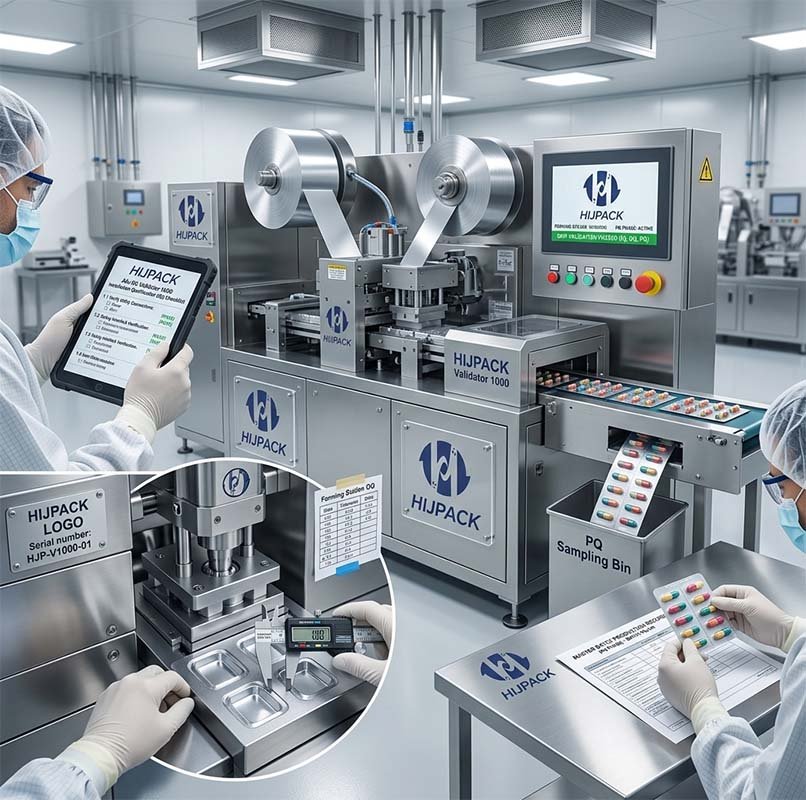
The four-phase qualification lifecycle for a GMP-compliant capsule blister packaging line — each phase requires a signed protocol and report before proceeding.
Why Blister Machine Validation Fails Before the Inspector Arrives
The real validation failure in capsule blister packaging is not a missing test — it is a documentation gap that appeared the moment the supplier shipped a machine with a generic IQ checklist that does not match the plant’s User Requirement Specification.
I’ve seen this pattern repeat across three continents. A manufacturer in Lagos receives a DPP-260 blister line, runs production for four months, then prepares a WHO pre-qualification dossier. The validation consultant opens the IQ report and finds 11 checklist items that reference components not installed on the actual machine — different PLC model, different sealing station dimensions, no mention of the vision inspection system added at FAT. The whole package goes back.
That’s not a technical failure. The machine runs perfectly. The seals are intact at 4 mbar dye-ingress. The fill rates are on spec. But the dossier fails because the qualification narrative doesn’t match reality.
FDA enforcement records for 2019–2023 show packaging as the root cause in 12% of pharmaceutical recalls — and a significant subset of those cases traces back to inadequate container closure integrity validation, not machine malfunction. The number I use when procurement teams tell me a faster IQ sign-off saves six weeks on the timeline.
The fix is structural, not procedural. Qualification documentation must be engineered alongside the machine — starting at DQ, not bolted on during commissioning.
Root cause: Supplier used a generic template rather than machine-specific documentation. IQ must be re-executed against the actual URS and as-built drawings. Allow 3–4 additional weeks.
Root cause: OQ challenge ranges were set under controlled ambient conditions, not at worst-case environmental limits. OQ must bracket humidity and temperature extremes. Re-run the sealing matrix with ±15% parameter variation.
Root cause: PQ protocol was not locked before production start. The third batch was treated as “commercial” rather than validation. Re-execute a formal third PQ batch with pre-approved protocol and full batch record documentation.
What Is the IQ OQ PQ Validation Lifecycle for a Capsule Blister Packing Machine?
IQ/OQ/PQ validation for a capsule blister packing machine is a four-phase documentary evidence chain — DQ, IQ, OQ, PQ — where each phase produces a signed protocol and a signed report, and no phase can begin without the preceding report approved. This is the structure mandated by EU GMP Annex 15 (2015) and WHO TRS 992 Annex 3.
Of the 31 blister line projects I handled in Southeast Asia and Africa between 2018 and 2023, every single regulatory challenge — FDA 483 observation, WHO pre-qual rejection, ANVISA query — came back to one of three gaps: a URS that didn’t survive DQ review, an OQ that didn’t bracket worst-case parameters, or a PQ executed before OQ was formally closed. Not one was a machine performance issue.
Confirms the proposed equipment design meets your URS, applicable GMP standards, and regulatory requirements. Executed before purchase order is placed.
Verifies the machine was installed correctly per supplier specifications, drawings, and site utilities. Completed at FAT and again at SAT after delivery.
Demonstrates the machine operates within defined limits across its full parameter range, including worst-case conditions. All alarms, interlocks, and safety systems are challenged.
Proves the machine consistently produces acceptable capsule blister packs under real production conditions over ≥3 consecutive batches, using commercial product and packaging materials.
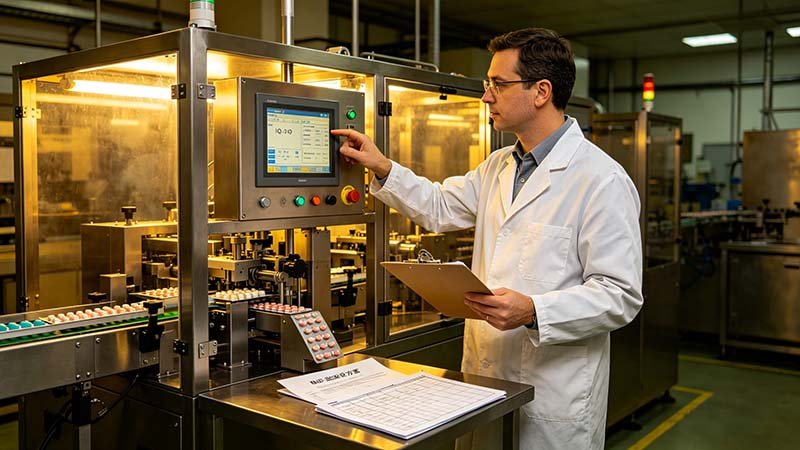
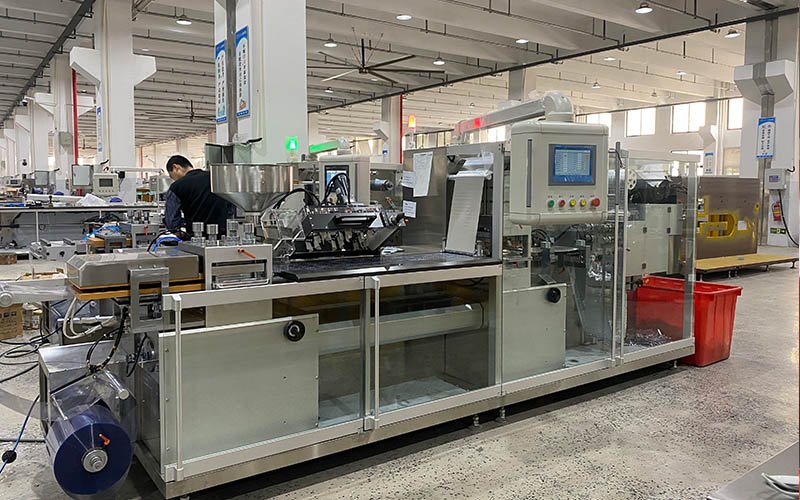
IQ through PQ validation process executed on a blister packaging line in a GMP-controlled environment — each phase requires a pre-approved written protocol and a signed completion report.
IQ/OQ/PQ validation is not bureaucratic paperwork — it is your legal shield and your quality guarantee. Skip any phase, and your entire batch release process becomes a regulatory liability that cannot be corrected after the fact without full re-execution.
— Forester Xiang, Founder, HIJ Machinery
IQ vs. OQ vs. PQ: What Each Phase Must Cover for Capsule Blister Machines
Each qualification phase answers a distinct regulatory question. IQ asks: “Was it installed correctly?” OQ asks: “Does it operate as intended?” PQ asks: “Does it consistently produce compliant product?” Conflating them — or running them in parallel to save time — is the fastest way to generate a 483 observation.
| Qualification Phase | Core Question Answered | Key Tests / Evidence Required | Responsible Party | Regulatory Reference |
|---|---|---|---|---|
| DQ — Design Qualification | Does the design meet the URS and GMP requirements? | URS review, supplier qualification, risk assessment (FMEA), regulatory compliance checklist | Purchaser QA + Supplier | EU GMP Annex 15 §4; WHO TRS 992 Annex 3 §6 |
| IQ — Installation Qualification | Was the machine installed correctly per specifications? | Component verification vs. BOM, calibration certificates, utility connections (compressed air, power, water), drawing review, software version check, cGMP material contact surfaces (316L SS) | Supplier Engineer + Plant QA | 21 CFR Part 211.68; ICH Q10 Section 2.7 |
| OQ — Operational Qualification | Does the machine operate within defined limits including worst-case? | Forming temperature range (±10°C challenge), sealing pressure range (±15% challenge), speed range test, alarm/interlock verification, reject system test, 21 CFR Part 11 audit trail check (if applicable) | Plant QA + Production | EU GMP Annex 15 §11; WHO TRS 992 Annex 3 §7.3 |
| PQ — Performance Qualification | Does the machine consistently produce compliant blister packs at scale? | ≥3 consecutive batches, commercial product and film, seal integrity (ASTM F2338 / USP <1207>), cavity fill rate ≥99.5%, blister appearance, batch record completeness, print verification (lot number, expiry) | Plant QA + Production | 21 CFR Part 211.100; WHO TRS 992 Annex 3 §7.4 |
Table: IQ/OQ/PQ phase comparison for capsule blister packing machine validation — scope, evidence requirements, responsible parties, and regulatory references.
EU GMP Annex 15 (2015) — Qualification and Validation: Defines the lifecycle approach; requires risk-based justification for each phase scope. • WHO TRS 992 Annex 3 — Guidance on Good Manufacturing Practices: Supplementary guidelines on validation. • 21 CFR Part 211 — Current Good Manufacturing Practice for Finished Pharmaceuticals: Equipment installation and operational requirements. • 21 CFR Part 11 — Electronic Records and Electronic Signatures: Applies to PLC audit trails on computerized blister machines. • ASTM F2338 / USP <1207> — Container closure integrity testing standards referenced in PQ seal verification.
How to Build a DQ and IQ Protocol That Survives a WHO Audit
The DQ report landed on my desk in March. The plant was in Nairobi — a greenfield generic manufacturer targeting WHO pre-qualification for an antimalarial capsule line. They had the machine. They had a supplier IQ checklist. What they didn’t have was a DQ that connected their URS to the machine’s engineering drawings. The WHO auditor’s first question would be: “Show me where the URS requirement for Zone IVb packaging is addressed in the design.” Nobody had documented that.
DQ is the phase most frequently underestimated by new pharma manufacturers. It must happen before the purchase order — not after installation. Done correctly, the DQ report becomes the governing document that every subsequent IQ, OQ, and PQ protocol traces back to.
What a GMP-Compliant IQ Protocol Must Include for Capsule Blister Machines
Equipment identification: Model number, serial number, machine tag number, installation location, and software/firmware version — all verified against the purchase order and as-built drawings.
Component verification: Each major component (PLC model, HMI, servo drives, forming station, sealing station, cutting station) verified against the Bill of Materials. Brand-name deviations must be documented with engineering justification.
Material contact surface verification: All product-contact surfaces confirmed as 316L stainless steel or FDA-approved polymer. Certificate of conformity filed with IQ report.
Calibration status: All measurement instruments (temperature sensors at forming and sealing stations, pressure gauges, torque transducers) must have current calibration certificates traceable to national standards at IQ execution date.
Utility connections: Compressed air pressure and quality (oil-free, dew point), electrical supply voltage and frequency, cooling water flow rate — all measured and recorded at point of use.
Documentation package: Operator manuals, maintenance manuals, wiring diagrams, P&ID drawings, and spare parts list — all received, logged, and stored in the site document management system.
Cleaning validation readiness: Surface roughness of product contact areas ≤ 0.8 μm Ra (or per URS); CIP/WIP provisions documented.
One point that costs manufacturers weeks of re-work: the IQ must be executed twice for international shipments — once at FAT (Factory Acceptance Testing) at the supplier’s facility, and again at SAT (Site Acceptance Testing) after delivery and re-installation. Components can shift in transit. Calibrations expire. The two IQ records are not interchangeable.

I’ve commissioned blister lines in Jakarta, São Paulo, and Lagos. The most dangerous validation gap I encounter isn’t technical — it’s documentary. Suppliers ship a machine, run a quick demo, and hand you a generic IQ checklist that doesn’t match your actual URS. When your QA team sits down for an FDA pre-approval inspection, that mismatch becomes a 483 observation overnight. The hidden trap: many low-cost machine vendors have zero experience generating cGMP-compliant validation master plans, leaving your team to build protocols from scratch under deadline pressure. At HIJ, our FAT-witnessed IQ templates are drafted alongside the machine design — they reference your URS numbers, your component tags, and your site SOP numbering system. That conversation starts at contract signature, not at factory acceptance. Demand the same from any supplier you’re evaluating — see our GMP compliance guide for capsule blister packaging for the full checklist framework.
How to Execute OQ on a Capsule Blister Packing Machine: Worst-Case Parameters and What to Challenge
OQ for a capsule blister packing machine must demonstrate that the equipment operates correctly across its full design range — including at the boundaries and deliberately introduced faults — not just at the center-point conditions used during the operator demonstration.
A QA director in São Paulo called me last year. Her OQ had passed, but production was seeing intermittent blister seal failures every third shift — always the night shift, always in the rainy season. The OQ had been run at 22°C and 45% RH. The plant ran at 28°C and 78% RH in December. Nobody had challenged the sealing station at ambient humidity extremes. The OQ was technically complete but operationally useless.
Critical OQ Test Parameters for Capsule Blister Lines
| Test Category | Parameter / System Challenged | Acceptance Criterion | Worst-Case Condition |
|---|---|---|---|
| Forming Station | Heating temperature, forming depth, film tension | Cavity depth ±0.15 mm of target; no film whitening or thinning at corners <0.18 mm | Temperature at lower limit (e.g., 140°C for PVC 250μm); ambient at 35°C |
| Sealing Station | Temperature, pressure (MPa), dwell time | Peel force ≥8 N/15mm (per ASTM F88); zero dye ingress at 60 mbar (ASTM F2338) | Temperature ±10°C from setpoint; pressure −15% from nominal; humidity 75% RH |
| Machine Speed | Strokes per minute, full range | Cavity fill rate ≥99.5% at all speeds; no capsule orientation errors detected by vision system | Maximum rated speed (e.g., 200 strokes/min for DPP-260) |
| Alarm & Interlock Systems | Film break sensor, low-film alarm, over-temperature cutout, empty-cavity reject trigger | Each alarm triggers within ±2 seconds of defined threshold; machine stops or rejects as specified in functional design spec | Deliberately induced: cut film mid-run; manually override temperature sensor |
| Reject System | Empty/underfilled cavity detection and rejection | Reject rate ≥99.8% for challenged defective blisters; no false positives >0.1% | Introduce 5 consecutive empty cavities at maximum line speed |
| 21 CFR Part 11 / Audit Trail (if applicable) | Electronic batch record, parameter change log, user access control | All parameter changes time-stamped with user ID; data not modifiable without audit trail entry; backup verified | Attempt unauthorized parameter change; simulate power failure during batch |
Table: OQ test matrix for capsule blister packing machine validation — parameters, acceptance criteria, and worst-case conditions per EU GMP Annex 15 and 21 CFR Part 211.
The 21 CFR Part 11 audit trail check is non-negotiable for any blister line where electronic batch records replace paper. I still encounter sites running Siemens PLC-controlled blister machines where nobody has validated the electronic record system separately. That’s a standalone compliance obligation — see the GMP compliance guide for capsule blister packaging for the 21 CFR Part 11 audit trail checklist.
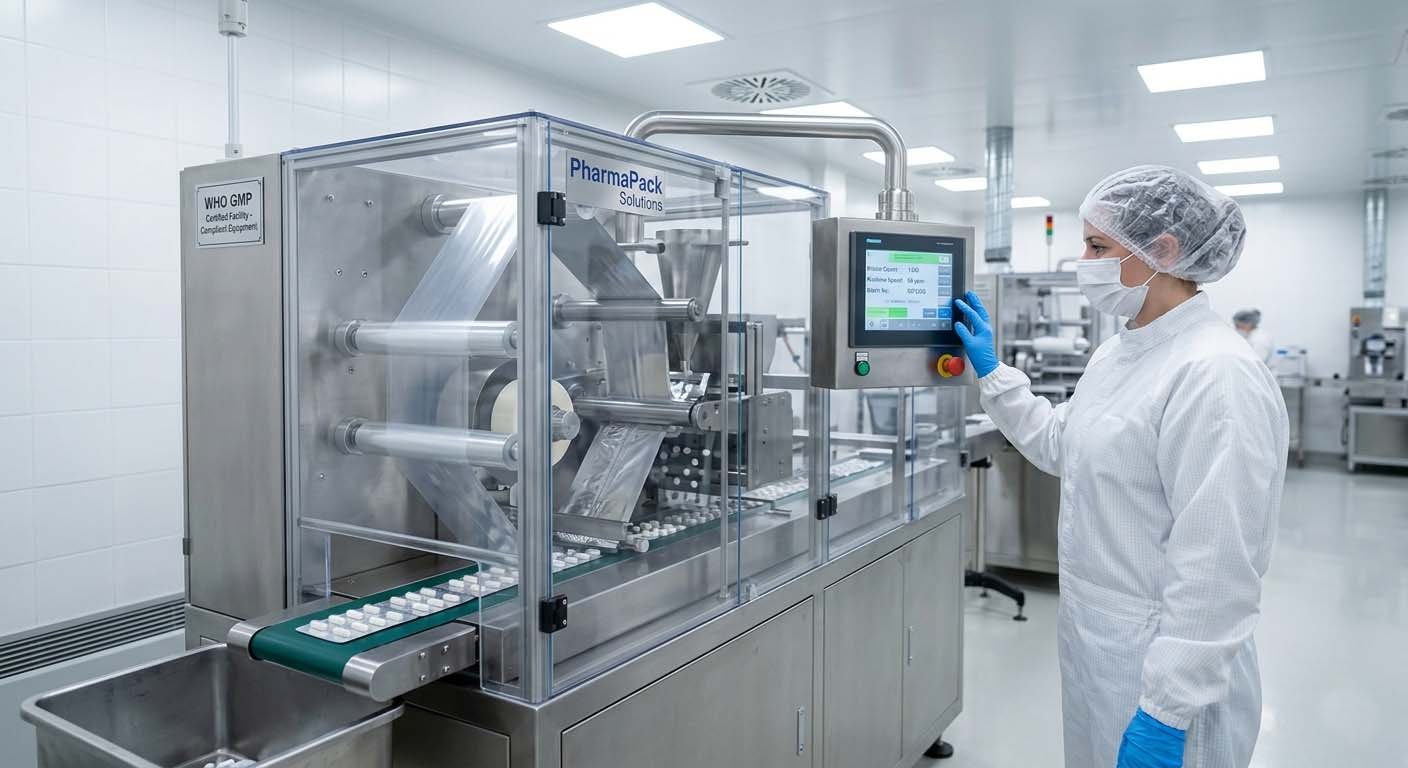
OQ execution in a GMP cleanroom environment — all sealing and forming parameters are challenged at worst-case conditions, with results documented in the pre-approved OQ protocol.
PQ Protocol for Capsule Blister Machines: How Many Batches, What to Measure, and When You’re Done
PQ requires a minimum of three consecutive batches produced under normal operating conditions, using commercial-grade capsules and packaging materials, with all results meeting pre-defined acceptance criteria documented in a locked protocol — approved by QA before the first PQ batch is manufactured. Three batches. Pre-approved protocol. No retrospective adjustments.
The number three is not arbitrary. WHO TRS 992 Annex 3 and the FDA’s process validation guidance both reference consecutive batch consistency as the statistical basis for demonstrating manufacturing reproducibility. Some regulatory reviewers — particularly for sterile products or highly humidity-sensitive APIs — will request five batches. Know your reviewer’s expectation before you write your PQ protocol. Changing the number after execution is not an option.
PQ Acceptance Criteria: Minimum Requirements for a Capsule Blister Line
Cavity fill rate: ≥99.5% across all three batches. Empty or mis-oriented capsule cavities rejected by the inline vision system and documented in the batch record.
Seal integrity: Zero dye ingress at 60 mbar vacuum per ASTM F2338, tested on a minimum of 10 blister cards per batch at start, mid-point, and end of run. USP <1207> referenced as the regulatory standard for container closure integrity.
Print verification: Lot number, manufacturing date, and expiry date on lidding foil — legible, correctly placed, and consistent across all cards in each batch. Defective print results in automatic rejection.
Blister appearance: No film whitening, no cavity deformation, no foil wrinkling. Visual inspection per site AQL standard (typically ANSI/ASQ Z1.4, Level II).
Batch record completeness: All in-process checks recorded in real time by operator; no retrospective entries. Parameter deviations, if any, must trigger a formal deviation report with impact assessment before batch disposition.
Throughput vs. URS target: Actual machine output (blisters/hour) within −5% of URS-specified production rate across all three batches. Downtime episodes documented with root cause.
One thing I’ve seen catch manufacturers off guard: the PQ protocol must specify the packaging materials by lot number and supplier — not just by grade. If you switch PVC film supplier or change lidding foil gauge after PQ, that change triggers a formal change control assessment and potentially a partial re-validation. Lock your material supply chain before you execute PQ.
Stop execution. Issue a formal deviation report. Investigate root cause before Batch 3. If the cause is assignable (e.g., sealing station temperature drift due to a faulty thermocouple), correct it, revalidate the fix under OQ, then re-execute all three PQ batches from the beginning. Partial re-execution starting from Batch 3 is not acceptable under EU GMP Annex 15 §14.
Recovery: Root cause investigation required. If the issue is attributable to a specific capsule lot (moisture-induced size variation), document the lot-specific limitation. Expand the feeder calibration range if needed and re-execute the affected batch. Three consecutive passing batches must be achieved — non-consecutively passing batches do not satisfy the requirement.
Does Your Blister Machine Supplier Need to Provide Validation Documentation — and What Should They Deliver?
Three weeks into a project in Jakarta, the plant’s validation manager asked me a question that I’ve since heard from almost every new pharmaceutical manufacturer: “Is the validation our job or the supplier’s?” The regulatory answer is unambiguous — it is always the manufacturer’s responsibility. But the practical answer is more nuanced.
A GMP-experienced blister machine supplier should deliver a defined documentation package that dramatically reduces the time your QA team spends generating protocols from scratch. What that package looks like varies enormously between suppliers — and the gap between a generic template and a site-specific protocol is measured in weeks of re-work during a pre-approval inspection.
Minimum Documentation a Blister Machine Supplier Should Deliver at FAT
- 1
FAT-witnessed IQ template
Machine-specific, referencing the actual BOM, component serial numbers, and your site’s URS requirement numbers. Not a generic checklist. - 2
OQ protocol draft with parameter ranges
Including the as-tested forming and sealing parameter ranges established during factory testing, with suggested worst-case brackets for your site conditions. - 3
Calibration certificates for all measurement instruments
Traceable to national or international standards, valid at the date of FAT and SAT execution. - 4
Software documentation (if 21 CFR Part 11 applicable)
PLC software version, access control configuration, audit trail setup guide, and backup/restore procedure. - 5
Risk assessment / FMEA for the qualification scope
Identifying critical quality attributes (CQAs) and critical process parameters (CPPs) specific to capsule blister packaging — forming depth, sealing integrity, fill rate, print legibility.
I won’t tell you this list is what every supplier delivers. It is not. But it is what separates a machine purchase that adds 4 months to your validation timeline from one that doesn’t. When evaluating suppliers, request their standard FAT documentation package before issuing a PO. The quality of that package tells you more about their GMP maturity than any sales presentation. For a detailed framework on supplier evaluation, the capsule blister machine manufacturer evaluation guide covers the documentation audit criteria specifically.
GMP-compliant machine design documentation — equipment drawings, BOM, and calibration certificates form the backbone of a defensible IQ report during regulatory inspection.
Of the 31 blister line projects I handled in Southeast Asia and Africa between 2018 and 2023, every regulatory challenge — FDA 483, WHO pre-qual rejection, ANVISA query — traced back to a documentation gap, not a machine failure. The machine always ran. The paperwork didn’t hold up.
— Forester Xiang, Founder, HIJ Machinery
How to Plan a Capsule Blister Packaging Validation Timeline: From URS to PQ Completion
A realistic validation timeline for a capsule blister packing machine — from URS finalization through PQ report approval — runs 12–20 weeks when executed by a QA team with existing validation infrastructure. For new manufacturers without a Validation Master Plan, add 8–12 weeks to develop the VMP before the equipment qualification work begins.
| Milestone | Typical Duration | Key Deliverable | Who Approves |
|---|---|---|---|
| URS Finalization | 2–4 weeks | Signed URS document with all functional and GMP requirements | QA + Production + Engineering |
| DQ Execution | 1–2 weeks | DQ report: URS vs. design cross-reference, supplier qualification records | QA Manager |
| Factory Acceptance Test (FAT) + IQ at Supplier | 3–5 days on-site | FAT report, IQ report (FAT version), calibration certificates | QA + Engineering sign-off |
| Shipping + Installation | 4–12 weeks (geography-dependent) | Installation complete, utilities connected | Engineering |
| Site Acceptance Test (SAT) + IQ at Site | 1–3 days | SAT report, IQ report (SAT version), re-calibration records | QA sign-off |
| OQ Execution | 1–2 weeks | OQ report: all parameter matrices, alarm challenge results, 21 CFR Part 11 audit trail verification | QA Manager |
| PQ Execution (≥3 batches) | 2–4 weeks | PQ batch records, seal integrity results, fill rate data, print verification | QA Manager + Site Head |
| PQ Report Finalization & Approval | 1–2 weeks | Final PQ report, validation summary, recommendation for routine production release | QA Director |
Table: Capsule blister packing machine validation timeline — from URS to PQ completion. Shipping duration (weeks 4–16) is the primary variable for international equipment procurement.
The shipping window is where most timelines fracture. A blister line ordered from China destined for West Africa can take 8–12 weeks in transit. If the IQ documentation package isn’t ready before the machine arrives, the installation team is idle, and the validation clock hasn’t started. I’ve seen sites lose four months on a project because the SAT IQ protocol was being drafted while the machine sat in customs.
For manufacturers planning a full turnkey blister packaging line — integrating capsule filling, blister packing, and cartoning into a single validated production unit — the validation scope expands significantly. Each piece of equipment requires its own IQ/OQ/PQ, plus an integrated system qualification that demonstrates the line functions as a compliant whole. Our capsule blister packing machine page details the DPP-260’s documentation package and FAT protocol scope.
I won’t tell you the IQ/OQ/PQ decision is simple. It involves your API profile, your target regulatory markets, your site SOP maturity, and sometimes your relationship with the validation consultant you’ve hired. What I can tell you is that the projects that finish on time are the ones where the validation documentation strategy is agreed at contract signature — not when the machine is on the floor and the operations director is asking when production starts. At HIJ, we treat validation documentation as part of the engineering scope. That conversation starts at Week 1. That’s not standard in the industry. It should be.
How Capsule Blister Machine Validation Connects to Tablet Blister Lines and Broader GMP Compliance
Capsule and tablet blister packaging lines share the same IQ/OQ/PQ framework, but the critical parameters differ. Capsule lines require specific attention to fill orientation (the capsule must land body-down in the cavity), feeder design (brush-type vs. vibratory), and moisture sensitivity of the gelatin or HPMC shell — parameters that don’t apply to solid tablets. PQ acceptance criteria for cavity fill rate are typically tighter for capsule lines — ≥99.5% vs. ≥99.0% for tablets — because a mis-oriented or double-filled capsule creates a patient safety risk that a mis-seated tablet does not.
Manufacturers running both tablet and capsule blister lines should maintain separate Validation Master Plan sections for each product category, even if the machines share the same physical space. Cross-contamination risk assessment under EU GMP Annex 15 applies to equipment qualification scope when the same blister line handles multiple dosage forms.
For tablet blister lines specifically, the IQ/OQ/PQ framework is identical in structure but differs in forming temperature ranges (tablets tolerate higher heat than gelatin capsules), sealing pressure profiles, and the rejection system calibration logic. Our tablet blister packing machine page covers the DPP-series technical specifications relevant to tablet validation qualification.
The GMP compliance landscape for blister packaging extends well beyond equipment qualification. Annex 1 (2022) sterile manufacturing requirements, ICH Q10 Pharmaceutical Quality System, and regional regulations like ANVISA’s RDC 658/2022 all impose obligations on packaging equipment validation documentation. The GMP compliance guide for capsule blister packaging covers the full regulatory cross-reference matrix for WHO, FDA, EMA, and regional authorities.
Frequently Asked Questions: IQ OQ PQ Validation for Capsule Blister Packing Machines
❓ What is the difference between IQ, OQ, and PQ for a blister machine?
IQ (Installation Qualification) verifies the machine was installed correctly per its specifications and drawings. OQ (Operational Qualification) demonstrates it operates as intended across its full parameter range, including worst-case conditions. PQ (Performance Qualification) proves it consistently produces compliant capsule blister packs over three or more consecutive commercial-scale batches. All three phases require pre-approved written protocols and signed completion reports before the line can release product for commercial distribution.
❓ How many PQ batches are required for a capsule blister packing machine?
A minimum of three consecutive batches is the standard requirement under WHO TRS 992 Annex 3 and FDA process validation guidance. Some regulatory agencies — particularly for moisture-sensitive products destined for tropical markets — expect five batches. Confirm with your regulatory affairs team before locking the PQ protocol.
❓ Does a blister machine need to be re-validated after relocation?
Yes. Moving a blister machine to a new location requires at minimum a SAT-level IQ re-execution, followed by OQ re-verification if utility conditions at the new site differ from the original installation. This applies to inter-facility moves and to moves within the same building if room classification or utility connections change. A formal change control assessment must be completed before the move and must determine the required re-qualification scope.
❓ What does 21 CFR Part 11 require for blister machine validation?
21 CFR Part 11 applies when electronic records or electronic signatures replace paper records in the manufacturing process. For blister machines with computerized control systems, this means the PLC audit trail, batch record system, and any electronic operator sign-off functions must be validated separately — covering access controls, audit trail integrity, data backup and restore, and system availability. This is typically addressed within the OQ scope but documented as a standalone 21 CFR Part 11 validation package.
❓ Can the supplier’s IQ template be used directly in the pharmaceutical dossier?
Not without review and amendment. A supplier’s IQ template must be verified against your site’s URS, adapted to match your document numbering system and SOP format, and approved by your QA department before execution. Generic templates that reference components or specifications not present on your specific machine will generate regulatory observations. Treat the supplier template as a starting point, not a finished document.
❓ What seal integrity test method is used in PQ for capsule blister packs?
ASTM F2338 (non-destructive vacuum decay) and the dye-ingress method at 60 mbar are the most widely used methods, referenced by USP <1207> for container closure integrity. The choice between deterministic (vacuum decay) and probabilistic (dye ingress) methods should be risk-justified in the PQ protocol based on the product’s moisture sensitivity and the regulatory expectations of your target markets.
❓ How long does IQ OQ PQ validation take for a capsule blister line?
From FAT sign-off to PQ report approval: typically 8–16 weeks for an experienced QA team with an existing Validation Master Plan. Add 8–12 weeks if the VMP must be developed from scratch. International shipping (China to Africa or Latin America) adds 8–12 weeks to the overall project timeline but does not affect the active validation execution period.
❓ What happens if a PQ batch fails mid-validation?
All three batches must pass consecutively. A single failing batch stops the PQ execution. A formal deviation report is required. Root cause investigation must be completed and documented. The corrective action must be validated (at minimum, re-verified under OQ conditions if a process parameter was changed). Then all three PQ batches must be re-executed from the beginning — not from the failed batch.
→ GMP Compliance for Capsule Blister Packaging: WHO, cGMP & 21 CFR Part 11 Requirements
→ How to Evaluate a Capsule Blister Packing Machine Manufacturer in China
→ HIJ DPP-260 Capsule Blister Packing Machine — Technical Specifications & Inquiry
HIJ Machinery delivers FAT-witnessed IQ templates, OQ protocol drafts, and full GMP documentation packages with every capsule blister machine — engineered alongside the equipment, not bolted on as an afterthought. Speak with an engineer about your validation timeline and regulatory requirements.