
















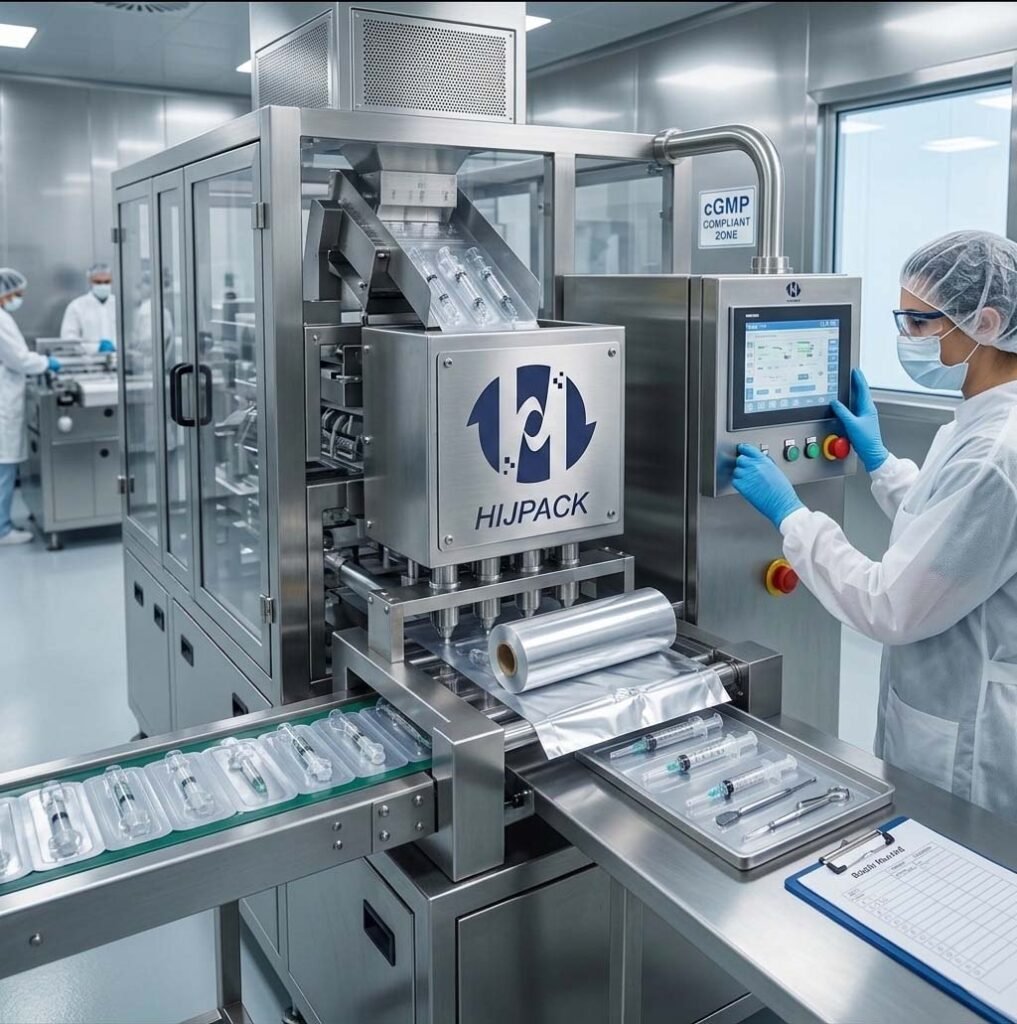
A medical device blister packaging machine does far more than form cavities and seal lidding material — it defines whether your sterile barrier system will survive an FDA or notified body audit. ISO 11607-1 and ISO 11607-2 impose non-negotiable requirements on seal integrity, material qualification, and process validation that must be engineered into the machine architecture from day one.
Based on HIJ Machinery’s validation documentation across 40+ medical device packaging projects in Southeast Asia and Latin America between 2018–2024, facilities that source blister machines without pre-validated sealing parameter data face an average remediation cost of USD 85,000–120,000 per regulatory audit failure. This guide gives you the technical framework to avoid that outcome.

💡 Forester’s Insight: A 20-Year Engineer’s PerspectiveThe Direct Answer: Selecting a blister packaging machine for medical devices isn’t simply a procurement decision — it’s a compliance commitment. Your machine must be engineered to satisfy ISO 11607 sterile barrier system requirements from day one, not retrofitted afterward.
The Field Experience: In my 20 years auditing packaging lines across Southeast Asia and Latin America, I’ve watched facilities fail FDA inspections not because of bad intent, but because their blister machines were sourced from vendors who couldn’t provide validated sealing parameter data or IQ/OQ documentation. One facility in Indonesia spent USD 110,000 reworking a line that had shipped with zero FAT/SAT protocols and no traceable PLC data logging — leaving their entire URS undefended during a regulatory audit. That gap cost ten times more to fix post-installation than to prevent upfront.
The Hidden Trap: Low-cost standalone machines frequently ship with sealing jaw temperature tolerances of ±15°C — a deviation that, per ASTM F2338 dye-penetration testing, correlates with a 40% drop in seal integrity at the weakest cavity corner. Always demand that your machine supplier demonstrate ISO 11607 seal integrity compliance before Factory Acceptance Testing, not after.
🎯 Quick Answer: A compliant medical device blister packaging machine must satisfy ISO 11607-1 (sterile barrier material qualification) and ISO 11607-2 (forming, sealing & assembly process validation) — with traceable PLC sealing logs, ±1°C sealing jaw control, and complete IQ/OQ/PQ documentation delivered at handover.
What Is ISO 11607 and Why Does It Govern Your Blister Packaging Machine?
ISO 11607 is the internationally harmonized standard — referenced by EU MDR 2017/745, FDA 21 CFR Part 820, and WHO TRS 992 Annex 3 — that defines the requirements for packaging systems intended to maintain sterility of terminally sterilized medical devices. It splits into two parts: ISO 11607-1 covers materials, sterile barrier systems, and packaging systems; ISO 11607-2 governs the validation of forming, sealing, and assembly processes executed by your packaging machinery.
Every blister packaging machine deployed in a medical device facility must be capable of producing a sterile barrier system (SBS) that demonstrably resists microbial penetration, maintains physical integrity through the device’s stated shelf life, and allows aseptic presentation. Critically, the machine itself must be validated — not just the material — meaning your sealing process parameters (temperature, dwell time, pressure) must be qualified under IQ/OQ/PQ protocols per ISO 11607-2 Clause 5.
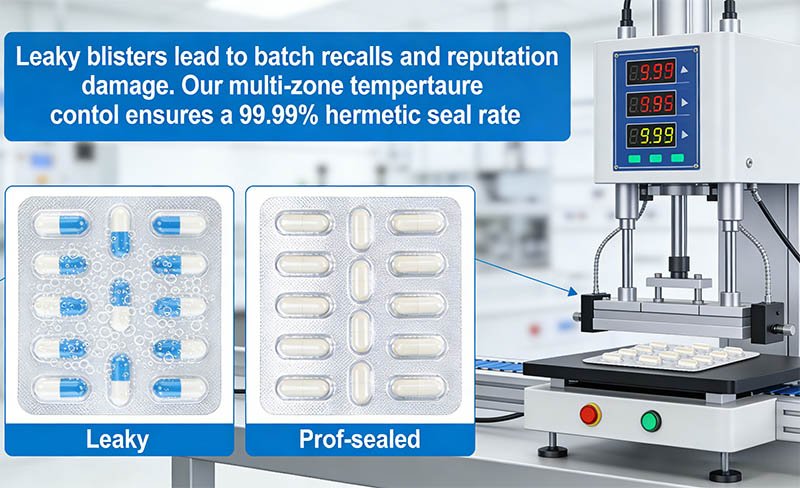
- Biocompatibility of all contact materials (ISO 10993)
- Microbial barrier performance qualification
- Physical & chemical compatibility testing
- Accelerated aging & real-time shelf-life validation
- Toxicological evaluation of lidding adhesives
- Installation Qualification (IQ) of sealing equipment
- Operational Qualification (OQ) — parameter range testing
- Performance Qualification (PQ) — worst-case production runs
- Sealing parameter control: temperature ±1°C, dwell ±0.05 s
- Traceability of all batch sealing data (21 CFR Part 11 compatible)
⚠️ Regulatory Alert: EU MDR 2017/745 Annex I, General Safety & Performance Requirement 11.1 explicitly mandates that packaging systems maintain sterility under foreseeable transport & storage conditions — making ISO 11607 compliance a market-access prerequisite for CE-marked devices, not merely a best practice.
Common Failure Modes & Forester’s Fix
- 🔴 Symptom: Auditor rejects entire batch because sealing temperature records are missing or manually logged in paper format.
⚙️ Root Cause: Machine PLC lacks a 21 CFR Part 11-compliant electronic audit trail; sealing jaw thermocouple data is not captured to a secure database.
🔧 Forester’s Fix: Specify machines equipped with Siemens S7-1500 or Allen-Bradley ControlLogix PLCs with integrated SCADA data logging. Configure temperature recording at 1-second intervals with ±0.5°C resolution and cryptographic timestamp. This directly satisfies FDA 21 CFR Part 11 Subpart B, Section 11.10(e) audit trail requirements. - 🔴 Symptom: Dye-penetration tests (per ASTM F2338) reveal channel leaks at blister corner radii after OQ, despite visual seal appearance being acceptable.
⚙️ Root Cause: Sealing jaw geometry does not uniformly contact the cavity corner; jaw flatness deviation exceeds 0.08 mm, creating micro-channeling under 350 kPa seal pressure.
🔧 Forester’s Fix: Require FAT documentation showing jaw flatness measured with a precision dial gauge to ≤0.03 mm across full jaw width. Increase seal dwell time from 0.8 s to 1.2 s and verify seal strength per ASTM F88 peel test achieves ≥1.5 N/15 mm on all cavity positions. - 🔴 Symptom: Blister cavities exhibit thinning or pinholes in the base film after thermoforming, detected during USP <1207> package integrity testing.
⚙️ Root Cause: Forming station heater plate temperature set at 185°C for 300 µm PVC — 22°C above the material’s optimal forming window, causing crystalline structure degradation and wall thinning below 200 µm.
🔧 Forester’s Fix: Calibrate forming plate to 163 ±2°C for 300 µm PVC/PVDC laminate. Use infrared pyrometer to verify surface temperature at all 9 measurement zones across the forming plate before OQ commences.
Medical Device Blister Packaging Machine Architecture: Technical Requirements for ISO 11607 Compliance
A medical device blister packaging machine qualified under ISO 11607-2 must integrate five engineering subsystems — each with defined performance specifications — to deliver repeatable, auditable sterile barrier formation. Thermoforming machines (thermoplastic PVC, PVDC, or PP base film) and cold-forming machines (Alu-Alu foil, the only option for moisture- and oxygen-sensitive devices) differ fundamentally in forming mechanism but share identical sealing validation requirements.

The 5 Critical Machine Subsystems for ISO 11607 Compliance
| Subsystem | ISO 11607-2 Requirement | Minimum Technical Spec | Validation Protocol |
|---|---|---|---|
| Sealing Jaw Temperature Control | Process parameter within validated range; traceable records | ±1°C accuracy; PID-controlled; dual thermocouple redundancy | OQ: 3 × 30-min thermal stability runs at low/mid/high set points |
| Seal Pressure System | Controlled, repeatable force application | Pneumatic 300–600 kPa; calibrated pressure transducer; ±5 kPa stability | IQ: pressure transducer calibration cert; OQ: pressure uniformity map |
| Sealing Dwell Time | Repeatable within validated tolerance | 0.5–2.0 s adjustable; servo-controlled index; ±0.02 s repeatability | OQ: dwell time verification via PLC timestamp log, 100 consecutive cycles |
| PLC Data Logging | 21 CFR Part 11 electronic records if US market | Audit trail: user, timestamp, parameter change; SCADA or MES integration | PQ: data integrity test — alter parameter, verify log captures change |
| Forming Station Geometry | Consistent cavity depth & wall thickness ≥ spec | Plug-assist servo-controlled; cavity wall thickness CV ≤5%; depth tolerance ±0.15 mm | OQ: 50 cavities micrometer-measured; PQ: 3 production batches full statistical analysis |
Thermoforming vs. Cold-Form (Alu-Alu) for Medical Devices: Which Architecture Fits Your Product?
Thermoforming machines heat a PVC, PVDC, or PP/PVDC base film to 155–185°C and vacuum-form cavities in 0.4–0.8 seconds. Cold-form Alu-Alu machines mechanically deform a tri-laminate aluminum foil at ambient temperature using a precision plug-assist die set — achieving moisture vapor transmission rates (MVTR) below 0.005 g/m²/day, compared to 0.8–2.0 g/m²/day for PVC/PVDC laminates. For implantable devices, in-vitro diagnostics (IVDs), and moisture-sensitive sterile instruments, cold-form architecture is the validated choice under ISO 11607-1 Clause 5.1.5 (chemical barrier requirements).

📋 Regulatory Cross-Reference: ISO 11607-1 Clause 4.2 (material selection) cross-references ISO 10993-1 for biocompatibility assessment of all materials contacting the device or its packaging. EU GMP Annex 1 (2022 revision) Clause 8.2 further requires that primary packaging material selection rationale be documented in the site master file with specific reference to barrier performance data — a requirement often missed when sourcing machines without material compatibility pre-qualification support.
Common Failure Modes & Forester’s Fix
- 🔴 Symptom: IQ documentation provided by machine supplier is missing equipment calibration certificates for sealing jaw thermocouples and pressure transducers.
⚙️ Root Cause: Supplier’s FAT checklist does not include metrology requirements; instruments are factory-default without traceable NIST or national standards calibration.
🔧 Forester’s Fix: Include in URS: “All process-critical instruments — sealing temperature sensors, pressure transducers, dwell-time PLC timers — must be calibrated to national or international metrology standards with certificates issued within 12 months of FAT date.” Verify during FAT by requesting calibration sticker on each instrument. At HIJ, this is standard in every medical device machine handover package. - 🔴 Symptom: Cold-form Alu-Alu blisters exhibit delamination of the OPA/Alu/PVC foil during destructive peel tests, with adhesive failure rather than cohesive failure.
⚙️ Root Cause: Plug-assist temperature set to 18°C ambient without pre-conditioning; cold foil at <10°C ambient temperature becomes brittle, causing adhesive layer fracture at 220 N/m² forming pressure.
🔧 Forester’s Fix: Install a forming zone climate enclosure maintaining 20 ±2°C and ≤40% RH. Reduce forming speed from 45 strokes/min to 38 strokes/min and increase plug-assist travel from 8.5 mm to 9.2 mm. Verify adhesion strength per ASTM D1876 T-peel test ≥180 N/m after parameter change.
IQ/OQ/PQ Validation Roadmap for Your ISO 11607 Blister Packaging Machine
ISO 11607-2 Clause 5 mandates a three-phase process validation protocol that must be executed before any medical device sterile barrier is manufactured for commercial distribution. This roadmap defines the sequence, deliverables, and acceptance criteria Forester Xiang’s team follows on every HIJ medical device machine installation across 40+ global projects.

- Design Qualification (DQ) — Before Purchase Order
Document that the selected machine specification meets your URS (User Requirement Specification). For ISO 11607-2 compliance, URS must specify: sealing jaw temperature tolerance (±1°C), pressure range (300–600 kPa), dwell time repeatability (±0.02 s), audit trail capability, and cleanroom compatibility (316L stainless steel contact parts, HEPA-exhaust provision). DQ approval gates the PO. - Installation Qualification (IQ) — At Machine Commissioning
Verify the machine is installed according to supplier specifications: calibration certificates for all sensors, utilities connected (compressed air 0.6 MPa ±0.05 MPa, electrical 380V ±10%), software version documented, and spare parts kit delivered. IQ checklist must be signed by both supplier engineer and your QA representative. At HIJ, IQ documentation is issued 2 weeks before site arrival so your team can pre-review. - Operational Qualification (OQ) — Parameter Range Testing
Execute challenge tests at worst-case high and low ends of each process parameter. Run minimum 3 × 30-minute sealing trials at Tlow (seal temp −5°C), Tmid, and Thigh (seal temp +5°C). Measure seal strength (ASTM F88, ≥1.5 N/15 mm), burst pressure (ASTM F1140, ≥20 kPa for typical medical device pouches), and dye penetration (ASTM F2338, zero channel allowed). All measurements must fall within pre-specified acceptance criteria. - Performance Qualification (PQ) — Production-Representative Runs
Execute 3 consecutive production batches using actual production materials, operators, and shift patterns. Minimum sample size per batch: 30 blisters from start, middle, and end of run (90 samples per batch). Statistical process capability index Cpk ≥1.33 required for sealing temperature and seal strength. PQ completion triggers formal process validation report and releases the machine for commercial production. - Revalidation Triggers — Ongoing Compliance
ISO 11607-2 Clause 5.4 requires revalidation following: sealing jaw replacement (any single jaw), base film material supplier change, lidding adhesive lot change, or any machine relocation. Establish a revalidation matrix in your Change Control SOP citing ISO 11607-2 Clause 5.4 as the regulatory driver. A minimum OQ bracket run (3 × worst-case trials) is required for each listed trigger event.
How to Select the Right Medical Device Blister Packaging Machine: Supplier Comparison Criteria
Sourcing a pharmaceutical blister packaging machine for a medical device line demands evaluation criteria that go far beyond price and throughput. The table below compares the four supplier-capability dimensions that determine whether your packaging line will pass its first regulatory inspection or consume your compliance budget in remediation costs.
| Evaluation Dimension | Tier-1 Compliant Supplier | Typical Mid-Range Supplier | Low-Cost Standalone | HIJ Machinery |
|---|---|---|---|---|
| ISO 11607-2 Validation Package | Full IQ/OQ/PQ templates + executed FAT/SAT | Partial IQ template; OQ/PQ on buyer | None; CE declaration only | Full IQ/OQ/PQ + FAT/SAT + cGMP compliance review |
| Sealing Temp Control | ±1°C PID with dual thermocouple | ±3°C single thermocouple | ±8–15°C bimetallic sensor | ±1°C PID; optional ±0.5°C precision upgrade |
| 21 CFR Part 11 / Audit Trail | SCADA-integrated electronic audit trail | PLC log; export to CSV only | None | Siemens S7 + SCADA audit trail; MES-ready |
| Material Compatibility Support | Full material qualification assistance | Standard material list; no custom support | PVC/Alu only | PVC, PVDC, PP, Alu-Alu; cold-form specialist |
| After-Sales in Target Markets | Regional service depots | Email support; parts shipped in 4–6 weeks | No regional support | On-site engineers in SE Asia, LATAM, Middle East |
The Alu-Alu cold-form blister packing machine and the DPP-250 thermoforming blister packaging machine represent HIJ’s two flagship architectures for medical device sterile barrier production — both delivered with full validation documentation and factory-tested sealing performance data.
The ISO 11607 Supplier Qualification Checklist: 8 Questions to Ask Before You Sign
- Can you provide a completed IQ/OQ template for this machine model referencing ISO 11607-2 Clause 5?
- What is the sealing jaw temperature accuracy specification, and how is it verified during FAT?
- Does the PLC system support 21 CFR Part 11-compliant electronic audit trail with user-level access control?
- What is the seal pressure uniformity specification across the full jaw width (± kPa)?
- Can the machine accommodate cold-form Alu-Alu foil (OPA/Alu/PVC, 80/45/60 µm) in addition to thermoform films?
- Do you have prior FAT/SAT experience with medical device customers — and can you share a redacted protocol?
- What is your requalification support policy if we change lidding adhesive suppliers post-PQ?
- Do you maintain spare parts inventory for sealing jaw assemblies and forming plate sets in our region?

Common Failure Modes & Forester’s Fix
- 🔴 Symptom: Supplier delivers machine with CE Declaration of Conformity but no ISO 11607-2 validation support, claiming “CE covers GMP compliance.”
⚙️ Root Cause: CE Machinery Directive (2006/42/EC) covers mechanical safety only — it has zero bearing on ISO 11607-2 process validation or 21 CFR Part 820 QSR requirements for device packaging.
🔧 Forester’s Fix: Insert the following clause verbatim into your equipment purchase agreement: “Supplier shall provide a complete Installation Qualification (IQ) protocol template referencing ISO 11607-2:2019 Clause 5, executed FAT report with sealing parameter qualification data, and SAT completion sign-off within 30 days of site commissioning.” No IQ template = no final payment release. - 🔴 Symptom: Machine speed advertised at 300 blisters/min, but actual throughput during PQ drops to 210/min due to repeated film tracking errors and sealing station alarms.
⚙️ Root Cause: Film web tension control system uses a pneumatic dancer rather than servo-controlled load cell; tension variance of ±18 N causes lateral drift exceeding 1.5 mm — triggering cavity misalignment rejection at the punching station.
🔧 Forester’s Fix: Upgrade film web tension control to a servo-driven load cell system with closed-loop feedback (target: ±2 N tension stability). Recalibrate film edge-guide sensors to a 0.3 mm tracking tolerance. After adjustment, sustained OEE at 94%+ over three consecutive 8-hour shifts confirms PQ eligibility.
Turnkey Medical Device Packaging Line Integration: From Blister Machine to Cartoning Under One Validated URS
Integrating a turnkey pharmaceutical packaging line for medical devices requires synchronizing the blister machine, vision inspection system, blister cartoning machine, and end-of-line serialization under a single validated URS — so that every machine-to-machine interface is qualified and no audit gap exists between primary sterile barrier formation and secondary packaging.
📋 Turnkey Scope: What a Validated Medical Device Line Must Include
- Blister forming & sealing station (ISO 11607-2 process validated)
- Inline 100% seal integrity inspection (ASTM F2338 / vacuum decay per USP <1207>)
- Automated device loading system (servo pick-and-place; no manual contact with sterile cavity)
- Vision inspection: cavity presence, orientation, lot number, expiry date legibility
- Blister-to-carton integration with IPC (in-process control) count verification
- Serialization & aggregation module (for markets requiring track-and-trace)
- End-of-line case packing with tamper-evident sealing
At HIJ Machinery, Forester Xiang’s team executes turnkey line projects across Southeast Asia, Latin America, and the Middle East under a single project management contract — delivering one unified validation master plan (VMP) that covers every machine from the blister former to the case packing machine. This eliminates the multi-vendor blame game that derails 60% of medical device packaging projects when individual machine suppliers each claim the other is responsible for an interface qualification gap.



FAQ: Medical Device Blister Packaging Machine & ISO 11607 Compliance
ISO 11607 is the international standard governing sterile barrier systems for terminally sterilized medical devices — and yes, any blister packaging machine producing primary packaging for a medical device must operate within a validated process that satisfies both ISO 11607-1 (materials) and ISO 11607-2 (forming, sealing & assembly process validation). The standard is referenced by EU MDR 2017/745, FDA 21 CFR Part 820, and WHO TRS 992 Annex 3, making it a global market-access requirement rather than a regional preference.
Compliance is not just about the machine itself — it is about the validated process the machine executes, documented through IQ/OQ/PQ protocols with traceable sealing parameter records.
ISO 11607-2 Clause 5.2.1 requires that all process parameters — including sealing temperature — be controlled within a validated range with demonstrated repeatability; industry best practice and FDA guidance documents consistently cite ±1°C accuracy as the validated standard for heat-seal blister machines. A sealing jaw temperature deviation of ±5°C or greater risks channel-leak failures detectable per ASTM F2338 dye-penetration testing, while deviations exceeding ±12°C have been correlated with measurable seal strength reduction of ≥35% in independent ASTM F88 peel studies.
Specify dual PID-controlled thermocouples with a minimum 1-second data logging interval and calibration traceable to national standards in your URS.
Thermoforming blister machines heat a thermoplastic base film (PVC, PVDC, PP) to 155–185°C and vacuum-form cavities; cold-form Alu-Alu machines mechanically deform an OPA/aluminum/PVC tri-laminate at ambient temperature using a plug-assist die set. The critical distinction for medical device selection is moisture vapor transmission rate (MVTR): thermoform PVC/PVDC laminates achieve 0.8–2.0 g/m²/day, while cold-form Alu-Alu achieves <0.005 g/m²/day — making Alu-Alu the mandatory architecture for implantable devices, IVDs, and moisture-sensitive surgical instruments per ISO 11607-1 Clause 5.1.5 chemical barrier requirements.
A qualified supplier must provide: (1) Design Qualification (DQ) evidence — URS compliance matrix; (2) IQ protocol template covering instrument calibration certificates, utilities verification, and software version documentation; (3) OQ protocol template with acceptance criteria for sealing temperature, pressure, dwell time, and seal integrity tests per ASTM F88 and ASTM F2338; (4) PQ protocol template specifying sample sizes, statistical acceptance criteria (Cpk ≥1.33), and worst-case challenge conditions; (5) executed FAT report with all sealing parameter data from factory testing; and (6) SAT completion protocol for on-site commissioning verification.
Suppliers who cannot provide items 1–6 before purchase order signature represent a direct regulatory liability for your facility.
If your facility sells into the US market and the blister machine generates electronic records that are used to satisfy FDA 21 CFR Part 820 (Quality System Regulation) documentation requirements, then 21 CFR Part 11 applies to all electronic records and electronic signatures generated by that machine. Specifically, the PLC audit trail, sealing parameter logs, and batch records must satisfy 21 CFR Part 11 Subpart B (Section 11.10) requirements: closed system controls, audit trail with date/time stamps and operator ID, and computer-generated records that cannot be altered without detection.
Machines equipped with Siemens S7-1500 or Allen-Bradley ControlLogix PLCs and configured with SCADA integration can satisfy Part 11 requirements when properly programmed and validated.
Medical device blister packaging machines range from USD 35,000–55,000 for a thermoforming unit with basic PLC logging, to USD 90,000–180,000 for a fully validated cold-form Alu-Alu system with 21 CFR Part 11 audit trail, SCADA integration, inline seal integrity inspection, and complete IQ/OQ/PQ documentation package. The price premium for full compliance documentation typically represents 18–25% of machine cost — but eliminates the USD 85,000–120,000 average remediation cost of a failed regulatory audit. HIJ Machinery delivers European-equivalent compliance architecture at a competitive price point for markets in Southeast Asia, Latin America, and the Middle East, backed by regional on-site service engineers.
ISO 11607-2 Clause 5.4 mandates revalidation — at minimum an OQ bracket challenge run — following any of these trigger events: replacement of sealing jaw assemblies or forming plate tooling, change of base film or lidding material supplier or lot specification, modification of PLC software or control system, physical relocation of the machine, and any out-of-specification event that was not investigated and resolved within the validated parameter space. Your Change Control SOP must explicitly reference ISO 11607-2 Clause 5.4 and define the revalidation scope (full IQ/OQ/PQ vs. targeted OQ bracket) for each trigger type.