














Equipment Buying Guide · 2026Most wet wipes startups overspend on the wrong machine — either a single-lane unit that bottlenecks growth in 12 months, or a multi-lane line that sits half-idle burning capital. In 20+ years auditing 100+ packaging plants across 30+ countries, I’ve seen this $100k+ mistake repeat in almost every market. This guide gives you the exact numbers — output, labor, footprint, film changeover, cost per 1,000 packs and total investment — so you choose right the first time.
Last Updated: June 13, 2026 · By Forester Xiang, HIJ Machinery
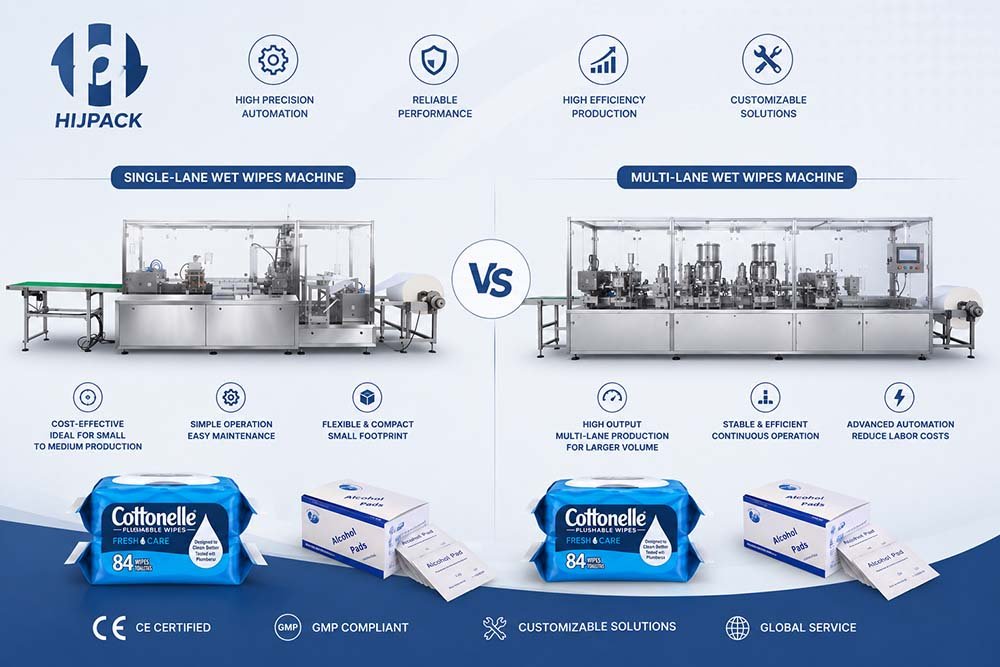
Single-Lane vs Multi-Lane Wet Wipes Machine — Quick Reference
- Single-lane (e.g. entry models): ~80–120 packs/min, 1 operator, lowest capital (~$45k start), best for <5 million packs/year and new brands testing the market.
- Multi-lane (e.g. 8-lane VPD800): up to 800 packs/min, 1–2 operators, $180k–$280k, best for 20 million+ packs/year and contract manufacturers.
- The decision metric is cost per 1,000 packs, not sticker price. Multi-lane wins decisively once volume justifies it because labor is spread across far more output.
- Crossover point is roughly 5 million packs/year — below it single-lane is cheaper per pack; above it multi-lane pulls ahead fast.
- Footprint: one 8-lane machine uses far less floor space than 6–8 single-lane units producing the same volume.
Source: HIJ Machinery (Wenzhou) field data across 100+ packaging line installations. Author: Forester Xiang.
The Real Question Isn’t “Which Is Better” — It’s “When”
Single-lane and multi-lane wet wipes machines aren’t competitors; they’re tools for different volume stages. A single-lane machine is not “the cheap version” of a multi-lane — it’s the correct choice for a specific phase of your business. The mistake buyers make is comparing them on price alone instead of on cost per pack at their actual output.
So before we compare specs, anchor on one number: your realistic 3-year annual pack volume. Everything below is read through that lens.
Head-to-Head Comparison Table
Here is the comparison that matters — built from real installation data, not brochure peaks. The “winner” column is honest: single-lane genuinely wins several rows.
| Factor | Single-Lane Machine | Multi-Lane (8-Lane VPD800) |
|---|---|---|
| Output | ~80–120 packs/min | up to 800 packs/min |
| Operators required | 1 per machine | 1–2 for all 8 lanes |
| Capital cost | ~$45k start | $180k–$280k |
| Footprint (per pack) | Higher when scaled | Far more space-efficient at volume |
| Film changeover | Simple, single web | ~15 min tool-free changeover |
| Cost per 1,000 packs | Higher at scale (labor-heavy) | 50–70% lower at full utilization |
| Best annual volume | < 5 million packs | 20 million+ packs |
| Ideal buyer | Startups, new SKUs, market testing | Scaling brands, contract manufacturers |
Why “Cost Per 1,000 Packs” Beats Sticker Price
Sticker price is a one-time number. Cost per 1,000 packs is what you pay every single shift for years. It bundles depreciation, labor, film, lotion and energy, then divides by real output.
On a single-lane line, one operator covers only ~100 packs/min — so labor is a heavy slice of every 1,000 packs. On an 8-lane VPD800, that same operator (or two) covers up to 800 packs/min. The labor cost is spread across 6–8× the output, which is why multi-lane cost per pack collapses once you’re running near capacity.
The Single-Lane Sweet Spot (When It Genuinely Wins)
Don’t let anyone upsell you out of a single-lane machine if your numbers say otherwise. The entry-level path is the smart move when:
• Your forecast is under ~5 million packs/year for the next 18–24 months.
• You’re validating a new brand and don’t yet know which SKUs will sell.
• Capital is tight and you’d rather prove demand before committing $200k+.
• You run many short batches and value fast, simple changeovers over raw speed.
For these buyers, an entry-level wet wipes packaging machine is the financially correct choice — lower risk, faster payback, and easy to keep as a flexible short-run unit later.
When to Jump to Multi-Lane
The signal to move to a multi-lane machine isn’t a date — it’s a set of conditions:
• You’re consistently running your single-lane machine across multiple shifts and still can’t meet orders.
• Two or three SKUs have proven, repeatable demand.
• Your annual volume is crossing 5 million packs and trending toward 15–20 million.
• You’re winning contract-manufacturing deals that require committed high volume.
When those line up, a high speed wet wipes packing machine like the 8-lane VPD800 stops being expensive and starts being the cheapest way to produce each pack. At up to 800 packs/min with 15-minute tool-free film changeover, it’s engineered for exactly the high-utilization, multi-SKU operation that scaling brands run.
Decision Flow: Which Should You Buy?
Step 1 — Forecast 3-year annual volume. Be honest, not optimistic.
Step 2 — Under 5M packs/year? → Single-lane. Validate the market.
Step 3 — 5M–15M and climbing? → Single-lane now, plan the multi-lane budget.
Step 4 — 15M+ or contract volume committed? → Go straight to the VPD800 8-lane machine.
Step 5 — Either way, size your budget against real machine prices before committing.
Don’t Forget the Line Around the Machine
Whichever lane count you pick, the packing machine is one stage in a wet wipes line: lotion prep → folding/filling/sealing → coding → cartoning → case packing. A multi-lane machine that out-produces your downstream cartoning or case packing just creates a bottleneck somewhere else. If you’re building from scratch, scope the whole line — that’s where a turnkey solution protects your throughput math.
Frequently Asked Questions
How many lanes does a wet wipes machine need?
It depends on target output. A single-lane wet wipes machine produces roughly 80–120 packs/min and suits startups under 5 million packs/year. Multi-lane machines such as the 8-lane VPD800 reach up to 800 packs/min and are built for 20 million+ packs/year. Choose lane count based on your 3-year volume forecast, not just current demand.
Is a multi-lane wet wipes machine more cost-effective than single-lane?
At high volume, yes. Multi-lane machines dramatically lower cost per 1,000 packs because one operator runs all lanes, spreading labor and overhead across more output. Below about 5 million packs/year, a single-lane machine usually wins on total cost because its lower capital cost is not yet offset by labor savings.
What is the cost per 1,000 packs on a wet wipes machine?
Cost per 1,000 packs combines depreciation, labor, film, lotion and energy divided by output. On a single-lane line, labor dominates because one worker covers limited output. On an 8-lane line, the same one or two workers cover up to 800 packs/min, so labor per pack drops sharply — often by 50–70% at full utilization.
Can I start with single-lane and upgrade to multi-lane later?
Yes. Many startups buy an entry-level single-lane wet wipes packaging machine first, validate the market, then add a multi-lane machine like the VPD800 once demand is proven. Keeping the single-lane unit for short runs and new SKUs is common, while the multi-lane handles core high-volume products.
How much floor space does a multi-lane wet wipes machine need?
An 8-lane wet wipes machine like the VPD800 occupies more footprint than a single-lane unit but far less than running 6–8 separate single-lane machines to match output. On a per-pack basis, multi-lane systems are significantly more space-efficient at scale.
Not Sure Which Lane Count Fits Your Volume?
Send us your target output and SKU mix. Forester’s team will run your cost-per-1,000-packs numbers on both options and recommend the right machine — no pressure, real engineering advice within 24 hours.

About the Author — Forester Xiang
Forester Xiang is the founder of HIJ Machinery (Wenzhou), with 20+ years of pharmaceutical and cosmetic packaging machinery experience. He has personally audited 100+ manufacturing facilities across 30+ countries, specializing in WHO GMP, cGMP and CE-compliant packaging lines. Contact: sales@hijpackingmachine.com · WhatsApp +86 13868822120