
















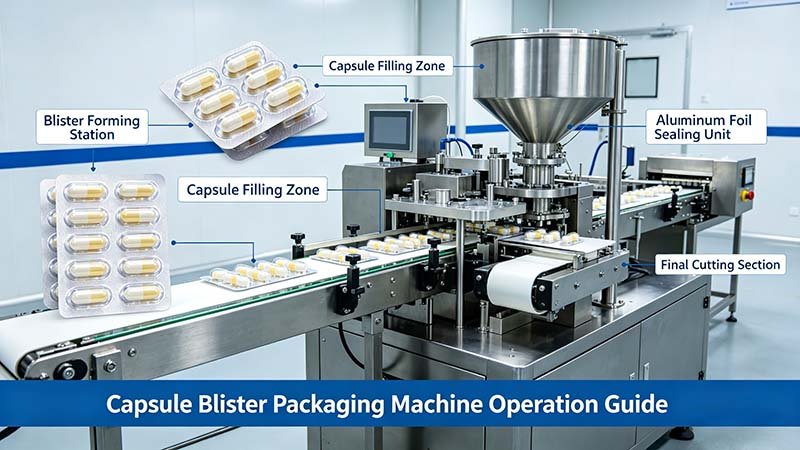
Blister Pack Basics
Pharma Packaging
GMP Compliance
Packaging Materials
📚 Complete Beginner’s Guide
What Is Capsule Blister Packaging? Every Pharma Buyer Should Know This Before Choosing a Machine
Most buyers who contact me about a capsule blister packing machine have already decided they need one. A smaller number haven’t made that decision yet — and those are the conversations I find most valuable. Because the decision to go blister over bottle, or PVC over alu-alu, shapes your regulatory dossier, your stability budget, and your distribution reach for the next decade. Getting it wrong at the format selection stage is far more expensive than any machine price difference.
This guide covers the fundamentals: what capsule blister packaging actually is, how the forming process works, what materials are available, and why the format choice matters far beyond aesthetics.
g/m²/day MVTR — alu-alu film
g/m²/day MVTR — standard PVC
of pharma recalls linked to packaging (FDA 2019–2023)
⚡ Direct Answer
Capsule blister packaging is a primary pharmaceutical packaging method that heat-seals individual capsules into pre-formed cavities in a base film (PVC, PVDC, or cold-form aluminum), then seals each cavity with an aluminum lidding foil — delivering dose-level moisture protection, tamper evidence, and batch-level traceability that bulk bottle formats cannot match.

Individual capsules heat-sealed into pre-formed blister cavities — the defining characteristic of primary blister packaging for pharmaceutical products.
What Is Capsule Blister Packaging — and Why the Definition Matters for Equipment Selection
Capsule blister packaging is a primary packaging format. That distinction — primary — matters legally and practically. Primary packaging is in direct contact with the drug product. It falls under the scope of ICH Q1A(R2) stability testing, WHO TRS 992 Annex 3 guidelines, and, for US market products, 21 CFR Part 211 current Good Manufacturing Practice regulations. The regulatory requirements that attach to primary packaging are substantially more demanding than anything applied to secondary (carton) or tertiary (shipper) formats.
The basic structure has three components: a forming film (the base), individual product units (your capsules), and a lidding foil (the seal). Heat and pressure bond the lidding foil to the forming film across the land area — the flat surface surrounding each cavity. The result is a hermetically sealed pocket for each capsule. Push the capsule through the foil from the back; it ruptures cleanly. That’s the user interaction the entire format is designed around.
Two mechanical processes create this structure. Thermoforming heats a thermoplastic base film (PVC, PVDC, PET, or laminates) until it softens, then draws or stamps it into a mold to form the cavities. Cold forming — used for alu-alu packaging — mechanically deforms a multi-layer aluminum laminate at room temperature, creating permanently deformed metal cavities without heat. The process choice determines your moisture barrier performance more than any other single variable.
Understanding that distinction before you contact a supplier changes the entire procurement conversation. It also changes your validation timeline and your capital budget. Thermoforming machines are faster and cost less to commission. Cold-forming lines carry a 20–35% capital premium and require longer changeover times. Neither is universally “better” — the right answer depends entirely on your API profile and target markets.
📌 Key Technical Point
The fundamental difference between thermoforming and cold-forming blister packaging is not speed or cost — it is the moisture vapor transmission rate (MVTR) of the base film. Standard PVC at 250μm delivers 4–6 g/m²/day MVTR. Cold-form alu-alu film delivers 0.02–0.05 g/m²/day. For a hygroscopic API distributed in a WHO Zone IVb climate (30°C / 75% RH), that difference is the difference between a passing and failing 6-month stability result.
The Four Components of a Capsule Blister Pack: What Each Layer Actually Does
Capsule blister packaging consists of four functional layers, each with a defined technical role in product protection. Every procurement decision — from machine specification to material sourcing — connects back to understanding what each layer contributes.
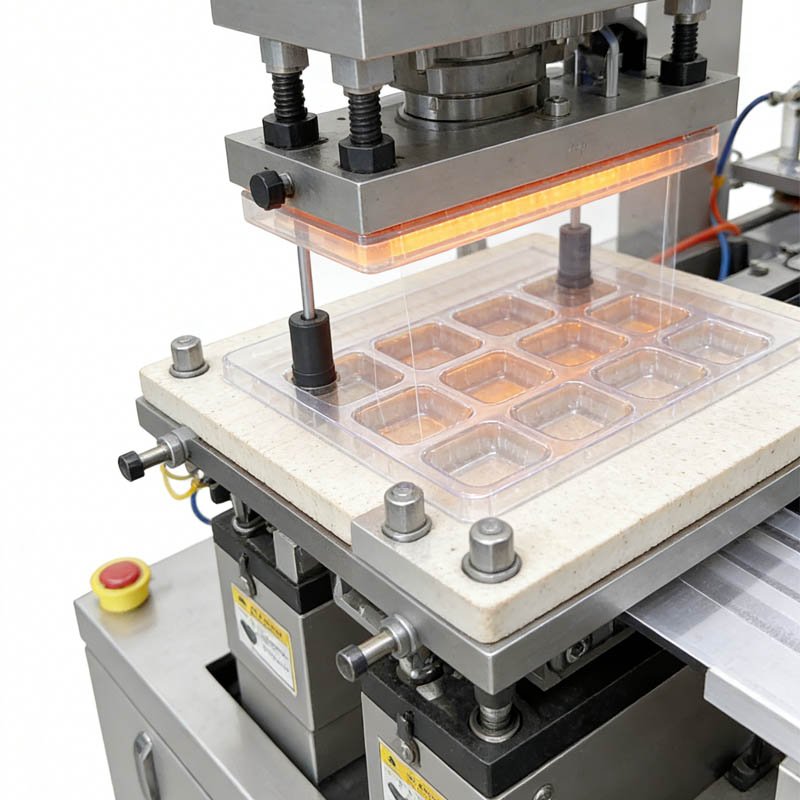
The forming station: base film is heated and drawn into precision-machined mold cavities before capsule loading. Film gauge and material type determine cavity geometry tolerances.
- 1
Base Forming Film
The foundation layer. In thermoforming, this is typically PVC (250μm), PVC/PVDC laminate (60/45 or 60/90 g/m²), or PVC/PCTFE (Aclar) for higher moisture barrier requirements. In cold forming, this is a tri-laminate of OPA (oriented polyamide), aluminum foil (45–60μm), and PVC heat-seal layer. The forming film defines cavity geometry, barrier performance, and material compatibility with your capsule shell chemistry.
- 2
Product Cavity
The pre-formed pocket that holds a single capsule. Cavity dimensions must match capsule size (00, 0, 1, 2, 3, 4) with a 0.3–0.5mm clearance on each axis to allow reliable automatic feeding without jamming. Undersized cavities cause feeding failures; oversized cavities allow capsule movement that can fracture the shell during sealing or transport. Tooling is capsule-size specific and must be validated as part of your IQ/OQ protocol.
- 3
Lidding Foil
The seal layer. Standard pharmaceutical lidding is a soft aluminum foil (20–25μm) with a heat-seal lacquer on the inner face and print lacquer on the outer face. The heat-seal lacquer bonds to the land area of the forming film under controlled temperature (140–220°C depending on forming material) and pressure (2.5–4.5 kN/cm²). Seal integrity is the most commonly cited quality attribute in blister packaging — and the most common source of deviation. ASTM F2338 dye-ingress testing at 60 mbar is the standard verification method specified in USP <1207>.
- 4
Print & Embossing Layer
Batch number, expiry date, and lot code are typically inkjet-printed or embossed onto the lidding foil during the packaging process. In markets with serialization requirements (EU FMD, India DAVA), a 2D Data Matrix code must be applied at the individual blister level. This layer connects your physical pack to your electronic batch record — and is the primary reason 21 CFR Part 11 electronic records requirements apply to the blister line HMI and audit trail.
PVC vs. PVDC vs. Alu-Alu: Which Capsule Blister Packaging Material Is Right for Your Product?
Of the 31 blister line projects I handled in Southeast Asia and South America between 2018 and 2023, 11 required a forming material change after the month-12 stability result came back with a moisture-related failure. Every one of those changes was avoidable — if the API moisture sensitivity profile had been mapped against the target market climate zone before material selection, not after.
Material selection is not a packaging decision. It’s a stability decision with packaging consequences.
| Material | MVTR (g/m²/day) | OTR (cm³/m²/day) | Typical Thickness | Process Type | Best For | Regulatory Markets |
|---|---|---|---|---|---|---|
| PVC (plain) | 4.0 – 6.0 | ~15 | 200 – 300μm | Thermoforming | Low-sensitivity APIs, Zone I & II markets, OTC, vitamins | Global (standard) |
| PVC/PVDC (60/45) | 0.8 – 2.0 | ~8 | 60/45 g/m² laminate | Thermoforming | Moderate-sensitivity APIs, Zone III & IVa markets | EU, ASEAN, LATAM |
| PVC/PVDC (60/90) | 0.3 – 0.8 | ~4 | 60/90 g/m² laminate | Thermoforming | Higher-sensitivity capsules, tropical secondary markets | EU, Middle East, Africa |
| Aclar / PVC-PCTFE | 0.08 – 0.25 | <1 | 51 – 102μm Aclar + PVC | Thermoforming | High-value hygroscopic APIs, biologic-derived capsules | US FDA, EU EMA |
| Alu-Alu (OPA/Al/PVC) | 0.02 – 0.05 | <0.05 | OPA 25μm / Al 45μm / PVC 60μm | Cold forming | Extreme moisture & light-sensitive APIs, Zone IVb markets | WHO PQ, FDA, TGA, CDSCO (Zone IVb) |
The number that changes the decision tree is 0.8% w/w moisture uptake. If your API absorbs more than 0.8% w/w at 75% RH — the condition used in WHO Zone IVb accelerated stability testing — plain PVC will not hold. That single data point from your preformulation report should trigger a material escalation conversation before machine procurement begins, not after your 12-month stability study fails.
Standard PVC blister film delivers 4–6 g/m²/day moisture vapor transmission at 38°C — which means that for hygroscopic APIs distributed in Zone IVb climates (30°C/75% RH), the packaging is not protecting the product; it is merely slowing the degradation curve. The alu-alu alternative reduces that transmission rate by a factor of 80 to 300, depending on film gauge and laminate specification.
— Forester Xiang, HIJ Machinery
How Does Capsule Blister Packaging Work? The Six-Stage Forming-to-Sealing Process
I walked a QC manager through a blister line commissioning run in Kuala Lumpur in early 2022. She had signed off on bottle packaging lines for eight years and had never seen a blister machine run. The first thing she asked, watching the film unwind: “What happens if the cavity depth is wrong?” She already understood the core risk. Capsule geometry and cavity depth are tightly coupled — and both must be validated before product release.

A complete pharmaceutical blister packing line: forming film unwind, thermoforming station, capsule feeding, heat-sealing, printing, and die-cutting in a single continuous process flow.
- 1
Film Unwind & Pre-Heating
The forming film unwinds from a roll (typically 300–500mm wide, 300–500m per roll) and passes through a pre-heating zone. For thermoforming, the film must reach its forming temperature (120–180°C for PVC) uniformly across the web width. Temperature non-uniformity at this stage is the primary cause of cavity depth variation — a defect that leads to capsule misalignment and sealing voids downstream.
- 2
Cavity Forming
Heated film is pressed into a forming mold using compressed air (positive forming) or vacuum (negative forming), or a combination of both. The mold geometry determines cavity depth, sidewall angle, and corner radius. Cavity depth tolerance is typically ±0.1mm for capsule sizes 00 through 4. Mold material is hardened tool steel for production tooling; aluminum for prototype/development runs. A capsule blister packing machine must form cavities within this tolerance at rated speed — a critical parameter to verify during OQ.
- 3
Capsule Loading
Capsules are loaded into formed cavities by gravity (brush or vibration feeder) or by vacuum pick-and-place for small batch or fragile capsule shells. Brush feeders work well for capsule sizes 0 through 3 at 200–400 blisters per minute. For sizes 00 or for soft-gel capsules, which deform under brush pressure, vibrating feeders with adjustable amplitude are preferred. Missing-capsule detection using photoelectric sensors is mandatory for cGMP compliance — any filled blister with an empty cavity must be rejected before sealing.
- 4
Heat Sealing
Lidding foil unwinds from a separate roll and is pressed against the land area of the filled forming film by a heated sealing plate. Sealing temperature (140–220°C), pressure (2.5–4.5 kN/cm²), and dwell time (0.3–0.8 seconds) are the three critical process parameters for seal integrity. These must be validated per ASTM F2338 and documented in your OQ protocol. Seal temperature too low: peel bond insufficient. Seal temperature too high: film distortion and potential capsule damage from heat transfer. The sealing window for a given material/lidding combination is typically 15–25°C wide.
- 5
Batch Printing & Embossing
Batch number, expiry date, and lot code are applied to the lidding foil immediately after sealing. Inkjet printing (continuous inkjet or thermal inkjet) is the dominant method for variable data. Embossing dies (raised metal characters) are used where permanence is required by local pharmacopeia. For EU FMD-compliant products, a 2D Data Matrix code must be applied and vision-verified at this stage. All print verification data must be captured in the machine’s electronic batch record to satisfy 21 CFR Part 11 audit trail requirements.
- 6
Die-Cutting & Discharge
The sealed web is cut into individual blister cards by a punch die. Card dimensions, perforation pattern, and notch positions are tooling-specific and must match the secondary packaging (carton) dimensions defined in your URS. Scrap trim is collected and removed continuously by a waste winding station. Finished blister cards are discharged to an in-line cartoner or accumulation conveyor. Card counting and cartoner infeed synchronization are the integration points where multi-vendor line assemblies most frequently fail during SAT.
What Products Use Capsule Blister Packaging — and When Is It the Wrong Choice?
The list of products suited to capsule blister packaging is longer than most buyers initially assume. Hard gelatin capsules (HGC) are the obvious application — but hydroxypropyl methylcellulose (HPMC) capsules, soft gelatin capsules (SGC), and liquid-filled hard capsules (LFHC) all run on blister lines with appropriate tooling and process adjustments.
📦 Products Packaged in Capsule Blister Format
Prescription pharmaceuticals (Rx): Hard gelatin and HPMC capsules containing APIs across all therapeutic categories. Blister packaging provides unit-dose dispensability and regulatory traceability required for controlled substances and high-alert medications.
OTC analgesics and cold & flu products: The dominant format in European and Australian OTC markets, where self-selection pharmacies require tamper-evident, consumer-friendly unit-dose packaging.
Nutraceuticals and dietary supplements: Omega-3 softgels, probiotic capsules, and vitamin formulations use blister packaging when premium positioning, shelf differentiation, or moisture sensitivity drives format choice over economy.
Antibiotics and anti-infectives: Hygroscopic beta-lactam antibiotics and macrolides in capsule form are among the highest-priority applications for alu-alu blister, particularly for WHO-prequalified products distributed in Zone IVb markets.
Controlled-release and modified-release capsules: Products with pellet-filled or multi-unit particulate system (MUPS) capsule structures that cannot be divided — blister format communicates dose integrity to prescribers and patients.
When blister is the wrong choice: High-volume generics sold in 100-count+ retail bottles, products requiring child-resistant bulk containers per 16 CFR Part 1700, and products with irregular geometry that cannot be cavity-formed. Bottle packaging has a lower per-unit material cost at scale — typically $0.004–$0.008 per dose versus $0.010–$0.025 for blister — and remains the right format for these applications.
Forester’s Insight — The Vendor Fragmentation Trap
I’ve commissioned blister lines in Jakarta, São Paulo, and Lagos. The most costly mistake I witness isn’t choosing the wrong machine — it’s sourcing the forming station, sealing unit, and cartoner from three different vendors. When a sealing defect triggers a cGMP deviation during SAT, nobody owns the problem. I’ve watched clients burn six months and six figures trying to finger-point between suppliers while product sits in quarantine.
Before signing any equipment contract, demand a single-source accountability model backed by full FAT/SAT documentation and a validated URS. Our turnkey integration approach means one contract, one engineering team, and one point of accountability if something goes wrong — so your line passes regulatory inspection on the first audit, not the third.
That conversation took 40 minutes with a procurement director in Manaus in 2021. I’m still not sure I fully convinced him before the contract was signed. But 14 months later, when his SAT passed on the first attempt, he called to say he understood what I had been describing.
Capsule Blister Packaging Compliance: What WHO GMP, 21 CFR, and ICH Q1A Actually Require
FDA enforcement records for 2019–2023 show packaging as the root cause in 12% of pharmaceutical product recalls — the category with the strongest correlation to tropical market distribution failures. That number matters when procurement teams cite a PVC cost saving of $0.006 per card against alu-alu. Annual volume of 8 million cards. Total saving: $48,000. I ask what a batch recall costs. The conversation usually ends there.
📌 Applicable Regulatory Standards
- WHO TRS 992 Annex 3
- ICH Q1A(R2) Stability Testing
- 21 CFR Part 211 (cGMP)
- 21 CFR Part 11 (Electronic Records)
- EU GMP Annex 1 (2022)
- USP <1207> Container Closure Integrity
- ASTM F2338 Dye-Ingress Test
- ISO 13849-1 Machine Safety
The WHO TRS 992 Annex 3 stability guideline defines four climate zones. Zone IVb — 30°C / 75% RH — applies to Sub-Saharan Africa, Southeast Asia excluding elevated-altitude markets, and parts of the Indian subcontinent. If your product is destined for WHO prequalification or for national procurement in any Zone IVb market, your packaging material selection must be justified against Zone IVb accelerated condition data. A CDSCO reviewer in Mumbai cited ICH Q1A(R2) directly and asked why Zone IVb data was absent from a dossier I reviewed in 2022. The dossier went back. Eight months later.
For US market products, 21 CFR Part 211.94 requires that packaging materials not react with, adsorb, or leach into the drug product. This applies directly to the inner heat-seal lacquer of the lidding foil and the heat-seal layer of the forming film. Extractables and leachables (E&L) studies are required — and the timeline to generate them is 6–18 months depending on study design. This is not a back-of-envelope consideration; it belongs in your packaging development timeline at the URS stage.
⚠️ Compliance Red Flags: Three Signs Your Material Selection Is Wrong
🔴 Stability failure at 6-month accelerated (40°C/75% RH) but pass at 25°C/60% RH
Cause: Forming film MVTR too high for API moisture sensitivity. ICH Q1A(R2) accelerated condition data does not support Zone IVb market claim.
✅ Action: Escalate to PVC/PVDC 60/90 or alu-alu. Rerun stability before regulatory submission. Expect 6–12 months delay if material change triggers a post-approval variation.
🔴 Seal integrity failures during WHO prequalification audit
Cause: Sealing temperature or pressure parameters not validated per ASTM F2338 / USP <1207>. Audit trail for sealing CPPs absent or incomplete in electronic batch record.
✅ Action: Generate sealing window study data. Establish validated CPP ranges in OQ protocol. Verify 21 CFR Part 11 compliance of HMI audit trail before next inspection.
🔴 Extractables & leachables study missing from NDA/ANDA submission
Cause: Packaging development timeline did not include E&L study planning. Common in projects where packaging format was decided late in formulation development.
✅ Action: Commission E&L study immediately. Typical timeline: 9–15 months. Identify a qualified analytical CRO with regulatory submission experience. This cannot be compressed without compromising data integrity.
Capsule Blister Packaging vs. Bottle Packaging: The Comparison That Most Buyers Get Wrong
The number teams look at first is exactly the wrong number. Per-dose material cost for blister is $0.010–$0.025. Per-dose material cost for a bottle is $0.004–$0.008. That’s the comparison that drives a lot of format selection decisions — and it ignores three cost categories that frequently outweigh the material difference.
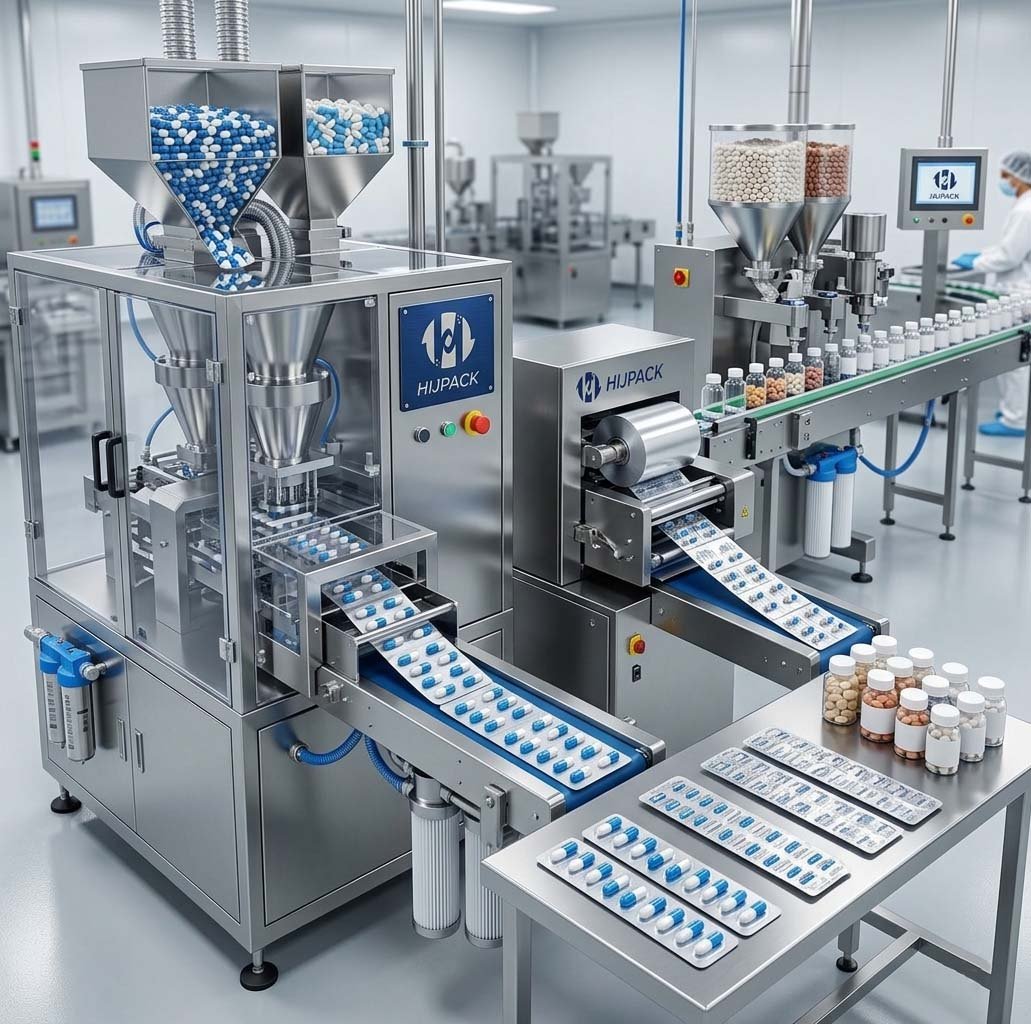
Blister vs. strip vs. bottle packaging for pharmaceutical capsules: material cost is one data point. Stability performance, distribution range, and recall risk are three others that rarely appear in the first comparison.
| Decision Factor | Capsule Blister Packaging | Bottle Packaging |
|---|---|---|
| Per-dose material cost | $0.010 – $0.025 | $0.004 – $0.008 |
| Moisture barrier (PVC) | 4–6 g/m²/day (forming film) | Depends on desiccant + closure system |
| Tamper evidence | Inherent (foil rupture per dose) | Cap-seal only (whole container) |
| Unit-dose traceability | Yes — batch/lot printed on each card | Batch-level only |
| Child-resistant compliance | Push-through or senior-friendly variants | CR cap (16 CFR 1700) standard |
| Partial-use stability | Each unopened cavity is sealed | Full bottle exposed after first opening |
| E&L study requirement | Yes — lidding foil lacquer + forming film | Yes — bottle resin + closure liner |
| Machine capital cost | $35,000 – $180,000+ (thermoforming) | $18,000 – $80,000 (filling + capping) |
| Preferred markets | EU, AU, JP, tropical markets, WHO PQ | US OTC, generic high-volume NA & LATAM |
The three cost categories the material comparison misses: stability failure remediation (batch rejection, reformulation, market withdrawal), WHO prequalification compliance costs if blister is required by the buyer specification, and partial-use stability. A patient opening a bottle of 100 capsules and using 10 has exposed 90 remaining doses to ambient conditions. A blister pack of 10 cards of 10 capsules means 90 doses remain hermetically sealed. For hygroscopic APIs in tropical climates, that difference is shelf-life-critical. It rarely appears in the procurement comparison spreadsheet.
What I’ve Seen in the Field: Capsule Blister Packaging Decisions That Defined Project Outcomes
Three weeks into a commissioning project in a facility outside Pune, the stability report landed on my desk. The product — an antibiotic capsule destined for Nigeria and Ivory Coast — had been developed in Germany at 25°C/60% RH. The packaging material selected was PVC/PVDC 60/45. Nobody had run Zone IVb extrapolation. Nobody had asked whether the target markets required WHO prequalification. Nobody had done that calculation.
The QA director was not careless. The timeline pressure had been extraordinary. The decision had been made eighteen months earlier when the product was eighteen months from launch. In that context, the packaging material conversation had lasted less than twenty minutes. Twenty minutes. And the consequence was a four-month project delay, a complete material change to OPA/Al/PVC cold-form laminate, and a re-commissioning of the line with new tooling. I won’t tell you that decision was simple. The right answer involved the API moisture sensitivity data, the Zone IVb climate data, the WHO prequalification requirement, and a frank conversation about project timeline risk. Those conversations take more than twenty minutes.
The lesson I draw from that project — and from a dozen similar ones — is that capsule blister packaging decisions made in isolation from regulatory strategy and target market climate data will generate delays. The format, material, and machine selection should happen in a single integrated conversation, not in three sequential ones separated by weeks.
For buyers evaluating a new capsule blister packing machine, the right starting point is not the machine specification. It is the target market climate zone, the API moisture sensitivity profile, and the regulatory submission strategy. Everything else — machine speed, forming station type, mold tooling, line integration — follows from those three inputs. Buyers who get that sequence right tend to pass their regulatory inspections on the first attempt. Those who don’t tend to call me about a year after commissioning.
⚠️ Field Diagnostic: Two Questions That Predict Whether Your Capsule Blister Project Will Hit Problems
🔴 Question 1: Has your API moisture uptake been measured at 75% RH?
If the answer is “not yet” or “we have data at 60% RH,” your packaging material selection cannot be finalized. Zone IVb stability requires 75% RH data. The equipment procurement conversation should not begin before this data exists.
✅ Standard: Run moisture sorption isotherm per ICH Q1A(R2). 4–6 weeks with a competent analytical laboratory. Do this before URS sign-off.
🔴 Question 2: Do your target markets require WHO prequalification or local GMP certification?
WHO PQ assessors review packaging material selection as part of the product dossier. If alu-alu is required by the API profile but PVC was sourced because it was cheaper, the submission will fail technical review. Resubmission after a material change typically costs 8–18 months of market delay.
✅ Standard: Confirm target market regulatory pathway before machine procurement. WHO PQ product lists are publicly available — check whether comparable products in your therapeutic category are all using alu-alu or PVC/PVDC.
Capsule Blister Packaging: Frequently Asked Questions
What is capsule blister packaging in simple terms?
Capsule blister packaging is a primary packaging method that seals individual capsules into pre-formed plastic or aluminum cavities using a heat-bonded lidding foil — so each dose is individually protected, tamper-evident, and traceable. The patient pushes the capsule through the foil from the back to access a single dose without exposing the remaining capsules to ambient conditions.
What is the difference between thermoforming and cold-form alu-alu blister packaging?
Thermoforming uses heat to soften a thermoplastic base film (PVC, PVDC, or Aclar) and draw it into a mold. Cold forming mechanically deforms a multi-layer aluminum laminate at room temperature to create permanent metal cavities.
The practical difference is moisture barrier performance. Thermoformed PVC delivers 4–6 g/m²/day MVTR. Cold-form alu-alu delivers 0.02–0.05 g/m²/day — roughly 100 to 300 times better moisture protection. The tradeoff is capital cost (cold-form lines carry a 20–35% premium) and forming speed (cold forming is typically 15–25% slower due to the mechanical deformation cycle).
Choose thermoforming for APIs with low-to-moderate moisture sensitivity and Zone I–III distribution. Choose cold forming for hygroscopic APIs, Zone IVb markets, or where WHO prequalification requires demonstrated Zone IVb stability data.
What capsule sizes can a blister packing machine handle?
Most pharmaceutical blister machines can be tooled for capsule sizes 00, 0, 1, 2, 3, and 4. Size 5 (smallest) is less common but achievable with precision tooling. Each size requires a dedicated forming mold and feeding tooling. The DPP-260 capsule blister packing machine handles sizes 00 through 4 with tooling changeover achievable in approximately 45–60 minutes by a trained operator.
Is capsule blister packaging GMP-compliant?
Capsule blister packaging can be GMP-compliant, but the machine and process must meet specific requirements. The machine must be constructed from pharmaceutical-grade materials (316L stainless steel contact surfaces), have an electronic audit trail meeting 21 CFR Part 11 requirements, and support IQ/OQ/PQ validation documentation. Compliance is not inherent in the format — it is achieved through validated process parameters, documented cleaning procedures, and change-control protocols.
For WHO prequalification products, the packaging material selection must also be justified against the stability data for the target climate zone. GMP compliance of the machine is necessary but not sufficient — the complete packaging system (material + process + validation) must be demonstrated.
How fast do capsule blister packing machines run?
Production speed ranges from 100 to 600+ blisters per minute depending on machine class. Entry-level machines (DPP-250 class) run at 100–200 blisters per minute. Mid-range machines like the DPP-260 run at 200–350 blisters per minute. High-speed continuous-motion machines exceed 600 blisters per minute. Output capacity should be calculated based on net effective speed after changeover, cleaning, and batch documentation time — not rated maximum speed. A 350 blisters/minute machine with 15% downtime for changeover and cleaning delivers approximately 297 blisters per minute net effective output.
What is the cost of capsule blister packaging equipment?
Entry-level thermoforming blister machines start at approximately $35,000–$55,000 (ex-works China). Mid-range machines with servo control, full 21 CFR Part 11 audit trail, and vision inspection run $80,000–$140,000. Cold-form alu-alu lines with comparable specification start at $110,000–$180,000. These figures exclude tooling, which adds $8,000–$25,000 per capsule size. A complete integrated line (blister packer + cartoner + case packer) typically runs $180,000–$450,000 depending on speed and automation level.
Can the same blister machine handle both tablets and capsules?
Yes — with tooling changes. Most pharmaceutical blister machines are designed to handle tablets, capsules, and soft-gel capsules by swapping the forming mold and the product feeding tooling. The machine frame, sealing station, and cutting station remain the same. Our tablet blister packing machine and capsule blister line share the same base platform, which reduces capital cost for manufacturers running both solid dosage forms.
What documentation is required to validate a capsule blister packing line?
A complete validation package includes: User Requirements Specification (URS), Design Qualification (DQ), Installation Qualification (IQ), Operational Qualification (OQ), and Performance Qualification (PQ). The IQ documents that the machine is installed per manufacturer specification. The OQ validates that critical process parameters (forming temperature, sealing temperature, sealing pressure, dwell time) perform within established ranges. The PQ demonstrates that the process consistently produces sealed blisters meeting product specification under normal operating conditions. Container closure integrity testing per ASTM F2338 and USP <1207> is conducted as part of OQ/PQ. Expect 8–16 weeks for a complete validation cycle on a new line.
🎯 Ready to Specify Your Line?
Talk to an Engineer Who Has Commissioned 30+ Capsule Blister Lines
Before you finalize your forming material, machine specification, or line layout — a 20-minute conversation with our engineering team can save you from the four mistakes that create six-month delays. No sales pitch. Technical questions only.