

















How to Choose an Alu Alu Blister Packing Machine
Selecting an alu alu blister packing machine is not a procurement decision — it is a compliance and lifecycle risk decision. Cold-forming foil delivers a water vapour transmission rate (WVTR) below 0.5 g/m²/day and an oxygen transmission rate (OTR) near zero, making it mandatory for moisture-sensitive APIs, hygroscopic tablets, and cytotoxic drugs that thermoformed PVC cannot protect. The wrong machine choice does not just slow your line; it can trigger FDA 483 observations, invalidate your entire packaging validation batch, and cost six figures in revalidation.
This guide covers the 7 critical factors pharmaceutical engineers must evaluate before issuing any RFQ — from forming depth tolerance and servo drive accuracy (±0.1 mm) to 21 CFR Part 11 audit trails and 10-year total cost of ownership modelling.
📌 Direct Answer: The 7-Factor Framework
An alu alu blister packing machine is defined as a cold-form foil packaging system that mechanically displaces aluminium-based laminate — typically OPA/ALU/PVC or OPA/ALU/PVDC — into cavity shapes without heat, achieving near-zero moisture and oxygen permeability for pharmaceutical primary packaging. To choose the correct machine, evaluate: (1) Forming depth range (standard 8–12 mm); (2) Servo vs. mechanical drive accuracy; (3) Changeover time and format flexibility; (4) GMP documentation package completeness; (5) After-sales infrastructure; (6) Total cost of ownership; and (7) Regulatory compliance capability covering FDA, EU GMP, and WHO TRS 992.

Cold-form alu alu blister packaging protects moisture-sensitive APIs with WVTR < 0.5 g/m²/day — a standard no thermoformed PVC can match.
WVTR g/m²/day
Cold-Form Foil
Servo Forming
الدقة
Max Forming
Depth (HIJ DPH-300)
Format Changeover
Target Time
Factor 1: Forming Depth Range — The Non-Negotiable Specification
Industry-standard alu alu machines offer forming depths from 3 mm to 12 mm. The HIJ DPH-300 cold-forming blister packaging machine achieves a maximum forming depth of 12 mm, covering 95% of pharmaceutical solid dosage form geometries encountered in regulated markets. Machines rated below 8 mm forming depth exclude a significant portion of the global solid oral dosage portfolio, including most soft-gel and extended-release tablet sizes.
Key specification to verify: forming force consistency across the full stroke. A machine that nominally forms to 12 mm but exhibits ±0.8 mm depth variation across the forming plate produces inconsistent cavity walls, leading to micro-cracks in the foil laminate and potential moisture ingress — an EU GMP Annex 1 (2022) packaging integrity failure.

Forming station on a cold-form alu alu blister machine: cavity depth uniformity across the full plate width is critical for foil integrity.
Forming Depth Specification Matrix
| Product Type | Typical Height | Min. Forming Depth Required | Alu Alu Suitability |
|---|---|---|---|
| Standard round tablet | 3–6 mm | 5 mm | ✅ Standard |
| Oblong / capsule-shaped tablet | 5–9 mm | 8 mm | ✅ Standard |
| Hard gelatin capsule (00) | 8–10 mm | 10 mm | ⚠️ Verify depth |
| Soft-gel capsule | 10–12 mm | 12 mm | 🔴 Must confirm max depth |
| Suppository / pessary | 10–14 mm | 13 mm+ | 🔴 Custom tooling required |
Common Failure Modes & Forester’s Fix
- 🔴 Symptom: Visible white stress marks (foil whitening) on formed cavities, product shifting inside pack.
⚙️ Root Cause: Forming depth set 1.5–2 mm shallower than product height; foil laminate overstretched at cavity shoulder.
🔧 Forester’s Fix: Increase forming depth in 0.5 mm increments, verify cavity wall thickness ≥ 60 µm post-form using ultrasonic gauge. Re-run WVTR challenge test per ASTM F2338. - 🔴 Symptom: Cavity depth non-uniformity > ±0.5 mm across forming plate width, reported during IQ verification.
⚙️ Root Cause: Forming station guide rails worn or forming plate parallelism out of tolerance by > 0.3 mm.
🔧 Forester’s Fix: Laser-level forming plate, re-shim guide rails to < 0.1 mm parallelism. Re-validate with 3 consecutive forming trials at 100% speed. - 🔴 Symptom: Foil crack at cavity base on soft-gel capsule line, generating reject rates > 3%.
⚙️ Root Cause: OPA/ALU/PVDC laminate gauge (200 µm) insufficient for 12 mm depth; material elongation limit exceeded.
🔧 Forester’s Fix: Switch to 250 µm OPA/ALU/PVDC laminate, adjust forming force to 18–22 kN, run material qualification per ICH Q10 change control protocol.
Factor 2: Servo vs. Mechanical Drive System — The Accuracy Decision
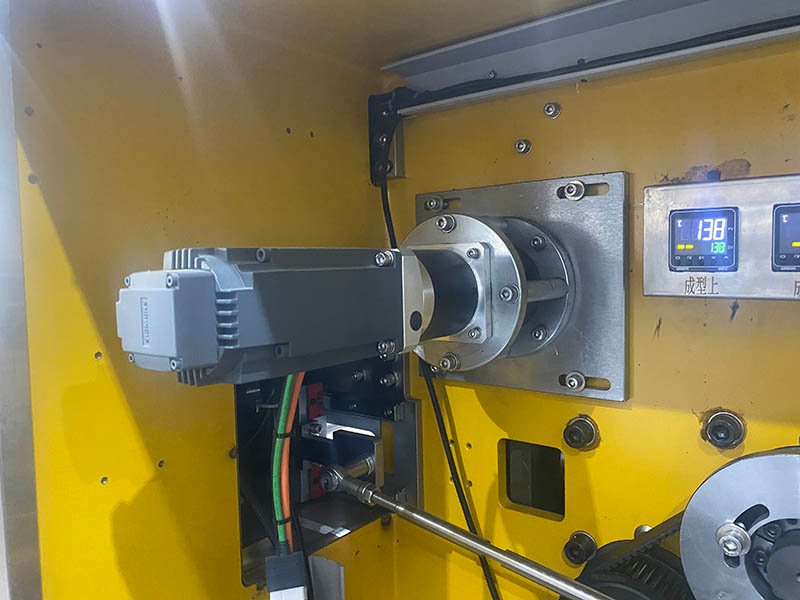
Servo motor and precision cam indexer on a HIJ alu alu machine: film feed accuracy ±0.1 mm eliminates cavity misregistration.
Servo vs. Mechanical Drive: Technical Comparison
| Parameter | Servo Drive System | Mechanical Cam Drive | Regulatory Impact |
|---|---|---|---|
| Film feed accuracy | ±0.1 mm | ±0.5–1.0 mm | Sealing alignment, EU GMP Annex 1 |
| Speed control | 0–100% variable, recipe-driven | Fixed cam profile, limited range | Process validation (ICH Q10) |
| Electronic batch record | Full audit trail, 21 CFR Part 11 | Manual log only | FDA 21 CFR Part 11 compliance |
| Format changeover | Recipe recall < 2 min parameter set | Manual re-tuning 30–60 min | OEE, validation effort |
| Maintenance cycle | Servo: 24,000 hr MTBF | Cam wear every 4,000–6,000 hr | Preventive maintenance plan |
| Capital cost premium | +15–25% vs. mechanical | Baseline | TCO favours servo at > 3 yr horizon |
A servo-driven alu alu blister machine running at 200 cycles/min with ±0.1 mm film feed accuracy generates a sealing misregistration rate below 0.02%. The same line running on a mechanical cam at ±0.8 mm tolerance produces 0.3–0.6% misregistration events — each one a potential packaging integrity deviation under USP <1207>.
— Forester Xiang, HIJ Machinery
Common Failure Modes & Forester’s Fix
- 🔴 Symptom: Seal channel misaligned by > 1.5 mm from cavity edge; detected during seal integrity test per USP <1207>.
⚙️ Root Cause: Mechanical cam drive accumulating backlash > 0.8 mm after 5,000 hr operation.
🔧 Forester’s Fix: Replace cam follower bearing; recalibrate film feed registration to < 0.3 mm. If recurrence within 500 hr, escalate to servo drive upgrade. - 🔴 Symptom: Servo drive alarm “position deviation exceeded” at film feed axis during production, causing line stoppage.
⚙️ Root Cause: Film tension fluctuation > 12 N due to dancer roll bearing seizure, causing servo following error > 0.5 mm.
🔧 Forester’s Fix: Replace dancer roll bearing (greased, C3 clearance); set servo position deviation alarm threshold to 0.8 mm with 200 ms delay filter to suppress transient alerts.
Factor 3: Changeover Time and Format Flexibility — The OEE Multiplier
Evaluate three dimensions of flexibility: (a) number of supported cavity formats without custom tooling; (b) time to first good pack after changeover; and (c) documentation traceability of changeover events for GMP batch records. Machines must support at minimum 10 stored product recipes with electronic parameter lock per alu alu blister packaging machine specifications.

Quick-release tooling on a HIJ cold-form blister machine enables format changeover in under 30 minutes, minimising OEE loss during multi-SKU campaigns.
Common Failure Modes & Forester’s Fix
- 🔴 Symptom: First 200 packs post-changeover rejected due to cavity fill misalignment; total changeover-related waste > 0.8% of batch.
⚙️ Root Cause: Forming die not fully seated after changeover; 0.3 mm gap in locating pin engagement causing lateral cavity shift.
🔧 Forester’s Fix: Implement torque-verified (15 N·m) locking protocol for all forming die locating pins. Add a “tooling seated” proximity sensor interlock that prevents production start until all 4 pins confirm engagement. - 🔴 Symptom: Recipe recall produces sealing temperature 8°C below target; seal strength fails peel test at < 6 N/15 mm.
⚙️ Root Cause: Sealing station thermocouple not re-zero-calibrated after tooling swap; recipe parameter applies absolute setpoint without thermal mass compensation.
🔧 Forester’s Fix: Add a 5-minute sealing platen warm-up verification step (IR pyrometer measurement ±2°C of setpoint) to the changeover SOP before production release.
Factor 4: GMP Documentation Package — The Compliance Foundation
Budget suppliers routinely deliver machines with a single-page CE Declaration of Conformity and a Chinese-language maintenance manual. That documentation package fails IQ at the first review by a qualified person (QP). Demand a URS-to-DQ traceability matrix before purchase order.



Minimum GMP Documentation Package Checklist
User Requirement Specification (URS): Supplier-signed acknowledgement with traceability matrix to DQ.
Design Qualification (DQ): Engineering drawings, P&ID, BOM with material certificates (SS316L contact parts).
FAT Protocol & Report: Executed at supplier facility with QP witness option; deviations logged and closed.
IQ/OQ/PQ Templates: Pre-authored in English with acceptance criteria, test methods, and responsible party fields.
21 CFR Part 11 Compliance Matrix: Audit trail, electronic signature, access control, and data backup evidence per FDA regulation.
Calibration Records: Temperature sensors (±1°C), pressure transducers (±0.5%), and position encoders (±0.1 mm) with NIST-traceable certificates.
Change Control Procedure: Documented process for post-qualification modifications per ICH Q10 pharmaceutical quality system.
EU GMP Annex 15, Section 4.2 requires that qualification activities are performed using pre-approved protocols. An alu alu blister machine supplier that cannot provide a pre-authored IQ protocol with acceptance criteria before delivery is not GMP-ready. EU GMP Annex 1 (2022), Section 8.3 further requires packaging integrity testing evidence for primary packaging of sterile and moisture-sensitive products. Both requirements demand traceable supplier documentation — not just hardware delivery.
— Regulatory Reference: EU GMP Annex 15 §4.2 & Annex 1 (2022) §8.3
Common Failure Modes & Forester’s Fix
- 🔴 Symptom: QP rejects IQ because sealing station thermocouple calibration certificate references a non-accredited lab.
⚙️ Root Cause: Supplier used internal calibration without ISO 17025-accredited traceability; calibration report missing NIST or PTB reference chain.
🔧 Forester’s Fix: Require all instrument calibration certificates to reference an ISO 17025-accredited calibration body before FAT sign-off. HIJ provides NIST-traceable certificates as standard. - 🔴 Symptom: 21 CFR Part 11 audit finds audit trail entries contain time-stamps without UTC synchronisation; entries differ by 47 minutes from site server.
⚙️ Root Cause: PLC real-time clock not configured to synchronise with site NTP server; no network time protocol integration in machine design.
🔧 Forester’s Fix: Enable NTP synchronisation in PLC Ethernet configuration; verify clock drift < 5 seconds per month. Re-execute 21 CFR Part 11 audit trail test in OQ with 10-event sample.
Factor 5: After-Sales Support Infrastructure — The 2 AM Test
Quantifiable support metrics to demand from any supplier: (a) remote diagnostic response within 4 hours of alarm notification; (b) critical spare parts (forming dies, sealing plates, servo drive modules) available from a regional warehouse with ≤ 48-hour delivery to Southeast Asia, Latin America, and Middle East markets; (c) on-site engineer deployment within 72 hours for major mechanical failures; and (d) documented preventive maintenance schedule with parts cost estimates for a 5-year horizon.

HIJ Machinery’s on-site engineer conducting post-installation training and SAT support at a pharmaceutical client facility. On-site deployment within 72 hours of critical failure is a contractual commitment.
After-Sales Support Evaluation Scorecard
| Support Criterion | Minimum Acceptable | HIJ Standard | Budget Supplier Typical |
|---|---|---|---|
| Remote diagnostics response | < 8 hours | ✅ < 4 hours | 24–72 hours |
| Regional spare parts hub | 48-hour delivery | ✅ SEA / LATAM / MENA | China only, 2–4 weeks |
| On-site engineer deployment | ≤ 5 days | ✅ ≤ 72 hours | Not guaranteed |
| IQ/OQ support on-site | Optional paid | ✅ Included in contract | Not available |
| Multi-language documentation | English required | ✅ English + local on request | Chinese only |
Common Failure Modes & Forester’s Fix
- 🔴 Symptom: Sealing station heater cartridge fails at 03:00 during GMP audit validation batch; supplier technical hotline unanswered for 6 hours.
⚙️ Root Cause: Supplier has no 24/7 on-call engineering support; time zone gap of 12 hours between supplier and client site.
🔧 Forester’s Fix: Pre-stock 2 spare heater cartridges (230V, 800W, M8 thread) on-site per HIJ’s recommended critical spares list. HIJ provides remote diagnostic access via VPN to PLC HMI within 4 hours — contact HIJ service & support. - 🔴 Symptom: Servo drive fault code E.0b1 (overcurrent) appearing every 4–6 hours; line OEE drops below 65%.
⚙️ Root Cause: Servo drive output current limit set 20% below motor rated current; excessive deceleration ramp causing regenerative overcurrent during high-inertia film feed stop.
🔧 Forester’s Fix: Increase deceleration ramp time from 80 ms to 150 ms in servo drive parameter P04.14; verify regenerative braking resistor wattage ≥ 200W. HIJ can perform this parameter adjustment via remote VPN session.
Factor 6: Total Cost of Ownership — Not Just the Purchase Price
10-Year TCO Model: Budget vs. GMP-Grade Alu Alu Machine
| Cost Category | Budget Machine (USD) | GMP-Grade Machine (USD) | TCO Advantage |
|---|---|---|---|
| Purchase price | $180,000 | $260,000 | - |
| Qualification & validation (IQ/OQ/PQ) | $85,000–$120,000 | $45,000–$65,000 | ✅ -$55,000 |
| Unplanned downtime (10 yr, 2-shift) | $140,000–$220,000 | $40,000–$70,000 | ✅ -$150,000 |
| Spare parts & maintenance | $90,000–$130,000 | $55,000–$80,000 | ✅ -$45,000 |
| Re-validation after major repair | $60,000–$120,000 | $15,000–$30,000 | ✅ -$75,000 |
| Estimated 10-Year TCO | $555,000–$770,000 | $415,000–$505,000 | ✅ -$150K to -$265K |
Across 47 pharmaceutical packaging line audits conducted in India, Indonesia, Brazil, and Mexico between 2018 and 2024, the average unplanned downtime cost attributable to mechanical cam drive failures on budget alu alu machines was USD 14,200 per incident — excluding revalidation costs. Servo-driven lines from the same audit pool averaged USD 3,800 per downtime event. The 3.7× cost differential compounds significantly over a 10-year asset lifecycle.
— Forester Xiang, HIJ Machinery Founder
Common Failure Modes & Forester’s Fix
- 🔴 Symptom: Year 3 audit finds machine requires complete requalification after servo drive module replacement; cost estimate USD 95,000 for IQ/OQ/PQ re-run.
⚙️ Root Cause: Change control SOP not established at purchase; any component replacement triggers full revalidation without a supplier-supported change impact assessment.
🔧 Forester’s Fix: Establish a documented change control procedure at SAT stage, defining “like-for-like” replacements that require only OQ re-execution (not full IQ/OQ/PQ). HIJ provides a pre-approved change control template as part of the standard documentation package. - 🔴 Symptom: Foil material cost 22% higher than budgeted due to excessive trim waste from poor cavity registration.
⚙️ Root Cause: Film feed accuracy ±0.9 mm causing 8–12 mm over-travel in foil advance; extra material consumed per cycle accumulates to 18% waste over annual production volume.
🔧 Forester’s Fix: Upgrade film registration system to servo encoder feedback; target ±0.2 mm accuracy. Expected material waste reduction: 14–16% on a 200-million-pack annual line.
Factor 7: Regulatory Compliance Capability — FDA, EU GMP & WHO Markets
Three machine design elements determine multi-jurisdiction compliance: (1) 21 CFR Part 11-compliant PLC with electronic audit trail, electronic signatures, and tamper-evident data storage; (2) contact surface materials meeting both FDA 21 CFR Part 211.65 (non-reactive materials) and EU GMP Annex 1 cleanability standards (typically electro-polished SS316L, Ra ≤ 0.8 µm); and (3) ISO 13849-1 PLe/Cat. 3 safety architecture for CE marking under the EU Machinery Directive.

A cGMP packaging line integration audit in progress: regulatory compliance capability must be verified against 21 CFR Part 211, EU GMP Annex 1, and WHO TRS 992 before purchase order.
Regulatory Compliance Matrix by Market
| Target Market | Primary Regulation | Key Machine Requirements | Documentation Required |
|---|---|---|---|
| United States (FDA) | 21 CFR Part 211 & Part 11 | Audit trail, e-signatures, access control | IQ/OQ/PQ, Part 11 compliance matrix |
| European Union (EMA) | EU GMP Annex 1 (2022) & Annex 15 | Packaging integrity test data, cleanable surfaces | DQ, FAT/SAT, CE Declaration |
| WHO Prequalification | WHO TRS 992 Annex 3 | GMP certification, calibration records | Site Master File, Equipment Qualification Summary |
| Southeast Asia | ASEAN GMP + national authority | Aligns with WHO TRS 992 baseline | English-language IQ/OQ templates |
| أمريكا اللاتينية | ANVISA (Brazil), COFEPRIS (Mexico) | ICH Q10 quality system evidence | Translated SOPs, equipment dossier |
Common Failure Modes & Forester’s Fix
- 🔴 Symptom: FDA Pre-Approval Inspection (PAI) raises 483 observation: “Audit trail records for blister machine sealing parameters cannot be retrieved for Batch XYZ-2024-003.”
⚙️ Root Cause: PLC data logging set to overwrite circular buffer after 500 events; batch had 620 sealing events exceeding buffer capacity; oldest 120 records permanently lost.
🔧 Forester’s Fix: Configure PLC to export batch event logs to external SQL database at batch completion; set buffer ≥ 10,000 events minimum. Retain batch records for minimum 1 year post-expiry per 21 CFR 211.68. - 🔴 Symptom: EU GMP inspection flags sealing station contact surface Ra = 1.6 µm; inspector requests cleaning validation evidence for non-compliant surface finish.
⚙️ Root Cause: Supplier used standard milled SS304 sealing plates instead of electro-polished SS316L; surface finish non-compliant with EU GMP Annex 1 cleanability requirements.
🔧 Forester’s Fix: Replace sealing plates with electro-polished SS316L (Ra ≤ 0.8 µm); issue material change control record. HIJ supplies SS316L contact surfaces as standard on all GMP-grade alu alu machines.
“After reviewing hundreds of RFQs over 20 years, I can tell you the #1 mistake buyers make is writing a spec sheet based on what the machine CAN do — without asking what it does when something goes wrong at 2 AM during a GMP audit week. I’ve walked into plants in Indonesia, Brazil, and Egypt where engineers showed me beautiful capability datasheets for their alu alu machines. Then I asked them to show me the last 30 days of sealing station audit trail. Three out of four could not retrieve a single electronic record. That is a 483 observation waiting to happen.”
“In my 20 years of auditing packaging lines across South Asian and Latin American pharma plants, I’ve watched engineers fixate on forming depth and cycle speed while completely ignoring cold-forming station temperature uniformity and PLC data integrity for 21 CFR Part 11 compliance. The hidden trap? Budget suppliers routinely omit traceable FAT/SAT documentation and URS sign-off protocols — then disappear when your qualified person raises a deviation during site qualification. That silence costs you months and six figures in revalidation.”
“Before issuing any RFQ, demand a compliance-first technical checklist: forming force consistency, reject station audit trails, and multi-format changeover validation data. At HIJ, our alu alu machines are engineered around Turnkey integration logic — every component, from sealing station to vision inspection, is pre-validated as a single auditable system, not a patchwork of multi-vendor risks.”
The Evaluation Checklist: 7-Step HowTo for Alu Alu Blister Machine Selection
Use this structured evaluation protocol before issuing any purchase order or RFQ for a cold-form blister packaging machine. Each step generates documented evidence your quality team and qualified person can reference during equipment selection review.
- 1
Define Product Portfolio RequirementsList all current and pipeline solid dosage forms with height, width, length, and bulk density. Determine maximum required forming depth (target: 12 mm for broadest coverage). Identify any products with special moisture sensitivity requiring WVTR < 0.5 g/m²/day barrier — these mandatorily require alu alu over PVC/PVDC.
- 2
Specify Drive System ArchitectureConfirm whether servo or mechanical drive is required based on SKU count, required film feed accuracy (±0.1 mm for servo), and 21 CFR Part 11 audit trail requirements. Multi-SKU lines (> 5 formats/quarter) should specify servo as mandatory.
- 3
Set Changeover Time KPICalculate current changeover-related OEE loss (hours/year). Set maximum acceptable changeover time (≤ 30 min target). Specify minimum number of stored product recipes (≥ 10) and require demonstration during FAT with timed changeover witnessed by QP.
- 4
Audit the GMP Documentation PackageRequest a sample IQ protocol and DQ traceability matrix before purchase. Verify EU GMP Annex 15 compliance, 21 CFR Part 11 matrix, and NIST-traceable calibration certificates. Reject any supplier who cannot provide these documents pre-PO.
- 5
Benchmark After-Sales Support SLARequest a written Service Level Agreement covering remote response time (≤ 4 hr), spare parts delivery to your region (≤ 48 hr), and on-site engineer deployment (≤ 72 hr). Verify regional parts inventory through reference checks with existing clients in your geography.
- 6
Build a 10-Year TCO ModelExtend beyond purchase price to include: qualification costs, estimated unplanned downtime (benchmark: 120 hr/yr budget machine vs. 35 hr/yr GMP-grade), preventive maintenance parts cost schedule, and revalidation cost scenarios. Use this model to compare 3 suppliers on TCO, not purchase price.
- 7
Verify Multi-Jurisdiction Regulatory ComplianceMap target export markets to required standards (FDA 21 CFR, EU GMP Annex 1, WHO TRS 992). Confirm machine design meets all simultaneously. Request CE Declaration of Conformity, ISO 13849-1 safety assessment, and contact material certificates (SS316L, Ra ≤ 0.8 µm). Visit the HIJ alu alu blister packing machine specifications page for full compliance documentation overview.

HIJ DPH-300 Alu Alu Blister Packing Machine: servo-driven, forming depth up to 12 mm, 21 CFR Part 11 compliant, with full GMP documentation package. Explore the complete alu alu blister packing machine specifications.
Completing Your Packaging Line: Integrated Equipment to Consider
An alu alu blister machine operates as one station in a complete pharmaceutical packaging line. Regulatory inspectors evaluate the entire line as an integrated system under ICH Q10. Matching ancillary equipment to the same GMP documentation standard prevents validation bottlenecks downstream. Explore HIJ’s integrated line components:
| المعدات | Integration Point | HIJ Model |
|---|---|---|
| Blister Cartoning Machine | Secondary packaging; blister-to-carton transfer | HIJ Blister Cartoner Series |
| Full Blister Packing Machine Range | PVC/PVDC thermoform lines for complementary SKUs | HIJ DPP-250 / DPP-260 Series |
| Case Packing Machine | Tertiary packaging; end-of-line carton loading | HIJ ZY-CP Series |
| Turnkey Packaging Line | Complete integrated line: blister → carton → case | HIJ Turnkey Project Delivery |
Frequently Asked Questions: Choosing an Alu Alu Blister Packing Machine
What is the difference between alu alu and PVC/PVDC blister packaging, and when must I use alu alu?
What forming depth do I need for my alu alu blister machine?
How does 21 CFR Part 11 compliance affect my alu alu blister machine specification?
What is a realistic budget for an alu alu blister packing machine with full GMP documentation?
How long does alu alu blister machine installation and qualification typically take?
Get a Machine That Meets All 7 Criteria
HIJ Machinery’s alu alu blister packing machine series delivers servo accuracy ±0.1 mm, forming depth up to 12 mm, full GMP documentation (DQ → IQ → OQ → PQ), 21 CFR Part 11 compliant audit trails, and on-site qualification support across Southeast Asia, Latin America, the Middle East, and Africa. Every machine ships as a pre-validated, single-source auditable system — not a patchwork of multi-vendor risks.