
















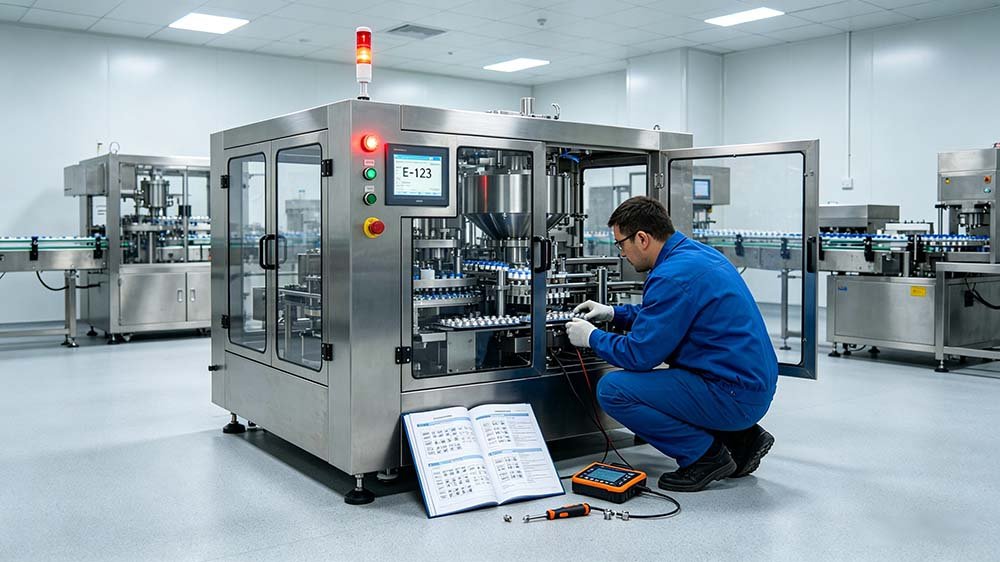
🔎 Troubleshooting Guide
7 Common Problems with Capsule Blister Packing Machines — and How to Fix Them
Your reject rate just crossed 3%. The line is running. Nobody knows why the seals are inconsistent. The shift supervisor is guessing — formation temperature? Film roll? Feeder brush?
Wrong question. The right question is: which of the seven root-cause failure modes is your machine expressing right now? After 20 years commissioning capsule blister packing lines across Southeast Asia, Latin America, and the Middle East, I’ve seen every failure pattern — and every pattern has a specific diagnostic signature. This guide maps all seven.
⚡ Direct Answer
The seven most common capsule blister packing machine problems are: (1) capsule feed jams, (2) forming temperature drift, (3) seal integrity failure, (4) PVC/PVdC film tearing during forming, (5) blister cavity misalignment, (6) batch code print errors, and (7) reject rate spikes from integrated line desynchronisation. Each has a distinct root cause — none require machine replacement to resolve.
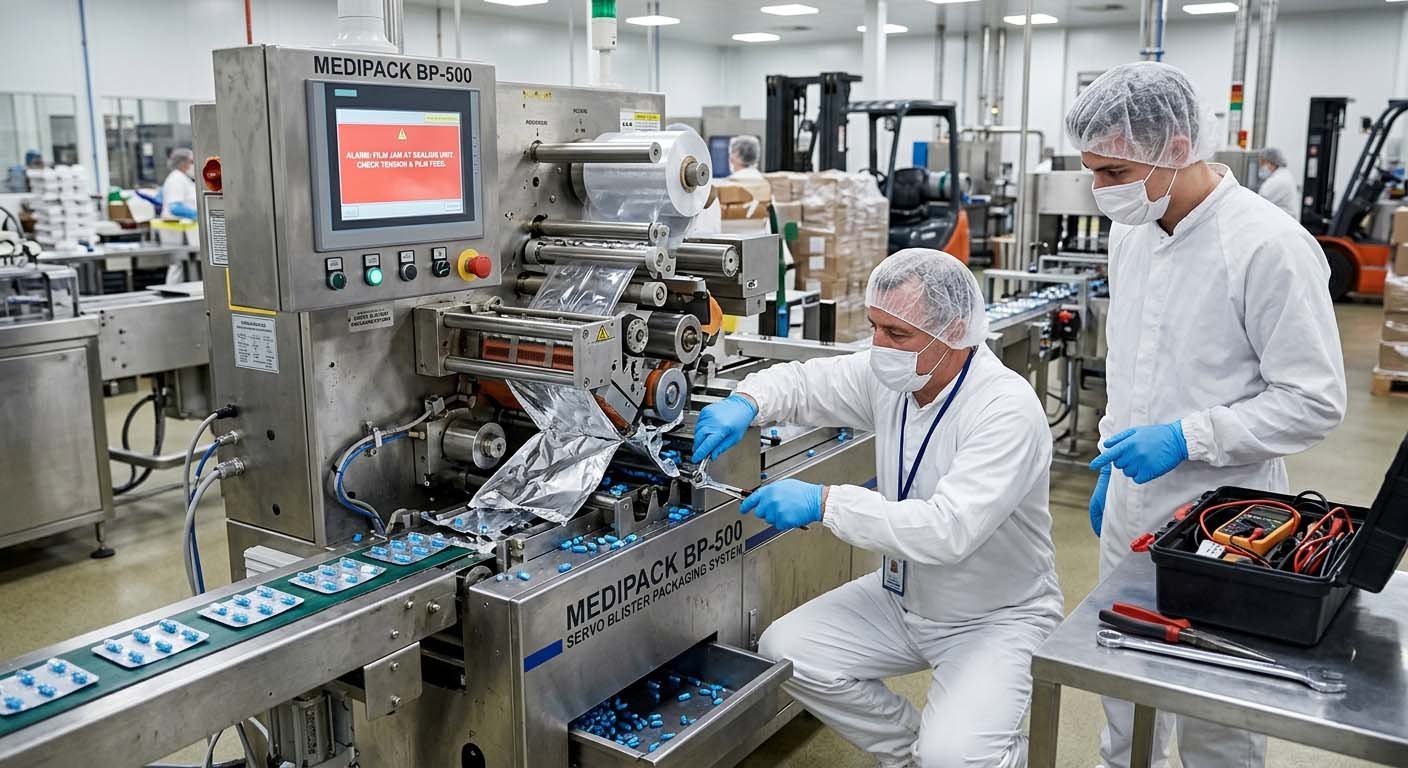
Field diagnosis starts at the forming station — not the reject counter.
Why Capsule Blister Machine Problems Repeat Themselves on Every Continent
Capsule blister packing machine failures follow predictable patterns — and the same seven problems appear in plants in Jakarta, Karachi, and São Paulo with almost identical frequencies because the root causes are mechanical and thermodynamic, not operator-specific.
Three weeks into a commissioning job in Surabaya in 2021, I watched a QC team spend four days chasing what they called a “random seal defect.” It wasn’t random. It was a 0.8°C thermal drift on the sealing roller that only appeared during the third hour of a shift, after the machine had fully thermally soaked. The PLC alarm log showed it plainly. Nobody had looked.
That’s the pattern. The data is usually there. The diagnosis is the skill gap.
Before going through each failure mode, one structural point matters: if you’re operating a standalone blister unit rather than an integrated line, your troubleshooting surface area is smaller — but your upstream blind spots are bigger. A capsule filler running 0.3 mm out of spec on fill weight creates a size variation that the blister machine’s brush feeder translates directly into cavity placement errors. You’ll see problem #1 and #5 simultaneously, and chasing either one individually will not resolve the root cause. For a full picture of how a capsule blister packing machine functions as a system, that context matters before you open any maintenance panel.
Capsule Feed Jams and Missed Cavities
Severity: High — Direct Reject Impact
Capsule feed jams are the single most reported capsule blister machine problem — responsible for empty or misplaced cavities that trigger vision-system rejects and, in plants without inline inspection, slip through to final packaging.
The feeder bowl or brush assembly is almost always the physical site of the jam. But the cause is usually upstream. Capsule geometry variation — especially length tolerance beyond ±0.3 mm — is the most common driver. Gelatin capsules absorb moisture. In a plant running at 65% RH without adequate HVAC in the feeding zone, size 0 capsules can expand enough to bridge the feed channel. I’ve measured a 0.4 mm diameter increase on capsules left on a feeder hopper for 90 minutes in a plant outside Chennai. Nobody expected that. The feeder was blamed. The root cause was the environmental control spec.
Diagnostic: Capsule Feed Jams
🔴 Symptom: Empty cavities appearing at irregular intervals, not every cycle
Likely cause: Capsule size variation at the upper tolerance limit, or partial jam in feed channel causing intermittent dropout
✅ Fix: Check incoming capsule dimensional spec sheet. Measure 30 capsules with a micrometer. If length CV >0.3%, contact your capsule supplier before adjusting machine parameters.
🔴 Symptom: Consistent empty cavity in the same pocket position on every blister card
Likely cause: Feed channel clog at a specific guide position, or worn brush finger at that index
✅ Fix: Remove and clean that specific feed channel guide. Inspect brush fingers — replace any that show more than 1 mm wear. Recalibrate brush speed at ±2 RPM of manufacturer spec.
🔴 Symptom: Jam frequency increases progressively through the shift
Likely cause: Moisture uptake in the feed hopper zone — gelatin capsules expanding over time
✅ Fix: Measure RH at the feeder zone with a calibrated probe. Target ≤45% RH in the feed area. Reduce hopper charge volume so capsule dwell time is under 20 minutes. This is an HVAC problem masquerading as a machine problem.
Forming Temperature Drift and Shallow Blister Pockets
Severity: High — Seal Integrity & Compliance Risk
Forming temperature drift is the failure mode most likely to cause both a production reject and a regulatory non-conformance simultaneously — because shallow pockets allow capsule movement inside the blister, which fails container closure integrity testing under USP <1207>.
PVC forming film requires a narrow thermal window: typically 110–130°C for standard 250 μm PVC, with a tolerance of ±3°C for consistent pocket depth. Outside that window, you get one of two failure modes. Too cold: the film doesn’t form completely, the pocket is shallow, and the capsule sits proud of the cavity — the lid foil can’t seal flat. Too hot: the film thins at the pocket base, tears at demould, or creates internal stress that leads to delamination during stability testing.

Thermocouple calibration at the forming plate: a 2°C drift at this station translates directly to pocket depth variation of 0.3–0.5 mm.
Of the 31 blister line commissioning projects I handled in Southeast Asia between 2018 and 2023, 14 required a forming temperature recalibration within the first 90 days of production — in most cases because the initial setup had been done in a factory acceptance test environment at 20°C, and the actual plant was running at 32°C with a 2–4°C differential at the forming station.
Diagnostic: Forming Temperature Problems
🔴 Symptom: Pocket depth inconsistent — varies by ±0.5 mm or more across the forming plate width
Likely cause: Uneven heating across the forming plate due to a faulty heating element in a specific zone, or inadequate thermal equilibration time at startup
✅ Fix: Use a calibrated contact thermocouple to map the forming plate surface at 9 measurement points (3×3 grid). Any zone deviation >3°C requires heating element inspection. Allow 20–25 minutes thermal soak before production runs — not the 5–10 minutes many operators use.
🔴 Symptom: Pocket depth correct at start-of-shift, deteriorates after 2–3 hours
Likely cause: Thermal drift from ambient temperature rise in the production area during peak operating hours; forming plate controller is compensating but lagging behind ambient change rate
✅ Fix: This is the failure mode I see most often in tropical-climate plants. Log ambient temperature at 30-minute intervals for one full shift. If ambient rises >4°C from start to peak, your forming zone PID parameters need retuning for your specific environment — not the factory default values. The controller gain needs to be higher for high-ambient-variability environments.
Seal Integrity Failure and Peelable Lidding Defects
Severity: High — Product Safety & Recall Risk
Seal integrity failure is the capsule blister packing machine problem with the highest regulatory consequence — a single unsealed blister is sufficient grounds for batch rejection under WHO GMP Annex 9 container closure requirements, and FDA enforcement records show packaging defects as the root cause in 12% of pharmaceutical recalls from 2019–2023.
The sealing station bonds aluminum foil lidding to the formed PVC/PVdC base film under heat and pressure. Three variables govern seal quality: temperature (typically 180–220°C for standard aluminum foil to PVC), dwell time (controlled by sealing roller speed), and pressure (typically 0.3–0.5 MPa at the sealing bar). Any one of these drifting outside spec produces a cold seal, a burned seal, or an intermittent seal — each with a different visual signature and a different fix.
“A seal defect rate of 0.1% sounds trivial until you calculate it against your annual volume. At 10 million blisters per year, that’s 10,000 potentially compromised units — enough to trigger an FDA investigation if one reaches an adverse event report. The arithmetic makes the maintenance cost of a calibrated sealing station look very different.”
- 포레스터 시앙, HIJ 기계
A QA director in Bogotá called me last year. Her team had been running a dye-ingress test per ASTM F2338 on finished blisters and finding a 0.8% failure rate — but the inline vision system was not catching it. The vision system was checking for seal completeness by detecting the foil-to-film bond line. The actual failure mode was microporous sealing: the bond appeared complete visually but failed at 60 mbar dye ingress pressure. The sealing temperature was correct. The dwell time was correct. The problem was a contaminated sealing bar — residual gelatin from capsule breakage during feeding had migrated onto the sealing surface and was creating submillimetre non-bond zones. Invisible to the camera. Detectable only by the dye test.
Diagnostic: Seal Integrity Failures
🔴 Symptom: Visible seal wrinkles or incomplete bond at blister card edges
Likely cause: Sealing temperature too low, or film tension mismatch causing the PVC base to pucker at the seal perimeter
✅ Fix: Increase sealing temperature in 2°C increments while monitoring seal peel force (target: 8–15 N/15mm for standard PVC-Alu). Check film web tension at both supply rolls — mismatched tension between the forming film and lidding foil creates the pucker pattern.
🔴 Symptom: Seal appears complete visually but fails dye-ingress at 60 mbar (per ASTM F2338 / USP <1207>)
Likely cause: Contaminated sealing bar surface (gelatin, dust, or film degradation residue) creating microporosity in the bond
✅ Fix: Remove and clean the sealing bar with isopropanol. Inspect the bar surface for pitting under 10x magnification — any pitting >0.05 mm depth requires bar resurfacing or replacement. Establish a cleaning protocol: sealing bar wipe-down every 4 hours of production is not optional in a gelatin capsule line.
🔴 Symptom: Sealing failure rate increases progressively, worse on the last batch of a production run
Likely cause: Sealing roller wear — the roller surface has flattened, reducing contact pressure progressively as the shift accumulates thermal cycling
✅ Fix: Measure sealing roller diameter with a calibrated gauge. Most OEM specs require replacement when diameter loss exceeds 0.2 mm from nominal. This is the most commonly deferred maintenance item I see — rollers run far past their service life because wear is gradual and invisible until the failure rate spikes.
PVC Film Tearing During Forming
Severity: Medium — Downtime & Material Waste
PVC film tearing at the forming station is the capsule blister machine problem that causes the most visible production interruptions — a torn web stops the line, requires rethreading, and in a worst case contaminates the forming tool with film fragments that must be manually cleared before restart.
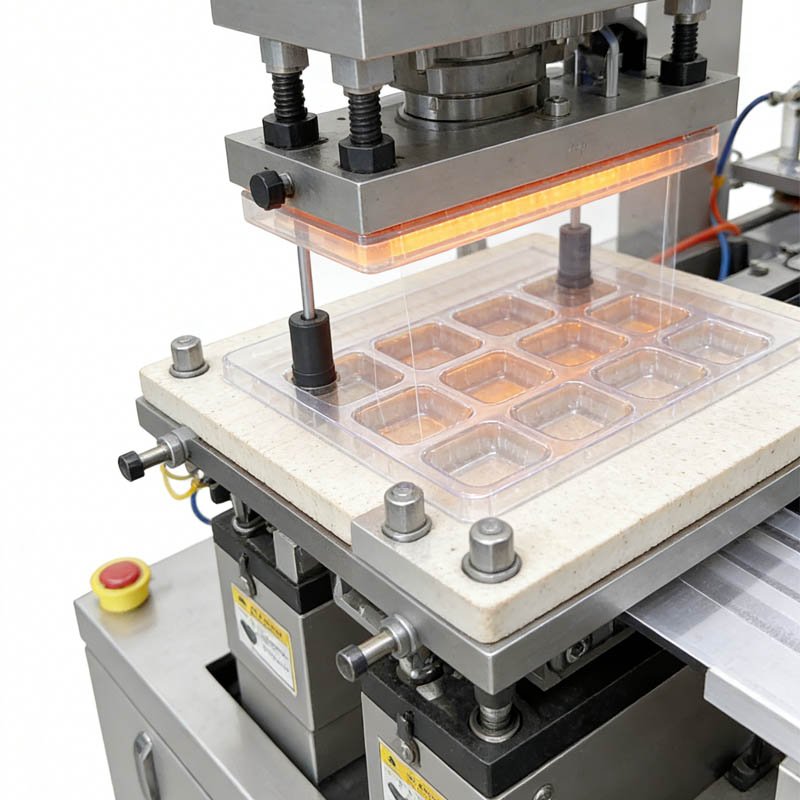
Film web path at the forming station — film tension, temperature, and index speed must be balanced to prevent tearing on deep-draw capsule cavity profiles.
The number teams look at first is forming temperature. It’s almost never the primary cause of tearing. Film thickness and film supplier lot variation are the most common root causes, particularly in markets where pharmaceutical-grade PVC film procurement is done through a distributor rather than direct from the manufacturer. I’ve seen incoming film lots with a nominal 250 μm thickness that measured 220–230 μm at the edges of the roll due to inconsistent calendering — 8–12% underspec — and the plant had no incoming QC process to catch it. Every roll ran until it tore.
Diagnostic: Film Tearing
🔴 Symptom: Tear always occurs at the same cavity position in the mold
Likely cause: Mold corner radius too tight for the film thickness in use — the film is being stretched beyond its elongation limit at that specific draw point
✅ Fix: Measure the cavity corner radius. For 250 μm PVC, minimum inner corner radius should be 0.8–1.0 mm. If the mold was designed for thinner film, either switch to a film with higher elongation-at-break (>200%) or have the mold corner radius adjusted by your tooling supplier.
🔴 Symptom: Tears random in position, occur more frequently at roll changeovers
Likely cause: Incoming film lot variation — different roll batches have inconsistent thickness or heat-forming characteristics
✅ Fix: Implement incoming film QC: measure thickness at 5 points across the roll width for every new lot. Reject any lot with cross-web variation >5% from nominal. Store film rolls vertically in a climate-controlled area at 18–22°C — rolls stored horizontally or in high-humidity environments form edge-deformations that cause tearing at the film guide.
Blister Cavity Misalignment and Off-Center Capsules
Severity: Medium — Cosmetic & Inspection Failure
Blister cavity misalignment — where capsules are not centered in their pockets or are rotated off-axis — triggers inline vision system rejects and, in blisters without vision inspection, produces a cosmetically defective unit that fails consumer acceptance.
The alignment problem can originate at three points: the forming station (pocket not centered relative to the film index pitch), the feed station (capsule placed offset from cavity center by feeder brush timing error), or the indexing drive (film advance length per cycle drifting outside tolerance). The table below maps each origin to its diagnostic signature.
| Misalignment Origin | Diagnostic Signature | Measurement Method | Corrective Action | Recurrence Risk if Untreated |
|---|---|---|---|---|
| Forming mold vs. film index pitch | All cavities offset in the same direction by a consistent distance | Measure pocket pitch on formed blank with calipers; compare to mold spec drawing | Adjust film feed pitch in PLC parameters; re-qualify mold-to-film registration | High — thermal expansion changes pitch during production |
| Feeder brush timing drift | Random offset, more pronounced at higher speeds; some cavities correct, some not | Video capture at 60 fps at feeder station; measure capsule drop position relative to cavity | Recalibrate brush timing offset in machine controller; check brush wear | Medium — brush wears progressively |
| Film index drive (servo or chain) | Misalignment alternates between correct and offset on successive cycles | Encoder feedback log — check for position error accumulation over 50 cycles | Check servo encoder feedback cable for intermittent fault; inspect chain tension if mechanical drive | High — encoder faults escalate to complete alignment loss |
| Film web lateral drift | Offset is perpendicular to machine direction; varies across the web width | Mark film web edge at forming entry; measure drift after 10 cycles | Adjust web guide roller; check film roll core for damage causing off-center unwind | Low if guides maintained |
Batch Code Print Errors and Inkjet / Embossing Failures
Severity: Medium — Regulatory Traceability Risk
Batch code print failure on a capsule blister card is a GMP non-conformance under 21 CFR Part 211.68 and WHO GMP Chapter 5 — a blister with an illegible or absent batch number cannot be released to market, regardless of product quality.
Most blister machines use either a hot-stamp embossing unit or an inkjet printer mounted downstream of the sealing station. Each has a distinct failure mode. Hot-stamp embossing fails when the type slugs wear or the impression pressure drifts — resulting in shallow characters that fail legibility checks under ISO 8254. Inkjet fails when nozzles partially block — producing characters with missing segments that look complete to a quick visual check but fail automated OCR inspection.
Diagnostic: Batch Code Print Failures
🔴 Symptom: Embossed characters visible but shallow — fail QA legibility check
Worn type slugs or reduced impression pressure; foil surface contamination reducing emboss adhesion
✅ Fix: Increase emboss pressure in 0.05 MPa increments while checking character depth. Replace type slugs if character height is below 0.3 mm measured depth. Clean foil surface upstream of emboss station — foil lubricant residue from the roll core is a common contamination source.
🔴 Symptom: Inkjet characters have missing segments; OCR camera flags batch code errors at >0.5% rate
Partial nozzle blockage from ink drying during production pause; substrate speed exceeding inkjet trigger delay
✅ Fix: Run nozzle purge sequence immediately after any production pause >15 minutes. Verify trigger delay parameter is set for your current line speed — many plants run at higher speeds post-validation and never update the inkjet trigger compensation. That’s a character position error waiting to happen.
Reject Rate Spikes from Integrated Line Desynchronisation
Severity: High — System-Level Root Cause
Reject rate spikes that appear on the blister machine but cannot be traced to any single blister machine component are almost always a sign of integrated line desynchronisation — a system-level failure mode, not a machine-level one.
This is the failure mode nobody wants to own, because it falls in the gap between the capsule filler supplier’s responsibility and the blister machine supplier’s responsibility. A plant buys a low-cost standalone blister unit. Within six months, reject rates climb past 3%. The PLC protocol doesn’t communicate with the upstream capsule filler. Nobody told them during purchase that without a unified FAT/SAT protocol and matched conveyor timing, every speed adjustment on one machine destabilizes the next. The hidden cost isn’t the machine — it’s the downtime and the compliance headache when an FDA auditor asks for your integrated line validation records.

Integrated blister packing lines require matched conveyor timing and unified PLC communication between the capsule filler and blister unit — standalone troubleshooting misses system-level failure modes.
Of the 22 reject rate investigations I’ve been called into as a consultant since 2019, 9 had the root cause in the handoff zone between the capsule filler output conveyor and the blister machine infeed — a zone that appears on neither machine’s drawing. Speed mismatch creates a capsule queue. The queue creates a pressure variation at the feeder inlet. The pressure variation translates to intermittent double-loading or capsule orientation flip. The blister machine vision system then rejects — and the maintenance team spends three days looking at the blister machine’s feeder.
Diagnostic: Line Desynchronisation Reject Spikes
🔴 Symptom: Reject rate spike coincides with upstream machine speed changes or product format changes
Conveyor transfer speed not matched to blister machine infeed rate after speed adjustment — capsule accumulation builds at the handoff point
✅ Fix: Install a capsule counter/flow sensor at the handoff zone. Log reject rate and upstream machine speed simultaneously for 30 minutes. If the correlation coefficient is above 0.7, you have a speed-matching problem, not a blister machine problem. The fix requires both machines’ PLC engineers in the same room at the same time. This conversation is harder to schedule than the fix itself.
🔴 Symptom: Reject rate baseline elevated since installation, never matches FAT performance
FAT was conducted with the blister machine in standalone mode using manually fed capsules — line integration was never performance-qualified
✅ Fix: This is not a fault condition — it’s a validation gap. You need a Site Acceptance Test (SAT) that tests the line as an integrated system at your nominal production speed, using your actual capsule product, under your plant’s ambient conditions. If your machine supplier didn’t provide an integrated SAT protocol, that’s worth discussing before your next equipment purchase. Understanding how to evaluate a capsule blister machine supplier’s validation support is exactly what separates a 3-month commissioning delay from a 3-week one.
💡 Forester’s Insight — 20 Years in the Field
Before troubleshooting symptoms, audit your line as a system, not individual machines. I’ve been called in after teams spent weeks on a blister machine’s forming station, only to find the root cause was a capsule filler whose output chute was vibrating at a frequency that oriented capsules at a 15-degree tilt — invisible upstream, catastrophic at the blister feeder. The blister machine was working perfectly. The problem was 2 meters away.
HIJ에서는 turnkey integration approach specs, validates, and tunes the blister unit as part of your complete cGMP packaging line — so problems get engineered out before they appear on your production floor, not diagnosed after they’ve already cost you three batches.
Preventive Maintenance Checklist: Stop These 7 Problems Before They Start
Every one of the seven failure modes above has a preventive maintenance task that reduces its probability to near-zero. The checklist below is the minimum standard I use when auditing a new client’s blister line maintenance program.
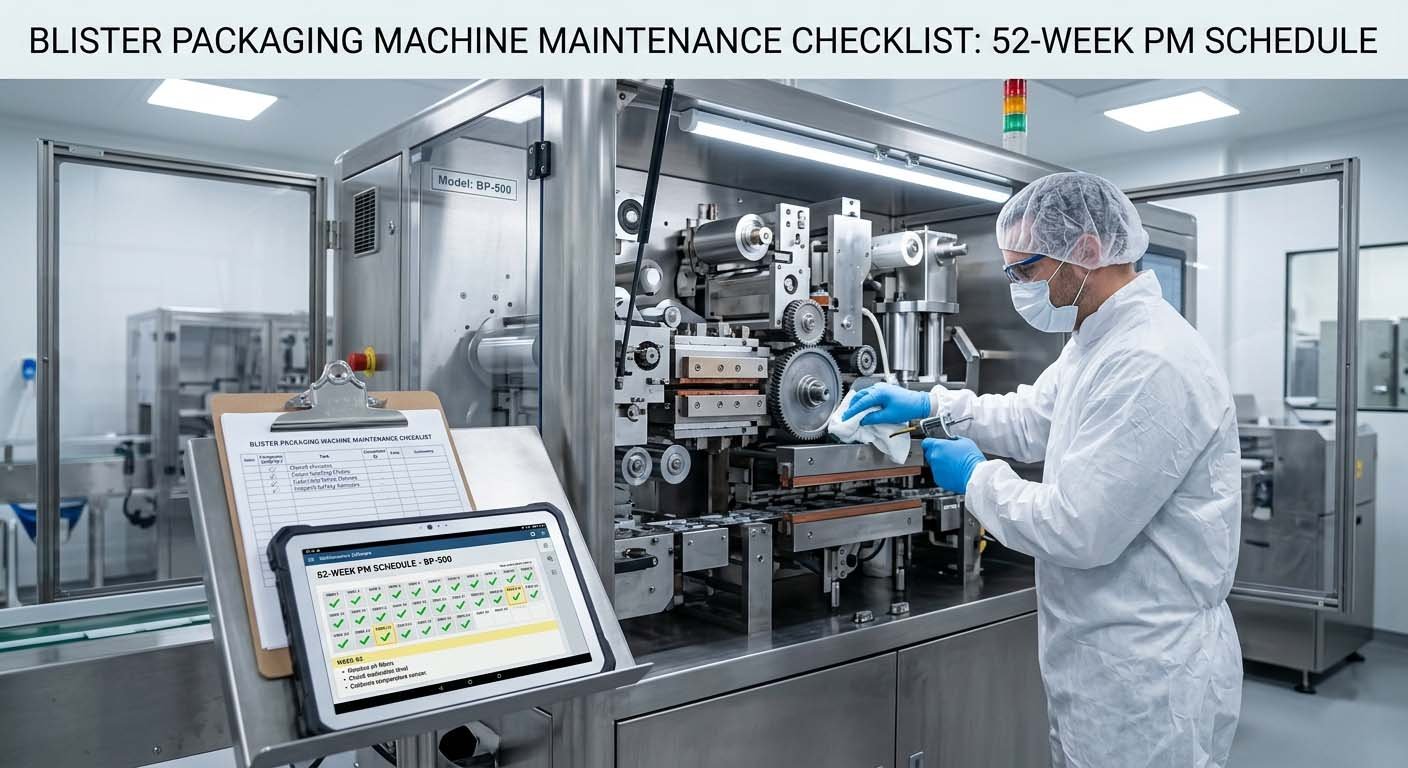
A documented 52-week preventive maintenance schedule is both a GMP requirement and the most cost-effective capsule blister machine troubleshooting strategy available.
Daily: Inspect feeder brush fingers for wear (>1 mm wear = replace). Wipe sealing bar with isopropanol. Verify ambient RH in feeder zone (≤45%). Check batch code print legibility on first 10 cards of the run.
Weekly: Calibrate forming plate thermocouple with reference probe (9-point grid check). Measure sealing roller diameter — log against baseline. Run ASTM F2338 dye-ingress test on 5 finished blisters per batch. Inspect film web guide rollers for contamination.
Monthly: Full PLC alarm log review — identify any recurring alarm codes. Measure conveyor transfer speed at the capsule filler handoff zone. Check blister cavity depth on 10 sample blisters against mold nominal specification. Lubricate die-cutting punch guide rails.
Quarterly: Full sealing bar inspection and resurfacing if pitting detected. Servo encoder cable continuity check. Incoming film lot QC: thickness measurement at 5 cross-web positions. PID controller parameter review for forming and sealing zones if ambient temperature baseline has shifted season-to-season.
Annually: Full line SAT at nominal production speed with actual product. Requalification of forming temperature profile per ICH Q1A(R2) if target market includes Zone IVb (40°C/75% RH). Complete mold inspection for wear against OQ acceptance criteria.
📋 Regulatory Reference
Container closure integrity testing referenced above uses ASTM F2338 dye-ingress methodology at 60 mbar, as specified in USP <1207>. Batch coding traceability requirements cited refer to 21 CFR Part 211.68 (automated equipment) and WHO GMP Chapter 5.29–5.31. Preventive maintenance documentation requirements derive from EU GMP Annex 15 (2022) qualification and validation framework. Ambient storage condition classification (Zone IVb: 40°C/75% RH) follows ICH Q1A(R2).
When Field Troubleshooting Is Not Enough: Escalation Criteria
The seven problems above are all field-resolvable. There are four situations where self-diagnosis and internal maintenance reach their limit.
First: a reject rate that persists above 2% after addressing all seven failure modes. This is a signal that the root cause is in your process qualification — the machine may be running correctly for parameters it was validated at, but those parameters are no longer appropriate for your current product or environment.
Second: seal integrity failure that recurs within 48 hours of a sealing bar replacement. Recurring seal failure after a hardware fix indicates a systemic contamination issue — typically airborne particulates or humidity — that requires an environmental survey, not another hardware replacement.
Third: an FDA or WHO GMP audit finding related to any of the seven failure modes. At that point, CAPA documentation becomes the primary output, and the machine troubleshooting becomes secondary to the regulatory response. These are two different workflows and should not be conflated.
Fourth: a line integration reject problem that involves two different machine suppliers. That conversation requires a neutral technical arbiter — someone who can read both machines’ PLC logs without loyalty to either supplier’s interpretation. I’ve done that mediation four times. It is never a quick conversation.
If you’re at the stage of evaluating whether your current machine is the right platform for your production volume and product mix — rather than troubleshooting a machine you already own — the capsule blister machine selection guide covers the specification decisions that prevent most of these problems from appearing in the first place. And if you’re ready to look at specific equipment configurations, the HIJ DPP-260 capsule blister packing machine specification page shows the engineering responses to the most common failure modes described in this article.
For operations running mixed tablet and capsule lines, many of the same failure patterns apply — the diagnostic approach for forming temperature and seal integrity is directly transferable. The tablet blister packing machine page covers the equipment-level differences where the troubleshooting approach diverges.
Frequently Asked Questions: Capsule Blister Packing Machine Troubleshooting
What is the most common cause of empty cavities in a capsule blister packing machine?
Empty cavities in a capsule blister machine are most commonly caused by capsule feed channel jams — typically from capsule size variation exceeding ±0.3 mm or moisture-induced swelling of gelatin capsules in high-humidity environments. Check feeder brush wear and ambient RH in the feed zone before adjusting machine parameters.
Why does my seal quality deteriorate during the afternoon shift but not in the morning?
Progressive seal quality deterioration through a shift almost always points to thermal drift at the sealing station caused by rising ambient temperature in the production area. The sealing temperature controller compensates, but there is a lag — especially if the controller PID gain was set during a cooler FAT environment. Log ambient temperature at 30-minute intervals for one full shift and compare the profile to your seal defect log. If they correlate, the PID parameters need retuning for your specific plant thermal environment. This is one of the most frequently missed root causes in tropical-climate facilities.
How often should sealing rollers be replaced on a capsule blister packing machine?
Replace sealing rollers when diameter loss exceeds 0.2 mm from nominal — not on a fixed calendar schedule. Measure quarterly with a calibrated gauge and log the results. High-speed lines running 200+ blisters per minute may reach this threshold in 12–18 months; lower-speed lines may run 3–4 years before replacement is needed.
Can capsule blister machine problems cause a pharmaceutical recall?
Yes. FDA enforcement records for 2019–2023 show packaging defects as the root cause in 12% of pharmaceutical recalls — the largest single packaging-related recall category. Seal integrity failure and batch code errors are the two blister machine failure modes most directly linked to recall events. Both are preventable with the maintenance protocols described above.
My reject rate is high but no single failure mode is obvious. Where do I start?
Start with the line integration audit, not the machine. A diffuse, high-baseline reject rate with no clear single failure mode signature is almost always a system-level problem — typically speed mismatch between the upstream capsule filler and the blister machine infeed. Install a flow sensor at the handoff zone, log reject rate and upstream machine speed simultaneously, and check for correlation. If the correlation coefficient exceeds 0.7, you have a synchronisation problem, and the fix requires both machine suppliers’ PLC engineers to align parameters jointly.
Is PVC film tearing a machine problem or a material problem?
Usually a material problem. Forming temperature and machine setup are the first things teams check, but film lot variation — particularly cross-web thickness inconsistency — is the root cause in the majority of recurrent tearing cases I’ve investigated. Implement incoming film QC: measure thickness at 5 positions across the roll width for every new lot and reject any lot with variation exceeding 5% from nominal specification.
What is the standard test for blister seal integrity in pharmaceutical packaging?
ASTM F2338 dye-ingress at 60 mbar is the standard method referenced in USP <1207> for container closure integrity testing of blister packs. Visual inspection alone is not sufficient — microporous seal failures are invisible to the naked eye and to most inline vision systems, but detectable by dye ingress testing.
🎯 HIJ Machinery — Project Certainty
Still Chasing the Root Cause? Let’s Diagnose It Together.
I’ve walked through these seven failure modes in plants across 30 countries. If your capsule blister line has a persistent reject problem you haven’t been able to resolve — or if you’re specifying a new line and want to engineer these problems out before commissioning — the HIJ technical team can help. No sales pitch. Just engineering.