
















📌 Packaging Format Decision Guide
캡슐 블리스터 포장과 병 포장: 귀사의 제품에 어떤 것이 적합할까요?
A side-by-side analysis of moisture barrier performance, per-unit cost structure, GMP compliance burden, and market access implications — from 20 years on the production floor.
12%
of pharma recalls linked to packaging failures (FDA 2019–2023)
4–6
g/m²/day MVTR through standard PVC blister film at 38°C/85% RH
<0.1
g/m²/day MVTR through PVDC-coated blister film (25 μm coating weight)
31
blister line projects handled in Southeast Asia, 2018–2023
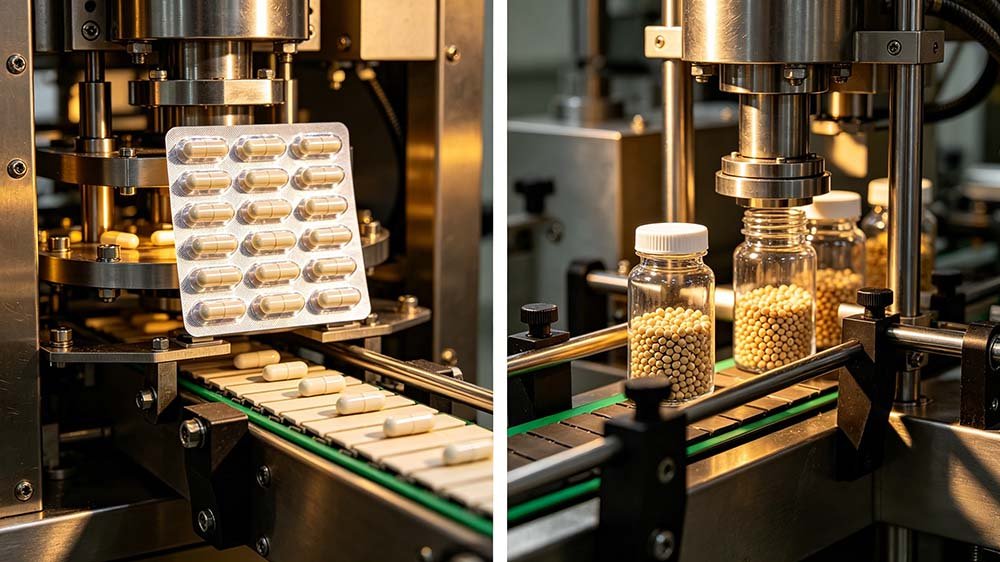
Blister packing vs. bottle packaging: two fundamentally different protection strategies with different compliance and cost implications for capsule manufacturers.
Why the Per-Unit Cost Comparison Misleads Most Capsule Packaging Decisions
🔹 Direct Answer
Blister packaging material cost runs $0.008–$0.018 per capsule unit for standard PVC/Alu configurations; HDPE bottle packaging runs $0.003–$0.007 per unit at comparable volumes — but this comparison ignores stability failure rates, recall exposure, and market access restrictions that can invert the economics entirely.
The number procurement teams look at first is exactly the wrong number. I’ve sat across from purchasing managers in Nairobi, Ho Chi Minh City, and Cairo who pulled up a spreadsheet showing bottle packaging saving $0.006 per capsule. Annual volume: 12 million units. Total saving: $72,000. They were ready to close on a bottling line.
I asked what a failed 12-month stability batch would cost. Nobody had calculated it. The API was a hygroscopic antibiotic, the distribution target was sub-Saharan Africa Zone IVb (40°C/75% RH), and the HDPE bottle specification on the table was 100cc natural with a polyfoam liner — no desiccant. That combination, in those conditions, would not get the product to end-of-shelf-life without degradation. The $72,000 saving would not survive a single regulatory inspection. It certainly would not survive a recall.
That conversation took about 45 minutes. I’m still not sure I fully convinced them. But they delayed the equipment decision, ran Zone IVb accelerated stability on both formats, and came back six weeks later. The bottle format failed at month 6. That’s the real cost. Not the $0.006.
The Correct Starting Variables for This Decision
Before comparing blister against bottle, three variables need to be locked. First: your API’s moisture vapor transmission sensitivity — specifically the moisture uptake rate (%w/w) at your worst-case distribution condition. Second: your primary target markets and their ICH climatic zones. Third: your regulatory dossier format requirements — some markets and some generics programs have specific packaging format requirements embedded in the registered dossier that make the “choice” much less open than it appears.
Get those three variables wrong and the rest of the analysis is noise. Learn more about the technical selection criteria in our guide to how to choose the right capsule blister packing machine for your pharma line.
Moisture Barrier Performance: Where Blister Packing and Bottles Diverge at the Physics Level
🔹 Direct Answer
Standard PVC blister film passes 4–6 g/m²/day MVTR at 38°C/85% RH. A 100cc HDPE bottle with polyfoam insert provides system-level moisture ingress of 1–3 mg/day depending on closure torque and liner integrity. Alu-Alu cold-form blister reduces per-cavity MVTR to effectively zero — the only format that provides hermetic individual-dose isolation.
Standard PVC at 250 μm passes 4–6 g/m²/day. That figure matters more than any machine price. For a hygroscopic capsule fill — common in antibiotic, probiotic, and enzyme-based formulations — that transmission rate means you’re not protecting the product; you’re managing how fast it degrades.
The HDPE bottle system looks better at the container level, but the comparison is not straightforward. A well-specified 100cc HDPE bottle with induction seal and molecular sieve desiccant canister can achieve moisture ingress below 1 mg/day into the bottle headspace. The problem is distribution chain integrity: once the bottle is opened in a pharmacy or household setting, all 30 or 60 capsules are simultaneously exposed. Every opening cycle after the first resets the protection clock. In tropical retail environments — where pharmacies in Lagos or Dhaka may not have climate-controlled storage — the cumulative exposure between first opening and last capsule consumed can exceed 6 weeks.
With blister packing, each cavity is hermetically sealed independently. The 29 capsules not yet consumed remain at full protection specification regardless of when the first cavity was opened. That individual-dose isolation is not a marketing point — it’s a structural protection difference that directly correlates with end-of-shelf-life potency for moisture-sensitive APIs.

Moisture vapor transmission rate (MVTR) comparison across blister film types — the primary technical driver in the blister vs. bottle decision for moisture-sensitive capsule formulations.
MVTR Comparison Across Packaging Formats
| Packaging Format | MVTR (g/m²/day @ 38°C/85% RH) | Individual Dose Isolation | Post-Open Protection | Typical Application | Verdict |
|---|---|---|---|---|---|
| PVC/Alu Blister (250μm PVC) | 4–6 | Yes — per cavity | Full (unopened cavities unaffected) | OTC, nutraceuticals, low-sensitivity APIs | BLISTER |
| PVDC/Alu Blister (60g/m² PVDC) | 0.05–0.3 | Yes — per cavity | Full (unopened cavities unaffected) | Hygroscopic APIs, tropical market distribution | BLISTER |
| Alu-Alu Cold-Form Blister | ≈ 0 (hermetic) | Yes — per cavity | Full (hermetic until puncture) | Highly moisture/light sensitive APIs, premium generics | BLISTER |
| HDPE Bottle + Induction Seal | System: 0.5–2 mg/day ingress | No — all doses share headspace | Drops sharply after first opening | Stable APIs, high-volume generics, OTC vitamins | BOTTLE |
| HDPE Bottle + Desiccant Canister | System: <1 mg/day ingress (sealed) | No — all doses share headspace | Limited after first opening without resealable desiccant | High-count solid-dose, hospital supply chains | DEPENDS ON API |
| Glass Amber Bottle + CRC | Near-zero (glass) | No — all doses share headspace | Drops after first opening | Light-sensitive liquids, high-value specialty drugs | DEPENDS ON FORM |
The unit-dose isolation that blister packing provides is not a compliance checkbox — it’s the only packaging architecture that maintains full protection specification for every capsule from the moment of manufacture to the moment of consumption, regardless of where the distribution chain takes it or how many times the package has been partially accessed. For tropical markets with 40°C/75% RH conditions, that distinction is the difference between a product that arrives in specification and one that doesn’t.
— 샹 포레스터, HIJ Machinery 설립자
GMP Compliance Burden: What WHO, cGMP, and 21 CFR Actually Require from Each Format
🔹 Direct Answer
Neither WHO GMP nor 21 CFR Part 211 mandates blister packing over bottle packaging for solid oral dosage forms — but both frameworks require that the chosen packaging system be validated to maintain product quality through the registered shelf-life under the labeled storage conditions, which functionally drives moisture-sensitive formulations toward higher-barrier blister formats for tropical market registration.
A quality director in São Paulo called me after a ANVISA inspection in 2022. The inspector had cited the facility for inadequate container closure integrity testing documentation on a 60-count HDPE bottle SKU distributed to the Brazilian northeast — a region consistently hitting Zone IVb conditions. The product’s registered storage condition was “store below 30°C.” The CCIT protocol on file had been run at 25°C/60% RH. Nobody had run the test at the labeled worst-case condition. The dossier went back for resubmission.
That story repeats in different forms across FDA, EMA, and WHO PQ submissions. The compliance burden for bottle packaging is not lower — it’s different. Both formats require container closure integrity testing per USP <1207>. Both require stability testing at the ICH zone applicable to your distribution market. Both require equipment IQ/OQ/PQ validation. The key difference: blister packing’s individual-cavity hermetic seal makes CCIT documentation more straightforward to defend — you’re testing a sealed aluminum foil lid against a formed cavity, not the cumulative integrity of a threaded closure system under variable human torque application.
The practical compliance implication: if your product goes to Sub-Saharan Africa, Southeast Asia, or Middle Eastern markets, your regulatory team will need Zone IVb stability data — and if the bottle format fails that stability study, you have no packaging format registered for those markets. Running stability on both formats in parallel adds 6–12 months to your timeline but preserves optionality. I recommend it for any mid-sized generic manufacturer targeting more than two climatic zones.
The Real Cost Structure of Capsule Blister Packing vs. Bottle Packaging: Beyond Material Price
🔹 Direct Answer
A capsule blister packing machine (DPP-260 class, 120–220 blisters/min) requires $35,000–$90,000 capital investment versus $18,000–$45,000 for a comparable bottle filling and capping line — but total cost of ownership over a 5-year period, including material costs, validation overhead, stability testing, and market access value, favors blister packing for most regulated pharmaceutical applications targeting multiple markets.
Of the 31 blister line projects I handled in Southeast Asia between 2018 and 2023, 11 came to me after the client had originally purchased a bottle filling line, run 12-month stability, failed the Zone IVb study, and then needed to pivot to blister. The sunk cost on those bottle lines averaged $28,000. The delay cost — in terms of product launch timeline — averaged 8 months. That’s the number I use when clients tell me blister machines are expensive.
Five-Year Total Cost of Ownership Comparison
| Cost Category | Capsule Blister Packing Line | Bottle Filling & Capping Line | Notes |
|---|---|---|---|
| Equipment CapEx (entry-level automated) | $35,000–$90,000 | $18,000–$45,000 | Blister includes forming, sealing, punching stations |
| Tooling & Molds | $4,000–$12,000 per SKU format | $1,500–$4,000 per bottle size | Blister molds are SKU-specific; bottle tooling is simpler |
| Material Cost (per 1,000 units) | PVC/Alu: $8–$18 / PVDC/Alu: $14–$28 | HDPE 60-count: $3–$7 (bottle + closure) | Bottle has significant material cost advantage at scale |
| Validation (IQ/OQ/PQ) | $15,000–$35,000 | $10,000–$25,000 | Blister CCIT documentation is typically more extensive |
| Stability Testing (both ICH zones) | $8,000–$20,000 | $8,000–$20,000 | Equivalent; failure risk higher for bottles in Zone IVb |
| Market Access (tropical markets) | Full access (Zone IVb compatible) | Restricted if stability fails — requires re-registration | Revenue impact can dwarf all other cost lines |
| Recall Exposure | Lower — individual cavity isolation limits scope | Higher — batch-level exposure affects all units in open containers | FDA data: multi-dose bottle recalls average wider scope |
For a full breakdown of blister line capital and operating costs, our detailed analysis at capsule blister packing machine cost breakdown for pharma buyers covers equipment tiers, tooling, and 5-year operating economics with market-specific scenarios.
⚠️ Decision Traps: When the Wrong Format Gets Specified
🔴 Trap 1: Choosing bottles because the machine is cheaper, then failing Zone IVb stability
Root cause: Equipment decision made before API moisture sensitivity and distribution geography are fully characterized. Procurement leads the decision rather than formulation or regulatory affairs.
✔ Fix: Run a 3-month accelerated moisture uptake study on the capsule fill before committing to packaging format. Cost: ~$3,000. Compared to a failed stability batch and 8-month delay: unavoidable.
🔴 Trap 2: Specifying blister packing because “it’s the pharma standard,” then discovering the output rate doesn’t match the filling line
Root cause: Blister machine speed (blisters/min) not reconciled against upstream capsule filling machine output (capsules/min) and downstream cartoning line capacity. Three vendors, three different PLCs, no integration testing before FAT.
✔ Fix: Define line throughput requirements in the URS before selecting any individual machine. The blister packer is not a standalone decision — it’s a node in a production system. At HIJ, we start every project with the full capsule blister packing machine specification alongside the upstream and downstream line layout before a single equipment quote is issued.
🔴 Trap 3: Multi-vendor line integration failure at FAT — vision inspection system can’t communicate with cartoner
Root cause: Three separate vendors, three different PLC protocols (Siemens S7, Allen-Bradley ControlLogix, and a proprietary Chinese HMI). No unified FAT/SAT documentation framework agreed before procurement.
✔ Fix: Single-source integration or a defined integration protocol agreed in writing before any PO is issued. I’ve personally seen a $2M product launch delayed six months because the vision inspection reject system sent a signal format the cartoner’s PLC didn’t recognize. The fix took 11 days of remote engineering. The delay cost was not 11 days.
Africa, Southeast Asia, and Middle East: Why Geography Changes the Blister vs. Bottle Calculus Completely
🔹 Direct Answer
Pharmaceutical manufacturers distributing to WHO ICH Zone IVb markets (40°C/75% RH) — covering most of Sub-Saharan Africa, Southeast Asia, and the Arabian Peninsula — face a 3–5x higher moisture-induced degradation risk with HDPE bottle packaging compared to PVDC or Alu-Alu blister formats, based on comparative MVTR calculations across standard distribution shelf-life periods of 24–36 months.
The stability report landed in March 2021. A client outside Accra had run 12-month accelerated stability on a 100-count HDPE bottle SKU of a probiotic capsule blend destined for West African pharmacy chains. Month 12 results: viable count dropped 1.8 log from label claim. The registered shelf-life was 24 months with a minimum viable count specification. They had a batch of 180,000 bottles in a Lagos warehouse. None of it could be released.
The root issue was not the formulation. The probiotic strains were stable at 25°C/60% RH for 30 months — that data existed. The issue was Zone IVb. At 40°C/75% RH, moisture ingress into the HDPE bottle headspace through the polyethylene liner was sufficient to drive water activity in the capsule fill above the threshold that triggered accelerated strain death. A PVDC/Alu blister format at the same conditions would have maintained moisture below that threshold for the full 24-month shelf-life. The MVTR numbers had predicted this outcome. Nobody had run the prediction before the batch was manufactured and shipped.
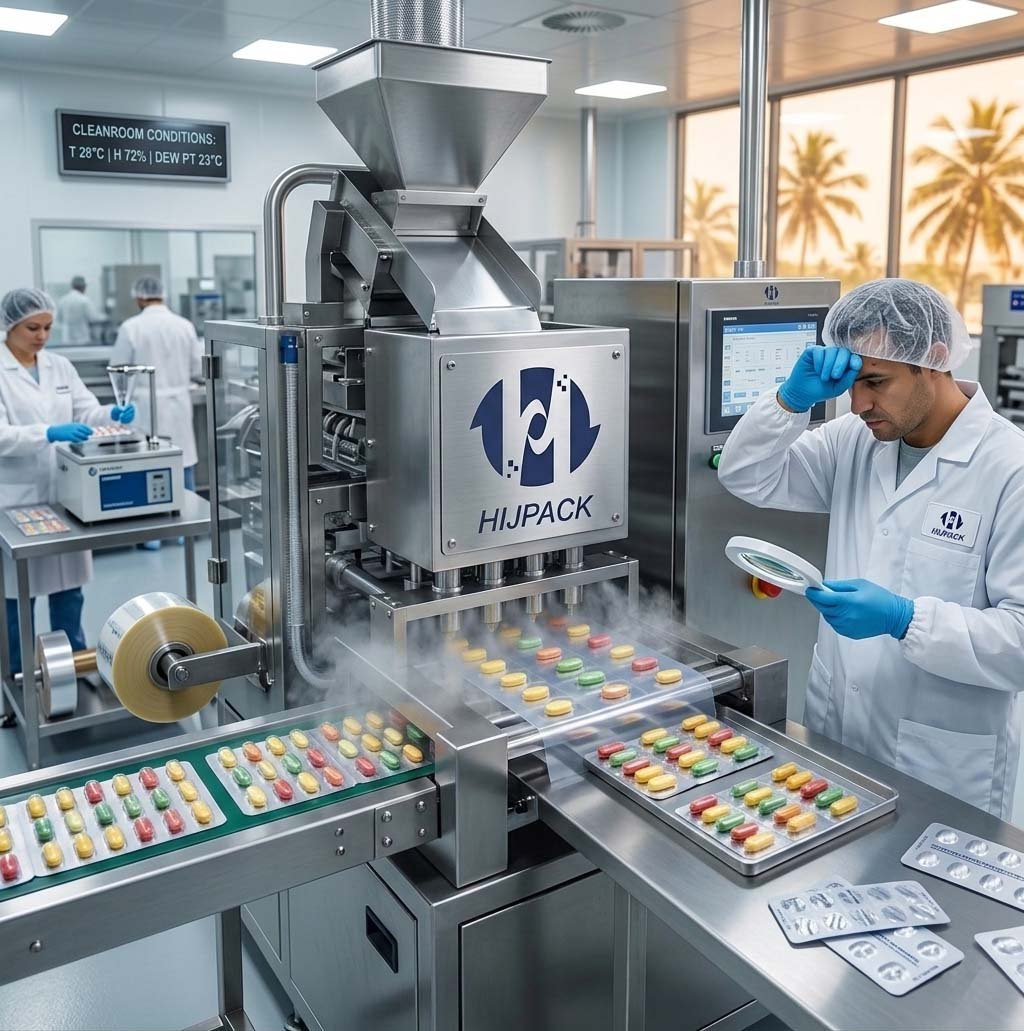
Tropical climate stability testing (Zone IVb: 40°C/75% RH) — the decisive data point for capsule packaging format selection in African, Southeast Asian, and Middle Eastern markets.
Market-by-Market Format Recommendation
✅ Choose Blister Packing When:
- Distribution includes Zone IVb markets (Africa, SEA, Middle East, South Asia)
- API is hygroscopic, moisture-sensitive, or probiotic/enzyme-based
- Regulatory dossier requires per-dose tamper evidence
- Retail pharmacy setting — patient access time spans weeks to months
- WHO PQ or EU GMP dossier with container closure integrity requirements
- Unit-dose dispensing required (hospital, government tender)
🛴 Consider Bottles When:
- Distribution limited to Zone I/II markets (Europe, North America, temperate regions)
- API has low moisture sensitivity — demonstrated by stability data
- High-count solid-dose (100ct, 250ct, 500ct) where per-unit cost dominates
- Hospital supply chain with controlled storage and fast turnover
- OTC vitamins and nutraceuticals with 18+ month inherent stability
- Child-resistant closure required by market regulation (CRC bottle is simpler)
Why the Blister vs. Bottle Decision Is Actually a Line Architecture Decision

💡 Forester’s Field Perspective
The choice between blister packing and bottle packaging isn’t purely aesthetic — it directly impacts your cGMP compliance posture, per-unit cost structure, and downstream market access. In my 20 years of walking production floors from São Paulo to Jakarta, I’ve watched mid-sized pharma manufacturers make this decision based solely on upfront machine price. The hidden trap? A standalone blister machine sourced from three different vendors means three different PLC protocols, zero unified FAT/SAT documentation, and a compliance nightmare when your FDA or EU auditor walks in. I’ve personally seen a $2M product launch delayed six months because the vision inspection system couldn’t communicate with the cartoning line.
Before committing to either format, lock down your URS first — define your target markets, moisture sensitivity requirements, and annual output. At HIJ, we always push for a turnkey integration approach: one supplier, one validated data chain, zero inter-vendor finger-pointing. That’s not a sales pitch. That’s 20 years of watching projects fail the other way. Our turnkey packaging solutions approach exists precisely because the equipment decision and the line architecture decision are not separable.
When a client asks me “blister or bottle,” my first question is always: “Who else are you buying equipment from?” The answer shapes everything. A fully integrated blister line — capsule filler feeding directly into a DPP-260 blister packer with a matched cartoning line — has a single FAT protocol, a single qualified supplier for spare parts, and a single point of accountability when something goes wrong during IQ/OQ/PQ. That structure is not just convenient. It is what makes your validation dossier defensible in front of a WHO inspector or an FDA 483 response.
The same logic applies to 태블릿 블리스터 포장기 selections: the format decision and the line integration decision must be made simultaneously. Choosing equipment in isolation creates gaps that show up six months later as compliance deficiencies or production bottlenecks — neither of which is cheap to fix after commissioning.

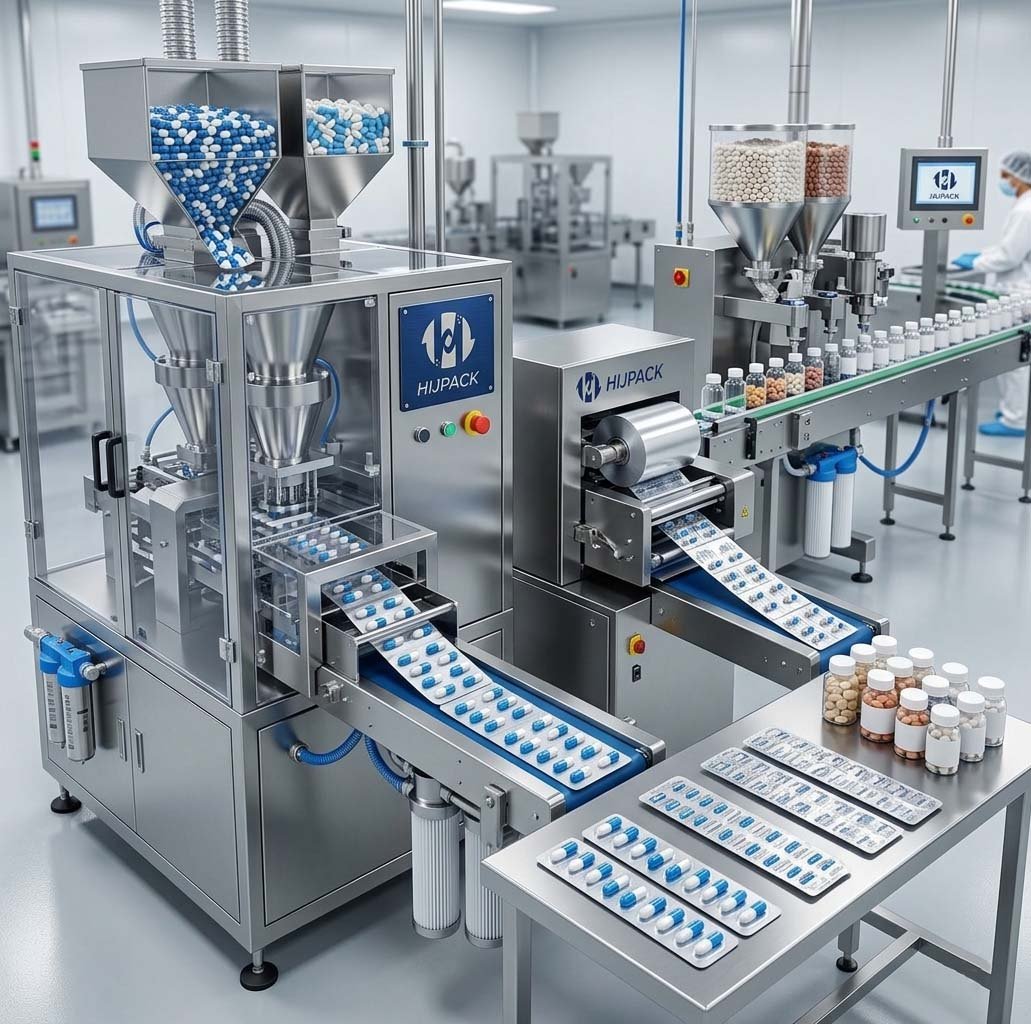
A fully integrated capsule blister packing line: upstream capsule filling, blister forming/sealing, vision inspection, and cartoning under a single validated FAT/SAT protocol — the architecture that eliminates inter-vendor compliance gaps.
Output Rates, Changeover Time, and Scalability: Which Format Fits Your Production Model?
🔹 Direct Answer
Automated capsule blister packing machines in the DPP-260 class run 120–220 blisters/min (typically 6–12 capsules per blister card), yielding 720–2,640 capsules per minute. Comparable automated bottle filling and capping lines handle 80–200 bottles/min at 60-count fills — roughly 4,800–12,000 capsules per minute. For high-count fill scenarios, bottle lines have a throughput advantage. For unit-dose or low-count scenarios, blister output is competitive.
Output rate comparisons between the two formats depend heavily on fill count configuration. A 10-cavity blister card at 150 cards/min gives you 1,500 capsules/min packaged into unit-dose cards. A 60-count bottle line at 120 bottles/min gives you 7,200 capsules/min into bottles. Those numbers favor bottles at face value — until you factor in the downstream cartoning and labeling steps.
A blister line with integrated cartoning typically processes cards directly from punching station into carton at the same cycle rate. A bottle line requires filling, capping, induction sealing, labeling, and cottoning or desiccant insertion as separate sequential steps. The net packaged-unit output per labor hour is closer between the two formats than the raw machine speeds suggest — typically within 15–25% when the full secondary packaging step count is included in the comparison.
Changeover time is the other variable most production planners underweight. A blister format change requires mold change, film roll change, and sealing station adjustment — typically 45–90 minutes for a trained operator on a well-maintained machine. A bottle format change requires adjustment of filling heads, capper chuck sizing, and label format programming — typically 30–60 minutes. For facilities running 6+ SKUs, this difference compounds into meaningful OEE impact over a year.
⚠️ Production Planning Miscalculations
🔴 Miscalculation: Comparing blister machine speed (cards/min) to bottle line speed (bottles/min) without accounting for dose count per unit
Root cause: Procurement specs often list machine speed without specifying cavity count per blister or count per bottle. 150 cards/min at 10 cavities/card is 1,500 doses/min. 120 bottles/min at 60 count/bottle is 7,200 doses/min. The headline numbers are not comparable.
✔ Fix: Always specify output in capsules (or tablets) per minute, not containers per minute. This is the only meaningful throughput metric for line capacity planning.
🔴 Miscalculation: Assuming blister line changeover is faster because the machine is smaller
Root cause: Blister mold sets are capsule-size and cavity-count specific. A facility running 00, 0, and 1 size capsules across multiple SKUs may need 8–12 different mold sets. Each changeover requires mold removal, cleaning, new mold installation, and re-qualification of forming temperature and sealing parameters.
✔ Fix: Audit your SKU portfolio and capsule size range before specifying the blister machine. A machine with tool-free quick-change mold design reduces per-changeover time from 90 to 35–45 minutes — a meaningful OEE recovery for high-mix production environments. This is a specification point worth negotiating with your supplier before PO issuance.
The Format Decision Framework: A Practical Guide for Capsule Manufacturers by Buyer Type
🔹 Direct Answer
Generic pharma manufacturers targeting multi-market distribution (especially Zone IVb) should default to blister packing unless stability data conclusively demonstrates bottle format adequacy for all registered markets. OTC nutraceutical and high-volume domestic-market producers with stable, low-sensitivity APIs and limited regulatory exposure may find bottle formats economically superior.
I won’t tell you this decision is simple. It involves your API profile, your target markets, your validation timeline, and sometimes your relationship with the regulatory reviewer who will evaluate your dossier. What I can give you is a framework that has worked across 20 years of projects.
Startup generic pharma (<$5M revenue, first GMP line): Blister packing. The validation documentation structure is more standardized, the individual-cavity hermetic seal makes CCIT straightforward, and the format gives you maximum market access flexibility as your product portfolio expands. The $15,000–$25,000 CapEx premium over a bottle line is your insurance against stability failures that could cost 10x more to remediate.
Mid-size generic manufacturer (established, 3–8 SKUs, Zone IVb distribution): Blister packing — PVDC or Alu-Alu depending on API sensitivity. Your regulatory dossiers in tropical markets almost certainly require Zone IVb stability data. If you don’t already have it for your bottle format, running it now will take 12–18 months and cost $15,000–$30,000 per product. Starting with blister packing eliminates that risk category entirely.
OTC nutraceutical / wellness brand (domestic market, vitamin/mineral capsules): Bottles are likely adequate and economically superior. Zone I/II stability data for standard multivitamin or mineral formulations consistently passes in HDPE bottle with induction seal. The per-unit material cost advantage compounds meaningfully at 50+ million units per year.
Contract manufacturer (CMO/CDMO, multi-client multi-format): Both — but integrate them on a single line architecture with format-change documentation. A blister-capable line that can also run bottle formats via quick-change tooling gives CMOs the flexibility to serve regulated and nutraceutical clients on the same platform. This is a capital efficiency argument, not a quality one.
EPC contractor / turnkey project engineer: Specify the packaging format in the URS before any equipment is sourced. Your client’s regulatory affairs team should sign off on the format decision before you issue a single RFQ. If that sign-off doesn’t happen and the stability data comes back negative after equipment procurement, the project timeline is broken and nobody wins.
For buyers at the stage of evaluating specific machine configurations and output specifications, our 캡슐 블리스터 포장기 제품 페이지 covers the DPP-260’s full technical specification, available cavity configurations, and integration options for turnkey pharmaceutical lines.
Frequently Asked Questions: Capsule Blister Packing vs. Bottle Packaging
Is blister packing or bottle packaging better for moisture-sensitive capsules?
Blister packing is significantly better for moisture-sensitive capsules. A PVDC/Alu blister format provides 0.05–0.3 g/m²/day MVTR versus the effectively open moisture environment of a repeatedly opened HDPE bottle — and the Alu-Alu cold-form format achieves near-zero MVTR per cavity. For hygroscopic APIs, enzyme-based formulations, or probiotics, the individual-cavity hermetic seal of blister packing is the only format that maintains protection specification for each dose from manufacture through the point of patient consumption, regardless of the number of previous accesses to the package.
Which packaging format is cheaper for capsules — blister or bottle?
Bottle packaging has lower per-unit material cost: HDPE bottles run $0.003–$0.007 per capsule-equivalent unit versus $0.008–$0.018 for standard PVC/Alu blister. However, total 5-year cost of ownership depends heavily on stability failure risk, market access restrictions, and validation overhead. For manufacturers distributing to Zone IVb tropical markets, the cost of a failed bottle stability study and delayed market entry typically exceeds the material cost differential by 10–20x over a product’s commercial lifecycle.
Do WHO GMP or FDA requirements specify blister packing for capsules?
No. Neither WHO GMP (TRS 992 Annex 3) nor 21 CFR Part 211 mandates blister packing over bottle packaging for solid oral dosage forms. Both require the selected packaging system to maintain product quality through registered shelf-life under labeled storage conditions — which functionally drives moisture-sensitive formulations toward higher-barrier formats for Zone IVb registrations.
What output rate can I expect from a capsule blister packing machine versus a bottle filling line?
A DPP-260 class capsule blister packing machine runs 120–220 blister cards per minute. At a 10-cavity card format, that yields 1,200–2,200 capsule doses per minute. A comparable automated bottle filling and capping line at 60-count fills runs 80–200 bottles per minute, or 4,800–12,000 capsule doses per minute. For raw throughput in high-count fill scenarios, bottle lines have a speed advantage — but when secondary packaging steps (cartoning, labeling, desiccant insertion) are included, net packaged-unit output per hour is typically within 15–25% between the two formats.
Can one machine run both blister packing and bottle filling for capsules?
Not on a single machine — they are fundamentally different processing architectures. Some CMOs and CDMOs run both formats on separate dedicated lines within the same production area, with shared upstream capsule filling equipment feeding either line via diverter conveyors. This configuration requires separate IQ/OQ/PQ validation protocols for each line and separate container closure integrity testing documentation for each format.
How long does it take to change formats on a capsule blister packing machine?
Typically 45–90 minutes for a full mold and film format change on a standard machine. Machines with tool-free quick-change mold systems reduce this to 35–45 minutes. Changeover time is a meaningful OEE factor for high-mix facilities running 6+ SKUs, and should be included in the machine specification requirements before purchase.
What is the minimum production volume where blister packing becomes economically justified over bottles?
There is no single volume threshold — it depends on API sensitivity and target markets. For regulated pharma with Zone IVb distribution, blister packing is justified from the first batch if the API is moisture-sensitive. For stable APIs in Zone I/II markets, bottle economics typically dominate below 5 million units per year. Above that volume, the stability insurance value of blister packing, combined with broader market access, increasingly offsets the material cost differential.
🎯 Ready to Make the Right Format Decision?
Get Expert Guidance on Blister Packing vs. Bottle Packaging for Your Capsule Line
Tell us your API sensitivity profile, target markets, and annual output. We’ll give you a format recommendation backed by MVTR data and 20 years of field experience — before you commit to any equipment.