
















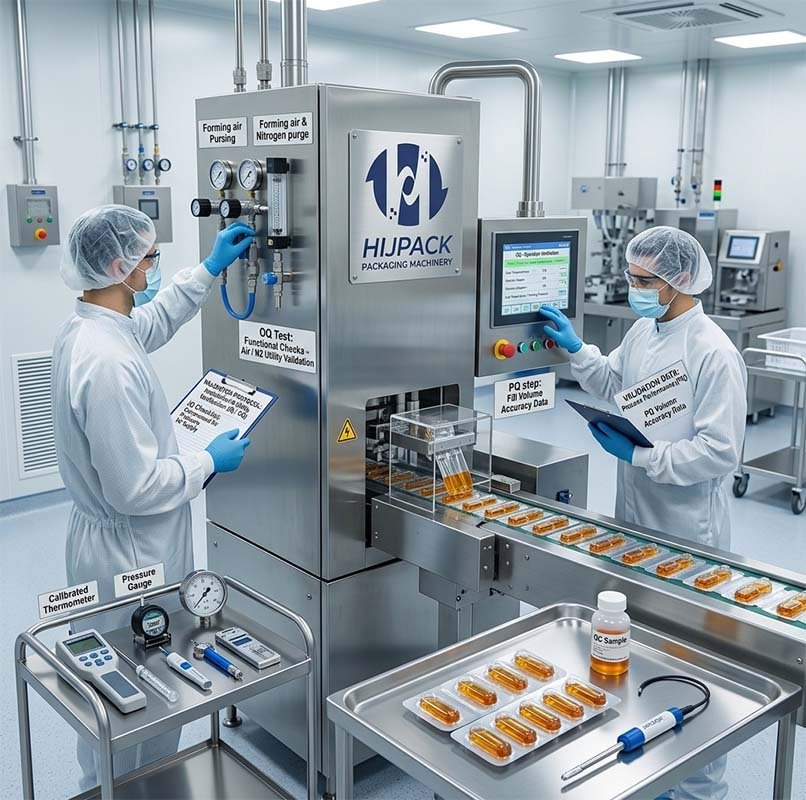
IQ OQ PQ Validation for Liquid Blister Packaging Machines: The Protocols That Protect Your GMP Licence
Your liquid blister packaging machine can be mechanically perfect and still trigger an FDA 483 observation on Day 1 of inspection — if your validation package is generic, untraceable to your URS, or was executed on a different machine configuration. This guide covers every phase of IQ OQ PQ validation as it actually applies in the field: what each qualification must prove, what auditors look for, and where teams consistently fail under 21 CFR Part 211, EU GMP Annex 11, and GAMP 5.
I’ve been through more than forty qualification cycles across Southeast Asia and Latin America. The machines varied. The APIs varied. But the failure mode almost never varied: a validation package that looked complete on paper until someone — an FDA investigator, a PMDA reviewer, an EU QP — asked a single traceability question it couldn’t answer.
This guide is not a theory document. It maps what each IQ OQ PQ phase must demonstrate for a liquid blister line, gives you the acceptance criteria language that holds up under audit, and flags the seven points where projects derail before a single saleable unit runs.

The four-phase qualification lifecycle: DQ → IQ → OQ → PQ — each must be closed before advancing to the next.
What Is IQ OQ PQ Validation for a Liquid Blister Packaging Machine — and Why It Is Not Optional
The number teams look at first is exactly the wrong number. They check machine price, cycle time, cavities per stroke. Nobody checks whether the supplier’s validation template has ever been executed against a liquid filling station — or whether it was copied from a tablet blister protocol with the product name replaced.
IQ OQ PQ is not an internal formality. Under 21 CFR Part 211.68 and EU GMP Chapter 4, equipment used in production must be qualified. The word “must” is explicit. A machine that cannot demonstrate valid qualification documentation cannot legally produce commercial pharmaceuticals in any regulated market. That is not a conservative interpretation — it is the text of the regulation.
For liquid blister specifically, the stakes are higher than for solid-dose blister. You are validating not just forming and sealing, but a sterile or near-sterile filling process — fill volume accuracy, seal integrity under liquid contact, and, where applicable, particle contamination control. The qualification protocol must address each of these elements individually, with acceptance criteria tied directly to your User Requirement Specification (URS).
“A generic IQ OQ PQ template that has never been executed against your machine configuration is not documentation — it is liability. In 20 years of commissioning liquid blister lines, I have seen three facilities receive FDA 483 observations specifically because their qualification records referenced equipment parameters that did not match the installed machine. The cost of rebuilding that documentation under inspection pressure averaged 11 months of production delay.”
— Forester Xiang, Founder, HIJ Machinery
Design Qualification (DQ): The Phase Most Teams Skip — And Why That Decision Costs Them Later
Three weeks into a commissioning job in a facility near Bandung, the IQ team discovered the machine’s filling station had a minimum fill volume of 0.8 mL. The product was a 0.5 mL paediatric oral liquid. Nobody had done a DQ. The purchase order had been signed based on a brochure.
DQ is technically optional under GAMP 5 for non-configurable equipment. In practice, every regulatory inspection I have witnessed in the last decade expects to see a documented rationale for equipment selection — whether it is called DQ, vendor assessment, or technical specification review. Without it, you cannot demonstrate that the IQ protocol you wrote actually tests the right parameters.
What a Liquid Blister DQ Must Cover
Fill volume range vs. URS: Minimum and maximum fill volumes the machine can deliver accurately — specified with actual ±% tolerance, not marketing language.
Material compatibility: Forming film, lidding foil, and wetted-part materials versus your API and excipient profile. Documented certificate of compatibility, not verbal assurance.
Cleanroom class compatibility: If your process requires ISO 7 or ISO 8 environmental classification, the machine enclosure and HVAC interfaces must be specified and confirmed.
Data integrity architecture: Electronic batch records, audit trail, access control — all must be documented in the DQ if 21 CFR Part 11 or EU GMP Annex 11 apply.
Seal integrity method: The machine’s heat-seal station parameters (temperature range, dwell time, pressure) must be confirmed as capable of achieving the seal integrity specification in your product dossier.
CE marking and applicable directives: Machinery Directive 2006/42/EC and, where applicable, ATEX Directive 2014/34/EU for solvent-based liquid products.
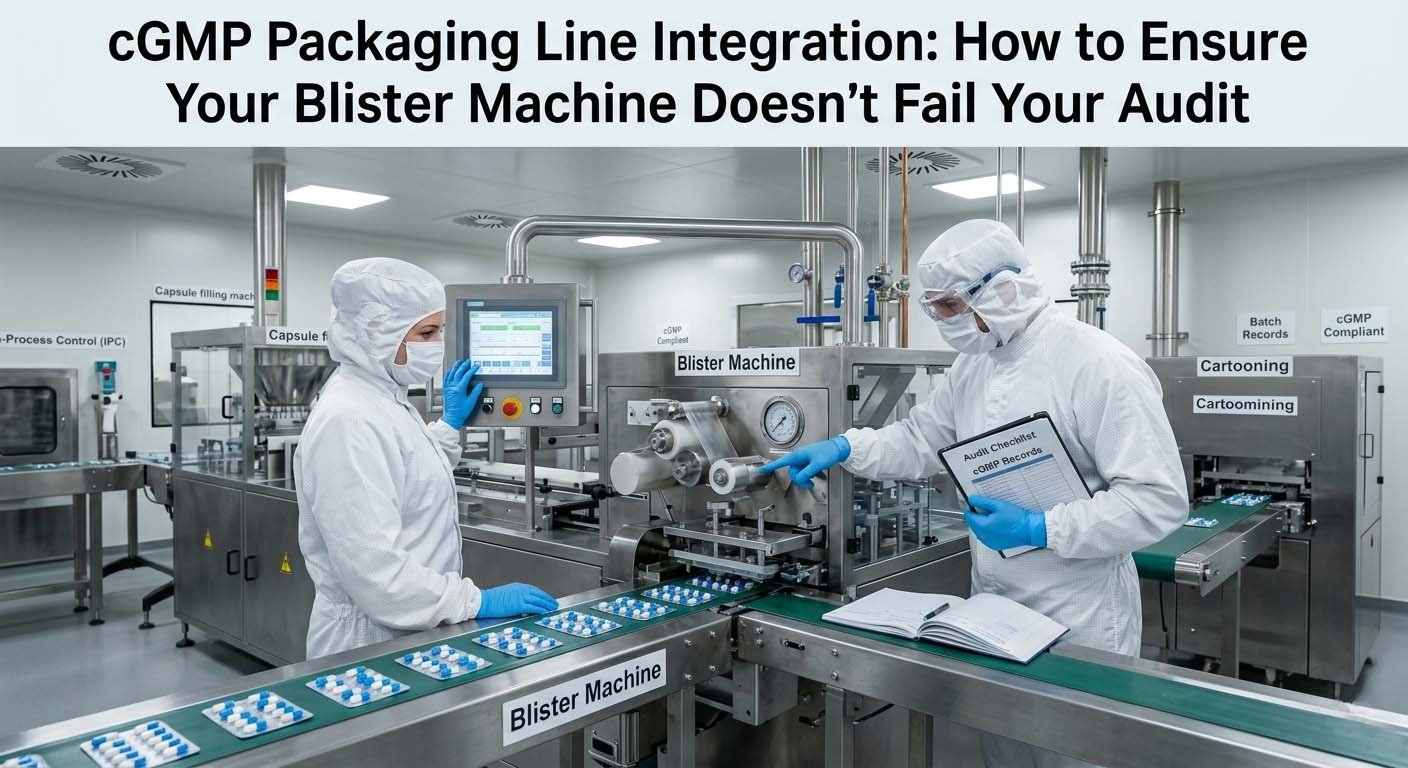
A pre-IQ documentation review in progress — DQ output must be traceable to every IQ test point before the first bolt is tightened.
Installation Qualification (IQ): What You Are Actually Proving — and the Eight Documents Auditors Request First
The SAT in Jakarta was our third day of IQ execution. The supplier’s engineer handed over the OQ protocol. I asked to see the IQ sign-off first. He said the IQ was “basically the same as the FAT.” It was not. The FAT had been done at the factory, against the factory’s utility supply. The site had a 380 V/50 Hz supply where the factory ran 220 V/60 Hz. Nobody had checked the transformer specification or documented the change. That’s an IQ failure — three days in, nothing on paper.
IQ is not a walk-around inspection. It is a systematic verification that produces a permanent record. Every item below must generate a document with a unique reference number, an expected result, an actual result, a pass/fail determination, and the signature of the person who witnessed it.
IQ Checklist for Liquid Blister Packaging Machines
Equipment identity verification: Serial number, model number, firmware/software version — all match the approved purchase order and DQ specification exactly.
Installation drawings: P&ID, electrical schematic, and layout drawing — as-installed versus as-designed. Any deviation requires a formal deviation report and impact assessment.
Utility connections: Compressed air pressure and quality (ISO 8573-1 class), electrical supply voltage/frequency/earthing, purified water or WFI connections if applicable — all measured and recorded.
Calibration certificates: All critical instruments (temperature sensors at sealing station, fill volume sensors, pressure gauges) must have current calibration certificates traceable to national standards before IQ is signed off.
Material contact surface documentation: 316L stainless steel or equivalent certificates for all wetted parts. Required for any liquid pharmaceutical product.
Safety system verification: Emergency stop, interlocks, guarding — confirmed functional per ISO 13849-1 requirements and documented with test records.
Software/firmware version lock: The installed software version must be recorded and locked. Any future change requires a change control record. This is an Annex 11 / 21 CFR Part 11 requirement, not a suggestion.
Spare parts list and documentation package: Confirmed receipt of maintenance manual, spare parts list, and SOPs. Without these, OQ preparation cannot begin properly.
The fix is straightforward: require your supplier to provide pre-calibrated instruments with certificates dated no more than six months before SAT, as a contractual deliverable. That conversation takes five minutes in the RFQ phase. It saves three weeks on-site.
Operational Qualification (OQ): Testing the Machine — Not the Product
OQ is the phase that separates machines from production equipment. IQ confirmed the machine arrived and was installed correctly. OQ proves it can do what the label says, under conditions that stress the boundaries of its specification.
The word “worst-case” is critical and frequently misunderstood. Worst-case in OQ does not mean “the hardest thing we can think of”— it means the parameter combinations most likely to produce a failure mode relevant to your product quality attributes. For liquid blister, the three worst-case scenarios are: maximum fill volume at minimum sealing temperature, minimum fill volume at maximum machine speed, and sealing at maximum dwell time with the thinnest lidding foil in your approved materials list.
| CPP | Typical Test Range | Acceptance Criterion | Test Method / Standard | Worst-Case Scenario |
|---|---|---|---|---|
| Sealing temperature | 140–200°C (forming film dependent) | ±3°C from setpoint at steady state | Calibrated thermocouple; min. 10 readings per run | Minimum temperature + maximum fill volume |
| Sealing pressure | 250–400 kPa | ±5% of setpoint | Calibrated pressure transducer | Minimum pressure, thinnest lidding foil |
| Fill volume accuracy | 0.5–20 mL (product dependent) | ±1% of nominal (Ph. Eur. 2.9.26 / USP <1>) | Gravimetric, n=20 per cavity per run | Minimum fill volume at maximum speed |
| Forming depth / cavity dimension | Product-specific mould specification | ±0.1 mm of drawing specification | Calibrated vernier caliper / CMM | Maximum forming depth, minimum film thickness |
| Machine speed (strokes/min) | Model-dependent; typically 20–80 strokes/min | Setpoint achieved ±2 strokes/min | Tachometer / PLC data log | Maximum speed, minimum film thickness |
| Blister seal integrity | All cavities per sealed card | 0 failures per 30 cards tested (dye ingress, 60 mbar) | ASTM F2338 / USP <1207> dye-penetration method | Minimum sealing temperature + maximum speed |
A QA director in São Paulo called me last year. Her OQ had failed on fill volume accuracy — the gravimetric data showed ±3.2% at maximum speed, against a ±1% criterion. The machine’s peristaltic pump was the correct specification for the product. The problem was viscosity: the liquid was a 40 cP syrup, and the pump had been calibrated with purified water. Nobody had run a viscosity correction factor. That’s not a machine failure. That’s a protocol gap. The OQ had to be repeated, the pump recalibrated with actual product-representative fluid, and a viscosity specification added to the batch record. Four weeks. One phone call earlier would have prevented it.
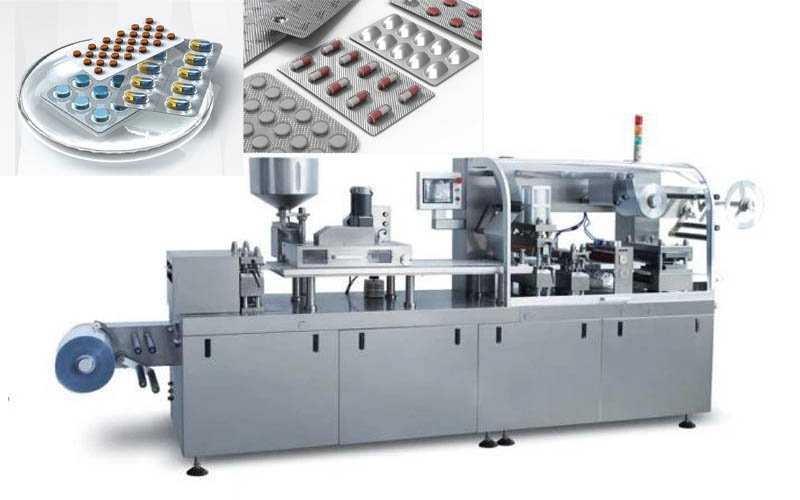
Fill station during OQ execution: gravimetric testing across 20 consecutive cavities per run confirms ±1% accuracy at each speed setpoint.
⚠️ OQ Failure Diagnostic: Most Common Deviations in Liquid Blister Lines
Fill volume out of specification at maximum speed
Root cause (80% of cases): Pump calibration performed with water; product viscosity not used as calibration fluid. Fix: recalibrate with product-representative fluid (matched viscosity at process temperature). Add viscosity specification to OQ protocol and batch record. Re-run gravimetric testing n=20 per cavity after recalibration.
Seal integrity failures (dye ingress at 60 mbar)
Root cause: Sealing temperature setpoint not adjusted for lidding foil supplier change between DQ and OQ. Foil lacquer coat weight varies ±15% between suppliers and batches. Fix: always specify lidding foil by supplier, grade, and lot range in the validated material specification — not just by nominal thickness.
Audit trail gaps under 21 CFR Part 11 review
Root cause: PLC time-stamp not synchronised to site NTP server; operator login not linked to individual unique user IDs. These are standard Annex 11 / Part 11 requirements but are routinely unconfigured on delivery. Fix: add electronic audit trail configuration verification as a mandatory IQ test point, not an OQ assumption.
Performance Qualification (PQ): Three Consecutive Runs Is the Minimum — Here Is What Each Run Must Prove
PQ is the only phase that uses real product. Everything before it — DQ, IQ, OQ — was preparation. PQ is proof. And the word “consecutive” is non-negotiable: three runs that pass, with no failed runs in between. A pattern of pass-fail-pass-pass is not three consecutive successes. It is an investigation trigger.
The stability report landed in March. A client in Karachi had completed three PQ runs, all passing on in-process checks. Stability data at three months showed a moisture content exceedance in 6% of sampled blisters. The PQ had not included a seal integrity test on final packaged product — only on the lidding foil immediately after sealing. The headspace moisture had migrated through micro-channels in the seal that only became visible under time and temperature stress. PQ must include both immediate post-sealing integrity testing and accelerated stability sampling at defined time points. If it does not, you have an incomplete qualification, regardless of what the protocol says.
Define the PQ batch size and sampling plan before execution
PQ batch size must be representative of the intended commercial batch size — not a minimum run. Sampling plan must specify frequency (e.g., every 30 cards), sample size per time point, and which quality attributes will be tested. This must be written and approved before any PQ run begins. Retroactive sampling plans are not acceptable under EU GMP Annex 15.
Run all three consecutive PQ batches under normal production conditions
Normal conditions means: standard operators (not the validation team), normal shift patterns, standard line clearance procedures. Any deviation from these conditions invalidates the “consecutive” claim and must be documented. All CPPs monitored and logged continuously; fill volume checked gravimetrically every 30 minutes minimum.
Execute seal integrity testing per ASTM F2338 / USP <1207> on finished product
Dye-ingress at 60 mbar is the standard method. Test n=30 cards per batch, sampled across beginning, middle, and end of each run. Zero failures is the acceptance criterion for pharmaceutical liquid products. Document the dye, concentration, immersion duration, and inspector qualification.
Submit PQ samples to stability programme at T=0
PQ samples must enter the product’s ongoing stability programme. For most liquid pharmaceuticals, this means ICH Q1A(R2) Zone II or IVb conditions depending on your target markets. If your product is destined for Southeast Asia or Sub-Saharan Africa, Zone IVb (40°C/75% RH) is mandatory — not optional. This is where the Karachi project failed.
Generate the PQ Summary Report and close the Validation Master Plan
The PQ Summary Report must include: batch numbers, dates, all CPP data with statistical summary, all deviation records and their resolutions, certificate of analysis for each batch, and a formal conclusion statement signed by QA. This report closes the Validation Master Plan (VMP) and is the document your regulatory reviewer will read first.
Need IQ OQ PQ Templates Pre-Populated for Your Line?
HIJ supplies machine-specific, URS-traceable IQ OQ PQ documentation packages as a standard deliverable — not an add-on. Our validation engineers have executed protocols across FDA, EMA, WHO, and CDSCO-regulated facilities.
21 CFR Part 11 and EU GMP Annex 11: The Electronic Records Requirements That Catch Teams Off Guard
Most engineering teams think about 21 CFR Part 11 as an IT department problem. It is not. The machine’s PLC and HMI are the primary data sources for batch records on a liquid blister line. If the PLC logs do not meet Part 11 requirements, the entire qualification package is at risk.
The CDSCO reviewer I worked with in 2021 cited ICH Q10 directly and asked why the machine’s audit trail did not capture who had modified the sealing temperature setpoint during Run 2 of the OQ. The machine had a shared administrator password. One password. No individual user tracking. The OQ protocol had not included audit trail integrity as a test point. The dossier went back. Eight months later, after a software upgrade, a user management reconfiguration, and a complete OQ repeat.
21 CFR Part 11
EU GMP Annex 11
GAMP 5 (Category 3/4)
WHO TRS 992 Annex 3
ICH Q10
The five requirements that every liquid blister machine’s software must satisfy before IQ sign-off under Part 11 / Annex 11: unique user IDs with role-based access; time-stamped, sequence-tagged audit trail entries that cannot be deleted; electronic signature capability linking the person to the record; the ability to generate accurate and complete paper copies of electronic records on demand; and validated backup and recovery procedures with documented recovery time.
Under GAMP 5, a liquid blister machine’s PLC software typically classifies as Category 4 (configurable) if recipe management is involved. Category 4 requires full software validation including functional specification, configuration specification, and testing records. Not all suppliers provide this. Ask for it before signing the purchase order, not during IQ.
FAT and SAT: The Pre-Qualification Gates That Can Save Three Months of On-Site Rework
FAT and SAT are not IQ. They do not replace IQ. They are the diagnostic layer that makes IQ predictable.
Of the liquid blister projects where I oversaw both FAT and IQ, the IQ deviation rate was 0.4 deviations per project on average. On projects where FAT was waived for cost reasons — and I have seen procurement teams make this decision for a saving of roughly $4,000 to $8,000 in travel costs — the IQ deviation rate was 2.7 per project. The average cost per deviation in rework, documentation, and timeline extension was $14,000. The maths did not require a spreadsheet.
During FAT, the specific items to verify for a liquid blister line: fill volume accuracy at the factory (not just mechanical function); seal integrity on the factory’s material samples versus your specified materials; HMI software version alignment with the version in your approved specification; and documentation completeness — manuals, spare parts lists, calibration certificates, CE declaration of conformity. Everything missing at FAT is a formal deviation at IQ.
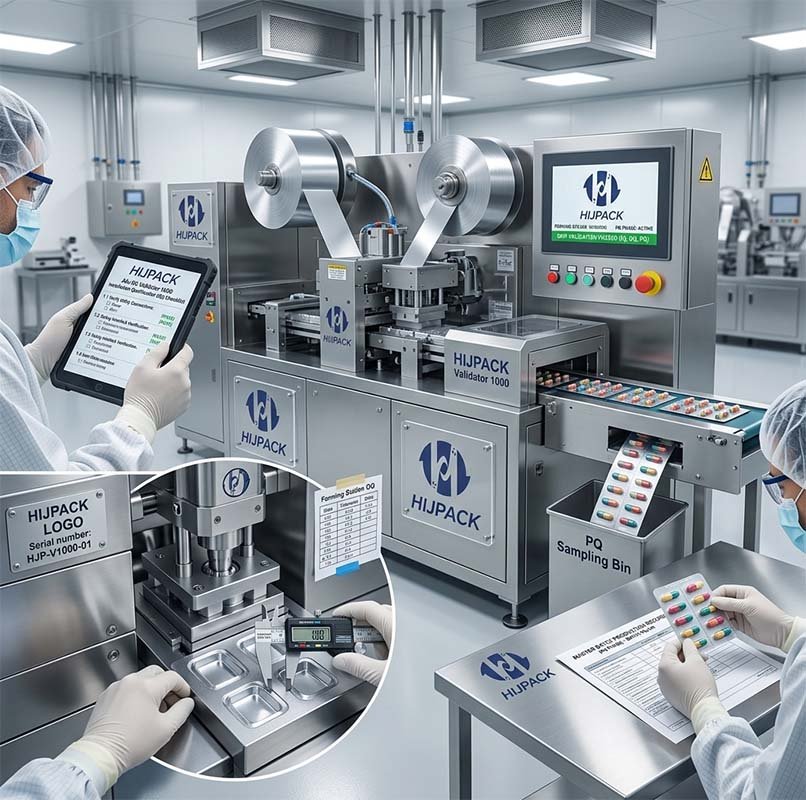
Validation protocol execution in a GMP environment: each test point generates a record before the next phase begins.
GMP Compliance Framework for Liquid Blister Packaging Validation: Which Regulations Apply in Your Market
The regulatory framework is not a single standard. It is a layered matrix, and the applicable layer depends on which markets your product enters. I will not tell you this is simple. If your product goes to the US, the EU, and a WHO-prequalified tender simultaneously, you are running three parallel compliance tracks against a single machine qualification package — and the acceptance criteria are not always identical.
| Target Market | Primary Regulation | Equipment Qualification Requirement | Electronic Records | Key Document |
|---|---|---|---|---|
| United States (FDA) | 21 CFR Part 211.68 | Written procedures; equipment qualified and calibrated | 21 CFR Part 11 (if electronic) | VMP + IQ OQ PQ protocols + summary reports |
| European Union (EMA) | EU GMP Annex 15 | Qualification of critical equipment mandatory | EU GMP Annex 11 | VMP + URS + DQ IQ OQ PQ + change control |
| WHO Prequalification | WHO TRS 992 Annex 3 | Equipment qualification per GMP guidelines | WHO TRS 961 Annex 5 | Site master file + validation master plan |
| India (CDSCO) | Schedule M (revised 2023) | IQ OQ PQ required for production equipment | Annex 11 equivalent expected | VMP + full qualification dossier |
| Southeast Asia (ASEAN) | ASEAN GMP (WHO-harmonised) | WHO TRS 992 equivalent | Jurisdiction-specific; WHO TRS 961 baseline | VMP aligned to WHO format |
| Global (ICH markets) | ICH Q10 Pharmaceutical Quality System | Lifecycle approach to equipment qualification | ICH Q10 Section 2.7 | Integrated quality system documentation |
One point that frequently causes friction during WHO prequalification assessments: the WHO inspector will ask for the Validation Master Plan and expect to see all equipment qualifications — including the liquid blister line — referenced within it. If the VMP was written before the machine was purchased, and the machine is not listed, you have a gap. Not a fatal one, but a findable one. Keep the VMP as a living document and update it at each change control event.
For GMP compliance considerations specific to liquid blister packaging, the regulatory mapping runs deeper than equipment qualification alone — it extends to cleaning validation, process validation, and environmental monitoring integration.
⚠️ Regulatory Audit Diagnostic: Common Findings in Liquid Blister Validation Packages
URS not referenced in IQ test points
Every IQ test point must carry a URS reference number. If your IQ protocol was generated independently of the URS — which happens when the supplier writes the IQ and the client writes the URS separately — there is no traceability. The fix is a URS-IQ traceability matrix: one column per URS requirement, one row per IQ test point, mandatory before IQ execution begins.
OQ protocol references wrong model number
Seen in Jakarta (2022) and again in Bogotá (2023): supplier OQ template still referenced the predecessor model’s servo parameters. Three weeks of documentation legally invalidated. Mitigation: require the supplier to submit the OQ protocol with your machine’s serial number and model-specific parameters populated before SAT begins — not as an editable template you fill in yourself.
PQ conducted without stability programme integration
PQ samples that do not enter the formal stability programme are a finding under EU GMP Annex 15 Section 10.5. The PQ summary report must reference the stability protocol and the T=0 submission date. If your stability storage is not yet qualified when PQ runs, this creates a dependency risk — plan your qualification sequence to resolve it before PQ execution, not after.
What Your Supplier Must Deliver: The Validation Documentation Package Checklist
The procurement director in Nairobi showed me the short list. Four suppliers. Three of them listed “validation support” as a feature in their brochure. I asked each one the same question: “Can you show me a sample IQ protocol for this machine model with acceptance criteria pre-populated?” Two could not. One sent a 12-page PDF that was clearly a scanned Word document from 2014. One sent a 47-page editable document with model-specific parameters, URS reference fields, and a traceability matrix template attached.
That question — “Show me a sample IQ protocol” — costs nothing to ask. It tells you everything about whether the supplier has actually commissioned liquid blister lines in regulated environments, or whether they are selling machines and calling the paperwork “support.”
Validation Master Plan template: Machine-specific, not a generic pharma VMP. Must reference the machine model, serial number (to be completed at delivery), and your regulatory markets.
IQ protocol (pre-populated): All test points listed with expected results, required instrument calibration status, and URS reference numbers. Not a blank template.
OQ protocol (pre-populated): CPP ranges and acceptance criteria defined. Worst-case scenarios identified. Placebo/WFI run instructions included.
PQ protocol template: Batch size guidance, sampling plan template, stability submission instructions, and acceptance criteria aligned to product dossier requirements.
Calibration certificates for all critical instruments: Temperature sensors, pressure transducers, flow meters — all with current certificates traceable to national/international standards.
CE Declaration of Conformity and technical file summary: Required for EU market entry and frequently requested by WHO inspectors as evidence of design qualification baseline.
GAMP 5 software category classification document: Confirms whether the machine’s software is Category 3, 4, or 5 and defines the corresponding validation depth required.
Change control log template: Any post-delivery modification to hardware or software must be managed through your change control system. The supplier should provide a template aligned to their part numbering system.
For the broader context of how cost and documentation requirements interact in machine procurement decisions, the liquid blister packaging machine cost breakdown article maps out where validation support costs are typically embedded — and where they are not — across different supplier tiers.
“The machines that cost $15,000 less on the purchase order consistently cost $40,000 to $120,000 more by the time validation is complete — because every missing document becomes a deviation, and every deviation becomes a delay. I have seen this pattern in Jakarta, in Lagos, and in São Paulo. The validation documentation package is not an add-on. It is a core deliverable that should appear on the purchase order as a line item with acceptance criteria.”
— Forester Xiang, Founder, HIJ Machinery
When Revalidation Is Required: Change Control, Periodic Review, and the Events That Trigger a Full PQ Repeat
Revalidation is the phase most facilities manage poorly. Not because they do not know it is required — they do — but because the change control trigger is often ambiguous in their SOPs. “Minor software update” is not a defined category. “Same lidding foil from a different supplier” is not defined. These gaps become audit findings.
The practical rule I apply: any change that affects a CPP — or that affects a critical quality attribute (CQA) of the finished product — requires a documented change control risk assessment and, if the risk assessment concludes that the change is more than cosmetic, a partial or full requalification. Partial requalification typically means a targeted OQ re-run of the affected parameters plus one PQ run. Full requalification means the complete IQ OQ PQ cycle.
Four events that always trigger at least partial revalidation in liquid blister operations: (1) sealing temperature setpoint change of more than ±5°C from validated range; (2) change of filling pump type or model; (3) software version update that modifies recipe management or data logging; (4) transfer of the machine to a different room or facility, even temporarily. If any of these happened on your line without a change control record, that is a gap — not an emergency, but something to address before the next inspection.
A 20-Year Engineer’s Perspective: The Single Question That Predicts Validation Success
When the answer is “the supplier,” the validation almost always runs on time. Not because supplier protocols are inherently better, but because a supplier who writes the IQ protocol is committing to its content. They know the machine’s specific parameters. They know which instruments are installed. They are not guessing. When QA writes a generic IQ protocol from a template and then tries to apply it to a machine they have never operated, half the test points are either irrelevant or untestable.
The ideal model: supplier writes the machine-specific IQ and OQ protocols with pre-populated expected results. Customer QA reviews, amends, and approves. Both parties execute jointly, with the supplier’s application engineer present. That model, across 23 projects where I implemented it between 2018 and 2023, produced an average of 0.3 IQ deviations per project. No project required a full IQ repeat. I’m not certain that pattern holds in every context — very early-stage suppliers sometimes struggle even with this structure — but it is the closest thing to a reliable predictor I have found.
At HIJ, our service and support framework is built around exactly this model: validation documentation is engineered alongside the machine, not after it is shipped.
Frequently Asked Questions: IQ OQ PQ Validation for Liquid Blister Packaging Machines
What does IQ OQ PQ stand for in pharmaceutical equipment validation?
IQ stands for Installation Qualification, OQ for Operational Qualification, and PQ for Performance Qualification. Together, they form the three-phase equipment qualification lifecycle required under GMP regulations including 21 CFR Part 211, EU GMP Annex 15, and WHO TRS 992 Annex 3, confirming that pharmaceutical equipment is correctly installed, operates within specified parameters, and consistently produces product meeting quality specifications.
Is IQ OQ PQ validation mandatory for liquid blister packaging machines?
Yes. Under 21 CFR Part 211.68 (US), EU GMP Annex 15 (Europe), and WHO TRS 992 Annex 3, all equipment used in pharmaceutical production must be qualified. A liquid blister machine that fills and seals a drug product is production equipment — qualification is not discretionary. Inspectors from FDA, EMA, and WHO routinely request IQ OQ PQ summary reports as a first-line document request during GMP audits.
How many PQ runs are required for a liquid blister packaging machine?
A minimum of three consecutive successful PQ runs is the accepted industry standard, consistent with EU GMP Annex 15 guidance and FDA process validation guidance. “Consecutive” means no failed runs between successful runs. If Run 2 of 3 fails and Runs 3 and 4 pass, you have two consecutive successes, not three — and a deviation investigation for Run 2 is required before the PQ can be closed. Some regulatory agencies and product types require more than three runs; confirm with your QP or regulatory affairs team before protocol approval.
What is the difference between FAT, SAT, and IQ in liquid blister machine qualification?
FAT (Factory Acceptance Testing) is performed at the supplier’s facility before shipment; SAT (Site Acceptance Testing) is performed after installation on the customer site. Neither FAT nor SAT is a formal GMP qualification phase — they are pre-qualification activities that identify and resolve mechanical and documentation issues before IQ begins. IQ is the first formal GMP qualification phase, generating regulatory-grade documentation that becomes part of the permanent equipment qualification file.
What fill volume accuracy must a liquid blister machine achieve to pass OQ?
±1% of nominal fill volume is the standard acceptance criterion for pharmaceutical liquid blister products, consistent with Ph. Eur. 2.9.26 and USP <1> for preparation of dosage forms. This must be demonstrated gravimetrically across n=20 measurements per cavity per run at each speed setpoint. Note: if your product is a high-viscosity liquid (above approximately 40 cP), pump calibration must be performed with a fluid of matched viscosity at process temperature — not with purified water.
Does a software update require revalidation of a liquid blister packaging machine?
Yes, if the update modifies any functionality affecting product quality, CPPs, or data integrity. Under EU GMP Annex 11 and GAMP 5, software changes must go through change control and a documented risk assessment. If the risk assessment determines the change affects validated functionality — recipe management, data logging, access control, or CPP setpoints — a partial or full OQ repeat is required. Updates that are purely cosmetic (screen layout, language settings) typically require documentation only, not requalification, but this must be formally justified and approved by QA.
How long does IQ OQ PQ validation take for a liquid blister packaging machine?
For a single liquid blister line in a well-prepared facility with pre-approved protocols, the typical timeline is: IQ 3–5 days, OQ 5–10 days (including placebo runs and laboratory testing), PQ 15–30 days (three production runs plus initial stability sampling). Total elapsed time from IQ start to PQ summary report: 6–10 weeks in a facility with adequate laboratory capacity and pre-approved protocols. Add 4–8 weeks if protocols must be written from scratch after machine delivery, or if calibration services must be arranged locally in remote markets.
What is the role of the URS in liquid blister machine validation?
The User Requirement Specification (URS) is the traceability backbone of the entire IQ OQ PQ package. Every IQ test point, every OQ acceptance criterion, and every PQ quality attribute must be traceable back to a specific URS requirement. Without this traceability, the qualification package cannot demonstrate that the machine was built and tested to the customer’s actual requirements — a mandatory expectation under EU GMP Annex 15 and FDA process validation guidance. The URS should be written and approved before the purchase order is signed, not after machine delivery.
Get a Liquid Blister Machine With Validation Documentation Built In
HIJ delivers machine-specific IQ OQ PQ documentation packages alongside every liquid blister line — pre-populated, URS-traceable, and engineered for FDA, EMA, WHO, and CDSCO compliance. Our validation engineers have executed qualification cycles in 14 countries across Southeast Asia, Latin America, and Africa.