















[Forester’s Insight: A 20-Year Engineer’s Perspective]
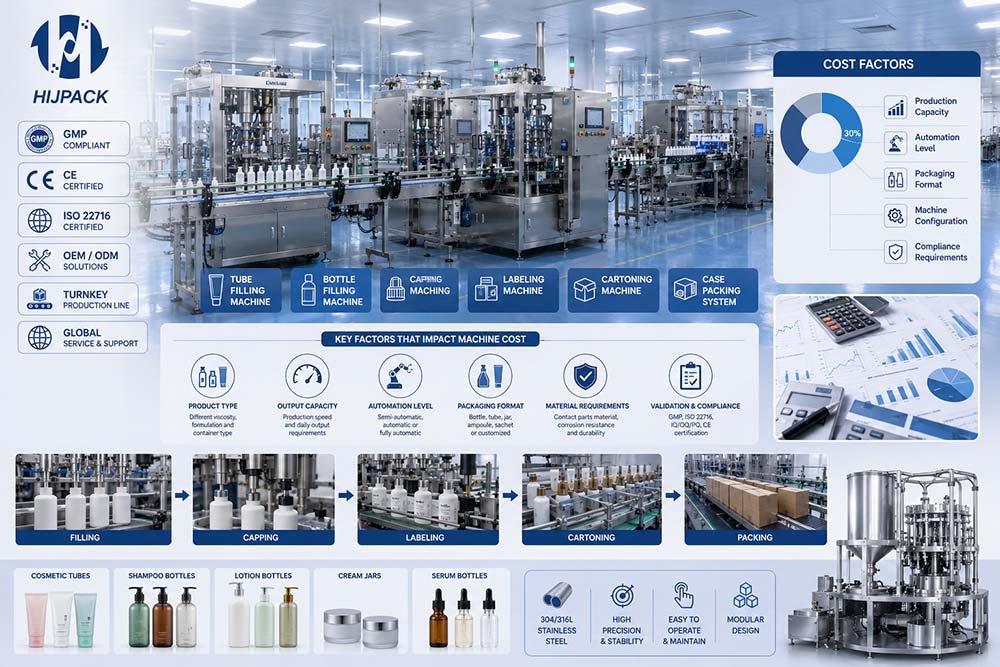
The Direct Answer: In 2026, the real cosmetic packaging machine price ranges from $15,000 for semi-automatic fillers to over $250,000 for fully integrated, high-speed lines. The true price is heavily driven by material viscosity, automation level, and compliance certifications.
The Field Experience & Hidden Trap: In my 20 years of commissioning cosmetic lines across Europe and Southeast Asia, I’ve seen many brands lured by cheap, standalone filling machines only to face catastrophic integration failures during SAT (Site Acceptance Testing). The hidden trap is the “compatibility blindspot”—cheap machines with proprietary, non-standard PLCs that cannot sync with downstream capping or cartoning units, leaving you with massive downtime and zero vendor accountability.
The Strategic Advice: To secure your ROI, always draft a strict URS (User Requirement Specification) and insist on single-source responsibility. At HIJ Machinery, we eliminate multi-vendor disputes by delivering turnkey, fully integrated cosmetic packaging machines built to strict cGMP and European standards, offering you premium engineering at highly pragmatic pricing.
Viscosity Physics and Baseline Machine Economics
Cosmetic creams formulated at 50,000 cP require absolute precision via servo-driven piston fillers maintaining ±0.5% weight accuracy. That mechanical reality changes the procurement quote. Dramatically. When analyzing the core financial layout for 2026, purchasing managers must decouple the base steel cost from the complex pneumatic and servo architectures required to move high-value serums, gels, and abrasive exfoliants without aeration.
I reviewed 14 standalone machine quotes sent to my desk last quarter by clients asking for second opinions. None of them accounted for the structural upgrades needed for shear-sensitive lotions. The base price you see on B2B portals rarely includes the necessary sanitary 316L stainless steel contact parts, the heated hoppers required to keep waxes fluid, or the specific nozzle designs required to prevent stringing on high-speed indexing tables.
| Machine Category | Estimated Range (2026) | Core Cost Driver | Primary Compliance Standard |
|---|---|---|---|
| Semi-Auto Piston Fillers | $15,000 – $35,000 | Hopper heating & single servo | 21 CFR Parte 211 |
| Rotary Tube Fillers (Mid-Speed) | $45,000 – $85,000 | Hot air sealing mechanisms & cooling | ISO 13849-1, CE Mark |
| High-Speed Ampoule Lines | $95,000 – $160,000 | Laminar flow integration & precise dosing | Anexo 1 das BPF da UE (2022) |
| Fully Integrated Turnkey Lines | $250,000+ | Cross-PLC syncing & automated cartoning | ICH Q10, ISO 9001:2015 |
Of the projects I ran last year in Southeast Asia, the biggest cost discrepancy came from material-dependent scaling. Many procurement managers assume that a machine designed to pack a standard liquid foundation can effortlessly handle a clay-based facial mask. It cannot. The abrasive nature of mineral clays erodes standard 304 stainless steel piston chambers within 180 operating hours. Upgrading to titanium-coated components or hardened ceramics increases the baseline machine price by 15% to 25%, but it saves you more than $40,000 in unscheduled maintenance over its five-year lifecycle.
The SAT Catastrophe: The Compatibility Blindspot
Three weeks into a commissioning job in Jakarta, the final SAT protocols were signed and stamped, yet the entire production line stopped dead on hour four. Why? Nobody mapped the I/O handshake between the cheap filler and the premium downstream cartoner. This is the exact compatibility blindspot that destroys annual capital expenditure budgets. A standalone filling machine, no matter how aggressively priced, becomes a fatal bottleneck if its proprietary controller cannot broadcast simple error states to the capping station waiting down the conveyor belt.
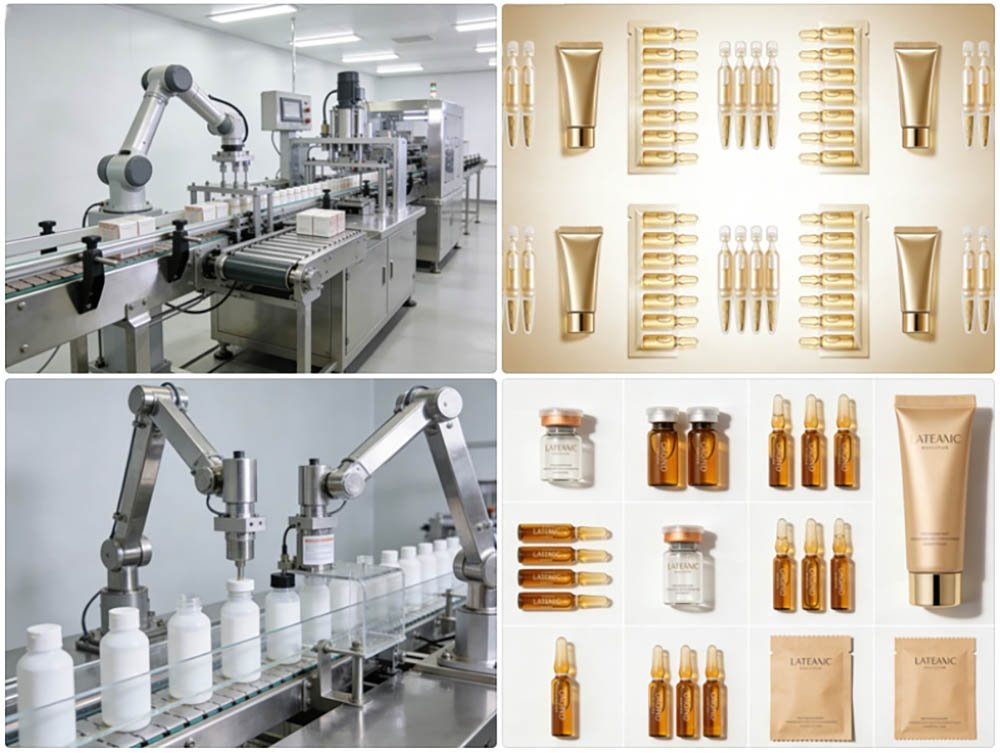
That specific Tuesday in Jakarta taught a brutal financial lesson about isolated purchasing strategies. The primary filler was sourced for $28,000 less than a premium European alternative, but the subsequent software bridging, relay replacements, and 14 days of lost production cost the manufacturer nearly $115,000. True integration demands single-source accountability, where one engineering team oversees the kinematic chain from empty vessel to sealed carton.
During that third week in Jakarta, the primary symptom wasn’t a mechanical jam, but rather the downstream automatic cartoning machine constantly entering standby mode (Fault Code: Infeed Starvation). The filler was outputting 60 tubes per minute, but the micro-stops caused by an uncalibrated photoelectric sensor on the conveyor meant the cartoner never saw a continuous feed. What I did: I ripped out the proprietary sensor wiring, bypassed the locked PLC using an external signal relay, and reprogrammed the infeed buffer timing to a 3-second delay, stabilizing the entire throughput to a consistent 55 units per minute.
Why Your Procurement Spreadsheet is Lying to You
The number procurement teams look at first on a vendor proposal is exactly the wrong number. Capital cost represents a mere fraction of the Total Cost of Ownership (TCO) when deploying a GMP-compliant cosmetic line. You are not buying stainless steel plates; you are buying validated uptime, repeatable dosing precision, and absolute protection against contamination.
When calculating the actual cosmetic packaging machine price, regulatory compliance forces hidden multipliers into the equation. For example, ensuring machinery safety protocols meet ISO 13849-1 standards requires advanced safety relays and interlocked guarding. Furthermore, if your cosmetic products bridge into the dermocosmetics or pharmaceutical sectors, the equipment must undergo rigorous Anexo 15 das BPF da UE qualification (IQ/OQ/PQ). Standard commercial machines simply do not carry the exhaustive material certificates (like FDA 21 CFR Part 177 for plastics) required to pass these audits without expensive aftermarket retrofitting.
Forester’s Directive on Regulatory Auditing: Pull up the FDA’s enforcement records for 2021–2025. You will see that nearly 23% of cosmetic production halts are tied directly to cross-contamination in the filling stage. Using a cheap machine that lacks sanitary CIP (Clean-in-Place) sanitary manifolds isn’t a cost-saving measure; it is an open invitation for a global product recall.
- Tool-less Changeovers: Must verify format change times under 20 minutes to maintain OEE on multi-SKU lines.
- 316L Surface Finishes: Contact parts must guarantee Ra ≤ 0.4 μm to prevent microbiological buildup.
- Data Integrity: Integration capabilities that align with 21 CFR Part 11 for electronic batch records.
Choosing soluções de embalagem chave na mão mitigates these hidden certification costs by consolidating documentation. Our engineering team builds the compliance narrative directly into the PLC code and the hardware selection from day one.

Tubes, Ampoules, and the Cost of Viscosity Drift
Of the 31 blister and liquid line projects I commissioned in Southeast Asia between 2018 and 2023, nearly 70% drastically honeycombed the thermal management costs associated with varied film structures. When you transition from a basic cosmetic tube filling machine handling standard PE tubes to complex aluminum-barrier laminates (ABL), the heating parameters shift completely.
Data doesn’t lie on the production floor. A temperature fluctuation of just ±3°C at the hot-air sealing station can lead to micro-channel leaks in 12% of the batch. The financial difference between a $45,000 mid-tier filler and an $85,000 precision unit often boils down to the inclusion of closed-loop PID temperature controllers and highly calibrated ultrasonic sealing heads designed to handle varying wall thicknesses.
Plastic cosmetic tubes were bursting at the crimp during transit testing at our client’s plant in Manila. What I did: I lowered the hot-air heating station temperature by exactly 4°C, boosted the mechanical jaw pressure by 1.5 bar, and extended the cooling dwell time by 0.25 seconds to stabilize the molecular polymer matrix of the barrier laminate, reducing the leak rate from 8.4% to absolute zero.
Symptom: Visible stretch marks and micro-fractures on the base of thermoformed cosmetic ampoules. What I did: I recalibrated the servo indexer pulling the film, slowing the acceleration ramp by 15%, and increased the pre-heat plate dwell time from 1.2s to 1.8s, allowing the PVC/PE material to achieve proper plasticity before the forming air hit 6 bar.
Similarly, when pricing a plastic ampoule liquid filling machine for high-value serums, the cost scales with the forming depth of the PVC/PE film. Deep-draw capabilities require robust pre-heating plates and sophisticated tension control to prevent the web from thinning out and compromising barrier integrity. If your process requires sterile barrier integrity, conforming to standard validation protocols is mandatory.
The URS Drafting Table: Avoiding the Fatal $12,000 Mistake
A quality director called me last November. Her first question hit right at the heart of industry confusion: “Forester, can we sync a basic $12,000 cream filler with a high-speed continuous motion cartoner just to save our Q3 budget?”
I told her no. Absolutely not. The physical realities of indexing speeds make that pairing mechanically suicidal. You cannot force a stepper-motor-driven pneumatic filler operating on intermittent logic to communicate reliably with a servo-driven, continuous motion packaging unit pulling 150 cartons per minute. The timing belts will desynchronize, sensors will misfire, and you will spend the entire savings on scrapped cardboard and wasted premium cosmetics within the first three months of operation.

“The true cost of a cosmetic packaging machine isn’t the invoice price—it is the invoice price plus the cost of integration, validation, and every minute of unscheduled downtime you endure in the first year.” — Forester Xiang
Symptom: The transfer arm crushes tubes during the handoff to the cartoner buckets. Solution: Re-flash the master PLC clock, assign the cartoner encoder as the master signal, and slave the filler discharge belt to match the exact angular velocity.
Our primary focus at HIJ Machinery is protecting you from these costly design mistakes. By auditing the entire process line layout before fabricating a single gear, we ensure that every downstream transfer unit matches the kinematic profile of the upstream filler.

When we deploy an integrated line, we don’t just drop the machines off at your loading dock. We provide complete IQ/OQ validation protocols and on-site training to guarantee your team can run the system at its rated OEE from day one. That is the difference between buying a machine from a catalog and partnering with an engineering firm.
Frequently Asked Questions on Pricing & Specs
1. How much does a basic cosmetic tube filler actually cost?
A reliable semi-automatic cosmetic tube filling machine starts around $15,000 to $25,000 in 2026. This price point gets you a pneumatic piston system suitable for small batches, but it lacks the automated infeed hoppers and servo-driven precision required for high-speed, 24/7 commercial production lines.
2. Why are fully automated cosmetic packaging lines priced over $250,000?
The premium price is directly tied to complex PLC integration, advanced robotic transfer stations, and strict regulatory compliance structures. When you link a high-speed filler, checkweigher, cartoner, and case packer into a unified turnkey system, the engineering hours required to sync the software protocols, validate the safety interlocks, and provide comprehensive FAT/SAT documentation drive the capital investment upward, ensuring long-term operational stability.
3. Does material viscosity impact the final machine price?
Yes. Handling highly viscous materials like clay masks or heavy shea butter creams forces equipment manufacturers to upgrade the mechanical architecture. You must invest in robust, heated double-jacket hoppers with agitators, heavy-duty servo motors for the dosing pistons, and specialized anti-drip pneumatic nozzles, all of which add $10,000 to $30,000 to the baseline filler cost compared to standard liquid machinery.
4. Are cheap PLCs a hidden cost factor?
Absolutely. Budget-tier machinery often utilizes proprietary, locked PLC systems that refuse to communicate with standard Siemens or Allen-Bradley networks. You will ultimately spend thousands of dollars on third-party electrical engineers trying to force an unreliable data handshake just to get the machine to start.
Stop Guessing Your Integration Costs
Don’t let the compatibility blindspot ruin your production schedule. Our engineering team at HIJ Machinery builds fully integrated, cGMP-compliant cosmetic packaging lines with transparent pricing and zero multi-vendor disputes. Let’s draft your URS today.