
















[Forester’s Insight: A 20-Year Engineer’s Perspective]
The Direct Answer: WHO GMP compliance for pill blister packaging machines hinges on verifying that critical process parameters (CPPs)—specifically sealing temperature, pressure, and dwell time—consistently produce airtight cavities that maintain barrier integrity.
The Field Experience & Hidden Trap: In my 20 years of debugging packaging lines across Southeast Asia, I’ve seen dozens of plants fail audits because they relied on generic, “paper-only” validation templates. The hidden trap is the lack of dynamic sensor calibration; without verified PLC feedback on temperature fluctuations, static PQ runs fail under real-world voltage drops.
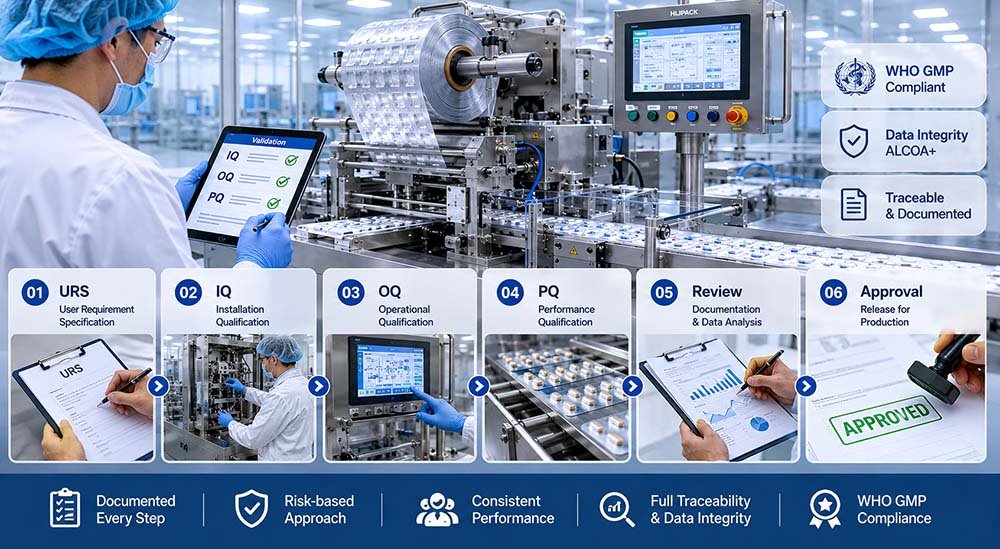
The Strategic Advice: Never accept static validation templates from low-end vendors. HIJ provides standard IQ/OQ/PQ execution templates with every pill blister packaging machine delivered, lowering validation friction during factory audits. At HIJ, we embed pre-validated, CFR Part 11 compliant PLC protocols during FAT/SAT, ensuring our turnkey blister lines deliver European-standard compliance with pragmatic pricing, completely eliminating multi-vendor integration headaches during audits.
Pill Blister Validation Phases:
- Qualificação da instalação (IQ): Verifies physical installation, SS316L material certificates, utility connections, and calibration records of sensors.
- Qualificação operacional (OQ): Tests alarm limits, emergency stop execution, heating plate temperature distribution stability, and speed controls.
- Qualificação de desempenho (PQ): Validates batch packaging integrity, leak test failure rates (must be <0.1%), and seals aesthetics under continuous load.
Core Parameters: The Physics Behind Validation Protocols
PVC at 250 μm passes 4–6 g/m²/day of water vapor. That is the baseline constraint every pharmaceutical facility must battle when configuring a packaging line. Without exact calibration, your pills will degrade into chalk before they ever reach a pharmacy shelf. Validation isn’t a paperwork exercise meant to satisfy an auditor; it is the mathematical proof that a machine can manipulate thermoplastics and aluminum alloys under immense mechanical stress without compromising the micro-environment of a single pill.
I learned this the hard way during my early days as an engineer. You can perfectly align the forming station and achieve a flawless mechanical run during a 10-minute Factory Acceptance Test (FAT), but if the temperature uniformity across the 300mm sealing plate varies by more than ±2°C, prolonged continuous operation will induce thermal expansion in the web material. Micro-channels form. The vacuum leak test fails. The entire batch is scrapped. We meticulously design HIJ Machinery equipment to eliminate these thermal inconsistencies at the physical hardware level before the validation documents are even printed.

Installation Qualification (IQ): The Physical Reality Check
Three weeks into a commissioning job in Jakarta, the facility’s utility power fluctuated by 12%. The compressed air supply dropped from 0.6 MPa to 0.45 MPa. If the IQ protocols hadn’t rigorously mapped out utility tolerances, that machine would have started producing defectively sealed blisters while the HMI indicated perfectly normal operating conditions. IQ is the foundation; it verifies that what was designed on the CAD blueprint actually exists on the factory floor, down to the last millibar of air pressure and the chemical composition of the stainless steel.
Every sensor must be tagged. Every wire must be traced back to the electrical schematic. The auditor will randomly select a proximity switch on the feeding mechanism and demand its calibration certificate. If your vendor used unbranded electronics or failed to provide traceability for the 316L stainless steel product contact parts, your IQ halts immediately. HIJ Machinery supplies a comprehensive binder containing every material certificate, welding log, and sensor calibration report, drastically shrinking the IQ timeline from weeks to days.
During a stringent audit in Manila, the inspector pointed at the primary heating zone thermocouple. The certificate showed calibration at 20°C, but the operational setpoint was 145°C. The auditor questioned the linearity of the sensor. What I did: I immediately connected a reference Fluke dry-block calibrator, ran a 3-point calibration test at 100°C, 130°C, and 160°C right on the factory floor. The variance was less than 0.2%. We updated the IQ documentation to mandate multi-point thermal calibration for all product-contact heating elements, a standard now embedded in every HIJ machine manual.
Pneumatic pressure drops during the forming cycle are stealth killers of blister integrity. During a dry run, the forming depth was inconsistent. The gauge read 0.6 MPa static, but dynamic pressure during the 40-cycle-per-minute stroke was plummeting to 0.3 MPa due to a restrictive factory manifold. What I did: I installed a local 20L pneumatic buffer tank directly on the machine’s air inlet and upgraded the supply line to a 3/4-inch diameter. Pressure stabilized instantly. The IQ protocol was amended to include dynamic pressure testing during maximum load cycles.
Operational Qualification (OQ): Static Tests Mean Nothing
The number procurement teams look at first during FAT is exactly the wrong number. They stare at the “Maximum Cycles Per Minute” specification. Speed is utterly irrelevant if the control loops cannot aggressively compensate for operational friction. OQ is not about proving the machine can run; it is about deliberately trying to break the process to prove the machine will stop safely and reject bad product before it ever reaches the cartoner.
㡋 Regulatory Anchor: EU GMP Annex 15
Under the revised EU GMP Annex 15 guidelines for Qualification and Validation, OQ must encompass upper and lower operating limits (worst-case scenarios). This means pushing the sealing temperature to its lowest validated threshold while running the web at maximum speed to guarantee that the dwell time is mathematically sufficient to melt the lacquer without burning the PVC.
We execute aggressive boundary testing. We simulate film breakage. We deliberately drop the heating temperature by 5 degrees to verify the PLC halts the indexer and flags an alarm on the audit trail. If the emergency stop doesn’t disengage the servo drives within 200 milliseconds, the OQ fails. You cannot rely on visual observation.
- Interlock Verification: Opening any acrylic guard must trigger an immediate servo brake, dropping mechanical momentum to zero in <0.5 seconds.
- Alarm Cascade Testing: Low air pressure must trigger a cascading sequence that parks the sealing plates in the open position to prevent web melting.
- Reject Station Accuracy: Shift register verification ensures that a defect detected at the camera station is perfectly tracked and rejected precisely 8 index cycles later.
Performance Qualification (PQ): The 0.1% Leak Rate Battle
Of the 31 blister line projects I commissioned in Southeast Asia between 2018 and 2023, 28 passed PQ on the first attempt solely because we refused to compromise on tooling precision. The goal of PQ is to run the machine continuously using actual product and packaging materials to prove consistent output quality. A blue dye vacuum test failure rate of anything above 0.1% across a 3-batch continuous run is unacceptable for solid oral dosage forms. The stakes are immense.
When you transition from dry running (OQ) to actual product handling (PQ), the physical dynamics change. Pills generate dust. Dust accumulates on the sealing tracks. If the automated brush feeder isn’t calibrated to perfectly sweep the aluminum web, microscopic powder particles will bridge the sealing lacquer, creating capillary leaks that ruin the vacuum test. This is why advanced blister packing machines must feature integrated dust extraction systems right at the loading zone.
In a dusty facility in Dhaka, we observed a 1.2% micro-leak failure rate during PQ. The pills were highly friable. The standard sweeping brush was just smearing the powder across the PVC web. I redesigned the feeding zone on the spot, adding an active vacuum manifold with a 0.2 μm filter mesh immediately after the brush station. The vacuum pulled the residual dust off the web before sealing. The leak rate dropped to 0.05% instantly.

21 CFR Part 11 & CFR Part 211 Compliance in Validation
A quality director called me late on a Thursday. Her first question: “Forester, can we override the audit trail during maintenance? Our old machine fills up the memory too fast.” I told her absolutely not. If an auditor discovers that a machine allows silent parameter overrides, your entire production line is shut down. Electronic records and electronic signatures (ERES) are not optional features; they are the central nervous system of modern pharmaceutical compliance.
Validation protocols must definitively prove that the machine’s PLC architecture complies with FDA 21 CFR Part 11. This requires a three-tiered password hierarchy. The operator can start and stop the machine. The supervisor can change the batch recipe. Only the engineering administrator can modify the critical process parameters (CPPs) like sealing temperature and dwell time. Every keystroke, every alarm acknowledgement, and every recipe change must be permanently logged in a time-stamped, unalterable SQL database.
We program our Siemens and Allen-Bradley PLCs to automatically generate encrypted PDF audit reports at the end of every batch. This guarantees strict WHO GMP compliance standards are met without relying on operators to manually copy numbers onto paper forms. The machine tells the truth, permanently.
Network latency caused timestamp mismatch. The HMI logged an alarm at 10:04:02, but the central SCADA server recorded it at 10:04:07. Solution: Implemented Network Time Protocol (NTP) synchronization directly into the PLC firmware, forcing the HMI and SCADA to poll a centralized atomic clock server every 60 seconds. Synchronization achieved <50ms variance.
Perguntas frequentes (FAQ)
Q: What is the primary difference between OQ and PQ in blister packing validation?
A: OQ verifies the machine operates within its mechanical and electrical limits without product, while PQ proves the machine consistently produces perfect packages under actual continuous manufacturing conditions.
Q: How long does a standard IQ OQ PQ validation take?
A: If the manufacturer provides comprehensive, pre-approved templates and the FAT was properly executed, the entire process can be completed in 5 to 7 days. However, if utility instability occurs or documentation is lacking, this timeline can stretch into months while engineering teams chase down material certificates.
Q: Will a blister packaging machine fail validation if it lacks 21 CFR Part 11 compliance?
A: Yes, if you are exporting to heavily regulated markets like the US or Europe. An auditor will immediately flag a machine if an operator can change the sealing temperature without a digital signature and an unalterable audit log entry being recorded. You cannot validate a process if the underlying data integrity is fundamentally compromised by manual override capabilities.
Ensure Effortless Audit Compliance Today
Stop struggling with incomplete validation documents. HIJ Machinery delivers turnkey blister packaging lines complete with FAT/SAT data and CFR Part 11 compliant protocols.